

Porsche 911 Reimagined by Singer
Classic Turbo Services
The charm of “restomod”
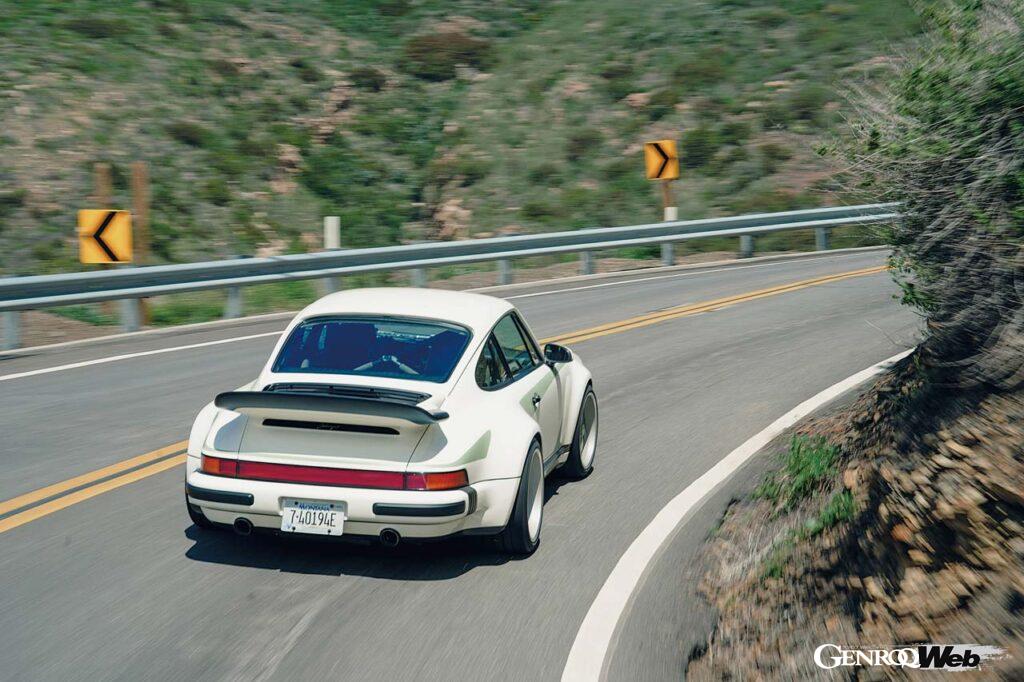
The driving feel is a perfect blend of classic wildness and modern ease, and this applies to both the engine and handling.
Relaxing in my seat on a late-night flight to Los Angeles, I began to think about Singer Vehicle Design’s restomod vehicles. The purpose of this trip was to test a model called the “Porsche 911 Reimagined by Singer.” But would it be a primitive tuned car with incredibly high performance but still retaining its classic unwieldy handling? Or would it be a modern sports car with all its classic charm completely stripped away? I fell asleep daydreaming about such things.
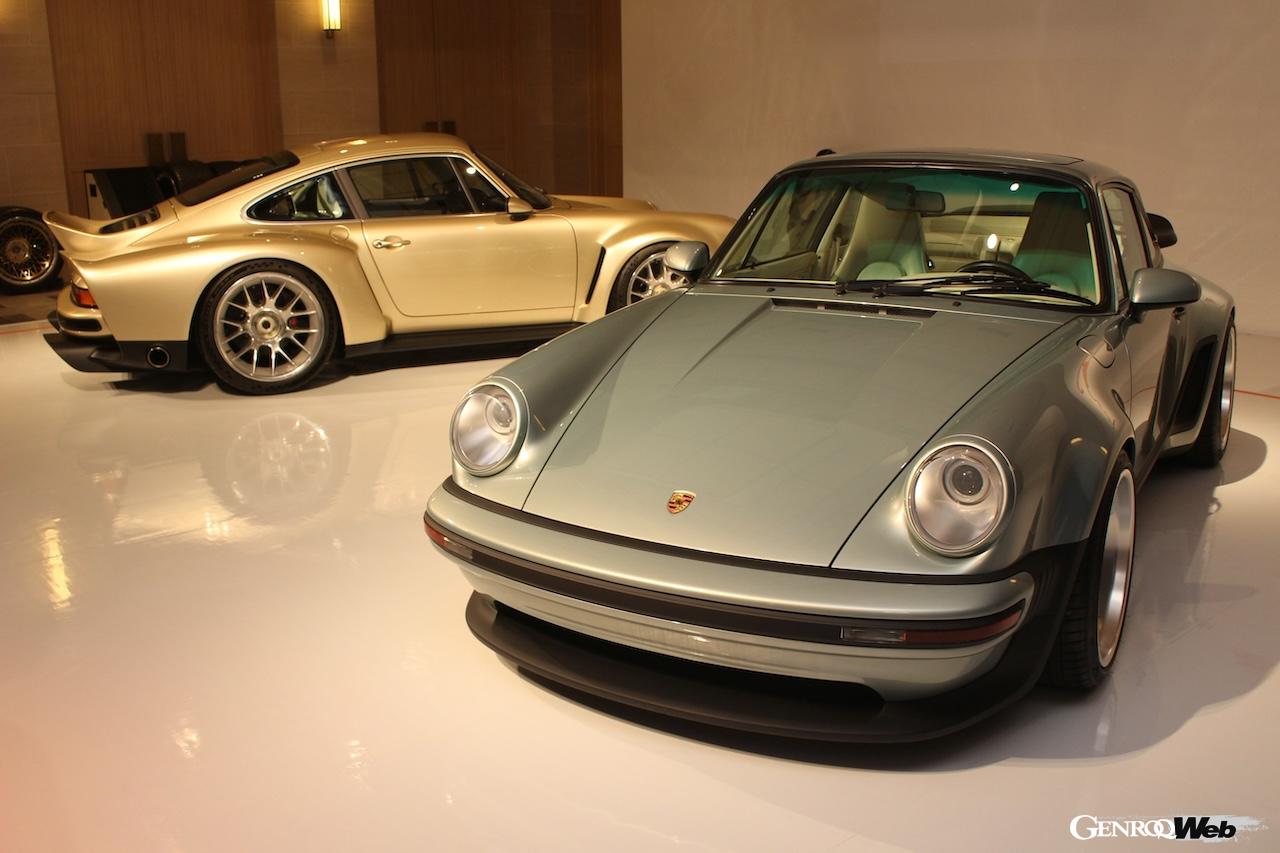
Waiting for me in Malibu, west of Los Angeles, was a 911 that Singer had given a service they call the “Classic Turbo.” Since it’s handled by Singer, the base is of course the “Type 964.” The powerfully jutting rear fenders and the rear wing known as the “whale tail” are reminiscent of the 930 Turbo, but apart from that, the car retains the pure and clean styling of the Type 964. Incidentally, the name “Classic Turbo” also seems to be intended as an homage to the 930 Turbo.
However, the Classic Turbo Service’s body panels have been completely redesigned using carbon fiber. The exceptions are the doors, which remain steel due to safety regulations. The car is fitted with the familiar Fuchs wheels and Michelin Pilot Sport 4S tires. This test car, called the “Fuji Commission,” was also equipped with optional Brembo carbon ceramic brakes. I was told that while these brakes have a strong initial bite on regular roads, they provide powerful stopping power when driven on a circuit.
Enlarged displacement and twin turbo

The Classic Turbo Service increases the displacement of the 964’s horizontally opposed six-cylinder unit to 3.8 liters, and adds two variable turbine geometry turbochargers, producing 510 PS. Cooling is air-cooled.
The air-cooled flat-six engine mounted behind the rear axle remains the same as the original, but the displacement has been increased from 3.6 liters to 3.8 liters, and many of the moving parts, including the pistons, have been remade using modern technology. The highlight is the two turbochargers, the same BorgWarner variable geometry turbos as those found in the Type 992 911 Turbo S. This is controlled by a modern Bosch engine control unit, which is said to be equipped with not only traction control but also stability control. Therefore, it can be said that the car is equipped with all the “modern safety nets”.
Twisting the ignition key on the left side of the steering post, the 510PS engine came to life with ease. After shifting the Ricardo 6-speed gearbox shift lever to the far left, I carefully released the organ-style clutch pedal. As usual, the pedal stroke is long and difficult for an untrained person to grasp, so you’ll find yourself wanting to engage the engine at a higher RPM, but once you get used to it, you’ll be able to start off just above idle RPM. In other words, it requires more careful operation than modern cars, but you can’t go so far as to say it’s difficult to handle. It has just the right level of difficulty, making the driver think, “I want to practice hard and be able to start off smoothly…”
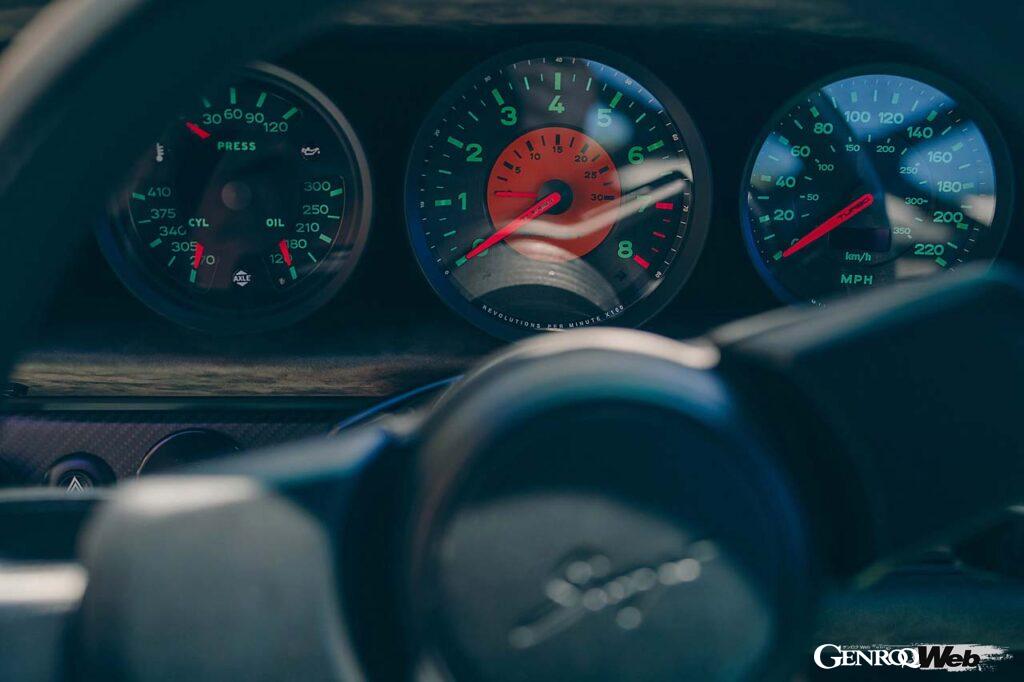
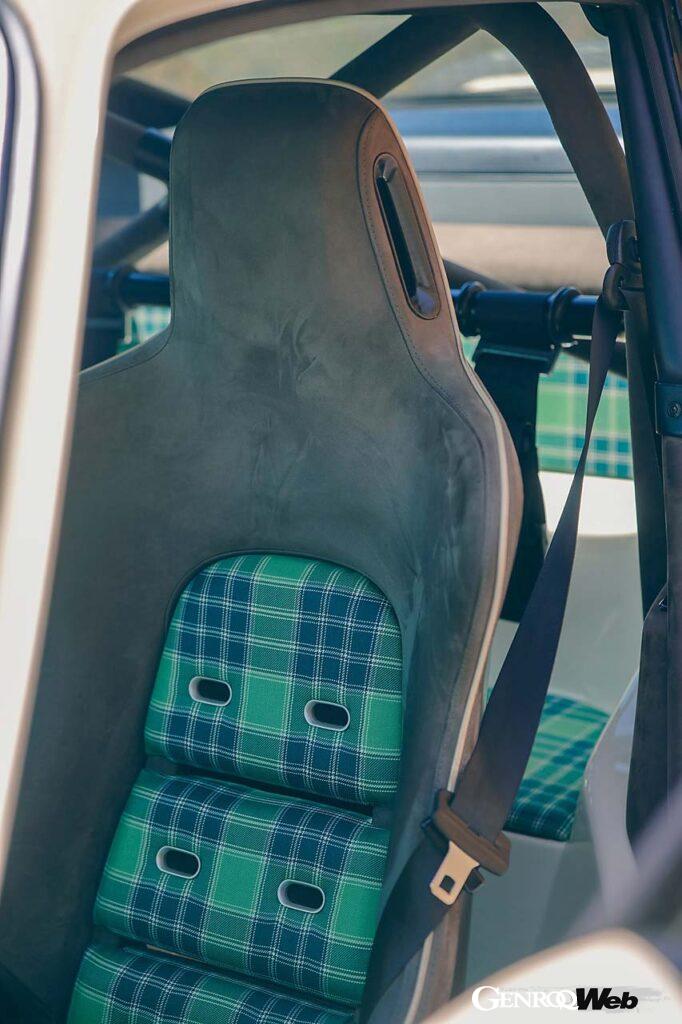

The interior can be almost completely customized to the owner’s tastes. The test car was equipped with bucket seats in a dark gray nubuck and green tartan finish.
The engine has a little bit of torque in the low rev range, but as it revs it becomes clearly more powerful, which is quite dramatic. However, the increase in revs itself is smooth and doesn’t take a breather along the way. In other words, here too, the modern and classic are exquisitely balanced, and modern comfort and classic thrills coexist.
The same can be said about the suspension. Immediately after starting to drive, you can clearly feel the roughness of the road surface, and when you go over a bump, you feel a clear shock. Therefore, at first I thought, “It might be a bit tough to drive for a long time,” but after driving a little further, I realized that my body wasn’t getting tired. This is probably because, even though shocks are transmitted, all parts like “sharp corners” have been removed. This impression must also be related to the incredibly high rigidity of the body.
It’s not a late-model or vintage car.
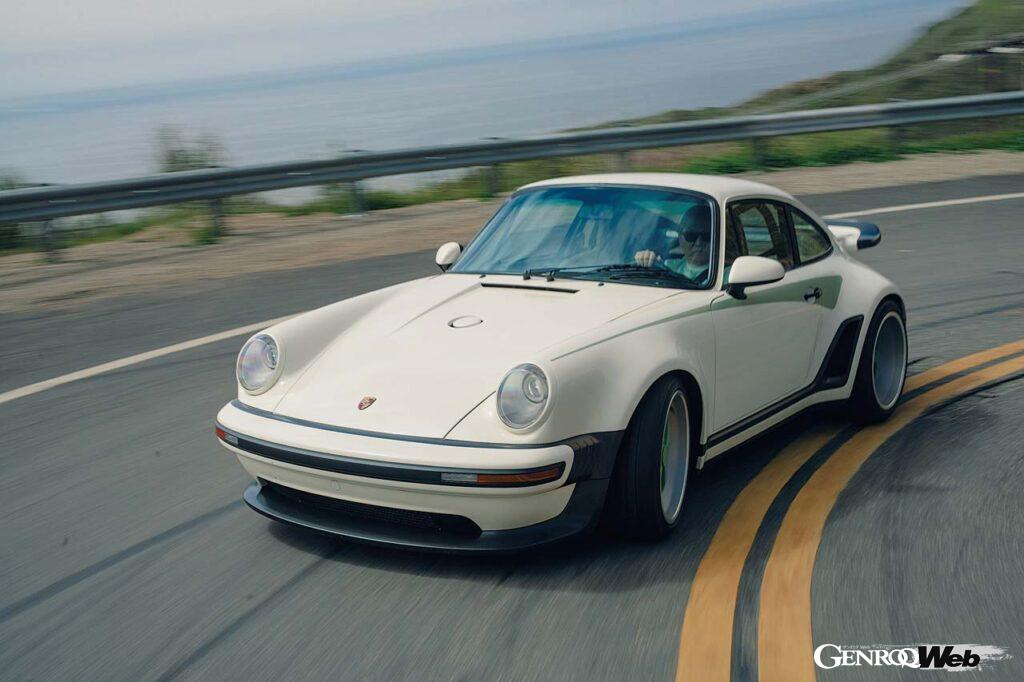
The Type 964 is fitted with ESC, which was not available when it was a new car. The presence of this modern safety device also helps to deepen the interaction with classic cars.
On the other hand, thanks to this extremely solid suspension, the road information you get through the steering is extremely abundant. Moreover, it doesn’t react in a tricky way while cornering, so you can enjoy cornering with peace of mind. This time, I only had the chance to push it to the point where I could feel what seemed to be “signs” that the tires were about to slip, but even so, thanks to the abundant information, I was able to fully enjoy the joy of controlling the 911. The sensation was extremely vivid, and it’s safe to say that it’s the polar opposite of cars that are overly protected by electronic devices.
When I shared my impressions with Singer’s Chief Strategy Officer, Mazen Fawaz, he said, “If a customer says, ‘I don’t want that classic feeling,’ it’s not impossible to remove it all. However, I would recommend that they drive a modern car. But modern cars are too easy to drive. With the Classic Turbo Service, we wanted to recreate the authentic feel of the 930 Turbo, without all the weird issues.”

[1]

[2]
[1] The tires have been enlarged in size from the original. The test car was equipped with Michelin Pilot Sport 4S tires, 245/35ZR18 in the front and 295/30ZR18 in the rear. The brake rotors were optional carbon ceramic. [2] Utilizing the design of the stone guard film that was installed on the 930 Turbo, a new air intake has been installed in front of the rear fender.
For those who pursue such ideals, it seems well worth it to buy a Type 964 Porsche 911 and pay $1 million to $1.5 million (approximately 140 million to 210 million yen) to have Singer do the work. As a result, orders are pouring in from all over the world, and the business is booming, with delivery taking nearly three years. There seems to be a profound world of restomods that is neither the latest model nor a pure vintage car.
REPORT / Tatsuya OTANI
PHOTO / Singer Vehicle Design
MAGAZINE / GENROQ July 2025 issue
[Inquiries]
Cornes Motors
https://www.cornesmotors.com/singer