

Maserati Classic

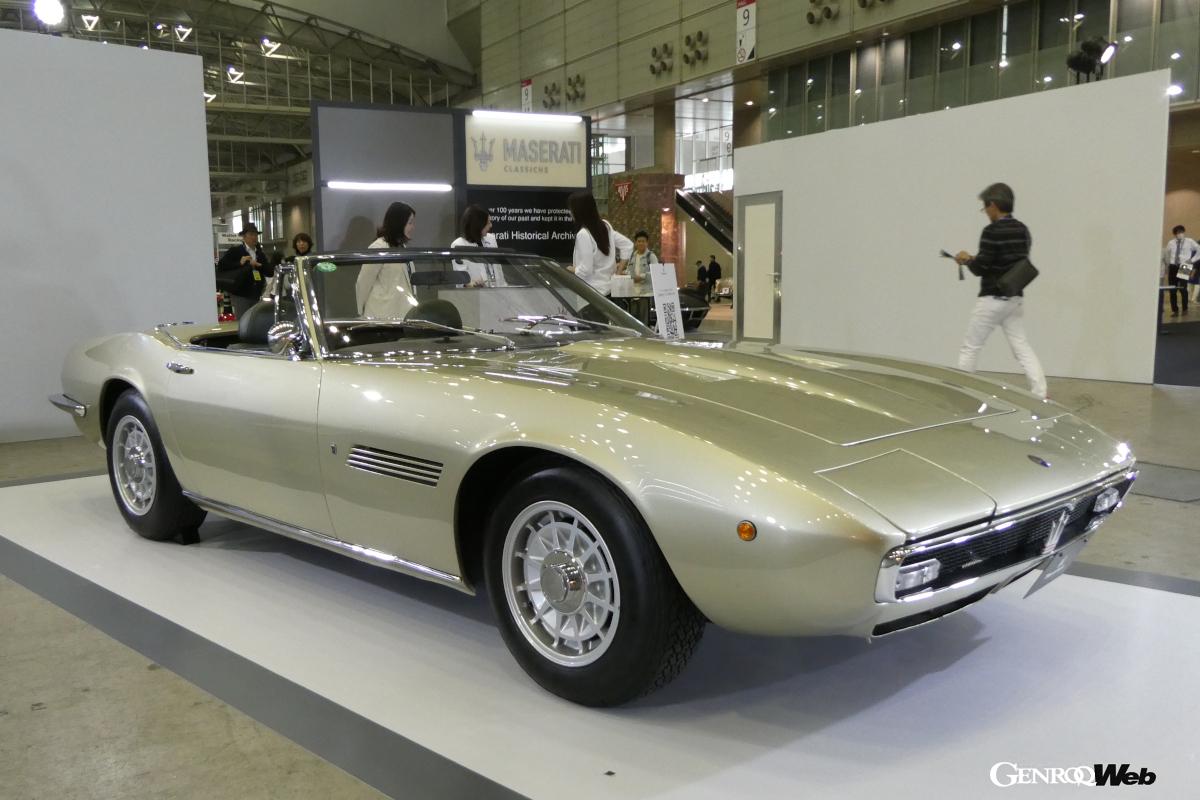
Takayuki Kimura, President of Maserati Japan Co., Ltd., and the first-generation Ghibli Spider. The Ghibli Spider on display is a rare Maserati road car, produced from 1969 to 1973 as an open-top model of the two-door, two-seater coupe “Ghibli” (1966-1973), with only 125 units produced.
Being certified as a Maserati Classiche (hereafter referred to as Classiche) means that Maserati, the manufacturer, has given its seal of approval to the car’s inherent authenticity, including the state of preservation and restoration, and its legitimacy. We spoke to Takayuki Kimura, CEO of Maserati Japan Co., Ltd., who had just given a presentation at the Automobile Council 2025 venue on April 11th.
──This time, you announced Classiche.
This initiative began in Italy in 2021. Japan has many owners with a deep knowledge of Maserati, and its owners’ club has long been active, resulting in a collection of some of the world’s most prestigious cars. Like the owner of the Ghibli Spider exhibited at this launch, many own both classic and modern models. Therefore, as we have long requested, Japan will become the second country after Italy to implement the Classiche Certification Program.
──What was the reason behind the start of Classiche in the first place?
Since the launch of the MC20 in 2020, Maserati has signaled its revival with a completely renewed lineup. The Classiche program is part of that. While there were many classic models in good condition, the manufacturer had not officially supported them. The program examines and verifies the authenticity of historical models, issues certifications, and offers services such as the reproduction of spare parts and support for vehicle restoration. While the number is still small—80 cars in four years—it is sure to increase in the future.

Ghibli Spider

Ghibli Spider

Ghibli Spider
──What are some initiatives unique to Japan?
Classiche requires that the authenticity of each historic model be inspected and certified, that is, that it maintains the original specifications and condition. However, sending the vehicle from Japan to Modena, Italy for inspection and certification is extremely costly in terms of both money and time. Therefore, we decided to invite inspectors to Japan and certify the vehicle in Japan. We plan to issue certificates to eight vehicles in Japan this year, but looking at the cars owned by the owners’ club members, we believe there are at least 20 to 30 in total.
──What vehicles are eligible for the Classiche event?
The eligible models are divided into three categories: Classic (1947-1978), Neo Classic (vehicles produced from 1978 onwards that have been in production for more than 20 years), and Special Cars (MC12 and derivative models, Birdcage 75th, Barchetta Biturbo, 320S, Alfieri, Quattroporte with Fluor body, A6 1500 Gran Turismo, etc.).
How do I apply for the review?
Applications will be accepted on the official Maserati Japan website from June 1st to 30th . Applications will be pre-screened based on documents and photos. If the vehicle passes the screening process, it will be transported to Maserati Japan’s Tech Lab, where judges from the Italian headquarters and the Japanese technical team will inspect and evaluate the vehicle over 300 items. Three employees with long-standing Maserati experience in Japan will be in charge of Classiche and will provide support at dealerships. A certificate will be issued to vehicles that pass the screening process.
──What is the direction of Maserati’s lineup going forward?
I don’t think that the same old saloons will remain mainstream. Our current lineup consists of four models: two SUVs, the Levante and Grecale; two saloons, the Ghibli and Quattroporte; the GranTurismo and GranCabrio; and the MC20 and MC20 Cello. However, these will also be subject to some revisions. It is true that customers are increasingly looking for taller cars with higher hip points. I also think that the growing trend toward individualism is why SUVs are preferred, as they offer a sense of enclosure and seem sturdy. This is why the SUV boom is unlikely to die down. In the future, we will be introducing SUVs and saloons larger than the Grecale, so please look forward to them.
──EV models have been released in the home country, but are there any moves towards electrification?
We will not be introducing any EVs to the Japanese market in the next year or so, but we would like to continue to offer a wide range of hybrid models.
PHOTO/GENROQ











![Hyundai unveils music-driven fully electric concept model in collaboration with MIYAVI [Tokyo Auto Salon 2026]](https://wheelfeed.com/wp-content/uploads/2026/01/4741-1768026274388.jpg)