

L’autodrome de Linas-Montlhéry
A category gaining position

[1]

[2]
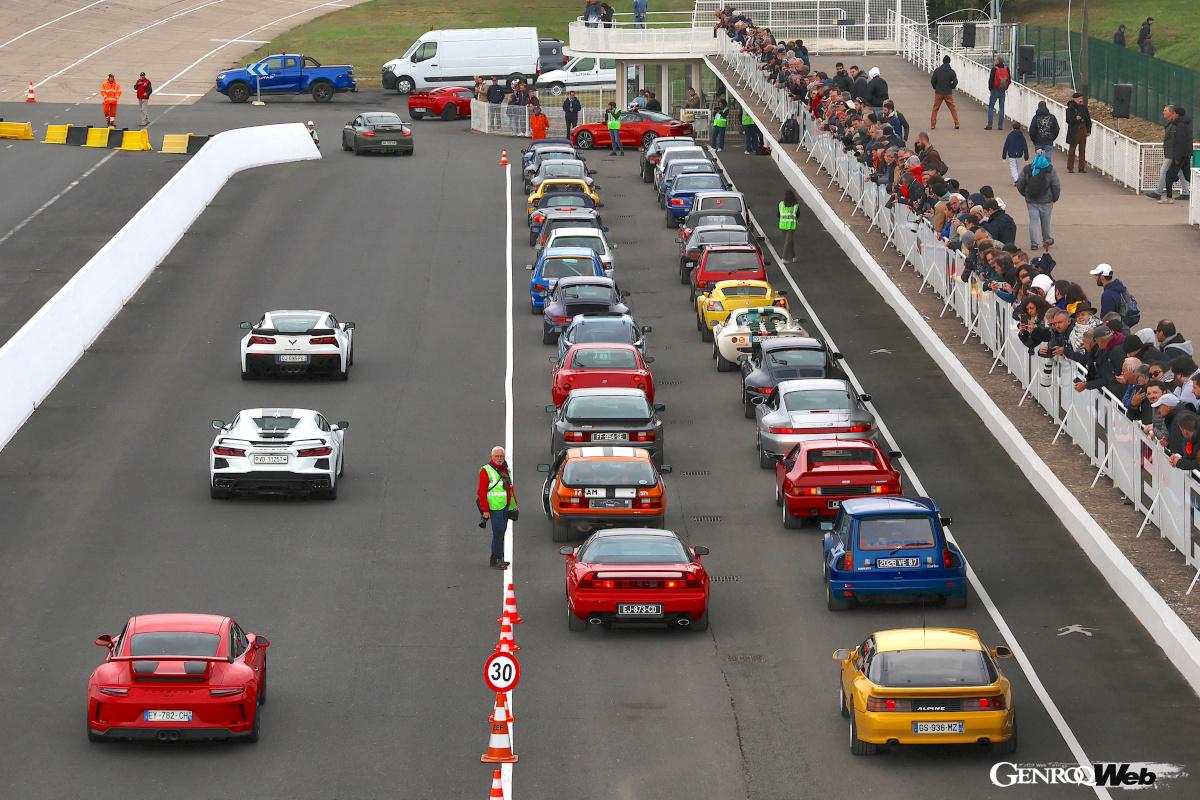
[1] A 1955 Fiat 16v Coupe is in the lead. Behind it on the bank are a 1982 Ford Capri 2.8i and a 1992 Alpine A610. [2] There are young timers in the parking lot too. The Renault Fuego (1980-1992) was designed by Robert Opron, who also worked on the SM and CX during his time at Citroën.
There are various definitions for what constitutes a “youngtimer” car. One theory is that it is between 15 and 40 years old after first registration. If we use 2024 as the benchmark, then vehicles registered between 1984 and 2009 would fall into this category. The German government has defined it as 20 to 29 years old after manufacture, while the French magazine YOUNGTIMERS uses a relatively loose definition, covering cars from the 1970s to the 2000s.
In any case, it’s certainly the easiest field of historic cars to get into today. Since around 2017, the market has become more active, centered around Porsche, and this field has also begun to attract attention. In response to the question of what kind of people are supporting this market, a young timer specialist I previously interviewed explained, “Some of the people who grew up in the 1980s have now achieved a certain level of social status and income. They are now starting to acquire the cars they once dreamed of.”
The Linas-Montlhéry 100th Anniversary Track Day also saw the inclusion of a Young Timer category, with restrictions on eligible models. As a result, 32 cars participated, second only to the 33 cars in the 1950s-60s category, which was the most popular this year. The oldest model was a 1979 Renault R5 Alpine, and the youngest was a 2003 Porsche 911 Carrera 4S.
A legendary French brand

[1]

[2]

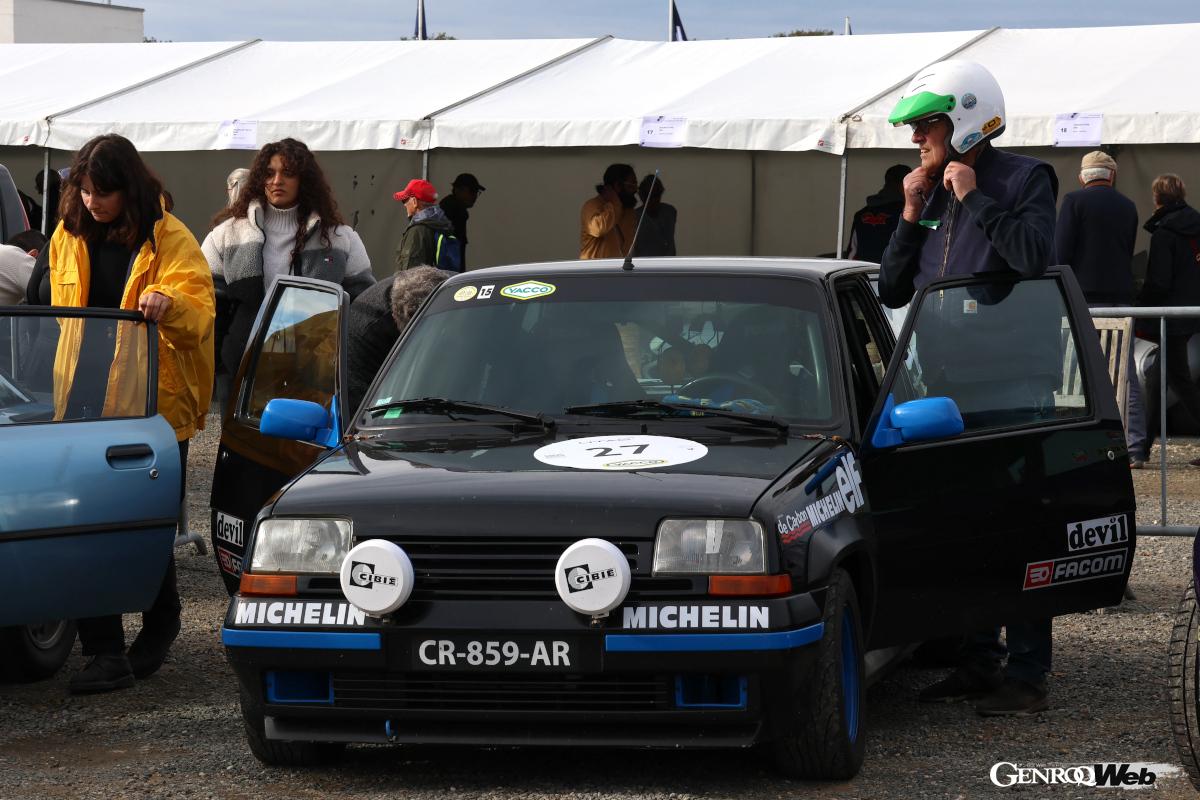
[1] Vehicles from the 205 GTI Club from Nivernay in central France. [2] A member of the Peugeot 406 Coupe Club. “I was captivated by the elegant design by Pininfarina,” he said. In the back, club members were sitting on the edge of the trunk, enjoying lunch. [3] A corner where members of Club Venturi gathered.
Among these, I discovered a typical French young timer in the club area: Venturi. The brand was founded by Gérard Godfrey and Claude Poirot, who worked at Ulysses, a leading French car body manufacturer. The brand got its start when they exhibited a prototype at the 1984 Paris Motor Show.
The following year, in 1985, they developed a running prototype using a mid-mounted turbo engine from the Peugeot 505 and the suspension from the Peugeot 205 GTI. At the same time, they officially launched as a constructor under the name MVS (Manufacture de Voiture de Sport). The production version, equipped with a PRV engine for the Alpine V6 turbo, rolled off the line in 1987.
However, in the European automotive industry, where long-standing brand power is crucial, it was not easy for the upstart Venturi to expand its influence. In 1996, the company attempted to revive itself with Thai capital, but went bankrupt in 2000. In 2002, it made a comeback as an EV manufacturer with Monegasque capital, but it was no longer the same as the original.
Venturi has had such a turbulent journey, but its courage in boldly taking on Grand Tourism in the mature automotive industry of the time, especially in France, where, unlike Italy, the image of luxury cars is weak, is worthy of praise. This time, members of Club Venturi brought their beloved cars to Linas-Montlhéry to commemorate the 40th anniversary of the prototype’s birth in 2024. One member told us that the club was founded in 1988, just four years after the prototype’s birth. To put it bluntly, they were obsessed with the charm of Venturi’s stylish GT at a time when it was unclear whether it belonged to the sea or the mountains. Their passion is palpable.
The outstanding popularity of the NSX

[1]

[2]

[3]

[4]

[5]

[6]
[1] 1991 Porsche 928GT. [2] 1997 TVR Griffith 500 from the UK. [3] Fiat, Alfa Romeo, Lancia… in the Italian car make club section. The 147 is now a respectable young timer. [4] The Ferrari 348 GTB leads the S-curve. [5] The first-generation Honda NSX from 1991. [6] Young people surrounding the 2016 Honda NSX.
Among the Japanese brands that stood out were the Mazda MX-5 and Honda. The NSX in particular attracted a lot of attention, even though only two cars, the first and second generation, were on display at the track.
Today, Toyota is the most familiar brand among the average French person, thanks in part to the Yaris, which is manufactured in a French factory. Toyota also boasts far more sales than other Japanese brands. However, among enthusiasts, Honda has long been exceptionally popular.
Behind this lies a long history in motorcycles. Honda rolled off the production line with the Super Cub in neighboring Belgium as early as 1963. For reference, the classic 1967 French musical film, “Les Young Girls of Rochefort,” features a Honda motorcycle show performed by stuntmen in a carnival scene. As in neighboring Italy, Honda motorcycles were a source of aspiration for older men born in the 1950s.
This is evidenced by a 2024 survey by the French Classic Car Association. A whopping 35% of motorcycle collectors own Hondas, making them the most popular brand. The next generation became passionate about Honda through MotoGP. The children raised by these parents are now at the forefront of motorization, ensuring Honda’s continued enthusiastic popularity in Europe.
As soon as the NSX returned from the course, it was immediately surrounded by young people. It seems that Japanese brands are driving part of the popularity of young timers. This autumn weekend made this future a reality.
Report & Photo by Akio Lorenzo OYA










![Hyundai unveils music-driven fully electric concept model in collaboration with MIYAVI [Tokyo Auto Salon 2026]](https://wheelfeed.com/wp-content/uploads/2026/01/4741-1768026274388.jpg)