


Lamborghini Few-Off Models
A first-off model following the Reventon

The Lamborghini Reventon, released in 2007, was developed as Lamborghini’s first two-off model.
Since 1963, Lamborghini has produced many rare models that combine unique style with powerful performance. Even in recent years, when the company has established a mass-production system for super sports cars, its limited-edition two-off models remain highly popular. The first of these was the Reventon, which debuted in 2007.
The Reventon was the first production model entirely designed by Lamborghini Centro Stile and introduced a world-first limited edition concept, paving the way for iconic limited edition models such as the Sesto Elemento, Veneno, Centenario, Sián and the Countach LPI 800-4.
These two-off models not only celebrated a significant moment for the brand, but also incorporated advanced technology and design that would later be incorporated into production models. Lamborghini is scheduled to unveil a new, all-new two-off super sports car at Monterey Car Week in 2025.
Lamborghini Chairman and CEO Stephan Winkelmann commented on the first-off model:
“I vividly remember the unveiling of the Reventon, our first two-off model, at the Frankfurt Motor Show. This car, like all the two-off models that followed, further reinforced the exclusivity of the Lamborghini brand. Produced in extremely limited numbers, it marks an important milestone in Lamborghini’s history in terms of performance, customization and exclusivity.”
The Reventon leads to the Aventador

The carbon fiber technology and cockpit LCD display used in the Reventon were also introduced in mass-produced models from the Aventador onwards.
Only 20 coupes and 15 roadsters were built, and the Reventon caused a sensation in the automotive world with its aeronautical-inspired design. It was the first car to feature a hybrid chassis made of carbon fiber reinforced (thermoset matrix composite) and steel, with body panels made entirely of carbon fiber composite.
These technologies were later adopted by the Aventador, which became Lamborghini’s first production car with a full carbon fiber monocoque chassis and carbon fiber body parts. The Reventon was also the first Lamborghini to feature three LCD displays in the instrument panel, a feature that was also introduced to production models with the Aventador.
“The Reventon is one of my favorite cars that we worked on in the early 2000s. It was revolutionary in both design and concept, and it transformed Lamborghini into a manufacturer of limited edition cars,” recalls Lamborghini Design Director Mitya Borkert.
Advanced materials introduced in the “Sest Element”

The Sesto Elemento, released in 2010, incorporated Cylosic and Forged Composite technologies, achieving a vehicle weight of less than one ton.
The Sesto Elemento, unveiled at the 2010 Paris Salon, was produced in a limited run of just 20 units. With a vehicle weight of just 999 kg, it achieved an astonishing power-to-weight ratio of 1.7 kg/PS. It made extensive use of advanced, ultra-lightweight composite materials, including magnesium and the non-flammable Pyrosic material used in the exhaust system.
The chassis and body are entirely molded from carbon fiber, incorporating advanced materials never before used in an automobile, including the newly developed Forged Composite technology, which Lamborghini patented and later used on exterior parts such as the Huracán Performante, and which is now part of the Reventon’s structural design.
![[Lamborghini History] A super lightweight sports car that weighs just 999kg!](https://motor-fan.jp/wp-content/uploads/sites/2/2020/09/GQW_Lamborghini_Sesto_Elemento_01.jpg)
The Veneno is a car that has been thoroughly designed to be aerodynamic

The Veneno, which was announced in 2013, was designed with meticulous aerodynamics in mind as a road-legal track car.
The Veneno, unveiled at the 2013 Geneva Motor Show, is a low-volume production model that thoroughly explores aerodynamics. Developed as a “road-legal track car (= a car exclusively for the circuit),” it makes the most of the Aventador’s mechanical potential and V12 engine, incorporating numerous advanced aerodynamic solutions.
The complex design is engineered to optimize efficiency and downforce, especially at high speeds. The monocoque, dashboard, seats, and headliner are made from a patented new carbon fiber material called “CarbonSkin.” From front to rear, every aerodynamic element is focused on performance, resulting in an astounding power-to-weight ratio of 1.93 kg/PS.
It was also the first Lamborghini to adopt a three-stage rear axle wing weight adjustment system, which was later installed on the Aventador SVJ and Huracán STO.
![[Lamborghini History] Limited to 3 units, the Veneno is priced at approximately 400 million yen](https://motor-fan.jp/wp-content/uploads/sites/2/2020/09/GQW_Veneno_275699.jpg)
Ferruccio’s 100th birthday commemorative model

The Centenario was unveiled in 2016 to commemorate the 100th anniversary of Ferruccio Lamborghini’s birth.
In 2016, to commemorate the 100th anniversary of the birth of founder Ferruccio Lamborghini, the Centenario, which pursues cutting-edge technology and design, was unveiled at the Geneva Motor Show.
The Centenario’s power unit is based on the Aventador’s 6.5-liter V12 naturally aspirated engine, producing a maximum output of 770 PS. Only 40 units were sold, with 20 coupes and 20 roadsters produced. It was Lamborghini’s first car to feature a central infotainment touchscreen, marking an important step in digitalization.
It also featured Lamborghini’s first rear-wheel steering system, which was later introduced in the Aventador S, delivering outstanding handling performance from low to high speeds.
![[Lamborghini History] Centenario, a limited edition model equipped with carbon body panels](https://motor-fan.jp/wp-content/uploads/sites/2/2020/10/GQW_Lamborghini_Centenario_Coupe__04.jpg)
The Sián, a pioneer in electrification

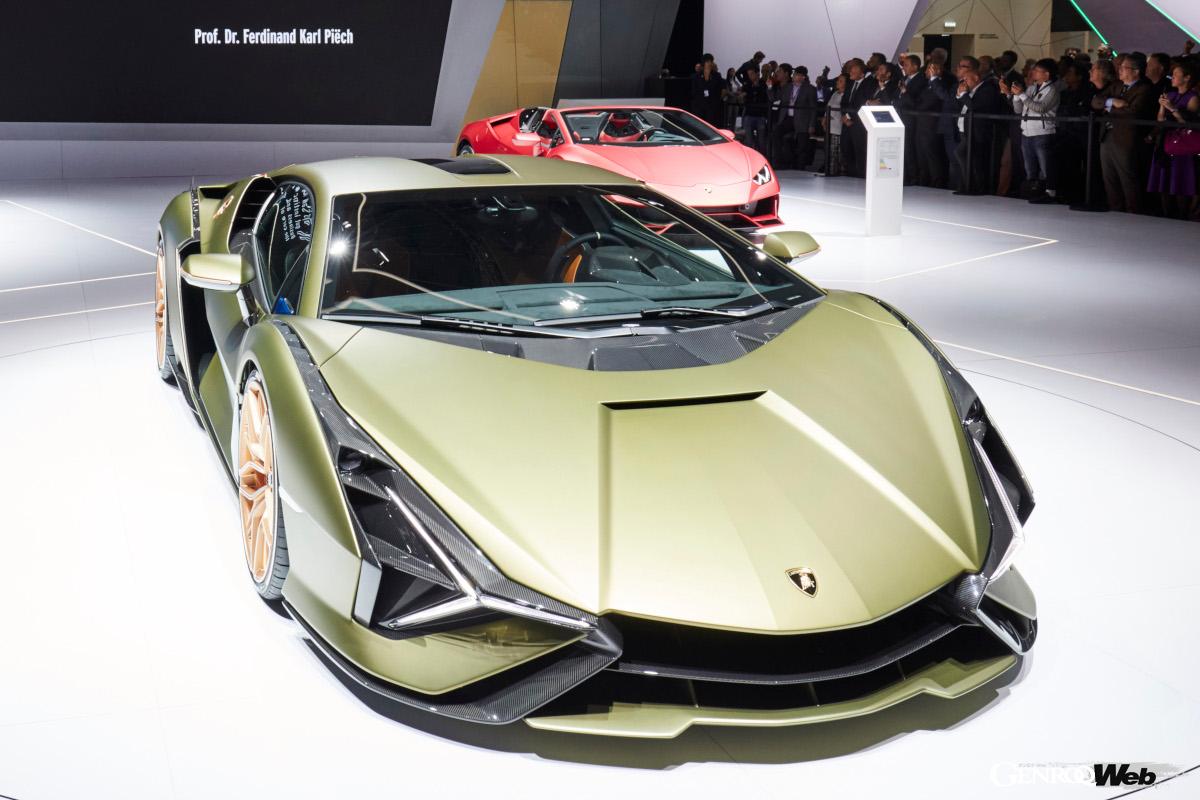
The Sián, unveiled in Geneva in 2019, was the first to feature a hybrid powertrain.
At the 2019 Geneva Motor Show, Lamborghini premiered the Sián FKP 37. It was Lamborghini’s first vehicle to feature an electric powertrain, combining a 6.5-liter V12 engine with a supercapacitor-equipped electrical system. The Sián’s distinctive Y-shaped design element was later incorporated into the Revuelto’s headlights.
In 2021, to celebrate the 50th anniversary of the Countach LP500, Lamborghini unveiled the Countach LPI 800-4. The new-generation Countach is based on the hybrid architecture used in the Sián, paying homage to the original with a longitudinally mounted V12 engine. Key innovations include a photochromic roof that can be turned transparent with a simple operation and 3D-printed interior air vents.