

PORSCHE 911GT3
Well done again as a pure engine car.
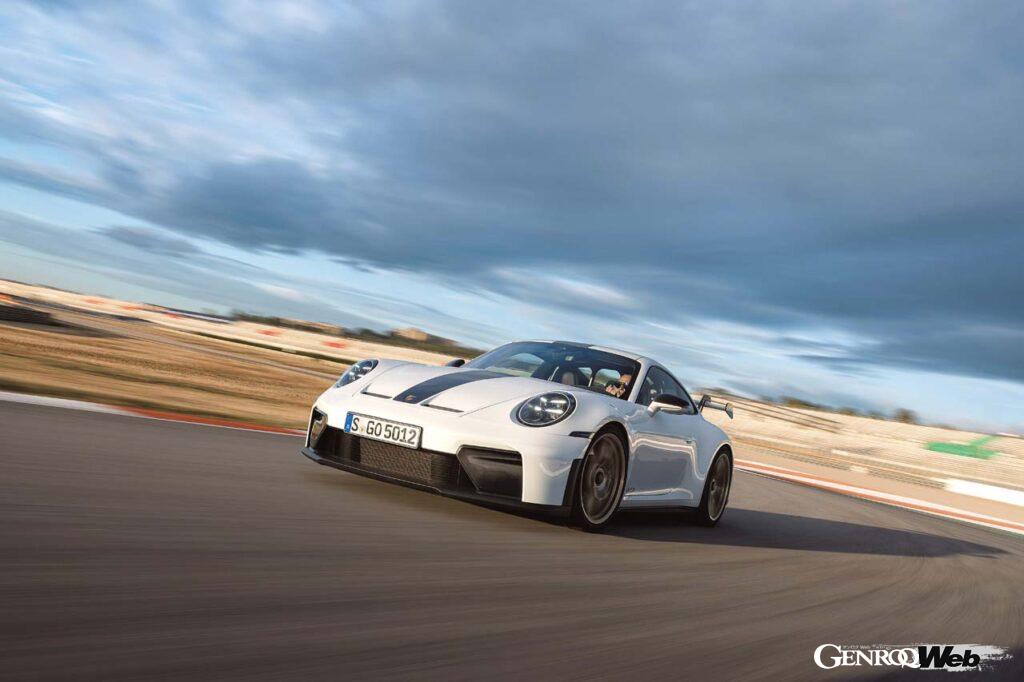
The Weissach package has been added to the standard GT3 model for the first time. For those who want to attack the circuit, the Weissach package is the best choice.
What impression did you have when you saw the specs of the new Porsche 911 GT3, commonly known as the “Type 992 II”? I’m sure there are many people who thought, “It hasn’t really evolved much.”
In fact, looking at the specs of the horizontally opposed 6-cylinder 4.0-liter naturally aspirated unit, the maximum output of 510 PS remains the same as before, but the maximum torque of 450 Nm has actually been reduced by 20 Nm. Acceleration from 0 to 100 km/h remains the same at 3.4 seconds with the PDK, but this can be attributed to the final drive ratio being 8% lower.
On the other hand, there must have been some who thought, “I’m glad they released it as a pure engine vehicle again this time.” As a result, the engine specs have remained almost unchanged, which is the result of a battle against increasingly strict environmental and noise regulations.
For example, in order to clear the latest exhaust gas regulations in each country, four catalytic converters have been installed. To accommodate this, the cam angle for both the intake and exhaust has been increased inside the engine, and the independent throttle valves have increased the flow rate. The cooling system has also been revamped to extract the maximum possible power. The distinctive 9000 rpm rev limit has also remained unchanged. If anything, the development team should be applauded.
Of course, the overall performance of the car cannot be compromised, so extensive modifications have been made to various parts of the car.
Corrects oversteer tendency

[1]

[1]

[2]
[1] Downforce has been improved compared to the previous model by changing the shape of the front diffuser and lip spoiler. [2] Lightweight forged magnesium wheels are available as an option for the Weissach package.
First, the chassis was modified with a shifted mounting point for the arms of the front suspension, which was a double wishbone type for the first time on the Type 992, and an anti-dive geometry was added to correct the tendency for oversteer when the front end dived during deceleration.
Other improvements include shortening the bump stoppers to extend the stroke and lightening the wheels, as well as many other small details inherited from the GT3 RS, such as aerodynamic covers for the arms.
Efforts have also been made to reduce weight. Although the standard specification has slightly increased in weight, the GT3 now comes with the first Weissach package, and the GT3 Touring package comes with a lightweight package. By making extensive use of CFRP parts and setting up magnesium wheels, the lightest specification has been kept at the same weight as the previous model. This shows a strong determination to absolutely surpass the previous model in terms of speed.
The test drive on the circuit begins with the standard GT3. I sit in the new bucket seat, which has removable headrest padding to accommodate a comfortable fit when wearing a helmet, and turn the start switch, which is only available on the GT3 as a knob. Right in front of me is the newly adopted full digital meter. While there are options for display, such as the traditional five-meter display, a mode that prioritizes visibility and displays only the bare minimum of information is available only on the GT3.
The powerful sound of a naturally aspirated flat-six

[3]

[3]
[3] The new GT3 will feature carbon fiber seats with improved support. The ignition switch is a rotary type instead of a button type.
Even though we were behind a lead car, once we exited the pit lane and entered the course, we immediately went into full throttle mode. Without any time to wait and see, I hastily switched to TRACK mode and stepped on the accelerator, and the powerful sound and vibration of the 4.0-liter naturally aspirated flat-six engine instantly lifted my spirits. I was worried that the engine noise would be as muted as that of a 911 Carrera, but thankfully, my fears were unfounded.
The power builds up as the rotation speed increases, and the exciting feeling of the engine gaining more and more momentum remains the same. There are no complaints about the power performance either. By lowering the final drive ratio, the engine revs up even more excitingly.
The top speed has been reduced from 318km/h to 311km/h, but even at the first corner of Fuji Speedway, it should still reach around 270km/h, so there should be no problems.
The change in footwork was greater than I expected. The early Type 992’s newly adopted double wishbone front suspension significantly improved steering response, but it also made the car more prone to oversteer. However, the new model’s suspension has become smoother in a good way, making it easier to control. This difference is quite significant.
Next, I tried the Weissach package, which gave me a particularly light feeling from the moment I started driving. On the other hand, it cannot be denied that the sharper the car is, the more severe it feels. I would say that this is for people who are confident in their driving.
A car free from complacency

The Weissach package makes handling sharper on the circuit, but also makes it more severe. It’s a setting for experts.
Next, on public roads, we tried out the Touring Package, which is a lightweight package equipped vehicle with both MT and PDK.
The most exciting thing was the manual transmission, and the joy of using both hands and feet to make the engine, which revs up to 9000 rpm, sing using the short-stroke shift lever as a baton was something that could not be replaced by anything else. It’s no wonder that it’s the most popular right now.
The PDK vehicle was equipped with rear seats, which are now available as an option. When driving, there was some jerking at very low speeds, probably due to the lowered final drive ratio, but this is within the acceptable range for a GT3. What bothered me more was how noticeably quiet the interior was. The rear seats seem to act as sound insulation, which is sure to be a matter of personal preference.
The new 911 GT3 has steadily evolved without compromising its beliefs even in these difficult times, while also offering an unprecedented range of options to meet customer demands. Even though it has become a popular car that is difficult to obtain, the development team seems to have no qualms about being complacent.
PHOTO/Porsche AG
SPECIFICATIONS
Porsche 911 GT3
Body size: Length 4570, width 1852, height 1279mm
Wheelbase: 2457mm
Vehicle weight: 1462 (MT) / 1479 (DCT) kg
Engine type: Horizontally opposed 6-cylinder DOHC
Total displacement: 3996cc
Maximum output: 375kW (510PS) / 9000rpm
Maximum torque: 450Nm (45.9kgm) / 6250rpm
Transmission: 7-speed DCT / 6-speed MT
Drive system: RWD
Suspension: Front double wishbone, rear multi-link
Brakes: Front and rear ventilated discs
Tire size: Front 255/35ZR20, rear 315/30ZR21
Top speed: 311km/h
0-100km/h acceleration: 3.4 seconds
Vehicle price: 28.14 million yen
911 GT3 with Touring Package
Body size: Length 4570, width 1852, height 1279mm
Wheelbase: 2457mm
Vehicle weight: 1461 (MT) / 1477 (DCT) kg
Engine type: Horizontally opposed 6-cylinder DOHC
Total displacement: 3996cc
Maximum output: 375kW (510PS) / 9000rpm
Maximum torque: 450Nm (45.9kgm) / 6250rpm
Transmission: 7-speed DCT / 6-speed MT
Drive system: RWD
Suspension: Front double wishbone, rear multi-link
Brakes: Front and rear ventilated discs
Tire size: Front 255/35ZR20, rear 315/30ZR21
Top speed: 313km/h
0-100km/h acceleration: 3.4 seconds
Vehicle price: 28.14 million yen
[Inquiries]
Porsche Contact
TEL 0120-846-911
https://www.porsche.com/japan/










![Test drive of Land Rover’s latest off-roader, the Defender Octa, on a dirt course [Video]](https://wheelfeed.com/wp-content/uploads/2025/08/1270-1761529533682.jpg)