

GR Yaris
The Type 25 has been further refined after the Type 24


The Type 24’s 1.6-liter inline-3 turbo engine, which is about 10% larger than the Type 20, is important, but the change in the upper mount shape for the Type 25 is also significant.
Genroku Web often deals with imported super sports cars, but occasionally there are Japanese cars or compact cars that pique the interest of our readers. The GR Yaris introduced this time is one such noteworthy model.
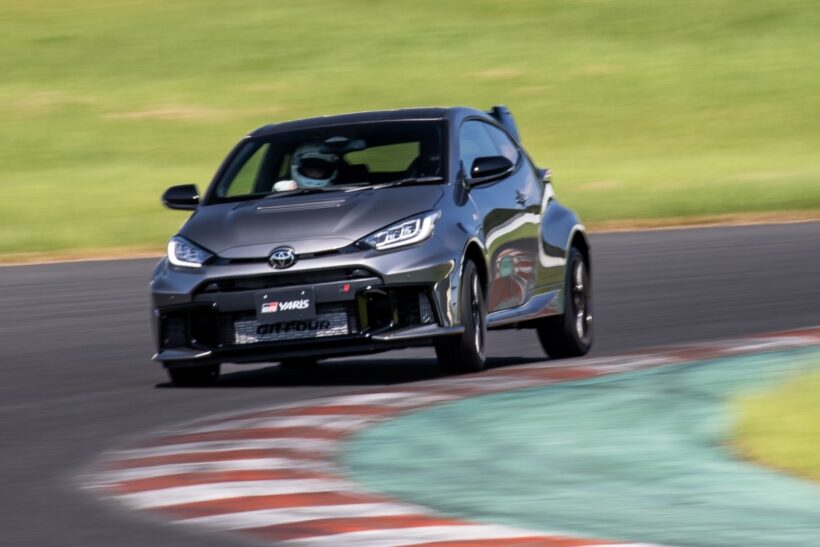
Toyota Gazoo Racing (TGR), Toyota’s sports brand, has launched the new Type 25 GR Yaris. The GR Yaris is a highly competitive model that was developed with a special background, aiming to win the WRC (World Rally Championship), as the base vehicle for the 2020 motorsports season. Having gone through the initial Type 20 and the Type 24, which received major improvements such as increased power output, a newly developed 8-speed automatic transmission, and the GR-DAT, the Type 25 has evolved into a more mature model.
The Type 24 featured a 1.6-liter inline 3-cylinder turbo engine with a maximum output of 304 PS (32 PS more than the Type 20) and a maximum torque of 400 Nm (30 Nm more than the Type 20), but the Type 25 has been further refined in performance in response to the demands of circuit enthusiasts. We test drove the Type 25 at Sodegaura Forest Raceway and got a feel for its potential in the motorsports realm.
Responding to professional driver feedback
[1]

[1]

[2]
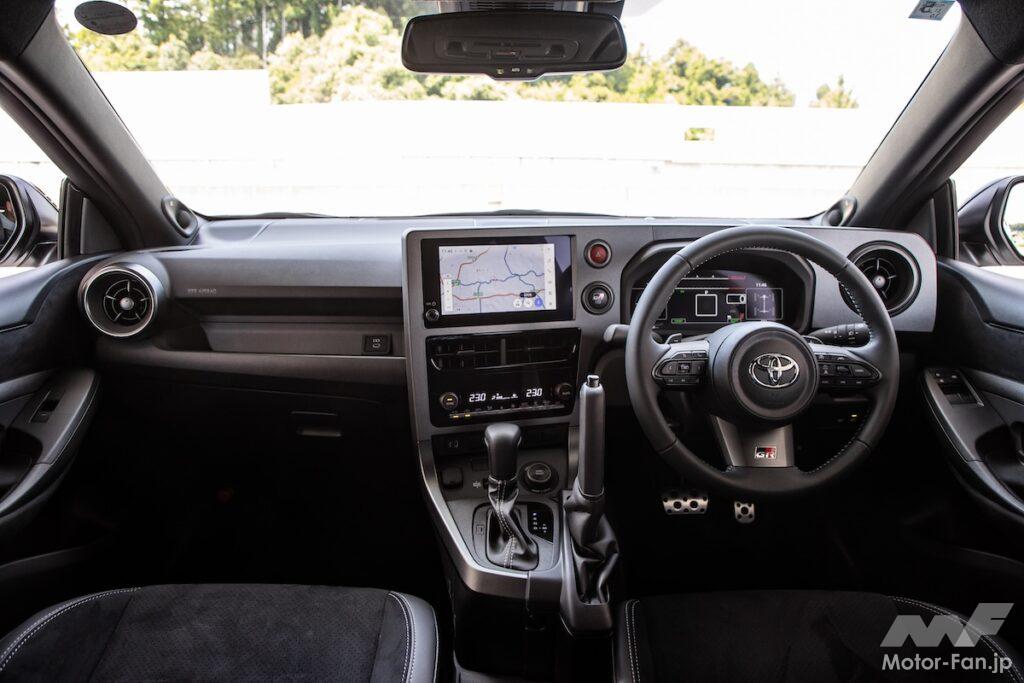
[1] The meter panel has been upgraded to a 12.3-inch TFT display, improving visibility while driving on a circuit. The vertical handbrake is linked to 4WD control, which will likely be useful in rallies. [2] I also test drove a car equipped with the Aero Performance Package. While the car’s behavior is clearly different at high speeds, its appeal lies in the fact that it can also be enjoyed at low speeds.
The improvements are wide-ranging. The GR-DAT’s shift-up timing has been optimized, and gear-changing times when using the paddles have been reduced by 16/1000 of a second. This has been further refined by utilizing knowledge gained from motorsports events such as the Super Taikyu and the Nürburgring 24 Hours, in addition to the WRC. Furthermore, improvements have been made in response to feedback from professional drivers, such as strengthening body rigidity, optimizing the EPS and shock absorbers, and making a vertical-pull handbrake, which is effective in rally racing, available on all grades.
I was also able to test drive the Type 20 MT for comparison, and while its brave, revving engine is powerful enough if that’s all you’re familiar with, the Type 25 MT is a whole other beast. With 304 PS and weighing 1,290 kg, it was developed with the involvement of racing drivers, and the 12.3-inch TFT meter lights up when you shift gears, making the driving mode clear at a glance, just like in a racing car. The Type 20’s small analog meter is still inconvenient.
The way the 4WD adjustment dial is operated has also been changed, dramatically improving circuit driving. On the original Type 20, turning it left set it for Sport (front 30: rear 70, same below), turning it right set it for Track (50:50), and pushing it set it for Normal (60:40). On the Type 24, turning it left set it for Normal (60:40), turning it right set it for Gravel (53:47), and pushing it set it for Track (60:40 to 30:70). The logic has been changed so that when driving seriously, you can switch your mood by pressing the dial. Incidentally, this change is also made to the GR Corolla. On the Track, since the rear is no longer engaged when decelerating, it can feel unstable when braking, but it is said to be easier to turn.
The main feature of this event is the Aero Performance Package


The aluminum hood with ducts and the large manually adjustable rear wing are impressive, but the bumper’s anti-fall bolts and other features reflect actual motorsport experience.
Next, I tried out the Type 25 DAT car. Two-pedal operation makes it easy to concentrate on driving, and using the paddles to push the rev limit right up to the limit gives a sense of accomplishment that’s close to that of a manual transmission. As advertised, it accelerates and decelerates intelligently, as it claims to be capable of handling the 24 Hours of Nürburgring in D range. In situations where you’re forced to upshift just before a braking point, the fact that it doesn’t control output even if you keep the revs pressed down (for three seconds) also shows its competitive spirit.
Finally, we were able to test drive the main attraction of this event, a car equipped with an aero performance package based on the Type 25 RZ High Performance. Developed to overcome challenges learned in motorsports, the package consists of six parts: an aluminum hood with ducts, a front lip spoiler, fender ducts, a fuel tank undercover, an adjustable rear wing, and a rear bumper duct.
Aiming to optimize aerodynamics and cooling during high-speed driving, installing all the components will maximize the effect. During the development stage, a 1-second reduction in lap time was confirmed at Fuji Speedway, and there was also an example of a 20km/h improvement in cornering speed on the Shimoyama test course. The results are directly linked to racing and are reflected in the numbers.
In fact, the huge manually adjustable rear wing has a tremendous effect, providing an overwhelming sense of rear stability in high-speed corners. The downforce is effective even on a low-speed course like Sodegaura, and grip is superior even at low speeds such as the fourth corner, to the point that it is difficult to swing the tail out unintentionally. It really felt like thorough aerodynamic development derived from motorsports had been poured into the car.
A production car with a competitive spirit
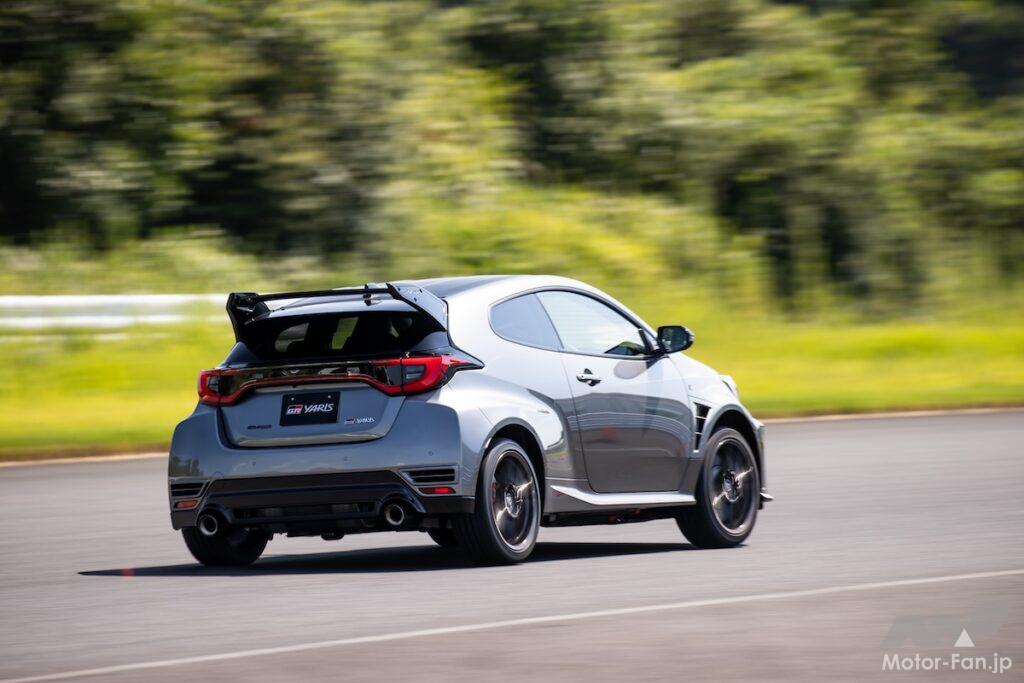
The rapid evolution from the Type 24 to the Type 25 came at a time when supply was to be expanded to over 70 countries, doubling the previous number of destinations, but it could also be said that the enthusiasm of the development team, who said, “We incorporated everything we wanted to do,” made it a reality. Even the bolt material and upper mount shape were revised to achieve both driving enjoyment and durability. It generously embodied the ideal of a competition car. For me, who spent my youth as a Sunday rallyist, this car was like the embodiment of the ideal I dreamed of 30 years ago.
It’s been a while since we’ve seen a production sports car that is so thoroughly competitive. The latest GR Yaris, which incorporates the knowledge and passion cultivated in the WRC, is a car that motorsport enthusiasts can confidently recommend to their team.
PHOTO/HIRANO Akio
SPECIFICATIONS
Toyota GR Yaris RZ High Performance Aero Performance Package DAT (6-speed MT)
Body size: Length 3995 x Width 1805 x Height 1455mm
Wheelbase: 2560mm
Vehicle weight: 1310 (1290) kg
Engine: Inline 3-cylinder DOHC twin turbo
Total displacement: 1618cc
Maximum output: 224kW (304PS) / 6500rpm
Maximum torque: 400Nm (40.8kgm) / 3250-4600rpm
Transmission: 8-speed automatic (6-speed manual)
Drive system: AWD
Suspension type: Front MacPherson strut, rear double wishbone
Brakes: Front and rear ventilated disc
Tire size: Front and rear 225/40ZR18
Vehicle price: 5,825,000 yen (5,475,000 yen)