
![Toyota and Joby Aviation conduct Japan’s first eVTOL test flight, aiming for commercialization by 2025 [Video]](https://wheelfeed.com/wp-content/uploads/2024/11/4180-1761208194390.jpg)

Joby Aviation eVTOL
An important milestone towards practical application
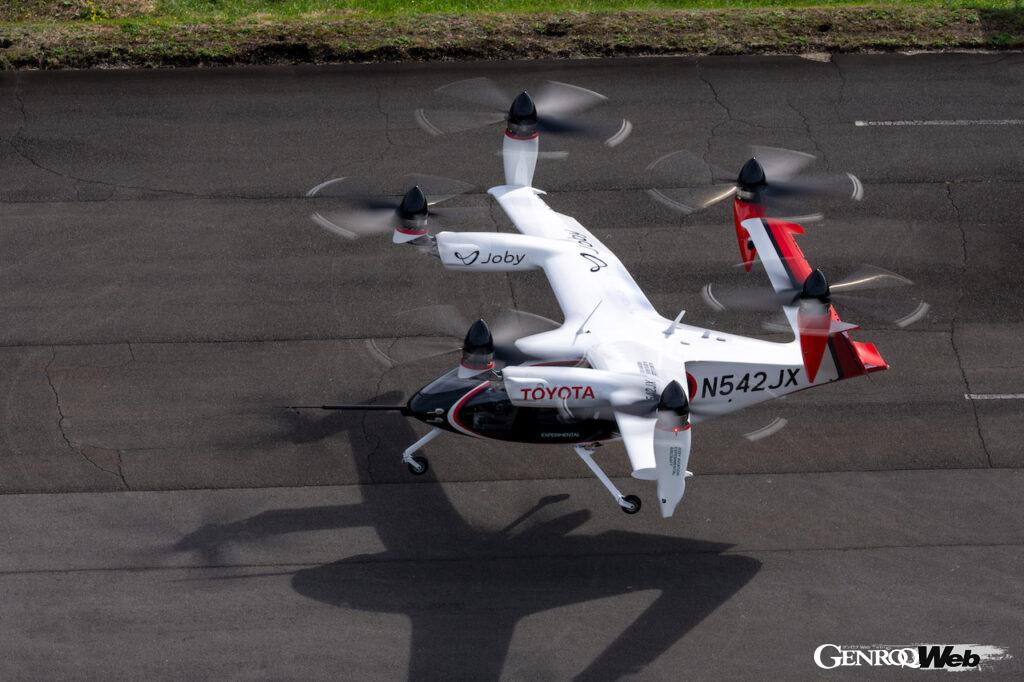
Many companies around the world are developing eVTOLs, but while various challenges have been identified for their practical application, Toyota and Joby Aviation have successfully completed the first test flight in Japan.
Since its founding, Toyota has continued to develop air mobility with the aim of realizing a society of mobility where everyone can move freely. 100 years ago, in 1925, Sakichi Toyoda, founder of the Toyota Group, donated a prize money to encourage the development of a storage battery capable of “loading it onto an airplane and flying across the Pacific Ocean.” He saw the potential of batteries as a power source, which is similar to the current eVTOL.
Later, Kiichiro Toyoda, the founder of Toyota Motor Corporation, took a strong interest in the aircraft business, and produced prototypes of helicopters and aircraft parts. After the war, Shoichiro Toyoda collaborated with a US company to develop the world’s first electronically controlled aero piston engine at the Higashi-Fuji Technical Center, the birthplace of Toyota’s aviation development, and it can be said that the challenge of air mobility has been passed down through the generations.
Currently, Toyota is continuing research and development with its partner, Joby Aviation, to commercialize eVTOL. Joby Aviation, which began as an engineering startup, has added Toyota’s automotive production and technology development expertise to the company, and Joby Aviation’s eVTOL has now successfully completed its first test flight in Japan.
“Our flight in Japan is a moment we’ve been waiting for for a long time and marks an important milestone on the path to clean air travel. We share Toyota’s vision for air mobility and are honored to have the opportunity to show a glimpse of that future,” said CEO Vivert.
Commercial operations are expected to begin as early as 2025

Joby Aviation CEO Joben Bibbert (left) met with Toyota Chairman Akio Toyoda on the occasion of the maiden flight in Japan. The company has revealed that it plans to begin commercial flights as early as 2025.
The eVTOL is designed for short-distance, high-frequency operations and was developed to meet the needs of the “flying taxi” market, which envisions on-demand use by commuters, business travelers, and tourists in urban areas. While incorporating elements of helicopters, drones, and small aircraft, it offers excellent features such as reliability, environmental friendliness (zero emissions), quietness, and cost performance.
This test flight marked Joby Aviation’s first flight test outside the United States. Toyota has been actively investing in Joby Aviation and providing production support, not only assisting with tooling design and factory layout in the production department, but also supplying parts to be installed on the eVTOL.
Joby Aviation’s eVTOL is scheduled to begin commercial operation as early as 2025. Its global partners include Uber, Delta Airlines, and ANA, and it has already applied for certification from the Japanese Civil Aviation Bureau of the Ministry of Land, Infrastructure, Transport and Tourism. Toyota Executive Vice President Hiroki Nakajima commented on the successful test flight:
“Air mobility has the potential to change our perception of distance and time. A future in which air mobility is a new option will further enrich the lives of many people. As a mobility company, Toyota aims to achieve seamless air and land travel and create a society in which everyone can move freely. Joby Aviation is an important partner in realizing this new mobility society.”












![Perfectly recreated! The officially licensed 1/8 Aston Martin Valkyrie is here! [Video]](https://wheelfeed.com/wp-content/uploads/2025/09/1230-1761528786769.jpg)