
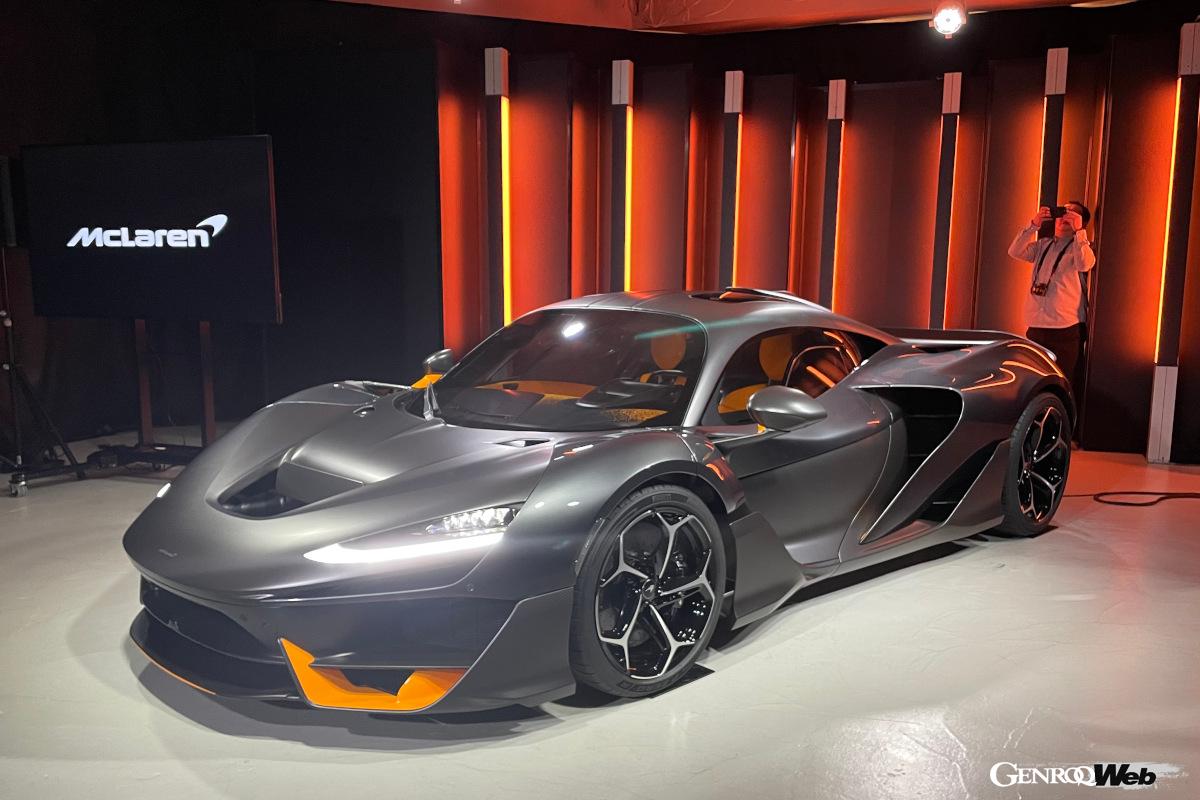

McLaren W1
Newly developed hybrid powertrain

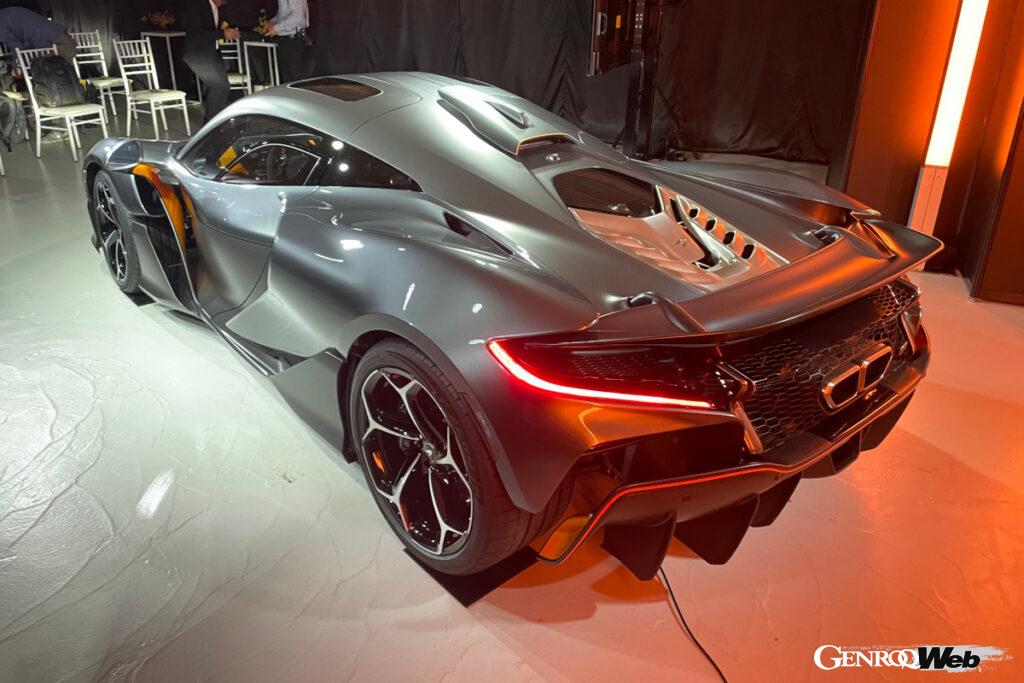

The newly developed MHP-8 4.0-liter V8 twin-turbo engine is mounted in the rear mid. From the right: Yoshihiro Masamoto (McLaren Automotive Japan Representative), Charlotte Dixon (Asia Pacific Regional Director), Tobias Schulmann (Chief Design Officer (CDO)), and Heather Fitch (Product Manager).
The McLaren W1, which just had its world premiere on October 6th this year, has already been unveiled for the first time in Japan. Officials from the UK came to Japan to give a presentation in front of a detailed mockup. There are many notable aspects of the W1, but the three main ones are its hybrid powertrain, aerodynamics, and lightweight chassis technology. These have resulted in the highest level of outstanding driving dynamics and pure engagement between driver and vehicle, which is said to be the best in the history of McLaren.
First of all, there’s the hybrid powertrain. The newly developed MHP-8 4.0-liter V8 twin-turbo engine is combined with an electric motor that integrates a motor control unit called the E-module and an 8-speed DCT to drive the rear wheels. The engine alone produces a maximum output of 928 PS, but with the E-module’s additional 347 PS, the system’s maximum output is an astonishing 1275 PS. Incidentally, the 8-speed DCT does not include a reverse gear, and the car is reversed using a motor. Reducing gears to reduce weight is a recent trend in electric super sports cars.
Dry weight is kept to 1,399 kg, achieving a power-to-weight ratio of 911 PS/t, the highest in the history of road-legal McLarens, resulting in performance of 0-100 km/h in 2.7 seconds, 0-200 km/h in 5.8 seconds, and 0-300 km/h in under 12.7 seconds, with a top speed electronically limited to 350 km/h.
The battery capacity combined with the E module is modest at 1.384kWh. This was chosen to preserve McLaren’s inherent strengths of light weight and high performance. Charging is also quick in race mode, so even if the battery is completely depleted, it will be fully charged again in 30 seconds to 1 minute, so there is no problem even when driving continuously around a circuit. As with the Artura, there is no regenerative braking, and the V8 engine charges the battery.
Long tail generates 1000kg of downforce
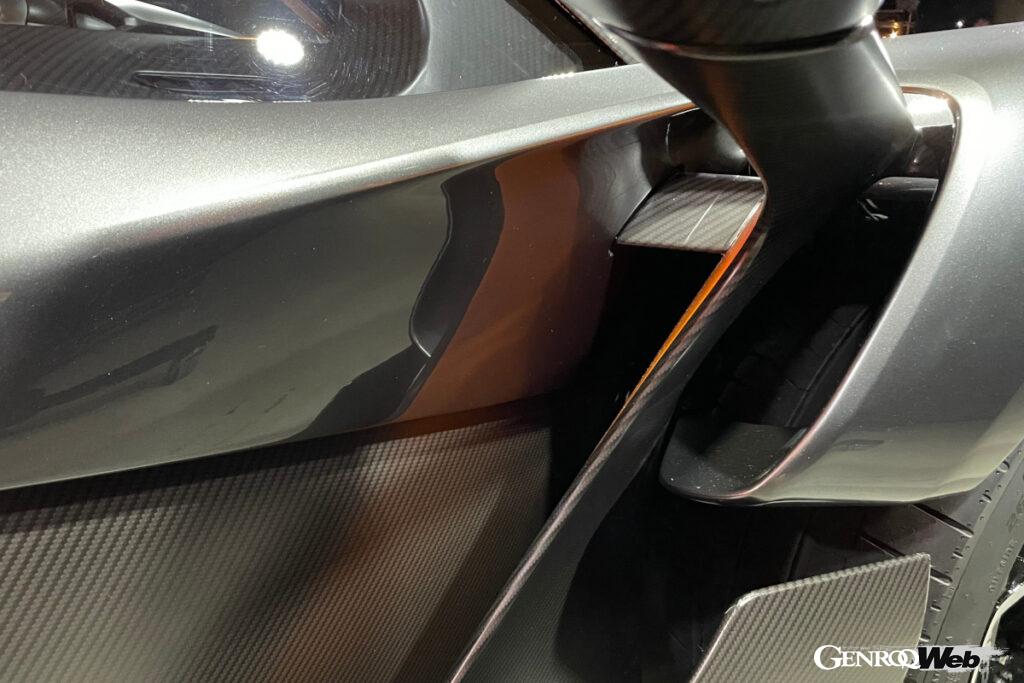


The adoption of anhedral wing doors, a first for McLaren, which open upwards, made effective use of the space behind the front fenders and improved airflow from the front.
The core of the W1, which is said to have adopted the most advanced aerodynamics in the history of McLaren road cars, is the latest monocoque “Aerocell.” At present, Aerocell is only introduced in the W1, but there is a possibility that it will be adopted in future next-generation models. More details will be provided later.
The biggest change from previous Super Series models is the adoption of McLaren’s first anhedral wing doors that open upwards. By moving the position of the dihedral wing doors that previously flipped up diagonally forward and the hinges from the base of the A-pillar to the roof side, the space behind the front fenders could be used more effectively, improving the airflow from the front. Another benefit to be touted is that the newly introduced gull-wing doors have significantly improved access to the cabin.
In Race mode, the suspension lowers the front by 37mm and the rear by 17mm. A special profile is introduced to the suspension settings, and the roof panel and front and rear active wings are activated. The rear wing, “McLaren Active Long Tail,” is extended 300mm rearward and generates 1,000kg of downforce around the rear axle.
First steering wheel equipped with switches


Both the left and right seats are fixed to a carbon fiber monocoque, and the position of the small-diameter steering wheel and pedals can be adjusted.
The lightweight chassis technology utilizes McLaren’s signature carbon fiber monocoque, the Aerocell, to keep the vehicle’s center of gravity as low as possible. Thanks to extensive weight reduction efforts, the total weight of the hybrid components has been reduced by 40kg, despite the car delivering nearly twice the power compared to the P1. Further weight savings have been achieved by eliminating engine-related equipment such as the alternator, starter motor, and additional components required for a conventional HVAC system.
The seats are fixed to the Aerocell carbon fibre monocoque in the same way as in a racing car, and the aluminium pedals, small diameter steering wheel and main controls, which are raised to improve aerodynamic efficiency under the floor, can all be adjusted to suit the driving position.
The small, flat-bottomed steering wheel, designed specifically for the W1, is equipped with “Boost” and “Aero” switches, a first for a McLaren sports car. Pressing Boost on the right spoke provides additional power according to the battery’s capacity, allowing for temporary stronger acceleration, while “Aero” on the left spoke maximizes aerodynamic performance. These switches are designed so that the driver can easily operate them with just their thumbs, without taking their hands off the steering wheel. Changing the chassis and powertrain modes is adjusted using a rocker control on the meter nacelle that moves with the steering column, just like in the Artura. Here too, modes can be changed without taking your hands off the steering wheel.
The W1 is said to have achieved performance that cut the lap time of the circuit-oriented super sports car “Senna” by 3 seconds at the Nardo Circuit. Due to its exceptional performance and price, production will be limited to just 399 units. According to sources, the price in the Japanese market will be approximately 320 million yen, and deliveries have already been decided at the time of the announcement.
*Some corrections made on November 18th.
PHOTO/GENROQ
SPECIFICATIONS
McLaren W1
Body size: Length 4635, Width 2074, Height 1182mm
Wheelbase: 2680mm
Dry weight: 1399kg
Engine: V8 DOHC Turbo
Total displacement: 3988cc
Engine maximum output: 683kW (928PS)
Engine maximum torque: 900Nm
Motor maximum output: 255kW (347PS)
Motor maximum torque: 440Nm
System maximum output: 938kW (1275PS)
System maximum torque: 1340Nm / 4500-5000rpm
Battery capacity: 1.384kWh
Transmission: 8-speed DCT
Drive system: RWD
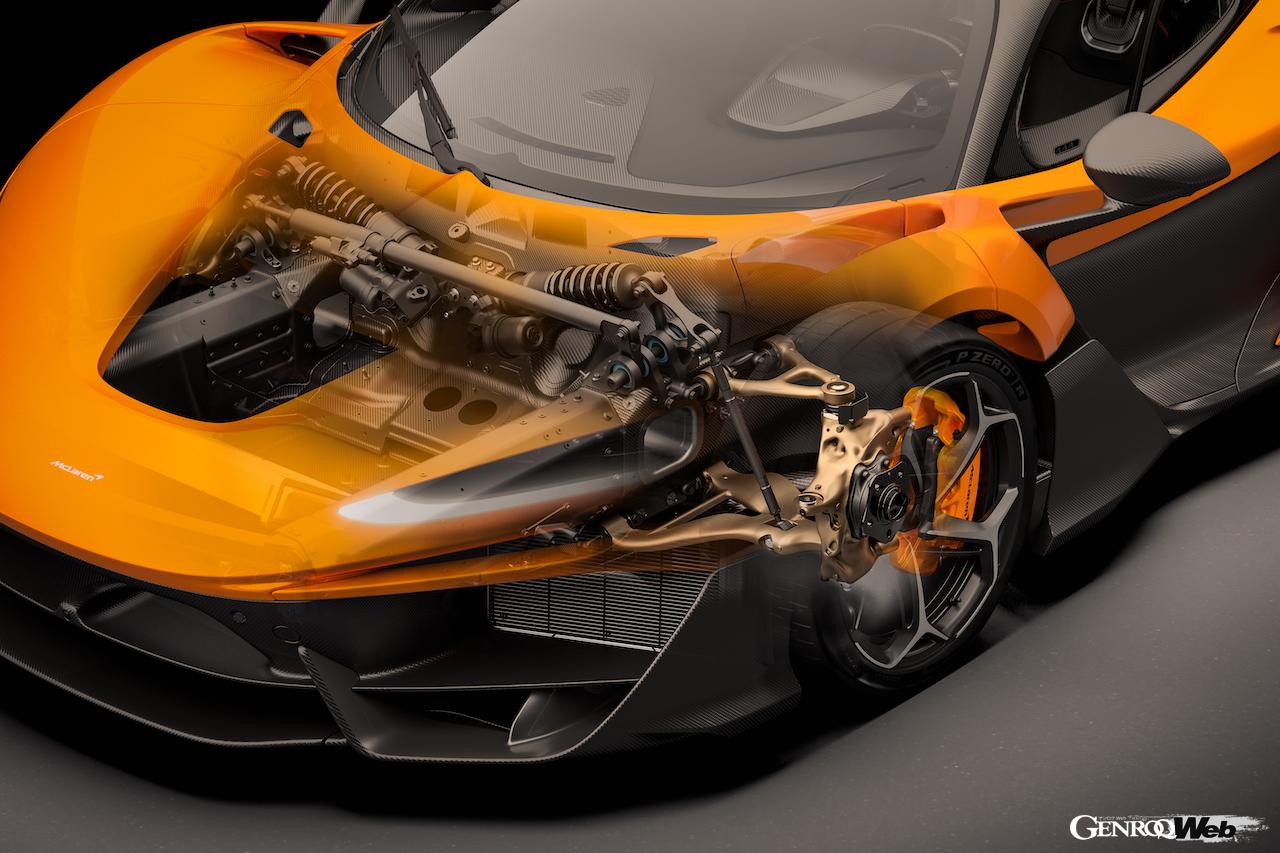
Suspension type: Front and rear double wishbone
Brakes: Front and rear ventilated disc Tire
size (rim width): Front 265/35R19 (9.5J) Rear 335/30R20 (12.0J)
Top speed: 350km/h (electronically controlled)
Acceleration from 0 to 100km/h: 2.7 seconds