
![The story behind Porsche’s “Golden Shield” [Car Emblem Secrets 01: Porsche]](https://wheelfeed.com/wp-content/uploads/2025/01/2609-1761201044833.jpg)

“The company of Dr. Ferdinand Porsche” founded in 1930

Dr. Ferdinand Porsche created the Lohner-Porsche, an electric car with a motor attached to the wheel hub, in 1898. After working for Daimler and other companies, he went independent in 1930, and the following year Porsche was founded as a company.
The history of Porsche as a company began in 1930. In December of that year, Dr. Ferdinand Porsche, then 55 years old, founded his own company. In April of the following year, he established “Dr. Ing. hc F. Porsche GmbH” in Stuttgart. With a staff of 12, he designed engines and vehicles, and in the same year obtained a patent for the torsion bar suspension.
Incidentally, “Ing. hc” stands for “ingenieur honoris causa” (derived from German and Latin), which translates to “honorary degree in Engineering” in English. A literal translation would be “honorary degree in engineering,” but in Japanese it would be more appropriate to combine it with “Dr” (doctorate) to read “Doctor of Engineering.” GmbH is also an abbreviation for “Gesellschaft mit beschränkter Haftung,” which translates literally to “limited liability company,” and is similar to the joint-stock companies and limited liability companies that previously existed in Japan.
Porsche’s official company name, which continues to this day, “Dr. Ing. hc F. Porsche GmbH,” literally translates to “Dr. Ing. hc F. Porsche’s company” in Japanese.
Porsche brand cars were born in 1948

The Porsche 356 “No. 1” Roadster under construction at the factory in Gmünd. Ferry Porsche is second from the left.
The Porsche car was born in 1948. Dr. Porsche’s son, Ferdinand Anton Ernst Porsche, commonly known as Ferry Porsche, explained the impetus for its development:
“I searched for the perfect car, but couldn’t find it anywhere, so I decided to build it myself.”
“Unit Zero” made in Austria

The Porsche 356 “No.1” Roadster is a prototype equipped with a tuned VW 1.1-liter flat-four engine mounted in front of the rear axle.
The result was the prototype Porsche 356 “No. 1” Roadster, the first car to bear the Porsche name. While the 356 was mass-produced in Stuttgart, the No. 1 was built in Gmünd, a small town in northwestern Austria where the company had been “evacuated” during World War II.
The emblem was born in America
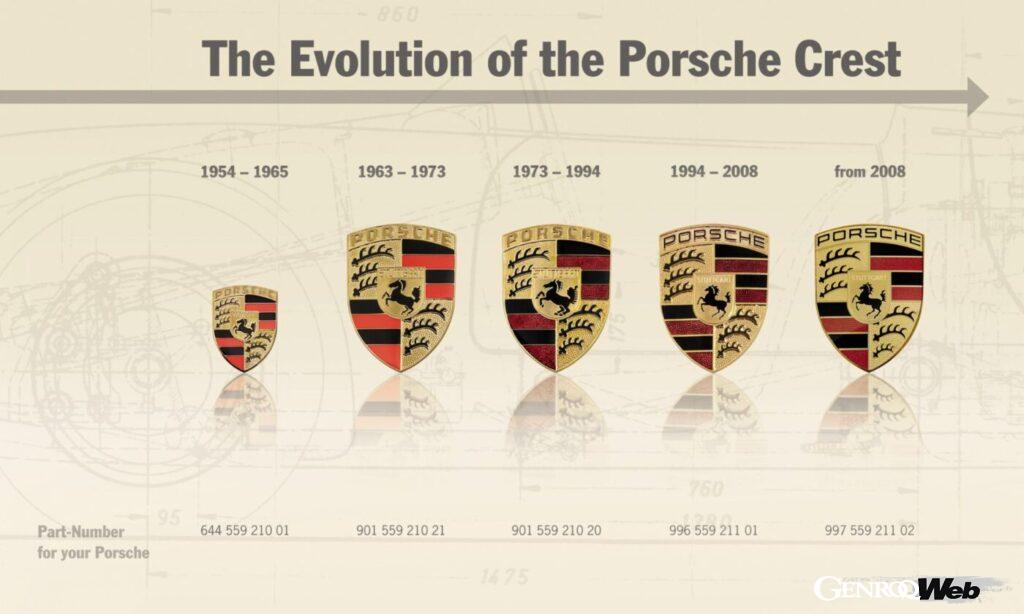
The basic design of the Porsche Crest has remained unchanged since its inception.
The Porsche crest wasn’t created until four years later, in 1952, when American businessman Max Hoffman proposed creating a visually appealing symbol. Ferry wrote in his memo: “Steering wheel rim decorated with ‘Porsche’ and the Stuttgart crest or similar.”
The initial design was created by Franz Xaver Reimspiess, a Porsche designer at the time. The emblem was first engraved on the steering hub of the 356, and two years later, it was also attached to the hood in 1954. It has been refined a total of five times between 1973 and 2023, but the basic design has remained unchanged.
Stuttgart coat of arms

Coat of arms of the city of Stuttgart.
The Porsche emblem consists of four elements: a horse, deer antlers, red and black stripes, and the word PORSCHE. The image of a powerful horse in the center of a golden shield, along with the word “STUTTUGART,” is taken from the coat of arms of the city of Stuttgart. The city’s origins date back to a horse breeding farm (stuotgarte) established around the 10th century, and horses have long been used as a symbol of the region.
History and traditions of the Kingdom of Württemberg
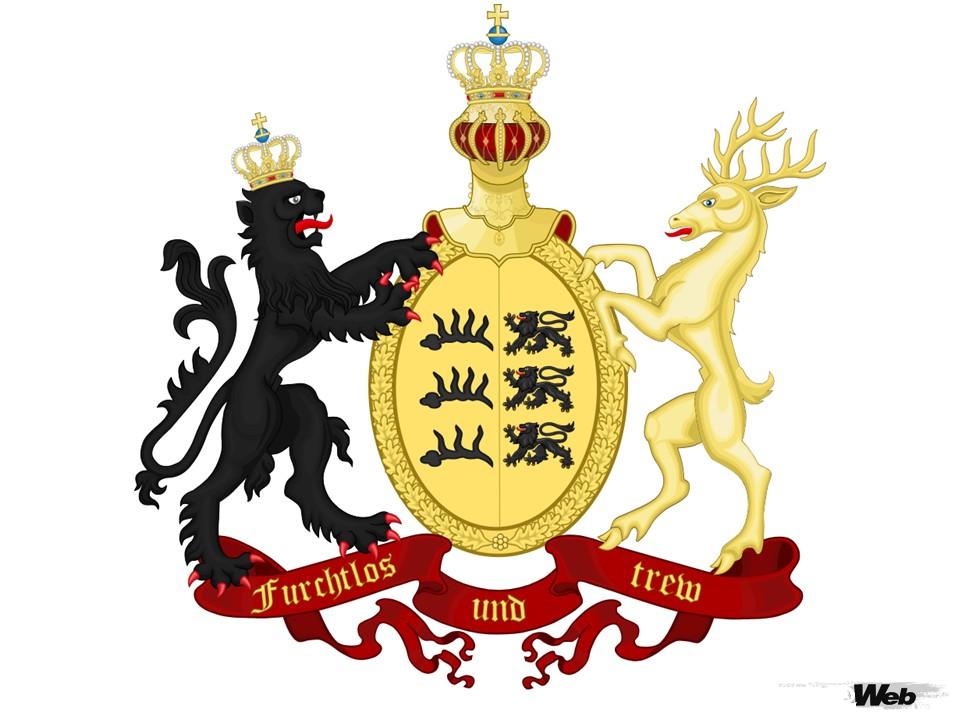
Coat of arms of the Kingdom of Württemberg.
The deer antlers in the upper left and lower right corners are based on the three horns depicted on the kingdom’s coat of arms (national emblem). Stuttgart is the capital of the state of Baden-Württemberg, but was also the capital of the former Kingdom of Württemberg.
The red and black stripes on the left and right sides of the deer antlers are also said to have originated from the national emblem. Because this region was a kingdom formed by the integration of several small territories, they symbolized unity as a nation and harmony in diversity. Furthermore, by combining them with deer antlers, which represent a hunting culture, it is said to have shown off the wealth and power of the territory.
In medieval Europe, red represented courage and power, and was used to express the nobility and bravery of lords and knights. Black was considered a noble color, symbolizing dignity, wisdom, and loyalty. At the time, it was often used to represent the authority and strong will of rulers.
Porsche’s dynamism is rooted in local traditions

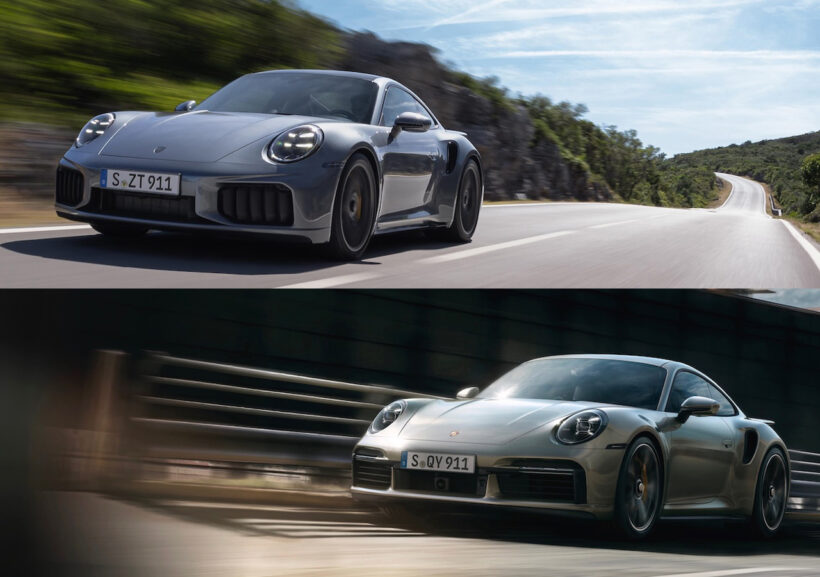
Porsche’s identity, based on the history and traditions of its hometown, continues to this day. The photo shows a limited edition 911 Turbo, which celebrated its 50th anniversary last year.
The word “PORSCHE” is engraved in large letters at the top of the emblem. It can be said that this emblem expresses Porsche’s association with the nobility and craftsmanship based on the history and traditions of the region. The design, which is based on the coat of arms of the city of Stuttgart, and the deep meaning of each element speak to the pride in the region and dynamism that have been cultivated in the process of Porsche’s growth into a global brand.
PHOTO/Porsche AG