

Porsche 911 GT3 (996)
The license plate number is “S-WR 996”

The Porsche 911 GT3 was unveiled at the 1999 Geneva Motor Show. Walter Röhrl was loaned a car bearing the number S-WR 996 by Porsche.
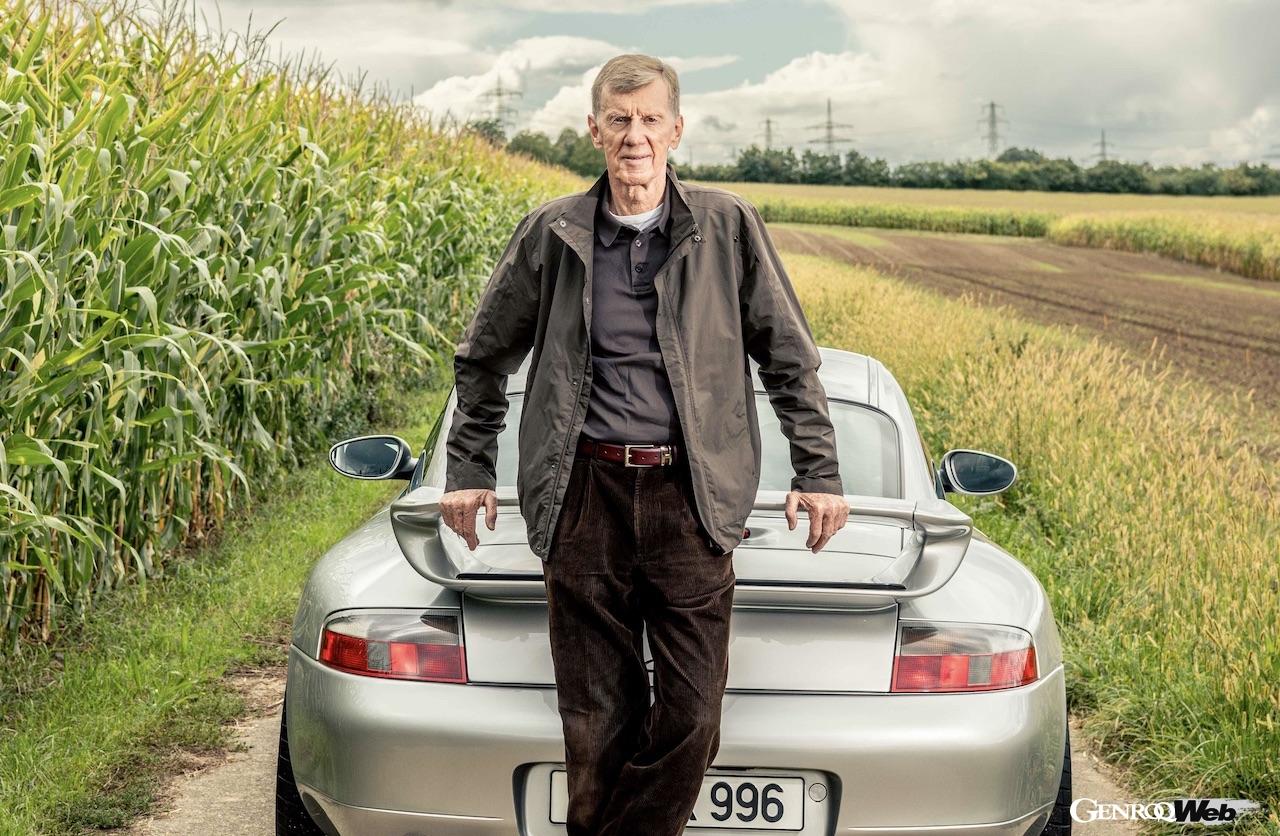
“It feels like I’ve stepped into a time machine,” said Walter Röhrl, a Porsche brand ambassador, standing in front of a perfectly maintained 911 GT3 (Type 996) equipped with the Clubsport package.
The car that Röhrl came face to face with was the Arctic Silver Metallic 911 GT3 that Porsche unveiled at the 1999 Geneva Motor Show. This particular car was the same one that Röhrl himself had driven as a company car more than 20 years ago. The license plate from that time, “S-WR 996”, indicates whose car it was.
Roll sat in a heat- and flame-resistant Nomex bucket seat. At 77 years old and 6’6″, he easily slipped through the roll cage. The steering wheel fit like a well-worn glove.
His keen gaze dropped to the five distinctive circular instruments and he murmured, “Fantastic…” “At the time, the original 911 GT3 was the sportiest Porsche on the road. Infinitely pure, one of a kind. Shall we take a lap or two?” a mischievous grin spread across Röhrl’s face.
A hideaway for 911 GT3 lovers

Timo Konrad (right), who currently owns Röhrl’s 911 GT3, built the hideaway at FL8WERK.
Röhrl and his 911 GT3 head to a garage near the town of Flacht in the Swabian region of Germany. This private hideaway is passionately run by a group of Porsche enthusiasts called FL8WERK. It’s filled with vintage neon signs, advertising posters, a pinball machine, a billiards table, and a cozy living area.
“Every single part has a story to tell,” explains Timo Konrad, co-founder of FL8WERK and owner of a Röhrl company car painted Arctic Silver Metallic.
Conrad led us through display cases filled with all sorts of books, automobilia (car-related collectibles), model cars of various scales, and countless commemorative photographs, each of which reveals a deep love for Porsche.
“We’ve been organising driving tours together for about 10 years, chatting, tinkering with cars and learning about the history of the 911 GT3. This garage is just a place to have fun. Most of the FL8WERK members work in other fields,” says Conrad.
The pure charm of the original 911 GT3

The members of FL8WERK collected their beloved first-generation 911 GT3 for Walter Röhrl.
To celebrate Röhrl, Conrad has gathered no fewer than seven rare 911 GT3 Clubsports in rare colors such as Nogaro Blue, Lapis Blue, and Rainforest Green Metallic.
“It’s said that only 20% of the original 996s were produced, with the 911 GT3 designed for motorsport,” explains Alex Schwaderer, co-founder of FL8WERK.
The differences between the different years can be identified by various details, such as the presence or absence of side airbags, the battery master switch on the center tunnel, Nomex bucket seats, and a fixed roll cage. Six-point harnesses and fire extinguishers were standard equipment on all models.
Cleto di Paolo, the other founder of FL8WERK, enthusiastically stated, “What we particularly like about the original 911 GT3 is the direct and pure driving experience. It’s narrow, light and the engine is perfect. Everything is well balanced and you get direct feedback every time you get behind the wheel.”
“There won’t be any driving assistance systems like we have today, so it’s purely about driving skill. But that’s what we like about it.”
Creating a new category in the history of the 911

Röhrl and the FL8WERK members engaged in lively discussions about the original 911 GT3. The 911 GT3 was developed with the concept of a “street-legal racing car,” and it created a new category in the Porsche lineup.
In 1997, Porsche introduced the fifth-generation 911 (Type 996), the first car to feature a liquid-cooled engine. This car set new standards in the sports car market in terms of comfort, safety, and efficiency. The 911 GT3, released two years later, was developed for customers who prefer circuit-oriented driving. The “GT3” model name comes from the racing category.
“At the time, I often worked with Roland Kussmaul, who was an engineer at Porsche,” recalls Röhrl, who was also involved in the development of the 911 GT3.
“He and his engineers had a clear vision: to develop a race car that could be driven on the road. The success of this radical 996 derivative has kept the concept alive in the Porsche lineup to this day. The ‘GT’ models have remained avant-garde with each generation of the 911.”
The 3.2-liter flat-six engine has been increased by 60 PS from the base model, bringing its maximum output to 360 PS. The chassis and body have been fine-tuned, and many of the comfort features have been removed to reduce weight. The fixed rear wing has also been retained by all generations of the GT3. Porsche once proclaimed in the 911 GT3 brochure that “every last millimeter is designed for maximum performance.”
The roll “S-WR 996” that I bought without knowing

Konrad bought his second 911 GT3, but he had no idea that it was the car Walter Röhrl drove at the Geneva Motor Show.
Konrad has always had a soft spot for the 911 GT3 Clubsport, having owned the original Rainforest Green Metallic model before upgrading to the Arctic Silver “Geneva Motor Show Car” a few years ago.
“I bought it from an owner living in southern Germany, but at first I didn’t know anything about its history (laughs),” says Conrad. However, the registration documents state that the first owner was “Dr. Ing. hc F. Porsche AG.” That’s right, this particular car was a factory car.
“I felt like an archaeologist. Of course, I was familiar with the photos of the car’s world premiere at the Geneva Motor Show. Then, one day, it just clicked.”
The final piece of the puzzle was the license plate “S-WR 996” that was forever inscribed on the registration documents.
“I had the opportunity to meet Walter Röhrl at an event and asked him about this car. He remembered it as if it were yesterday! That’s a rare stroke of luck,” Conrad laughs.
The moment he got behind the wheel of his old partner, the 911 GT3 Clubsport, for the first time in 20 years, Röhrl felt a sense of complete peace. When he turned the ignition, he heard the typical rattle of the single-mass flywheel. “If you didn’t know what that sound was, you’d think the engine was going to break,” Röhrl said with a laugh.
“On the Nürburgring Nordschleife, the Type 996 911 GT3 recorded a time of 7 minutes 56 seconds. It was the first time a road-legal 911 had achieved a time under 8 minutes. The car caused a sensation at the time, and the excitement remains to this day.”