

Concorso d’eleganza Villa d’Este
100 years ago, the latest high-end model show

I had breakfast at the hotel’s terrace restaurant, where the view was amazing.
In the world of car enthusiasts, “Villa d’Este” refers to the Concorso d’Eleganza Villa d’Este, officially held every May. Villa d’Este itself is an aristocratic mansion whose construction began in the 16th century, and since the 19th century it has become a place of aspiration for many Italians as the most symbolic 5-star classic hotel on the shores of Lake Como, one of Italy’s leading lake resorts. The hotel also includes a building that was once used as a summer home by the Queen of England. Its greatest attraction is its beautiful gardens, which are also registered as a UNESCO World Heritage Site.
The first car show held at the historic Villa d’Este was actually quite a long time ago, in September 1929. Since it was nearly 100 years ago, it wasn’t a vintage car show. It was a festival of the latest high-end models of the time, what we would call one-off hypercars and ultra-luxury models today.
After a hiatus during the war, it was revived after the war, but then closed for a time. After a hiatus of about half a century, it was revived as a vintage car competition. BMW, seeing the potential, became the main sponsor, and the foundation of the event was established. In its current form, it has grown into a competition event that rivals Pebble Beach and Goodwood, attracting attention from car collectors around the world, and has achieved unprecedented fame. Now, it has returned to its roots, and is also used to announce the latest models, as well as exhibit concept cars and one-off models.
The specimen exhibited in 1972

The vehicle entered this time is the De Tomaso Pantera Gr.4.
I received an invitation from a Japanese entrant participating in Villa d’Este to “come along.” I had the same experience of accompanying him two years ago, and this time he was asked to be the driver of the entry vehicle.
From here on, we will introduce the contents of the three-day event from the perspective of the entrants (you can find plenty of official announcements such as contest results by searching).
This year’s event took place from Friday, May 23rd to Sunday, May 25th. Entrants had to check in (through vehicle inspection) at the venue by the evening of the 23rd. We rented a car and headed to Villa d’Este from Milan Malpensa Airport. After a 30-minute drive, we arrived at the shores of Lake Como, which can only be described as picturesque. The roads along the lake are narrow and there are many small towns, so traffic jams had already begun to form. This is because there were many other events scheduled besides Villa d’Este.
Upon arriving, the first thing we did was collect our car. The entry vehicle this time was the De Tomaso Pantera Gr.4. This Group 4-based vehicle, of which only eight were produced, was not a homologation model but a race car, and it was the exact car exhibited at the 1972 Geneva Motor Show. It was the last of the eight to be produced and was never used in a race, making it a rare example. It has been in Japan since 1977, during the supercar boom, so it is likely the exact car that excited us as boys. The current owner acquired this car at an auction held in Tokyo seven years ago. I was involved in that auction, so I am thrilled by this twist of fate.
The gasoline tank had to be emptied during the transport from Japan. I filled it with the gasoline I had prepared and started the engine as if praying. The roar of the V8 roared through the quiet lakeside hotel. “We’ve made it to Italy!” I thought, and my spirits were lifted. This was also the Pantera Gr.4’s first homecoming.
Do you have a Celia A team?

[1]

[2]

[3]
[4]

[5]

[6]
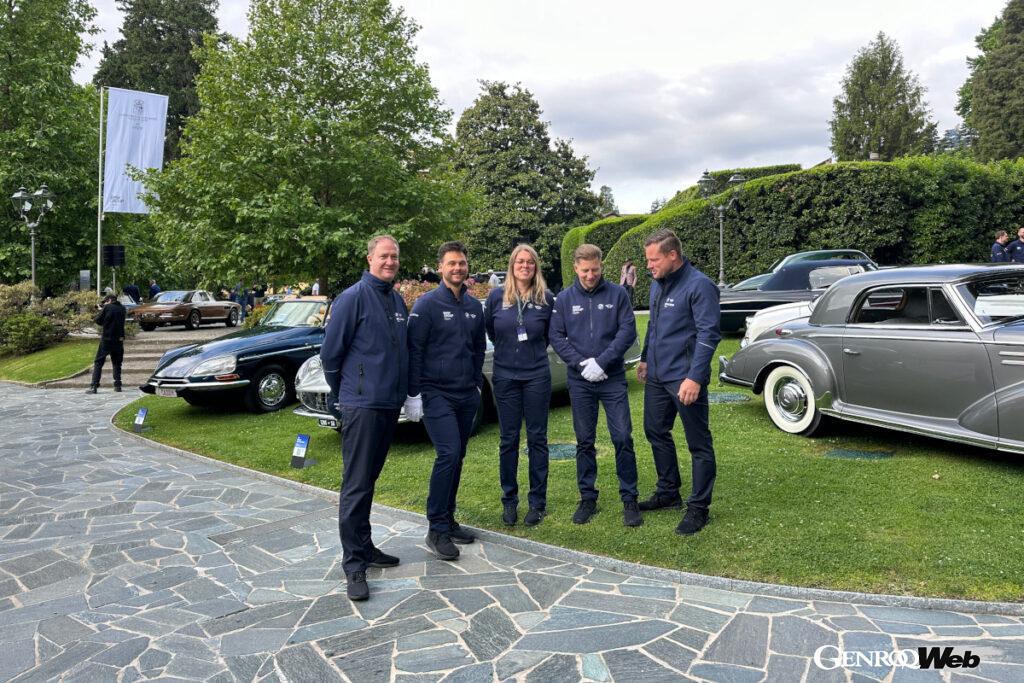
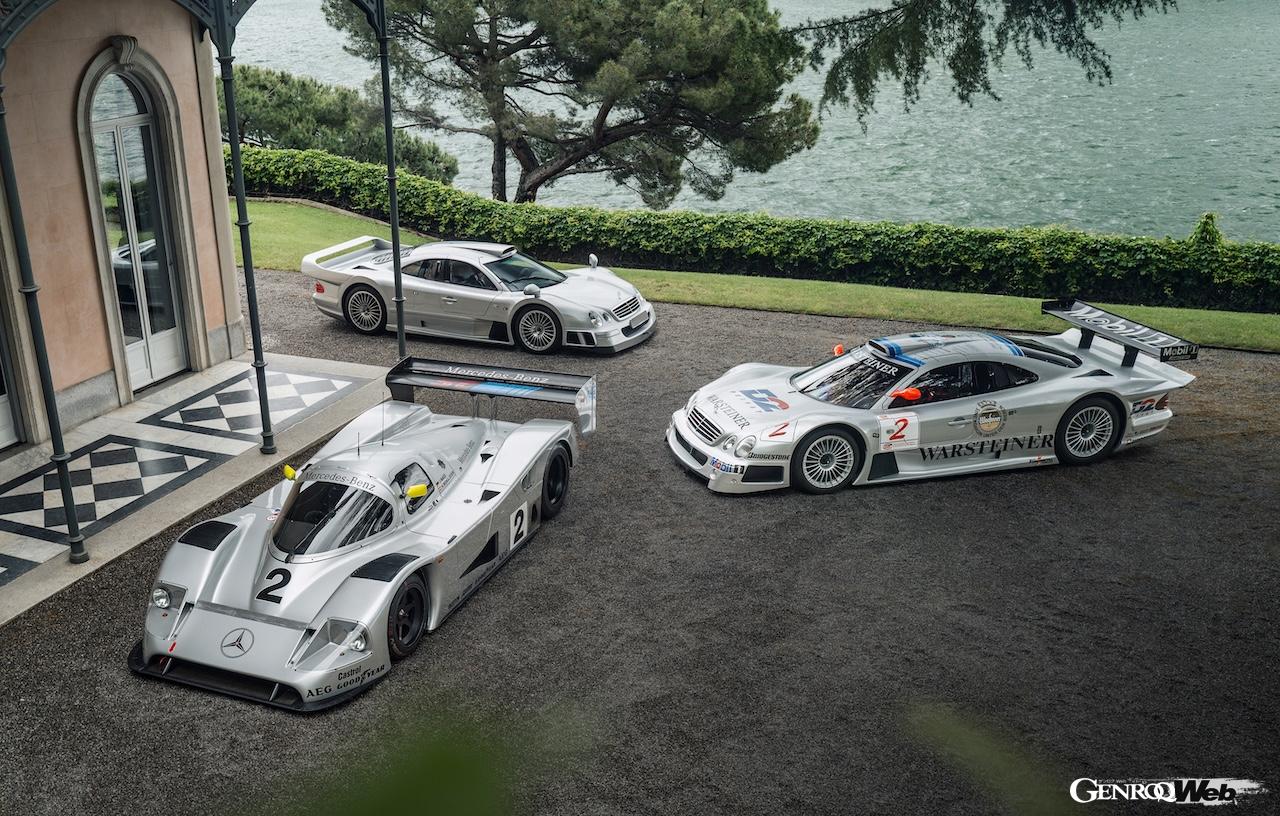
[1] BMW’s new car, the Concept Speedtop. [2] The BMW M2 CS also had its world premiere. [3] The pre-war Alfa Romeo 8C 2900. [4] The dedicated staff at BMW Classic. [5] The neo-classic Ferrari F40 GTE. [6] The Mercedes-Benz CLK-GTR.
We head to the check-in counter in front of the hotel entrance. A pre-war Alfa Romeo 8C 2900 and a neo-classic Ferrari F40 GTE are already waiting for their inspections. After receiving our pass set at the reception and checking into the hotel, we wait for our turn for inspection.
It was the Pantera’s turn. We were excited, as the event was about to begin. We placed the car on a platform and members of the Selecting Committee inspected it. They conducted a brief interview with the owner and checked the chassis number, engine number, and basic functions of the car. They checked to make sure it matched the vehicle that had been applied for and was roadworthy. Once the inspection was completed without incident, the car was taken to the hotel garage, led entirely by BMW Classic staff. Their dedicated work continued until the end of the event, and even until we checked out afterwards. We are truly grateful.
The official event on Friday was the participant briefing in the evening, where the judges were introduced. The BMW M2 CS was unveiled in the garden. Another highlight was the dinner party, a casual stand-up party hosted by BMW on Friday night. BMW’s new car, the Concept Speedtop, was also unveiled here.
The young couple sitting next to me at the table own a Mercedes-Benz CLK-GTR and are fans of neo-classic manual transmission supercars. We hit it off and had a great time. Apparently, Seria A Team (!) also owns one. It’s encounters like these that make Villa d’Este so interesting.
Surprisingly rare model
[1]

[2]

[3]

[3]
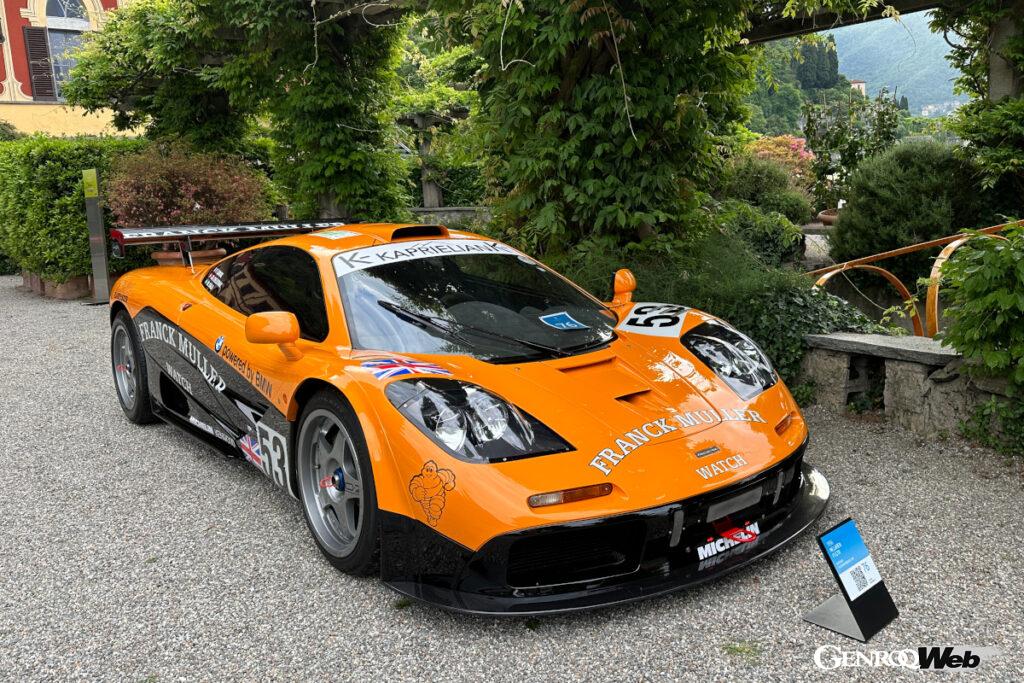
[1] The “short tail” of the “McLaren F1 GTR.” [2] The final pre-production prototype, the “Bugatti EB110 GT.” [3] The 1967 “OSI Silver Fox Prototype.”
The main event at Villa d’Este is on Saturday, not Sunday. It’s good to remember this. We have breakfast at 7am on the hotel’s terrace restaurant. The view from here is also amazing. We take the Pantera out of the garage. We are guided to the exhibition area, where by 7:30am more than half the people are already lined up. From 9am, spectators who have paid an admission fee of nearly 100,000 yen enter, and the judging for each class (there are eight) begins.
The Pantera is in Class G. The catchphrase was something like “extremely rare and unforgettable models on the verge of extinction,” but if you say that, then all 50 cars lined up here are the same. The Bugatti EB110 GT lined up next to it in the next class is a rare green car, but at first glance it looks normal. Why? I wondered, and it turned out to be the final pre-production prototype. In other words, even if it’s a Bugatti, a normal production car wouldn’t be able to participate. Whether or not it can participate is determined by whether it’s worthy of being lined up there. The McLaren F1 was also a “short tail” version of the GTR, and the F40 was a “GTE” driven by Michelotto himself.
Among the cars lined up in Class G, the most surprising and rare was the one next to it, the 1967 OSI Silver Fox Prototype. It was, of course, my first time seeing one in person. Its catamaran-like design made it impossible to tell at first glance where the engine was. It looked like two motorcycles had just been hitched together. The engine was housed at a 45-degree angle in front of the left rear wheel. It was an Alpine 1100cc. The bridge connecting the two bodies functioned as a spoiler, with the front axle housed inside the front and the gearbox and rear axle in the rear. OSI was a coachbuilder founded by a former Ghia designer. Its bizarre appearance made it seem even more beautiful. It was photographed at every opportunity throughout the event.
The highlight of the event was…

[1]
[2]
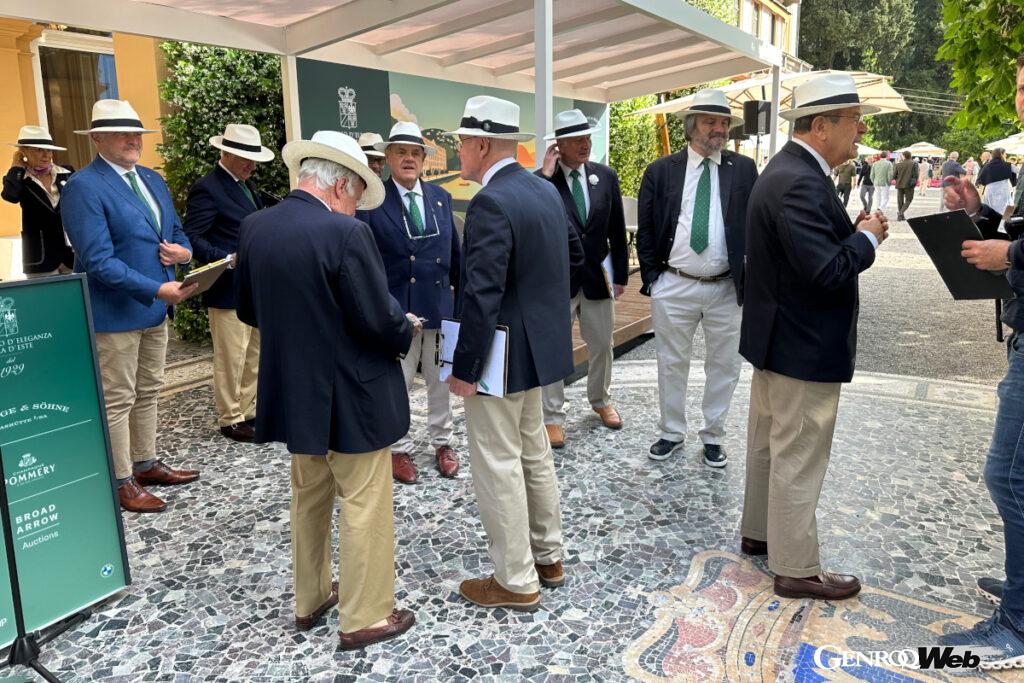
[1] Former Lamborghini test driver Valentino Balboni. [2] Members of the Selecting Committee.
All sorts of people started talking to me. Of course, there were many Pantera fans. Some were Pantera club members, and some even owned three Panteras. They even extended a delightful invitation to come to a Pantera meeting in Luxembourg in early June. Unfortunately, they had already arranged for my bike to be sent back by sea immediately, so I had no choice but to decline.
Old friends also welcomed us. Among them was our very own Valentino Balboni, who, as always, smiled and posed for photos. Both the Miura and the Pantera were designed by Giampaolo Dallara. He said he had driven one before. When I asked him how they compared to Lamborghini, he cleverly replied, “They’re both great cars with their own unique personalities.”
The judges finally arrived just after 11 o’clock. Class G featured a wide variety of cars from various eras, from a 1948 Talbot to a 1972 Pantera. There were also many cars that enthusiasts coveted, such as Siata, Pegaso, and Iso. I expected it to be a tough battle, and sure enough, the class winner was a Talbot. Incidentally, an Iso Grifo A3 in the same class was apparently caught by the Italian police and the car was seized. They say it was because it was driving on public roads without license plates or insurance, but there were other entrants who had the same problem. After all, there were racing cars as well…
Once the judging was over, it was time for the highlight of the event: the parade inside Villa d’Este. The cars were introduced in front of the crowd and judges at a speed of about 5km/h. What a thrill to drive through the crowd (mostly the owners and their friends) with the acclaimed commentary from Simon Kidston! The wife of the Pantera owner drove the car in the parade that day, much to Simon’s delight, and the crowd was thrilled. In our next issue, we’ll move the venue to Villa Erba and bring you the red carpet.











![Hyundai unveils music-driven fully electric concept model in collaboration with MIYAVI [Tokyo Auto Salon 2026]](https://wheelfeed.com/wp-content/uploads/2026/01/4741-1768026274388.jpg)