
![The legendary Linas-Montlhéry Circuit 100th Anniversary [Part 1] At the stage of that “Dabadabada”](https://wheelfeed.com/wp-content/uploads/2024/10/4308-1761210134316.jpg)
L’autodrome de Linas-Montlhéry
It was the scene of a speed record

[1]

[2]

[3]

[4]
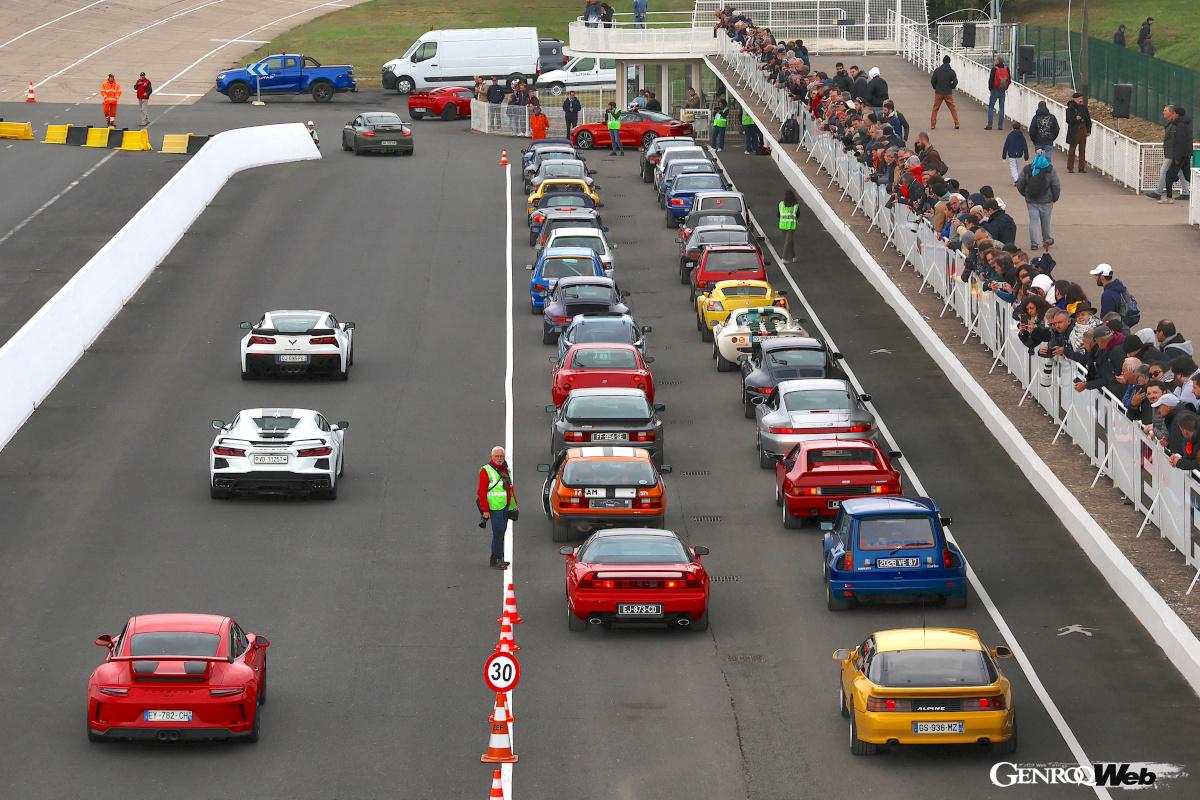
[1] Cars competing in the pre-war division wait to enter the pit lane. On the left is a 1937 Riley Sprite, and on the right is a 1938 Morgan 4/4. [2] This circuit is known for its 52-degree banking. The 2018 Donkerbuch D8GTO is chasing the Alpine A110, a car competing in the supercar division. [3] Directly below the banking, the passageway where the 1962 Porsche 356 is about to approach is named after Alpine’s founder, Jean Rédélé. [4] A corner where nostalgic French cars stand. From left: Renault 4, DB HBR5, Simca Aronde, Panhard Dina.
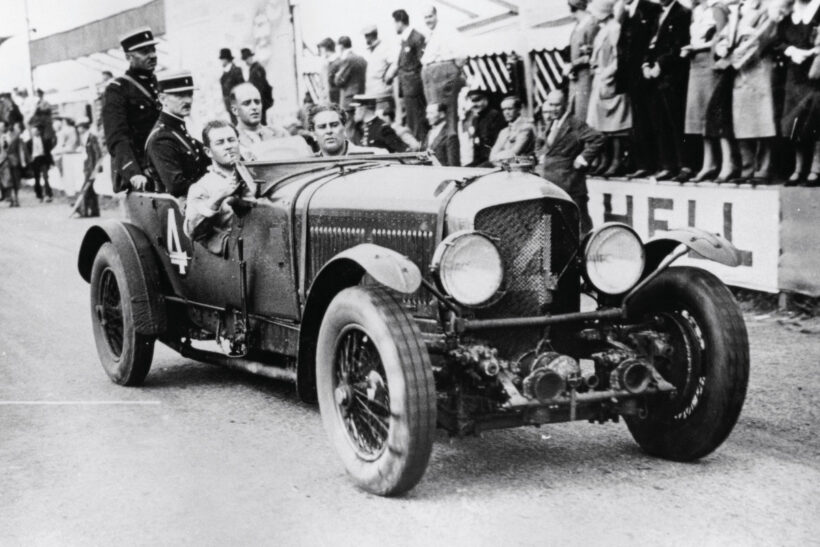
Officially known in French as the Haute-Dromé Linas-Montléry, it is located 25km southwest of Paris. It was opened in October 1924 by Alexandre Lambrun, an inventor and businessman who made his fortune in aircraft radiators. As a racing circuit, it is the third oldest after Brooklands in the UK, Indianapolis in the US, and Monza in Italy. The 52°-banked course, measuring approximately 2.5km (oval portion), hosted the French Grand Prix multiple times between 1925, the year after its opening, and 1937.
At the same time, speed was an important issue for the automotive industry at the time, and Linas-Montlhéry was a frequent site of attempts. Between 1925 and 1939, an astonishing 86% of the world speed records were set here, making it a facility that truly supported the early French automotive industry.
In 1939, the year of the outbreak of World War II, the track came under state control, and after the war, in 1946, it was taken over by the industrial testing institute UTAC. It was also used as the stage for the Paris 1000km endurance race from 1956 to 1972 and again from 1994 to 1995.
Currently, UTAC uses the facility as a testing ground for various performance and technology projects, and in recent years has also conducted experiments on autonomous driving and connected vehicles.
A corner reminiscent of a famous scene

[1]

[2]

[3]

[4]
[1] In the corner where participating cars from the 1970s are gathered. The 1973 Fiat 128 Coupe is signed by Scuderia Filippinetti, the legendary racing team that also competed at Le Mans. On the right is the 1976 Simca Rally 2. [2] In the foreground is a 1971 Citroën SM, modified in 1977 by Pierre Tissier, a specialist in Citroën modifications, to be fitted as a tow truck. [3] Cars participating in the Young Timer division are released onto the course. [4] A Porsche 996 Carrera from the Young Timer division is racing smoothly around the banking.
The centennial celebration was organized by UTAC, with the long-established French motor oil company Yacco as its main sponsor. It was also styled as a sister event to the Paris Motor Show, which opened immediately afterwards. Approximately 200 cars were registered for participation, and approximately 250 were registered by clubs across France.
The eight categories are as follows:
1. Pre-war cars 1924-1939
2. 1950s-1960s
3. 1970s
4. Cars competing in the Paris 1000km
5. Young timers
6. Supercars
7. Motorcycles from the 1950s-1970s
8. Motorcycles from the 1970s-1990s
For four-wheeled vehicles, the participation fee of 500 euros (approximately 81,000 yen) for one vehicle and two people for two days seems to have required a certain amount of courage from average enthusiasts. A French fan I know initially considered entering the young timer division with a Mazda MX-5, but gave up at the last minute.
On the morning of the first day, we headed to the venue. As it is usually a testing ground, the circuit entrance is not as glamorous as an international course. However, when you visit after learning about the history mentioned above, you get a feeling similar to visiting an ancient temple.
Directly below the bank, passing through the passage named after Alpine founder Jean Rédélé, we saw many entrants queuing up to enter despite the occasional rain. One participant told us that their turn to race would come in the evening, but he said he had arrived early with his family to enjoy the whole day, and introduced us to his wife and son. Among the international participants, many had come from the UK, crossing the English Channel.
The scat of that theme song

[1]

[2]

[3]
[1] A 1966 Ford GT40 that participated in the Paris 1000km race. [2] A 1965 Ford Mustang. [3] A gallery watches the Mustang speeding along.
Looking at the list of participating cars, the oldest are three models from 1924, the same year the circuit opened. They are from old brands: “Anthony,” “Chénard & Walker,” and “AC.” Meanwhile, the newest are the 2024 models, the “Alpine A110 Le Mans” and “Lotus Emira.”
The 1966 Ford GT40 exuded a unique aura in the paddock. In fact, the scene in the 1966 French film A Man and a Woman, in which racing and test driver Jean-Louis Trintignant plays Jean-Louis, test drives the GT40, was filmed here in Linas-Montlhéry.
Nearby is his first-generation Ford Mustang. Also present is the Ford Mustang in “A Man and a Woman,” in which Jean-Louis drives to Deauville after competing in the Monte Carlo Rally to meet his girlfriend, Anne, played by Anouk Aimée. Both cars are simply the same model, and no explanation is provided. But the scat-like theme song “Daba-daba-da” by Francis Lai must have been playing in the minds of visitors.
Report & Photo by Akio Lorenzo OYA










![Hyundai unveils music-driven fully electric concept model in collaboration with MIYAVI [Tokyo Auto Salon 2026]](https://wheelfeed.com/wp-content/uploads/2026/01/4741-1768026274388.jpg)