

BUGATTI Tourbillon
First impression: very compact
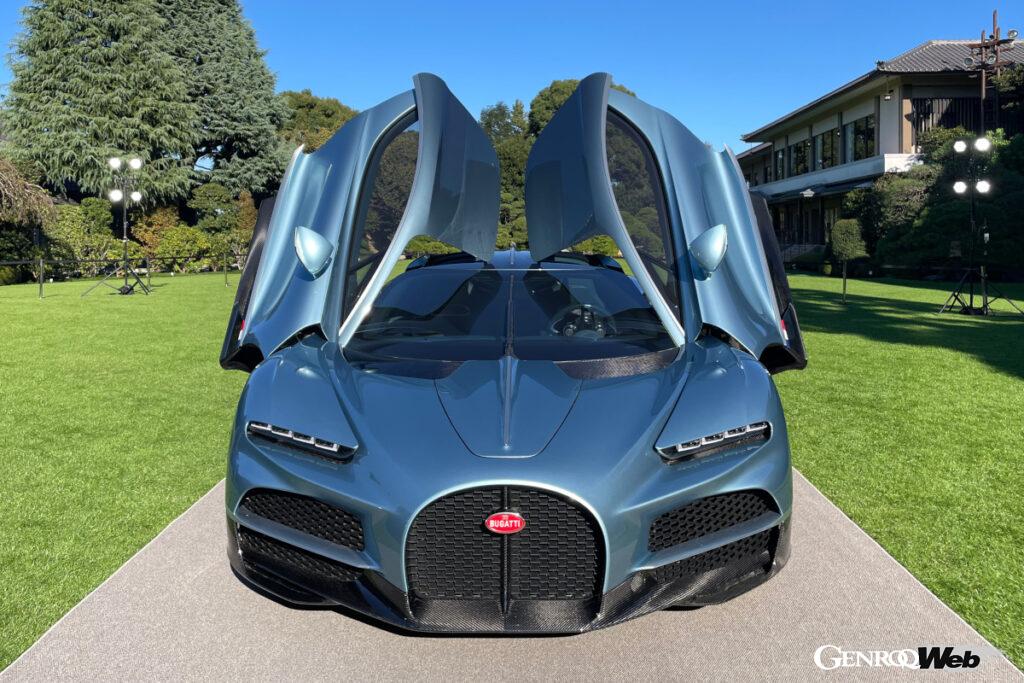


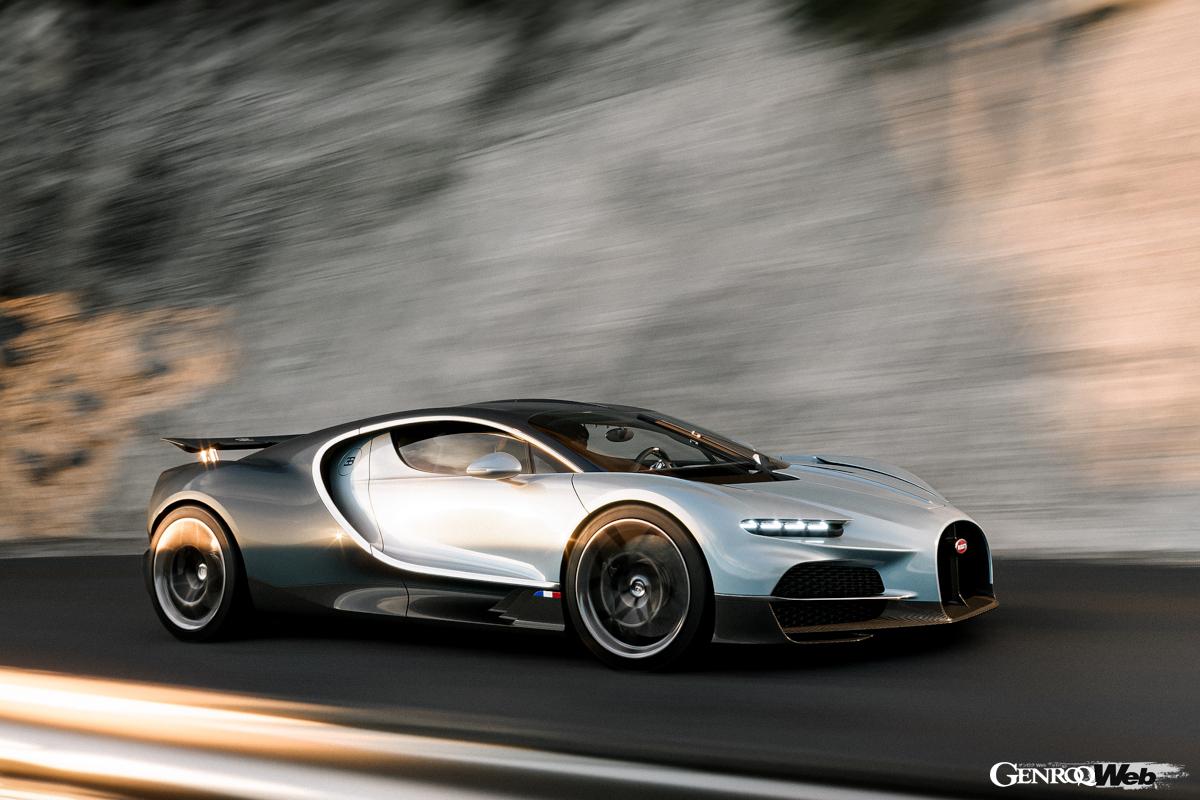
The exterior design is influenced by legendary models of the past, such as the Type 35 and Type 57SC. The newly developed 8.3-liter V16 naturally aspirated engine is mounted longitudinally in the rear mid-section.
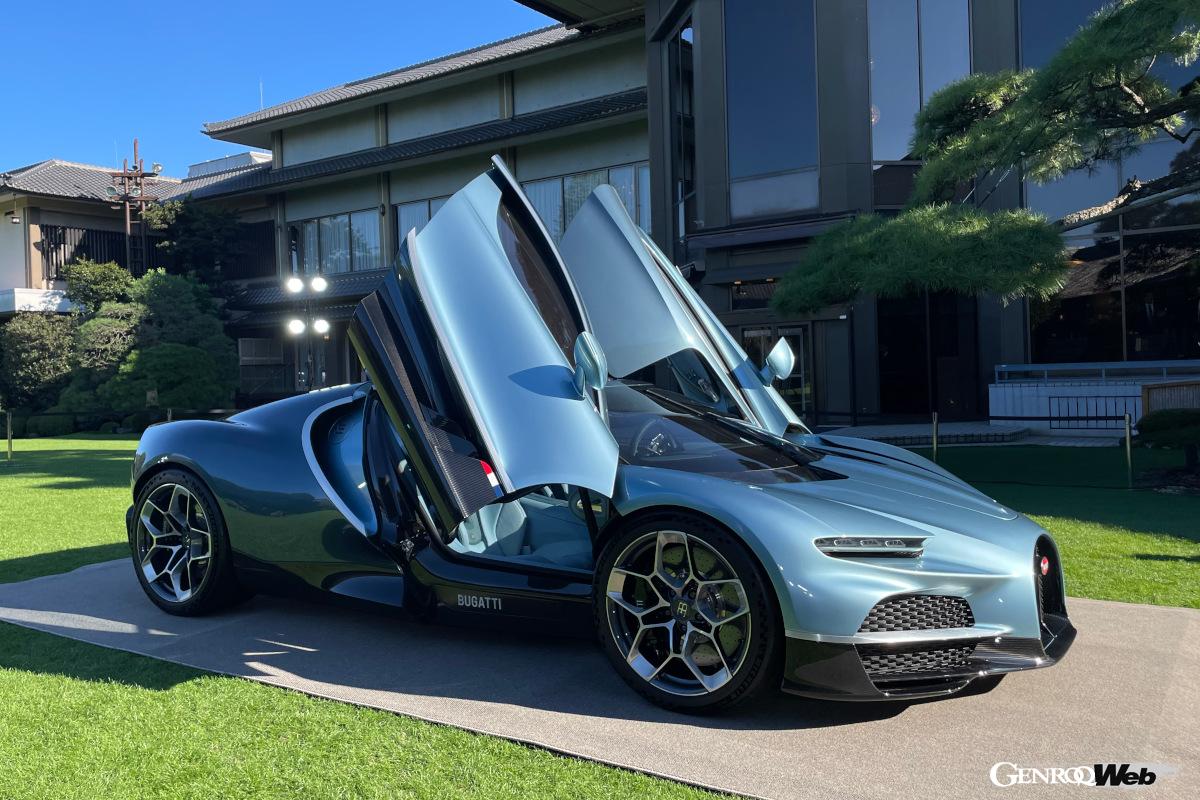
On November 7th, Bugatti Tokyo (SKY Group) held a launch event for the Bugatti Tourbillon in Tokyo. The Tourbillon, which Bugatti Automobiles announced in June this year as the successor to the Chiron, is a plug-in hybrid hyper sports car equipped with an 8.3-liter V16 naturally aspirated engine.
Unfortunately, the car exhibited in Japan this time was a mockup, not a real car, but the first impression was that it was very compact. Instead of the 8.0-liter W16 quad-turbo engine that was installed in the Chiron, the 8.3-liter V16 naturally aspirated engine is mounted longitudinally in the rear mid-mounted. It boasts a weight of just 252 kg, and its slim size makes it hard to notice its displacement.
With the cooperation of Cosworth, this newly designed V16 unit with a 90-degree bank angle has a rev limit of an astounding 9000 rpm. With a maximum output of 1000 PS and a maximum torque of 900 Nm, the engine alone is said to achieve overwhelming specifications. It is mated to a new generation 8-speed DCT transmission. In addition, it is equipped with three electric motors, one on each side of the front and one in the rear, each producing a maximum output of 340 PS and a maximum torque of 240 Nm, for a total of 1800 PS of system output.
It weighs about 2.3 tons?

It features a horseshoe-shaped grille that continues from the Veyron and Chiron.
The exterior design, typical of Bugatti’s 115-year history, is influenced by legendary models of the past, such as the Type 35 and Type 57SC. Of course, the horseshoe-shaped grille and sides, which are a continuation of the brand from the Veyron and Chiron, give the car a sense of continuity, while the design is full of the latest functional beauty.
The 800V lithium-ion battery installed in the center tunnel and rear of the cabin has a capacity of 24.8kWh (gross) and an EV driving range of 60km. Bugatti merged with Rimac Automobili, a Croatian hyper EV manufacturer, in July 2021, and Rimac’s knowledge and expertise will likely be utilized in the battery technology.
The car has a dry weight of 1,995 kg, and according to sources, the vehicle inspection certificate weight is expected to be around 2.3 tonnes. It is said to accelerate from 0 to 100 km/h in 2.0 seconds, from 0 to 200 km/h in under 5.0 seconds, and have a top speed of 445 km/h (electronically controlled at 380 km/h).
Production volume: 250 units


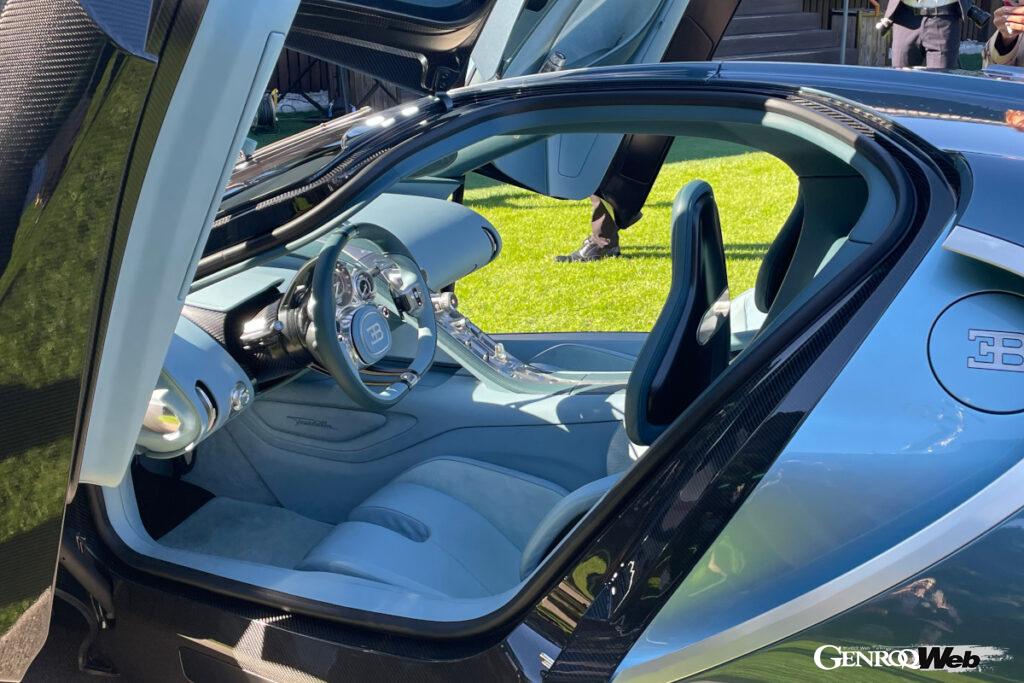

The interior design is reminiscent of the tourbillon, one of the three major complicated mechanisms in mechanical watches.
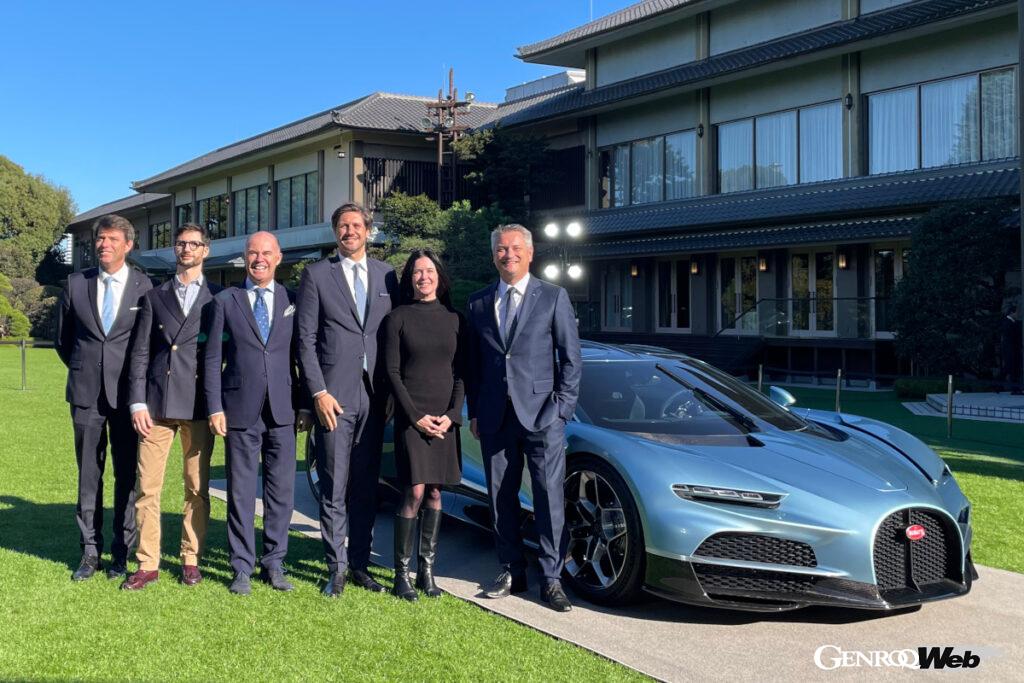
The people who rushed over from the head office: from the right, Christophe Piochon (President), Nicole Auger (Head of Communications), Konstantinos Psaris (Asia Middle East Region Manager), Guy Claquelin (Europe Regional Director), Jean Schmid (Head of Exterior Design), and Pierre Fresset (Aftersales Asia Middle East Region Manager).
The interior design is reminiscent of the tourbillon, one of the three major complications in mechanical watches, from which the car’s name is derived. The steering wheel and meter cluster were designed by Swiss watchmakers and assembled from over 600 parts, including titanium, sapphire, and ruby, touting a timeless and unparalleled authentic finish. The center console features a vertical control panel made from a combination of aluminum and Bohemian glass.
The planned production volume is 250 units, with around a dozen expected to be introduced in Japan. Delivery is scheduled to begin in 2026, with the price set at 3.8 million euros (approximately 630 million yen) excluding tax.