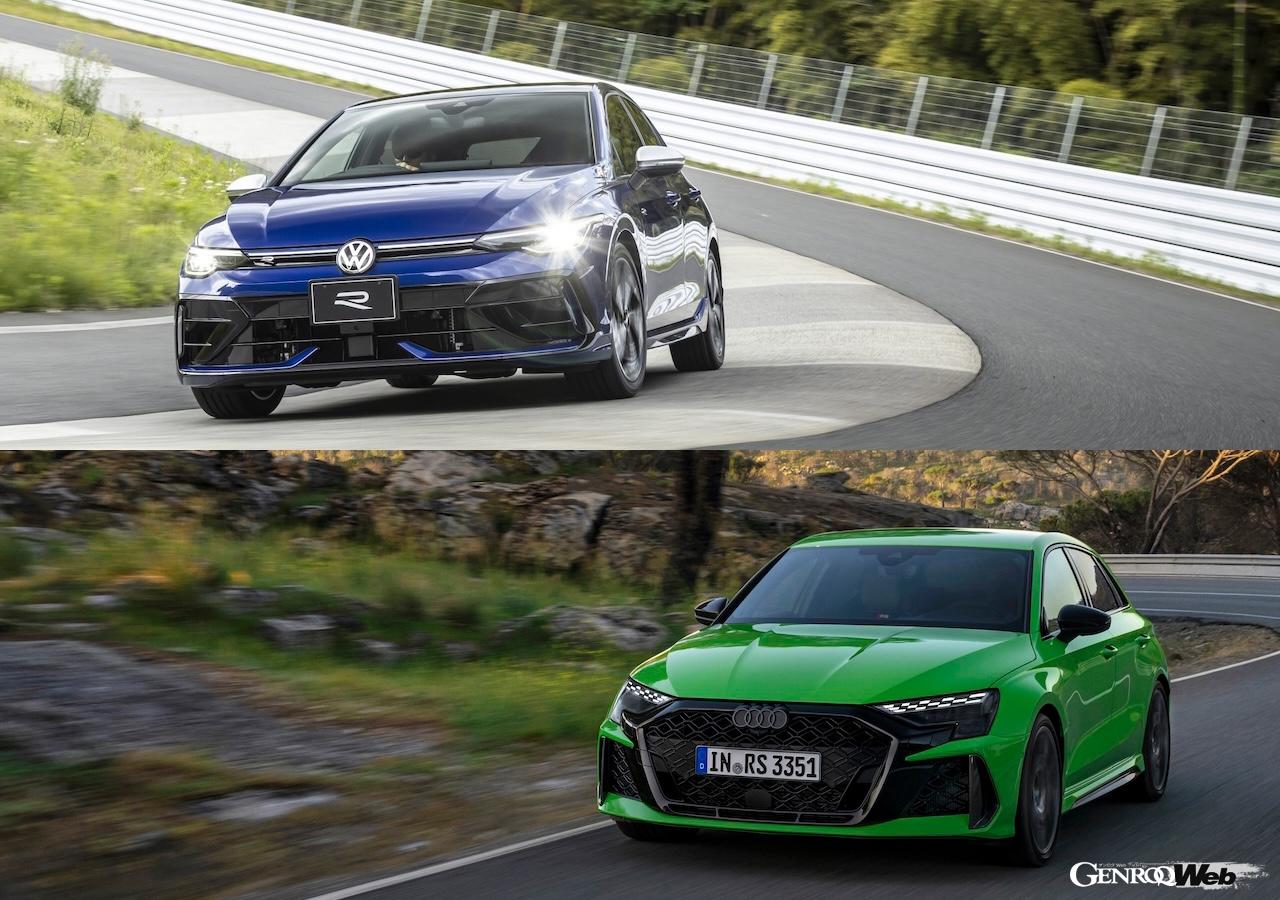

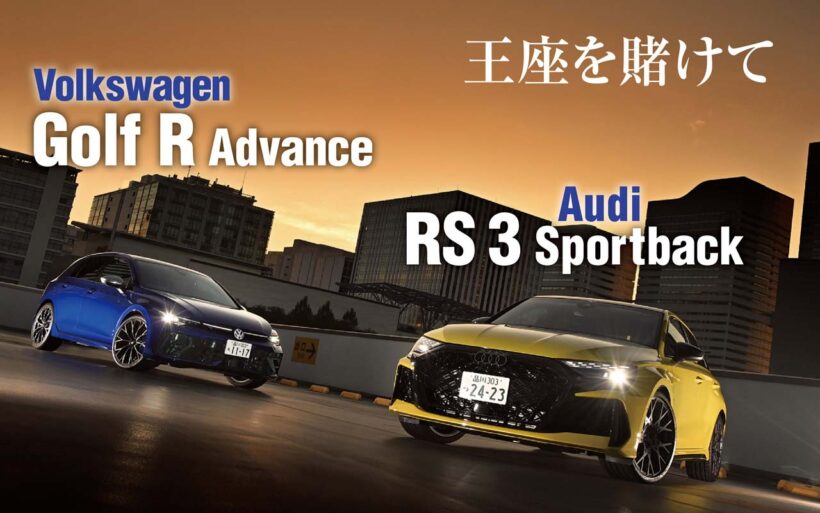

Audi RS 3 Sportback
✕
Volkswagen Golf R Advance
The RS3 boasts performance on par with that of a super sports car, leaving you amazed
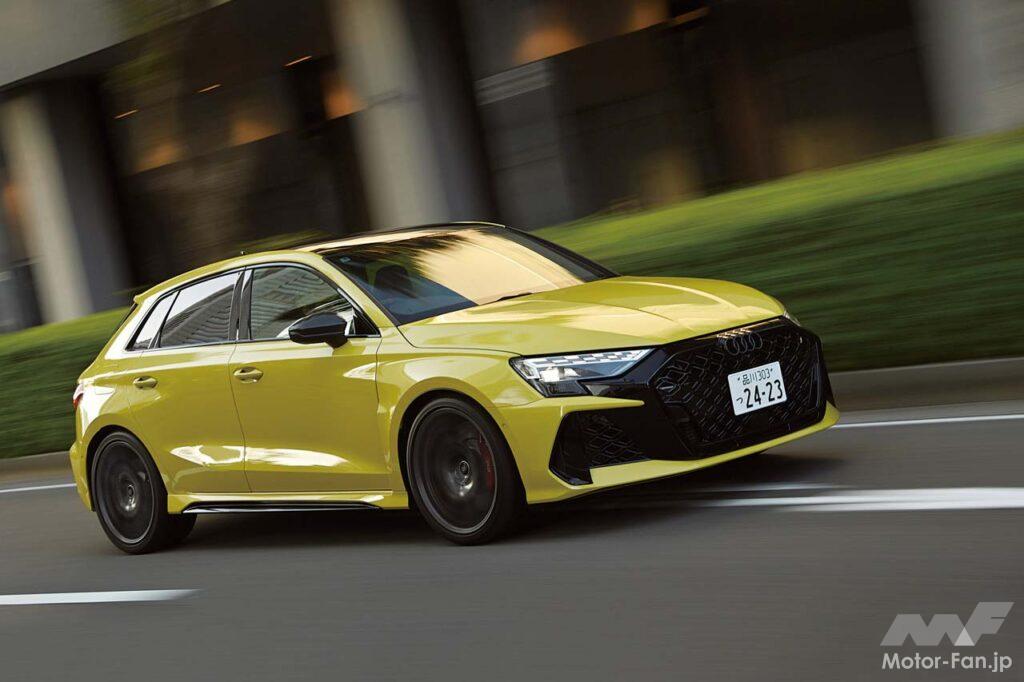
The test vehicle was equipped with RS-specific front and rear bumpers and matte black wheels made by Audi Sport, giving it a very sporty appearance.
C-segment hot hatches are almost extinct in Japan, but they remain highly popular in Europe. Personally, the term “hot hatch” inevitably evokes memories of the old street racing and mountain climbing culture. That’s why I’d like to call them “premium compacts.”
Germans are particularly enthusiastic about premium compact cars, with a huge list including the Audi RS 3 Sportback, Volkswagen Golf R, BMW 135xDrive, and Mercedes-AMG A 45 S 4Matic.
Unlike Japan, where speed limits are unrealistic, Germany has its own Autobahn, where cars can be driven at high speeds. Cars developed in this environment, even high-performance versions of C-segment cars, offer ultra-realistic performance. In other words, owning a high-performance car is not only a status symbol, but also akin to buying travel time with money. This is why the category of AWD premium compact cars, which are family cars but have over 300 PS of power, has been established.
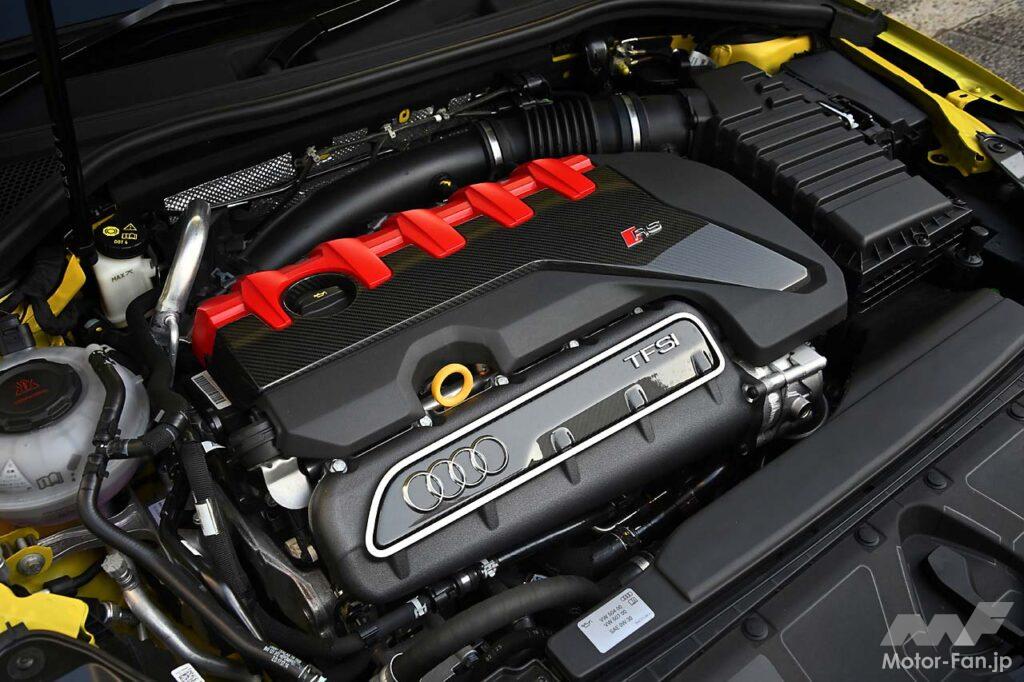
Now is the time to experience the exquisite Audi 2.5-liter unit!
[1]

[2]
[1] Equipped with a traditional 2.5-liter inline 5-cylinder turbo engine with a unique firing order. The transmission is a 7-speed DCT. [2] Equipped with a 2.0-liter inline 4-cylinder turbo engine that produces 333 PS, the highest output in the E888 engine family. The transmission is a 7-speed DCT.
This introduction has gotten a little long. Now, let’s get back to the two main characters of this article, the Audi RS 3 Sportback (hereinafter referred to as RS 3) and the Volkswagen Golf R (hereinafter referred to as Golf R). First of all, when I saw the two cars in front of me, I was surprised at how different their appearances were.
While the RS 3 has an extremely sporty feel, with front and rear bumpers exclusive to the RS and matte black wheels made by Audi Sport, the Golf R is extremely understated. The only subtle “R” badge on the front grille and the familiar bright lapis lazuli blue body color subtly assert the “R”. Tastes are divided, but it seems to be well-received by those who prefer understated styling.
The powertrains of the two cars are also significantly different. The Golf R, which saw an update in 2013, saw its maximum output increased by 13 PS to 333 PS. The 4WD combined with the EA888 engine features “R Performance Torque Vectoring,” which can adjust the torque distribution between the left and right rear wheels from 0 to 100%, allowing for flexible cornering.
The Spartan RS 3 cockpit

[3]

[3]
[3] It features a double-flat steering wheel with a flat top and bottom, an RS-exclusive display mode, and Finappa leather seats with excellent holding power.
While its rivals all use 2.0-liter inline-four turbocharged engines, the RS 3 is equipped with the traditional 2.5-liter inline-five turbocharged engine. In fact, this 2.5-liter five-cylinder engine, which is a symbol of Audi, is scheduled to end production with the current RS 3. This is because it cannot meet the increasingly stringent Euro 7 emissions regulations. Just to experience this engine makes it worth owning an RS 3.
Like the Golf, the RS 3 uses a torque vectoring mechanism called the “torque splitter” exclusive to the RS. Although we weren’t able to try it out during this test drive, there is also an “RS Torque Rear” mode that allows you to enjoy free-flowing drifting by giving 100% torque to the outer rear wheel.
First, I got into the RS 3. As I started driving, I was impressed by the solid construction of the seats, which I didn’t expect to find in a C-segment car. The firm leather seats supported my body firmly, giving me a sense of security as if I was being wrapped up in them. Combined with the suede-wrapped steering wheel, which is flat at the top and bottom, I couldn’t help but feel excited. As I entered the highway and switched the driving mode from “Auto” to “Dynamic,” the scenery around me changed completely.
Golf R’s dashboard appeals to enthusiasts

[4]

[4]
[4] The car features a sporty steering wheel with touch switches and large shift paddles. It also comes standard with R-specific sports seats with integrated headrests.
The smart transmission selects a lower gear, and as the engine speed rises, the deep roar of the inline-five engine, synonymous with Audi, roars through the cabin, getting the adrenaline pumping in your brain. What a shame! You’ll probably never experience an engine with such a wonderful feeling again. Enthusiasts who are attracted to Audi’s inline-five should buy the current RS 3.
The suspension is a little stiff, but not uncomfortable. Another great feature is the high-quality steering feel that is characteristic of Audi, without any impurities. The cornering behavior is like that of a super sports car. The more you press the accelerator, the more the nose moves in due to the torque vectoring effect. It may take a little skill to drive the RS 3 lightly.
On the other hand, the Golf R is no slouch in terms of driving. Although the engine isn’t as sensual as the RS 3, the EA888 2.0-liter turbo provides truly linear acceleration. What was impressive was the excellent balance between the chassis and engine. With a light weight of just 1,520 kg, the car offers a nimble feel while driving. Like the RS 3, torque vectoring allows for ultra-fast cornering when you apply the throttle after turning in.
I was impressed by the high level of perfection of these two machines!
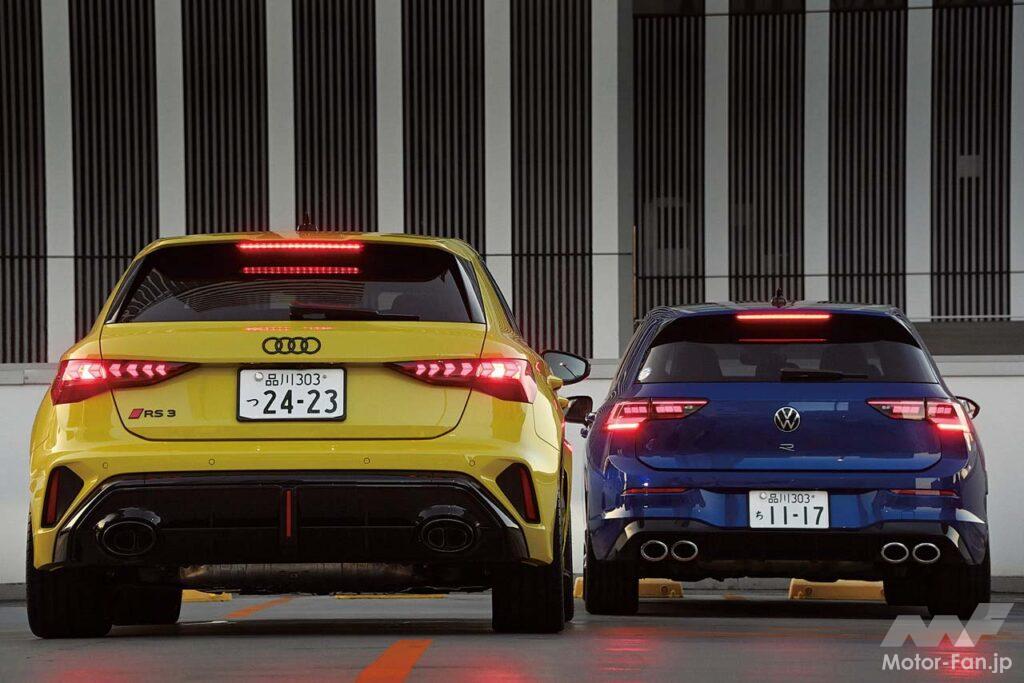
These premium compact cars from two German manufacturers offer driving performance and quality at a whole new level.
On the other hand, I was a little concerned about the car’s manners at low speeds. Perhaps it wasn’t a good match with the Hankook Ventus S1 Evo III wheels that come as standard, but the bumps on the road were quite strong. Given the car’s potential for high-performance driving, the ride comfort in everyday driving was disappointing.
The RS 3 fully demonstrates its driving capabilities that put super sports cars to shame, while the Golf R is a car for enthusiasts who have experienced both the good and the bad. Personally, I would give the edge to the RS 3, which allows you to enjoy the traditional inline-5 engine, which is the pinnacle of sensuality, even in everyday driving.
REPORT / Ryohei Ishikawa
PHOTO / Wataru Tamura
MAGAZINE / GENROQ December 2025 issue
SPECIFICATIONS
Audi RS 3 Sportback
Body size: Length 4380, Width 1850, Height 1435mm
Wheelbase: 2630mm
Vehicle weight: 1580kg
Engine type: Inline 5-cylinder DOHC turbo
Total displacement: 2480cc
Maximum output: 294kW (400PS) / 5600-7000rpm
Maximum torque: 500Nm (51.0kgm) / 2250-5600rpm
Transmission: 7-speed DCT
Drive system: AWD
Suspension: Front MacPherson strut, rear double wishbone
Brakes: Front and rear ventilated discs
Fuel consumption rate (WLTC): 10.6km/L
Tire size: Front 265/30R19, rear 245/35R19
Vehicle price: 9,060,000 yen
Volkswagen Golf R Advance
Body size: Length 4295, Width 1790, Height 1460mm
Wheelbase: 2620mm
Vehicle weight: 1520kg
Engine type: Inline 4-cylinder turbo
Total displacement: 1984cc
Maximum output: 245kW (333PS) / 5600-6500rpm
Maximum torque: 420Nm (42.8kgm) / 2100-5500rpm
Transmission: 7-speed DCT
Drive system: AWD
Suspension: Front MacPherson strut, rear multi-link
Brakes: Front and rear ventilated discs
Fuel consumption rate (WLTC): –
Tire size: Front and rear 235/35R19
Vehicle price: 7,499,000 yen
[Inquiries]
Audi Communication Center
TEL 0120-598-106
https://www.audi.co.jp/
Volkswagen Customer Center
TEL 0120-993-199
https://www.volkswagen.co.jp/