
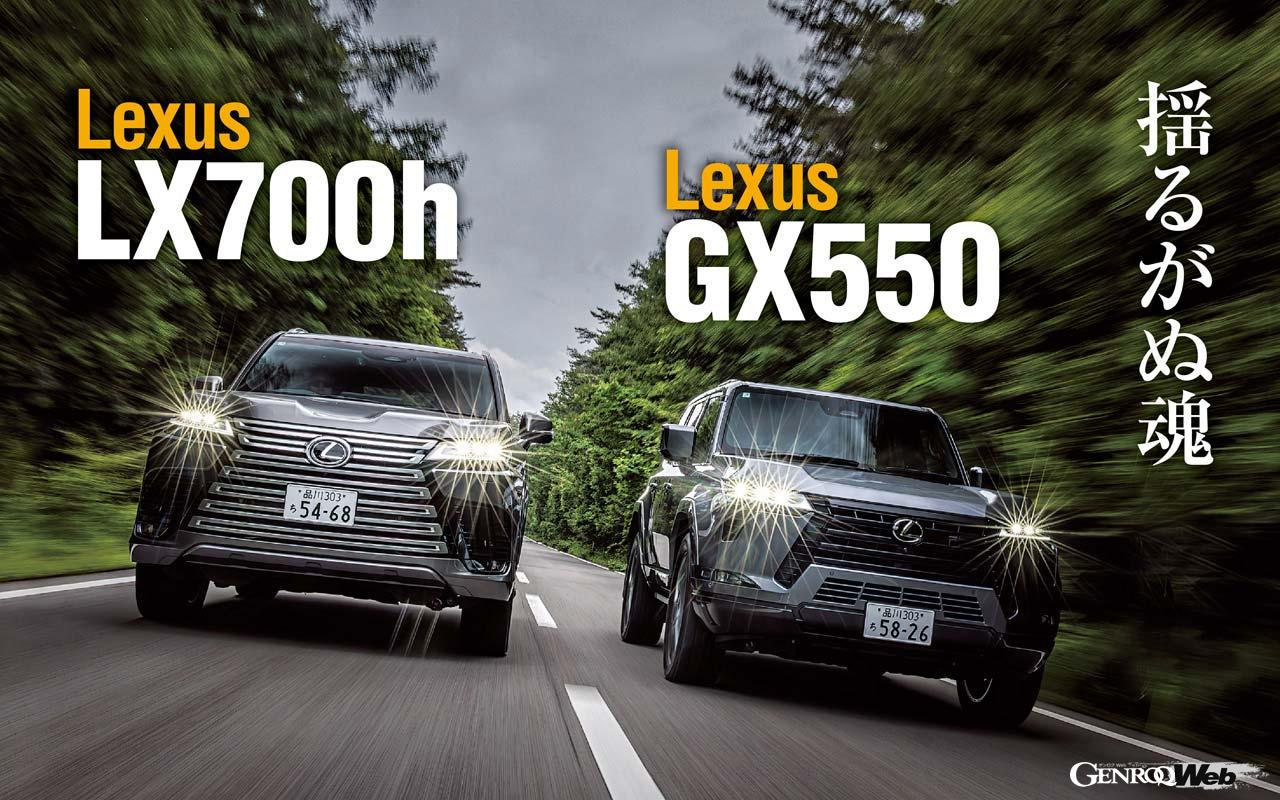
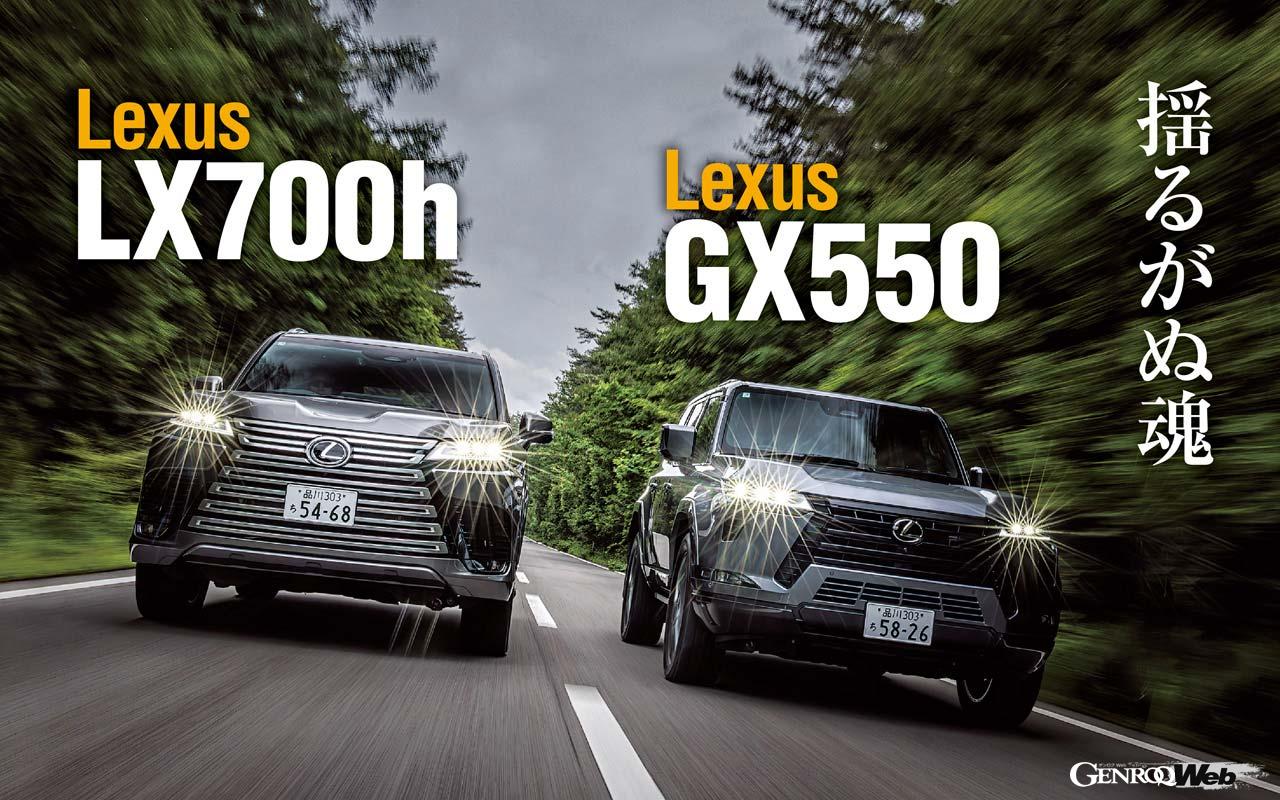
Lexus LX700h & GX550
Flagship and Heavy Duty
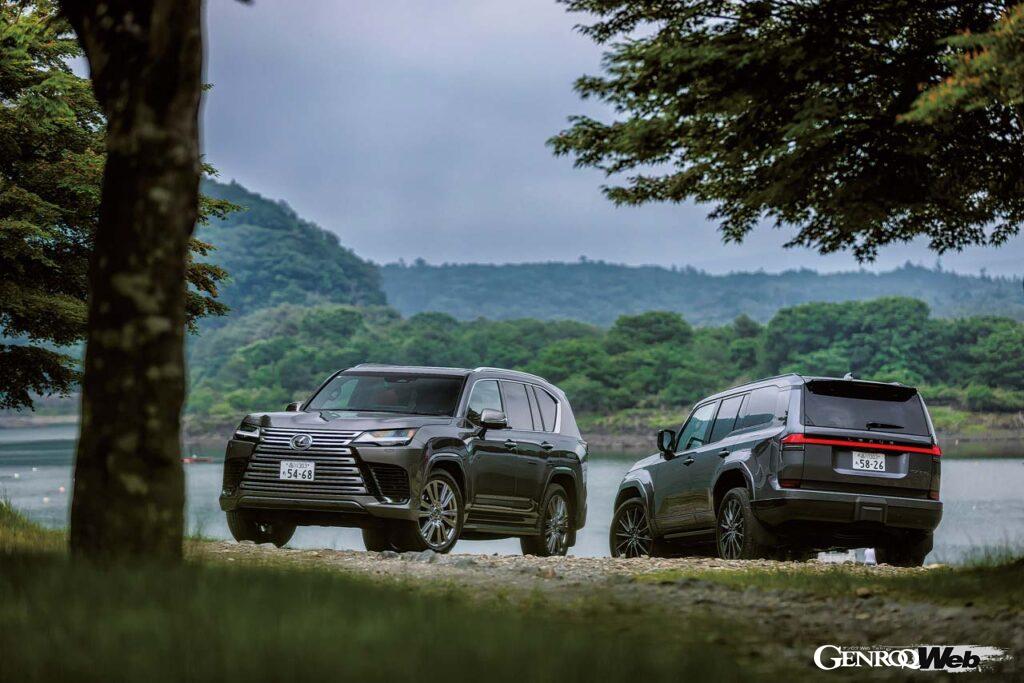
This time, we chose the luxury version for both test ride vehicles: the LX700h Executive (left) for the LX, and the GX550 Version L (right) for the GX.
In the Lexus SUV lineup, which began with the LBX, the brand’s entry-level model, the two models at the top of the price range are the LX and GX. These two models share a mechanical characteristic: they are four-wheel drive vehicles with a ladder frame structure.
While many SUVs, including other Lexus models, are based on a monocoque structure, offering ease of entry and exit and comfort comparable to that of regular passenger cars, the only SUVs that use a ladder frame, which is characterized by its robustness, are the G-Class and Escalade in the premium segment. The reason for offering two models is that there are quite a few users who want the individuality of each.
The first-generation LX was released in 1996, and the first-generation GX in 2002, so they have quite a long history. Over that time, the two models have been positioned as either an overwhelming flagship or a full-fledged heavy-duty vehicle. There are differences in price range, but for example, the LX has served as a luxury saloon or Gran Turismo in harsh natural environments, while the GX has met the demand for a high-quality tool more rooted in real life. The core added value that users feel for both vehicles is reliability, and the backbone of this is likely related to the well-established reputation of the Land Cruiser, which shares the same architecture.
The current fourth-generation LX underwent a minor change in March of this year, adding the 700h, which is equipped with a new HEV powertrain. When you learn about its mechanism, you can see the manufacturer’s desire that “reliability is also a premium.”
Equipped with a newly developed hybrid system
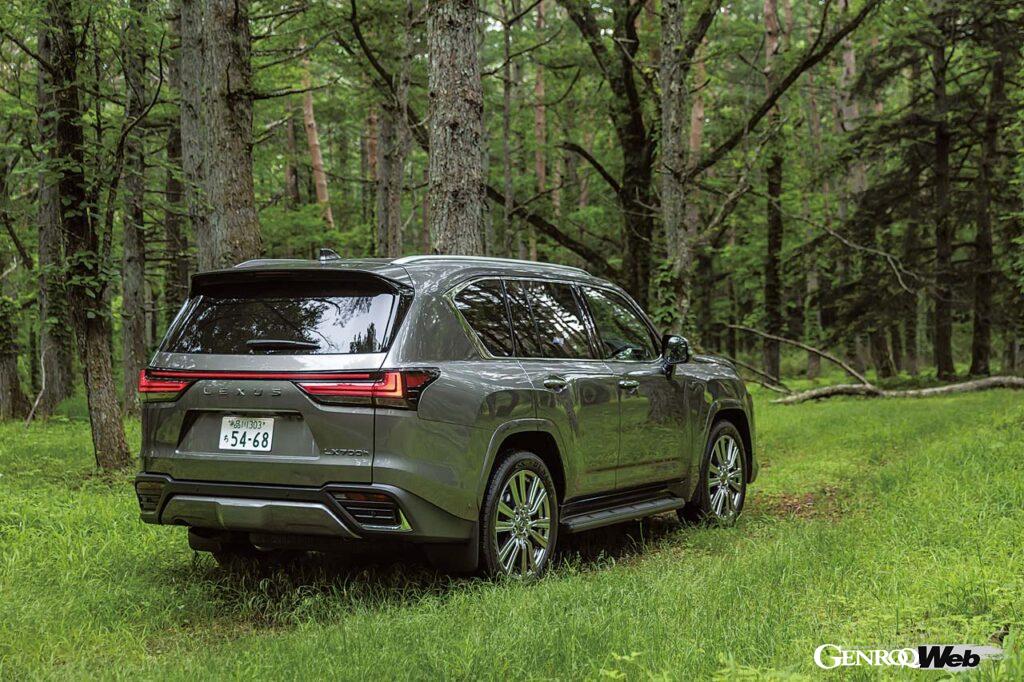
The new LX has undergone a minor change three years after its debut in 2022. The lineup consists of the LX700h and LX600, each available in three grades: Normal, Executive, and Overtrail+.
The powertrain is a single-motor parallel system, with a drive motor that also starts the engine sandwiched between the 3.5-liter V6 twin-turbo and 10-speed automatic transmission that are also installed in the previous 600 grade, and controlled by a clutch. With the addition of an output of 54 PS/290 Nm, the total system output is 463 PS/790 Nm. In other words, the 700h grade name comes from the fact that the naturally aspirated engine has maximum torque equivalent to that of a 7.0-liter engine.

[1]

[2]
[1] The LX700h’s 3.5-liter V6 twin-turbo engine. The orange high-voltage cables indicate that it’s a hybrid. The system output is 463 PS/790 Nm, which is 48 PS/140 Nm higher than the LX600. [2] The tire size is the same as the GX, 265/50R22 front and rear.
Although the manufacturer specializes in hybrids, the reason they chose the parallel system is that it allows them to utilize the drivetrain including the sub-transmission as is, can handle high loads, and has a simple structure. All of these are important factors related to off-road performance and reliability. As a result, there is little room for improvement in fuel efficiency, but this was also a compromise that was made from the start. On the other hand, the ability to use a maximum 1500W power supply function when reaching extreme terrain may be an unexpected bonus.


The test drive vehicle was an Executive model with captain seats in the rear, and it seats four, while other grades can be chosen as five-seater or seven-seater. The Executive model has a luggage capacity of 580 liters.
Another feature of the 700h is that it is equipped with an independent alternator and starter so that it can run on the engine alone in case of a system failure. Incidentally, all grades of the LX are equipped with an elaborate suspension that uses both hydraulic and gas pressure, and this also has coil springs to support the body in case of a slippage. In any case, they are making ample preparations to avoid immobilization at all costs.
In fact, the engine tuning is different.
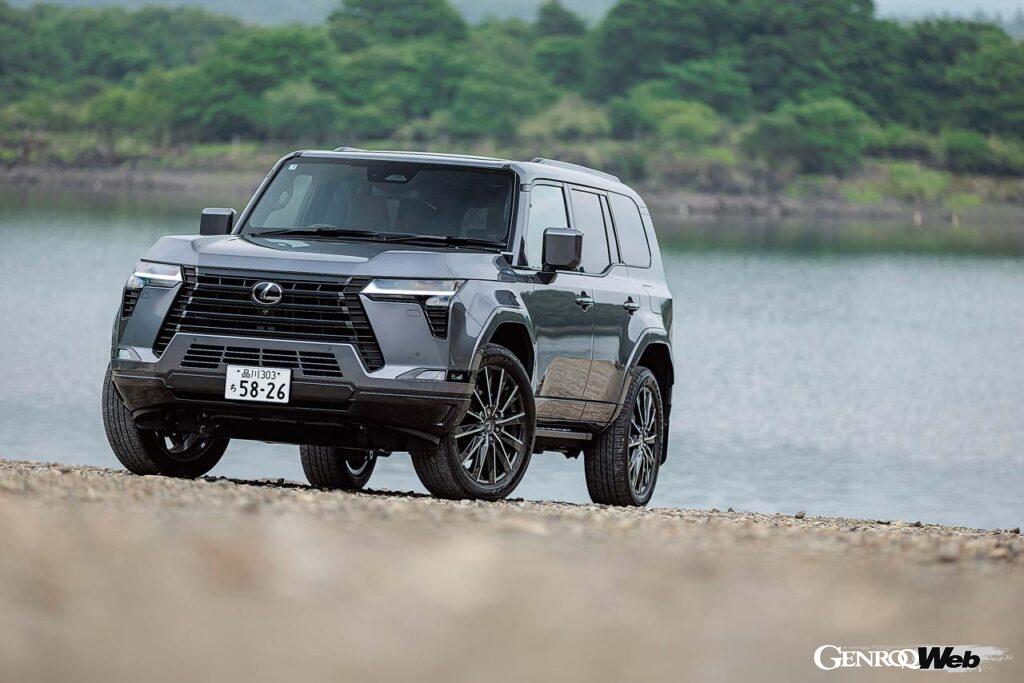
The GX, which was released in limited quantities in 2024, will now be sold as a regular model. The lineup includes two models: the off-road version “Overtrail+” and the luxury version “Version L” (pictured).
The GX, the third generation globally and the first to be released in Japan, shares the same mechanisms as the LX. Of course, they’re not exactly the same, but there are no differences in the basic design of the ladder frame and suspension, or the basic types of engine and transmission. In terms of the Land Cruiser, it might be easier to understand if you think of the 300 as the LX and the 250 as the GX, but naturally, there are unique features everywhere.
The engine is the same 3.5-liter twin-turbo as the LX, but the GX prioritizes picking up power from lower revolutions and uses a smaller diameter turbine with less lag. Although peak power is lower, it has been tuned to handle 353 PS of power over a wider range. The drivetrain is a 10-speed automatic with sub-transmission, the same specifications as the LX.

[1]

[2]
[1] The GX550 is equipped with the same 3.5-liter V6 twin-turbo engine as the LX. However, the specifications are different, with maximum power being tuned to be generated at a lower rpm range. The torque characteristics are the same. [2] The tire size is 265/50R22 front and rear.
The vehicles we reviewed were the Executive LX and Version L GX, both top-grade models designed for city use, but both also come with the Overtrail+ model, aimed at users with a more active lifestyle. Both models are equipped with exclusive interior and exterior colors, 18-inch tires with large air volume, and triple differential locks on the front, middle, and rear axles, making them highly adaptable to rough roads.
The GX Overtrail seats five, while the L version seats seven, and the third-row seats can be folded down electrically. The third-row seats are not very comfortable due to the ladder frame, so even children will have to sit with their knees hugged to their chest. It should be considered as a vehicle for emergency use only.


The GX550 is based on the Land Cruiser 250, but the instrument panel and center console have been redesigned for the GX. The Overtrail+ seats five people, while the Version L seats seven. The latter’s luggage capacity is 171 liters when seven people are on board, 949 liters when five people are on board, and 2,100 liters when two people are on board.
GX with a tougher scent
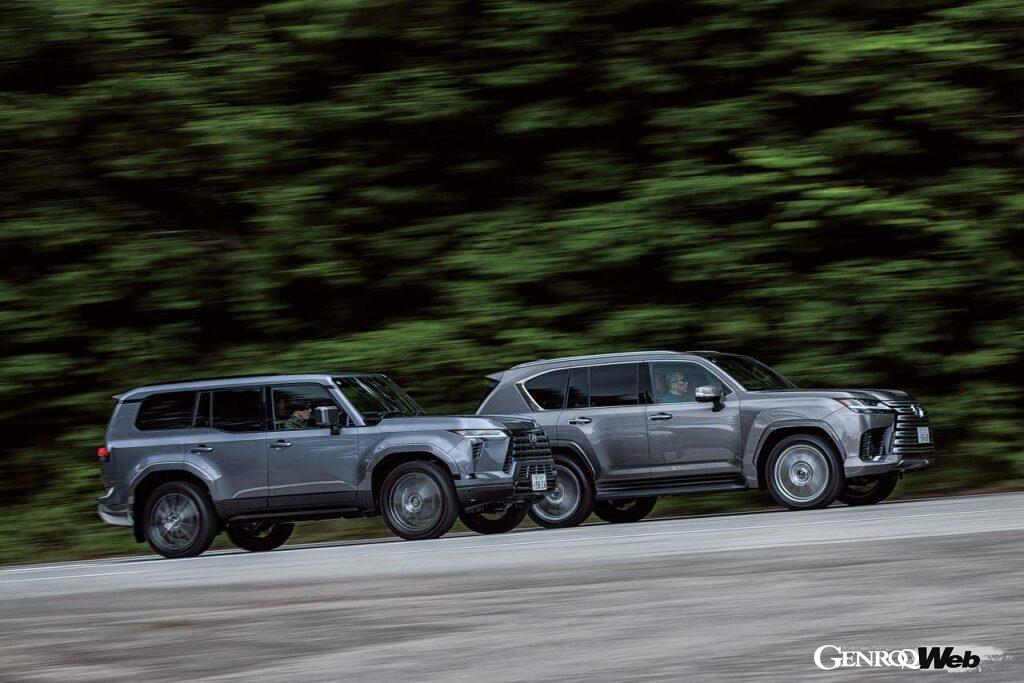
What determines the difference in the ride quality between the two vehicles is whether or not the LX has the hydraulic “active height control suspension,” which the GX does not.
Not that it’s a big deal, but the view from the tall body is even clearer than the LX. In addition to the square shape, the belt line is low, making it easy to see to the sides. Thanks to this, you can drive the car without feeling intimidated, even though it’s about 5x2m in size.
The GX is positioned as the heaviest duty Lexus, and it shows solid off-road capability. The front double wishbone and rear rigid suspension configuration is standard for off-roaders, but the suspension also has good flexibility, resulting in extremely high traction. The electronic controls that help with rough roads are merely a supporting role, and the way the car’s structure grips the uneven surfaces with ease conveys a sense of reliability to the driver.
For a car that sells itself on its toughness, the on-road ride is not bad either. On uneven roads, the rigid axle’s tendency to shake sideways can be revealed with short pitches, even when the body mounts cannot suppress it, but this can be seen as a positive characteristic of off-road vehicles, and this may be the key to the GX. The design, which is different from the G-Class and Defender, also exudes a unique rugged feel.
The two cars have different goals

Although the two cars share the same GA-F platform, the LX is 140mm longer and 10mm wider, but the GX is 25mm taller than the LX. They share the same wheelbase of 2850mm.
The difference between the GX and the LX is obvious in static quality, but it’s most noticeable in the driving feel. The chassis, dimensions, and tire size are very similar, but the road contact is round and soft from town driving to high speeds. The suppleness of the suspension movement, which even suppresses the tendencies of the rigid axle mentioned above, is largely due to the aforementioned gas pressure + hydraulic support “active height control suspension.”
The LX does not use air suspension, which is easy to adjust the ride height of and effective for on-road ride comfort, due to issues not only with durability but also with comfort when going over large bumps with the air fully inflated. The LX uses hydraulics for ride height adjustment, which allows for active control of stroke amount, and the unique comfort of hydraulics provides gentle support even on full bumps. When you think of old Citroëns, the first thing that comes to mind when thinking of sports cars is McLaren’s proactive chassis, but it is undoubtedly these suspensions that define the character of the LX as an off-roader.

[1]

[2]
The GX550’s monitor [1] shows the AWD operating status, while the LX600h’s vehicle height adjustment switch [2]. While the basic configuration of the AWD system is the same, the LX has the advantage of being able to avoid interference with the road surface by hydraulically raising the vehicle height. The off-road driving mode adjustment system is called “Multi-Terrain Select,” and offers “Auto,” “Dirt,” “Sand,” “Mud,” “Deep Snow,” and “Rock.”
The 700h’s unique HEV powertrain not only delivers precise drive transmission when it first starts rolling, but also works to linearly compensate for torque fluctuations that accompany the boost from very low rpm. In this way, it compensates for the quirks of the internal combustion engine, and delivers a sense of power that sets it apart from the 600 in mid- to high-speed acceleration. On the other hand, fuel economy is not expected to improve significantly compared to the 600. At high-speed cruising, it would be a great success if it could achieve around 10km/L, the same as the GX with the same engine.
The price difference between the 700h and 600 with the same equipment is 1 million yen. Considering the price range and the benefits it brings, I think it’s set at a reasonable price. On the other hand, the GX is a model that focuses on pursuing the quality that is characteristic of Lexus, while being a pure off-roader. Although the LX draws a clear line when it comes to the quality of the ride, the design and character of the GX are irreplaceable. These are two cars that can be difficult to choose between.
REPORT / Toshifumi WATANABE
PHOTO / Ryota SATO
MAGAZINE / GENROQ August 2025 issue
SPECIFICATIONS
Lexus LX700h Executive
Body size: Length 5100, Width 1990, Height 1895mm
Wheelbase: 2850mm
Vehicle weight: 2770kg
Engine: V6 DOHC twin turbo
Total displacement: 3444cc
Maximum output: 300kW (408PS) / 5200rpm
Maximum torque: 650Nm (66.3kgm) / 2000-3600rpm
Motor maximum output: 40kW (54PS)
Motor maximum torque: 290Nm (29.5kgm)
Transmission: 10-speed AT
Drive system: AWD
Suspension: Front double wishbone, rear rigid
Brakes: Front and rear ventilated disc
Tire size: Front and rear 265/50R22
Top speed: 209km/h
0 → 60mph acceleration: 6.4 seconds
Vehicle price: 21 million yen
Lexus GX550 Version L
Body size: Length 4960, Width 1980, Height 1920mm
Wheelbase: 2850mm
Vehicle weight: 2510kg
Engine: V6 DOHC twin turbo
Total displacement: 3444cc
Maximum output: 260kW (353PS) / 4800-5200rpm
Maximum torque: 650Nm (66.3kgm) / 2000-3600rpm
Transmission: 10-speed AT
Drive system: AWD
Suspension: Front double wishbone, rear rigid
Brakes: Front and rear ventilated disc
Tire size: Front and rear 265/50R22
Top speed: 175km/h
0→60mph acceleration: 6.5 seconds
Vehicle price: 12.7 million yen
[Inquiries]
Lexus Information Desk
TEL 0800-500-5577
https://www.lexus.jp