
![The 880 horsepower, rear-wheel drive Ferrari 296 Speciale debuts with exclusive aerodynamics [Video]](https://wheelfeed.com/wp-content/uploads/2025/04/1887-1761190811754.jpg)
Ferrari 296 Speciale
The latest high-performance Berlinetta
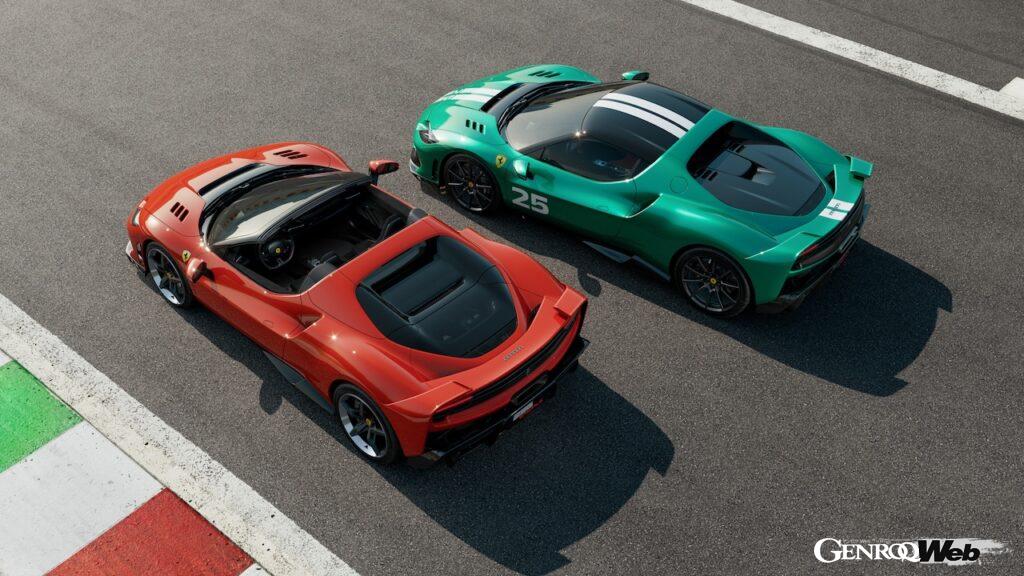
The body types available are the Berlinetta “296 Speciale” and the open-body “296 Speciale A (Aperta).”
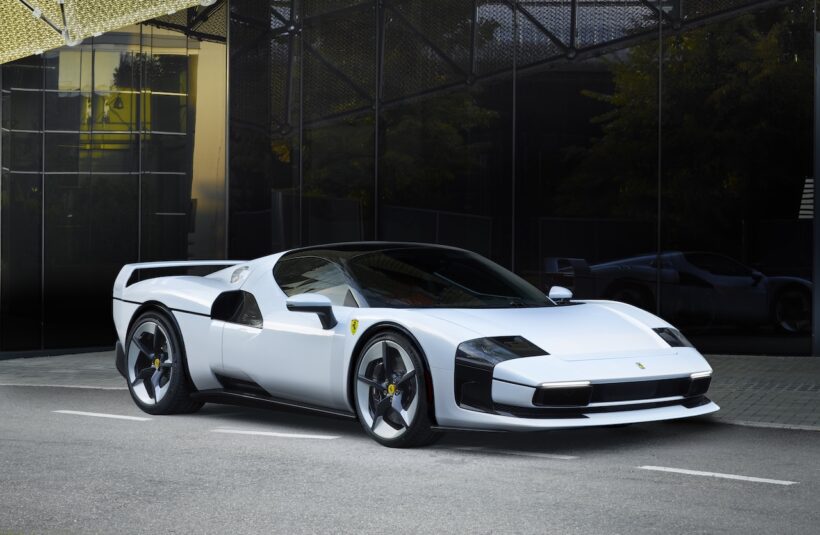
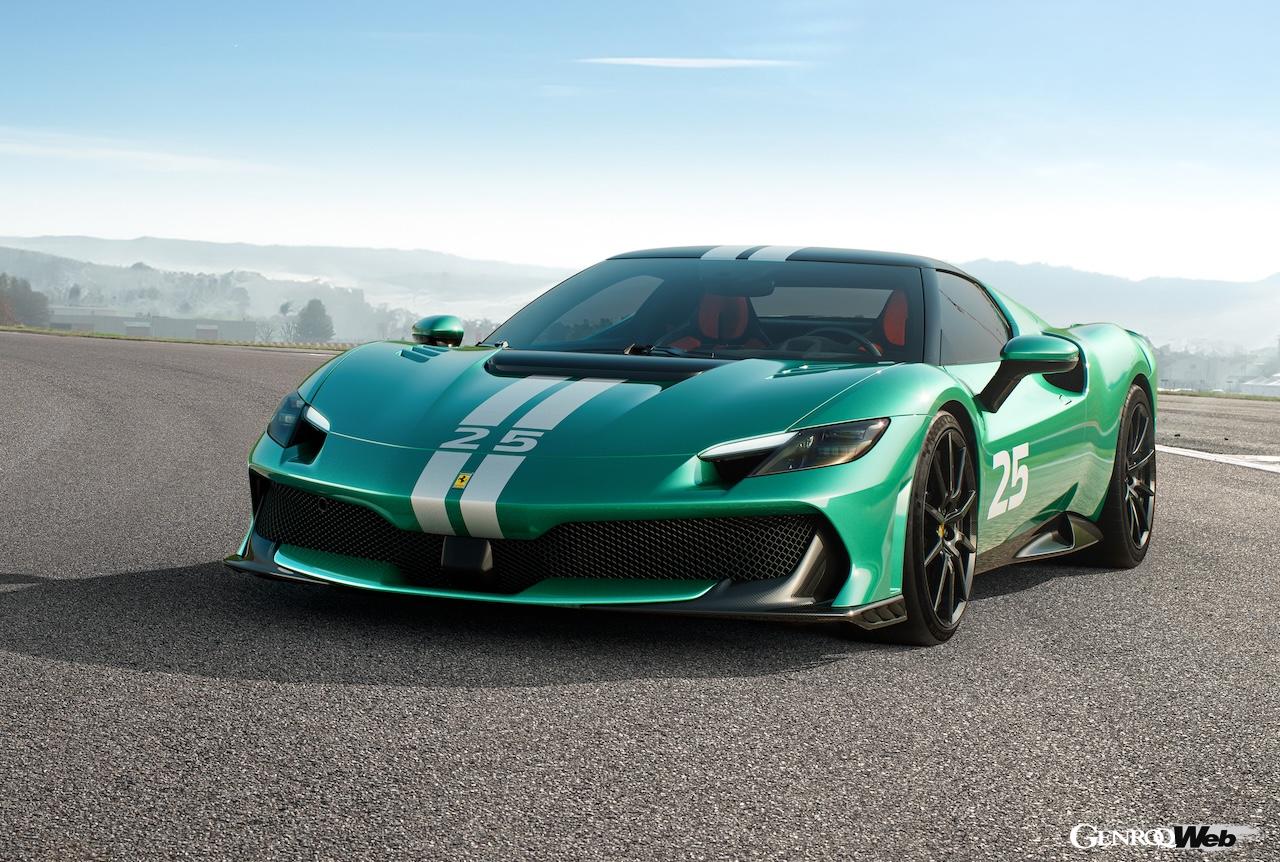
Ferrari has announced the 296 Speciale, a special edition of the 296 GTB hybrid super sports car. This is the latest version of Ferrari’s high-performance berlinetta, following the Challenge Stradale, 430 Scuderia, 458 Speciale, and 488 Pista. This new model has been developed to set a new benchmark for driving pleasure not only in Ferrari’s production car lineup, but also in the super sports car segment.
The 296 Speciale makes full use of the 296 GTB’s components, including a rear-mid mounted 3.0-liter 120-degree V6 twin-turbo engine, plug-in hybrid architecture incorporating an electric motor, a short wheelbase, and a dynamic control system. Its agility, turn-in responsiveness, and stability have been significantly improved over the 296 GTB.
The powertrain has been increased by 50 PS from the 296 GTB, delivering a maximum system output of 880 PS, making it the highest output ever for a rear-wheel drive Ferrari production model. It achieves specifications of 0-100 km/h acceleration in 2.8 seconds, 0-200 km/h in 7.0 seconds, and a top speed of 330 km/h.
To enhance driving pleasure, significant weight reductions were implemented, including for the power unit. Carbon fiber body parts and extensive use of titanium for the engine parts have resulted in a weight reduction of 60 kg compared to the 296 GTB. This gives the car a power-to-weight ratio of just 1.60 kg/PS, the best ever for a rear-wheel drive production Ferrari Berlinetta.
The lineup includes the Berlinetta “296 Speciale” and the open-body “296 Speciale A (Aperta).” The new livery “Verde Nürburgring,” developed exclusively for the 296 Speciale, emphasizes the sporty spirit derived from motorsport with its vibrant green.
Feedback on F1 and WEC technologies

The power unit incorporates various technologies honed through actual races in F1 and WEC, achieving a maximum system output of 880 PS.
This time, Ferrari has made active use of its extensive experience in motorsports. The ICE (internal combustion engine) incorporates engine management mapping and boost strategy from the 296 Challenge power unit, and titanium connecting rods, reinforced pistons, and a lightweight crankshaft have been introduced. In addition, a knock control system derived from F1 has been installed, and the V6 engine alone achieves a maximum output of 700 PS, 37 PS more than the 296 GTB. The engine sound has also been improved in terms of sound quality, volume, and resonance.
New parts have been introduced for many components, including castings, connecting rod and piston assemblies, and stud bolts, reducing the engine weight by approximately 9 kg compared to the 296 GTB. To withstand the increased pressure in the combustion chamber, the same connecting rods as the F80 and stronger pistons are used, and special new oil jets have also been used to improve cooling performance. The titanium connecting rods are approximately 35% lighter than the steel ones used in the 296 GTB. The nitrided steel crankshaft has also been lightened, reducing the weight of the entire piston-crankshaft-connecting rod assembly by 2.2 kg.
The engine block and crankcase were machined using the same techniques as those used in the 499P prototype racing car that won the 24 Hours of Le Mans, removing excess metal, saving 1.2 kg in weight, and the screws and studs on the cylinder block and cylinder head are made of titanium, saving a further 1.9 kg.
The electric motor has also been strengthened, and in the newly introduced “Extra Boost mode” it produces 180 PS. In conjunction with the strengthening of the motor, a new strategy has been introduced that adds additional torque when shifting the 8-speed DCT, shortening shift speeds and further enhancing performance and driver engagement.
The electric motor works in tandem with the internal combustion engine to provide additional torque and power, as well as charging the high-voltage battery and starting the internal combustion engine. An “EV mode” with a range of up to 25km is also available.
20% more downforce than the 296 GTB
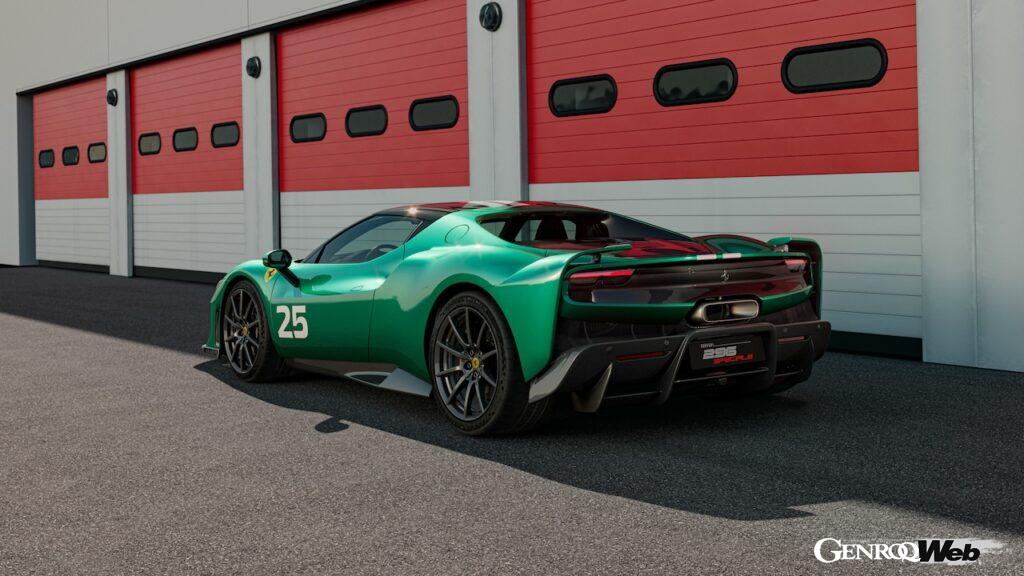
By incorporating aero parts derived from racing cars such as the 296 Challenge and 296 GT3, downforce has been increased by 20% compared to the 206 GTB.
The 296 Speciale’s downforce level is 20% higher than the 296 GTB, generating 435 kg of downforce at 250 km/h. This is made possible by the introduction of an innovative aerodynamic package developed and tested for the 296 Challenge. Aerodynamic dampers integrated into the front bonnet, vertical fins on the rear bumper, and an active rear spoiler combined with side wings work together to generate even greater downforce while driving.
The front section adopts the 296 Challenge’s “Aero Damper Concept.” This system connects the front undertray and the front bonnet with a duct, directing part of the airflow from the underbody to the upper body. This increases the downforce generated by the undertray and improves the efficiency of the vortex generator’s ground effect.
The front bonnet is fitted with two sets of louvers on both sides, just like the 296 GT3. They utilize the downward force generated around the fenders to reduce pressure inside the wheel wells. The front wheel arches have sill covers that help to expel air from the front undertray in the front-to-rear direction. An air intake is located behind the sill, which creates a streamlining effect by blowing air into the rear wheel wells.
A simple, lightweight cockpit
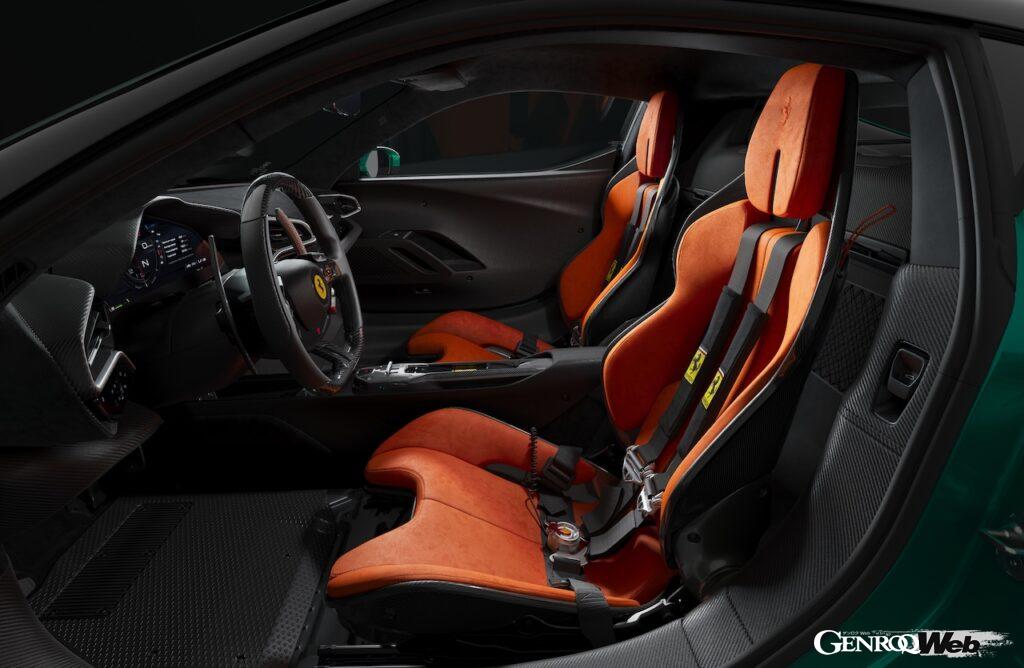
The cockpit has been made lighter by reducing the number of elements such as trim and making extensive use of carbon fiber and aluminum.
The cockpit follows Ferrari’s latest generation design philosophy. The interior has been simplified from the 296 GTB, with the total number of elements deliberately reduced. The interior is also lighter thanks to the extensive use of carbon fiber, aluminum and Alcantara.
The exposed fastenings are in perfect harmony with the motorsport atmosphere of the cockpit. The central tunnel structure is entirely made of carbon fiber, and the controls are located on the console, including the “shift gate” element, which is inspired by Ferrari’s gear shift gate and is laid out as a clearly separated block.
The dedicated door panels feature a minimalist design made from a single carbon fiber component, and the hi-fi system speakers are integrated into the same zone as the door handles to create a sense of continuity with the door panels.