

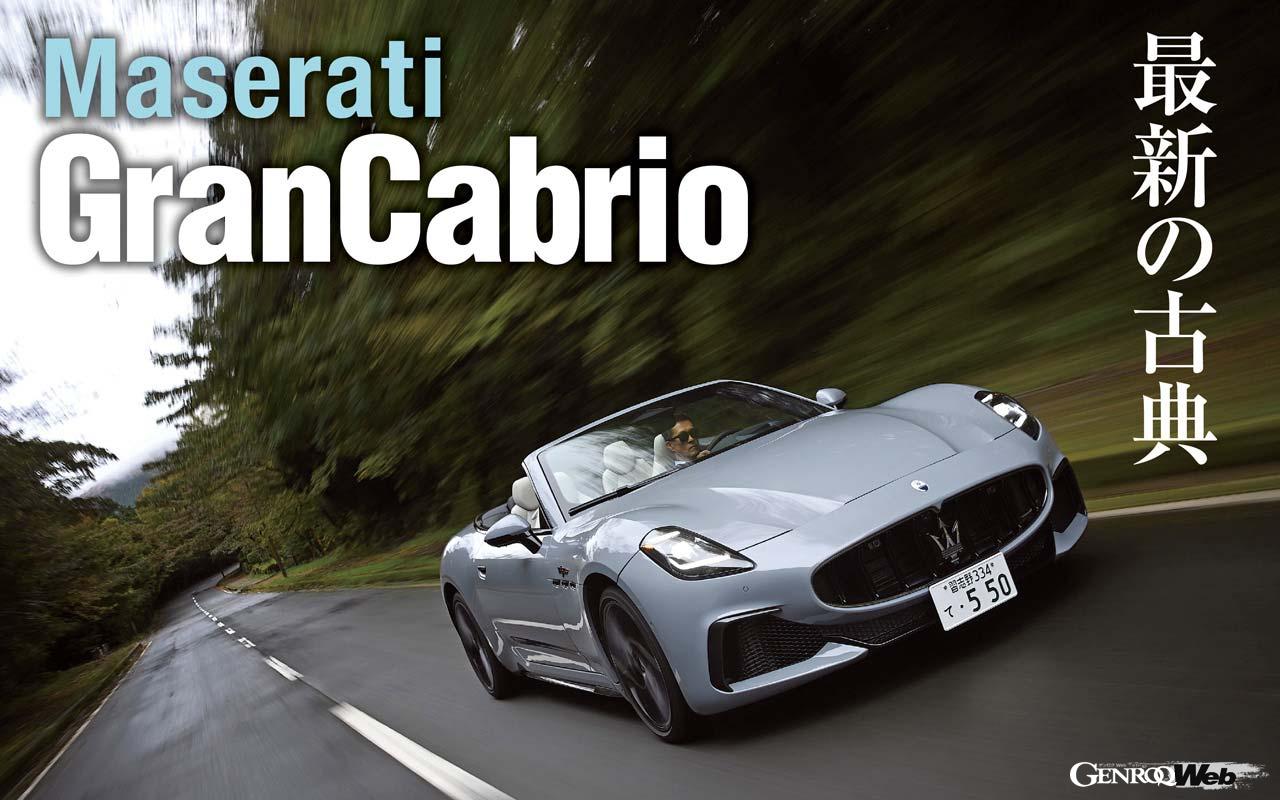
Maserati GranCabrio
Open version of GranTurismo
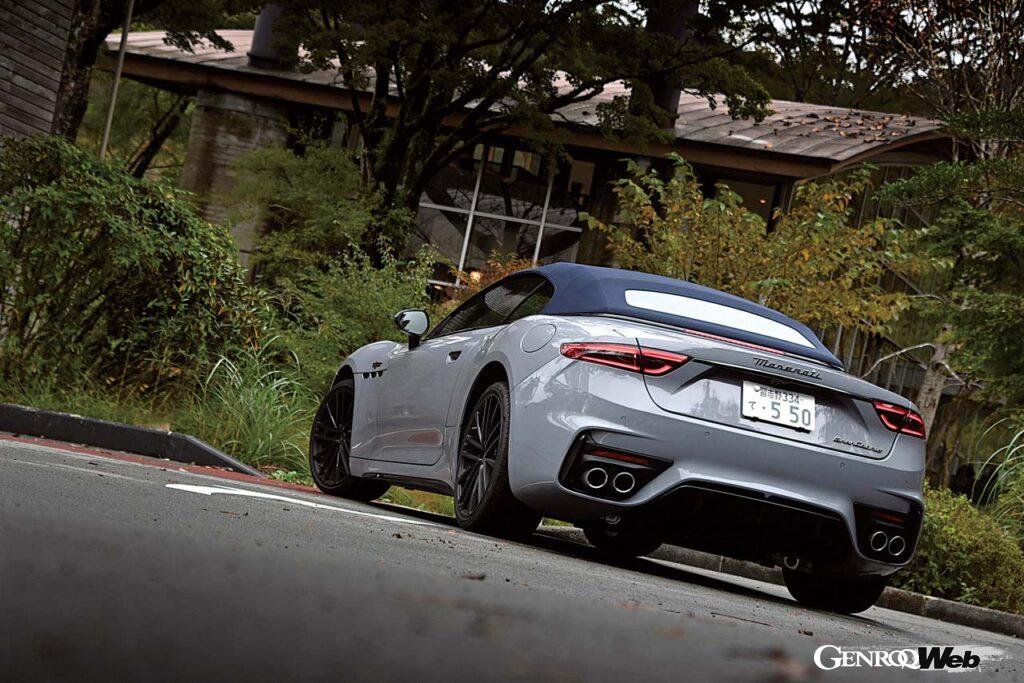
The canvas soft top is available in five colors: beige, gray, red, black, and blue. It takes 14 seconds to open or close, and can be operated while driving at speeds up to 50 km/h. Operation is via the touchscreen.
Following the coupe-bodied GranTurismo, the open-top model is making its debut, as is customary. The star of the show this time is the new GranCabrio, a two-door, full four-seater open-top model.
When I test drove the new GranTurismo, I was impressed by the styling that continued the legacy of its predecessor, and the solid evolution of its interior. The combination of a chassis rigidity that meets current standards and an air suspension that gives the impression of ample capacity boasted a dynamic quality that could be described as “this is a luxury car.” Meanwhile, the sharp turbo kick that linearly picks up on the throttle movement and delivers, and the gap between the elegant interior space that envelops the driver, also strongly conveyed Maserati’s tradition.
Many imported cars are categorized as premium cars, but the new GranTurismo seems to have demonstrated what a true luxury car is, transcending price and specs. That’s why we can’t help but have high hopes for its derivative model.
The only trim level available for the GranCabrio in Japan is the top-of-the-line Trofeo. Hidden under the long nose is a 3.0-liter V6 twin-turbo Nettuno engine with a maximum output of 550 PS and an AWD drive system.
Sleek styling that makes the most of its size
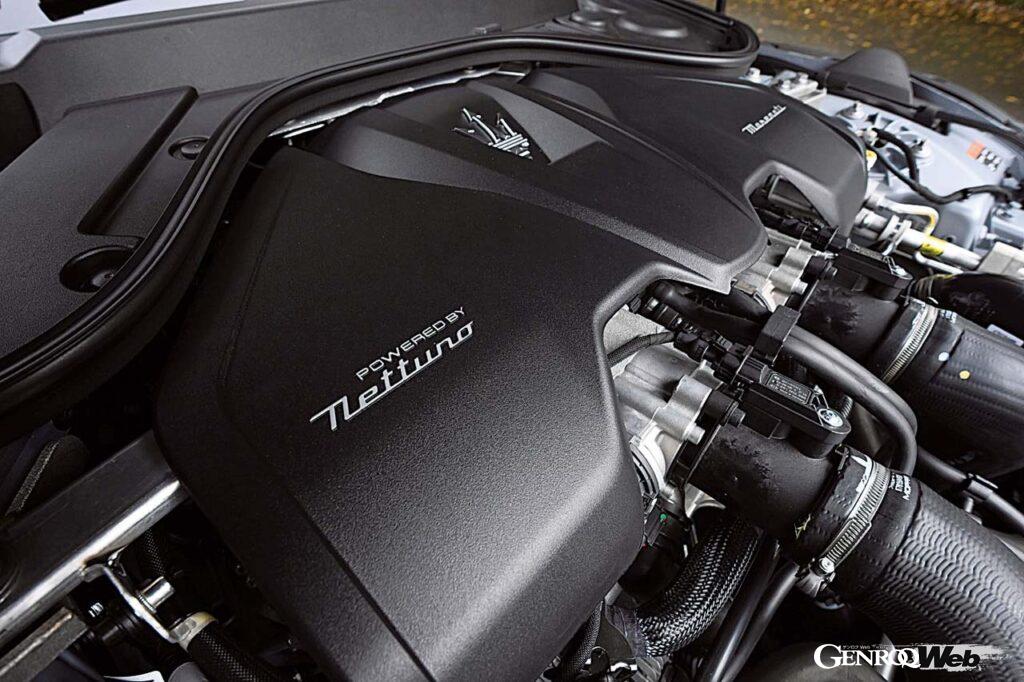
The MC20 is equipped with a 3.0-liter V6 twin-turbo engine, the Nettuno engine, which uses pre-chamber combustion, a technology derived from F1, to improve thermal efficiency. The transmission is an 8-speed automatic transmission made by ZF.
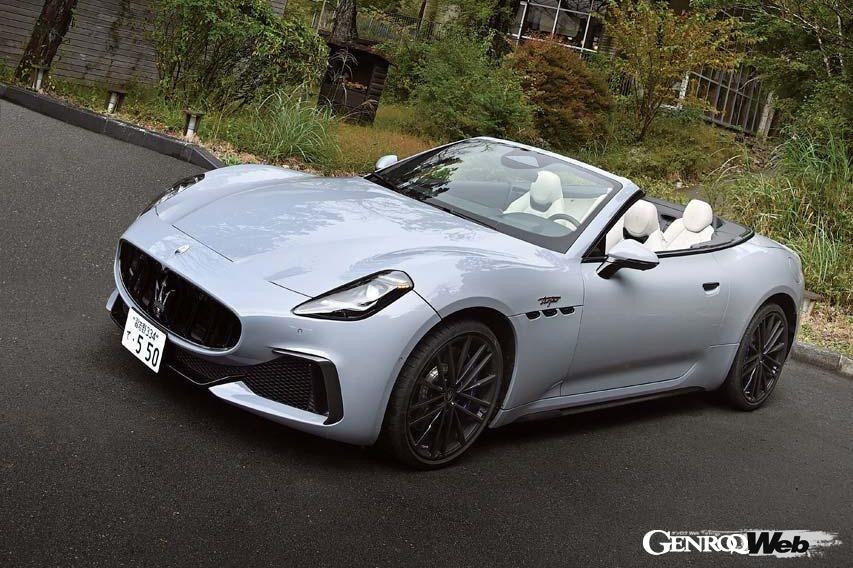
Body parts such as the rear quarter panels and trunk are exclusive and different from those of the GranTurismo.
The test car, a GranCabrio painted in a gray called Grigio Incognito, was parked with the top down. The beautiful continuity of the line that flows from the long, slender nose, reminiscent of the Grand Prix Maseratis of the past, to the rear end was a welcome relief. Recently, many cars have hoods with high waistlines, and there have been some examples where the silhouette of the open-top version is less than beautiful. In the case of the GranCabrio, the car’s size has been taken advantage of, and a generous amount of newly designed body panels have been used, resulting in the car successfully exuding the elegance that only an open-top model can offer.
The term “elegant” can also be applied to the interior design. The front seats and the wide center console give a spacious impression. The rear seats also have ample legroom, making it seem more like a full four-seater than a 2+2 setup.

[1]

[2]

[2]
[1] The interior color can be chosen from three colors: white, black, and red. The front seats are equipped with neck warmers as standard. The temperature can be adjusted in three stages. [2] The instrument panel is modeled after the GranTurismo Coupe. The two round switches under the center pad of the steering wheel are the engine start/stop button on the left and the drive mode selection dial on the right.
The view from the driver’s seat and all the controls are supposed to be the same as the GranTurismo, but the atmosphere looked quite different just with the light pouring down on the ivory seats. That said, this test drive took place in the mountains of Hakone, under skies that looked like they might start raining at any moment. Still, one of the great things about modern open-top models is that you don’t have to give up on open-air driving just because of the rain. If you sense rain, you can quickly change into coupe style in just 14 seconds, even while driving (at speeds below 50 km/h).
The GranCabrio’s suspension was slightly softer than the coupe’s, and the car’s height was raised by 10 mm. However, when I started driving, it didn’t feel particularly soft or fluffy.
What’s more, it seems that the body rigidity, which may have been slightly reduced by converting to an open-top design, has been compensated for with reinforcement materials, and careful balancing with the air suspension has been achieved.
The relatively short suspension stroke allows the car to smoothly and carefully ride over uneven road surfaces, something only the latest air suspension can do. What surprised me was that there was not even the slightest creaking noise as long as I drove around Hakone at a normal pace. I remember that in older Maseratis, especially open-top models, even new cars would creak and squeak in various parts. Maserati quality has definitely improved.
Suspension settings are exclusive to the Cabriolet
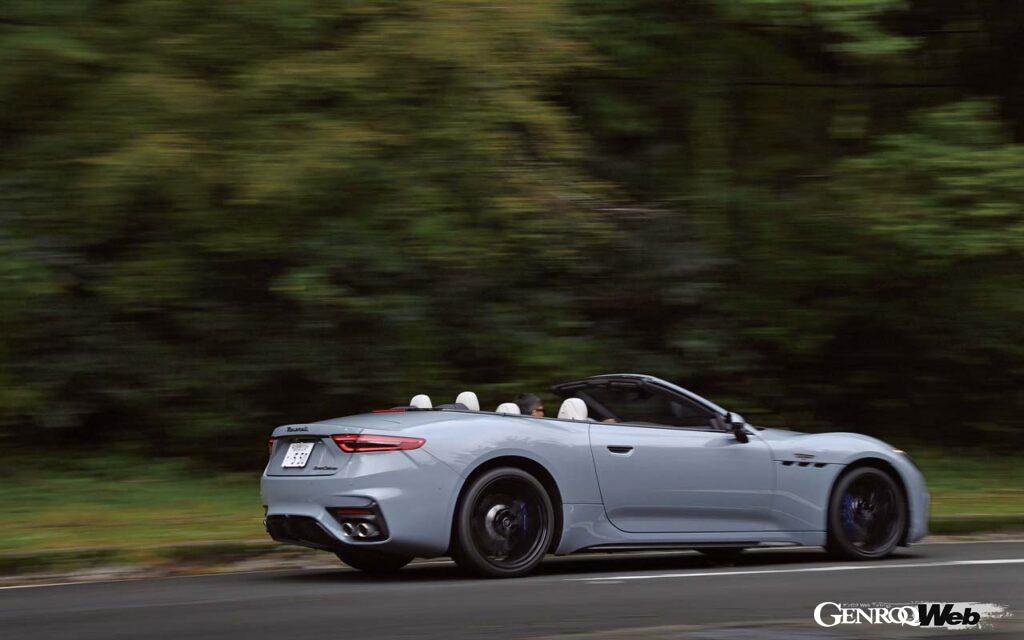
The car weighs 120 kg more than the coupe, but at least when driving alone, I didn’t notice any negative effects. There are four driving modes: “Comfort,” “GT,” “Sport,” and “Corsa.”
Even while driving, you can clearly feel the long front nose, but in contrast, the handling is very straightforward and you don’t feel the weight of the engine. And once you step on the throttle, most of the traction goes to the rear tires, and the acceleration makes you forget the body size. With the top down, the exhaust sound resonates loudly, loud enough to rival the wind blowing around your ears, and it feels really good.
On the other hand, when I closed the top, I was impressed by the quality of the soft top, which was thick enough to completely shut out noise. The sound-insulating glass on the sides also did a good job, and the moment it became a coupe, silence descended upon me. I also liked how, even when I stepped on the throttle, I could still hear the noise from the cylinder head and wastegate from the front.
The ability to clearly distinguish between the two sides of the car—a coupe whose glamour is hidden by a soft top and a lively open-top—is what makes a luxury and sporty model like the GranCabrio so special.
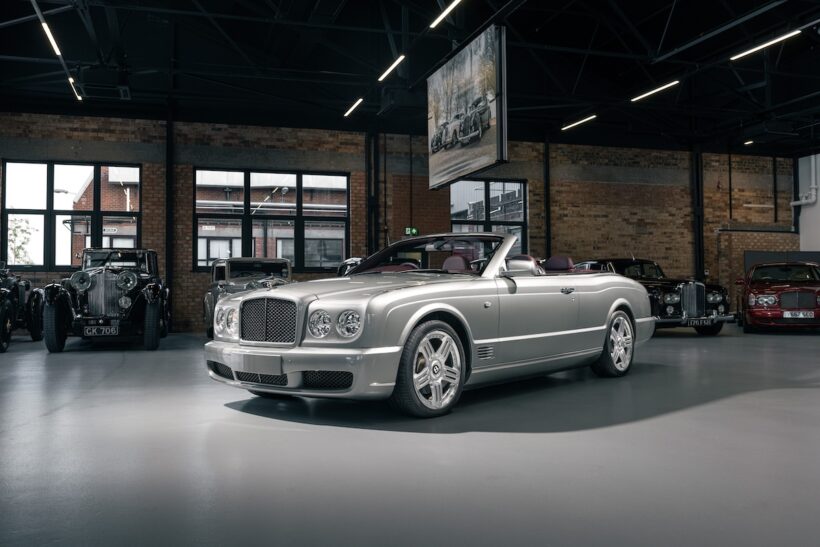
If you think about it that way, this car’s rivals are not sports models with minimal rear seats, but rather luxurious models like the Bentley Continental GTC.
Coupe or Cabrio?

[1]

[2]
[1] The test car is equipped with Pirelli P Zero tires, 265/30ZR20 in the front and 295/30ZR21 in the rear. Red brake calipers are standard, with blue, yellow, and black available as options. [2] The trunk capacity is 172 liters when closed, and 131 liters when open, as the soft top is stored at the top.
If I were asked to choose between the GranTurismo and the GranCabrio, I would choose the latter without any hesitation. The price difference between the two is “only” about 1.2 million yen, but the range of fun you can get for that extra cost is immeasurable.
Nowadays, it’s not uncommon to find cars that cater to all tastes, such as crossover SUVs that you can dress casually, sports models that are just fast, and convertibles that can easily open and close the top electrically. On the other hand, when it comes to a sophisticated car that makes you want to choose a jacket to match the body color, the options seem quite limited.
The GranCabrio is a car that embodies that rare charm, a presence that doesn’t stand out, and top-tier performance.
REPORT / Takuo Yoshida
PHOTO / Wataru Tamura
MAGAZINE / GENROQ January 2025 issue
SPECIFICATIONS
Maserati GranCabrio Trofeo
Body size: Total length 4966mm, total width 1957mm, total height 1385mm
, wheelbase: 2929mm,
vehicle weight: 1895kg
, engine: V6 DOHC twin turbo,
total displacement: 2992cc,
maximum output: 404kW (550PS) / 6500rpm,
maximum torque: 650Nm (66.3kgm) / 3000rpm,
transmission: 8-speed AT,
drive system: AWD,
suspension type: front double wishbone, rear multi-link,
brakes: front and rear ventilated disc,
tire size: front 265/30ZR20, rear 295/30ZR21,
top speed: 316km/h,
0-100km/h acceleration: 3.6 seconds,
vehicle price: 31.2 million yen
[Inquiries]
Maserati Call Center
TEL 0120-965-120
https://www.maserati.co.jp/