
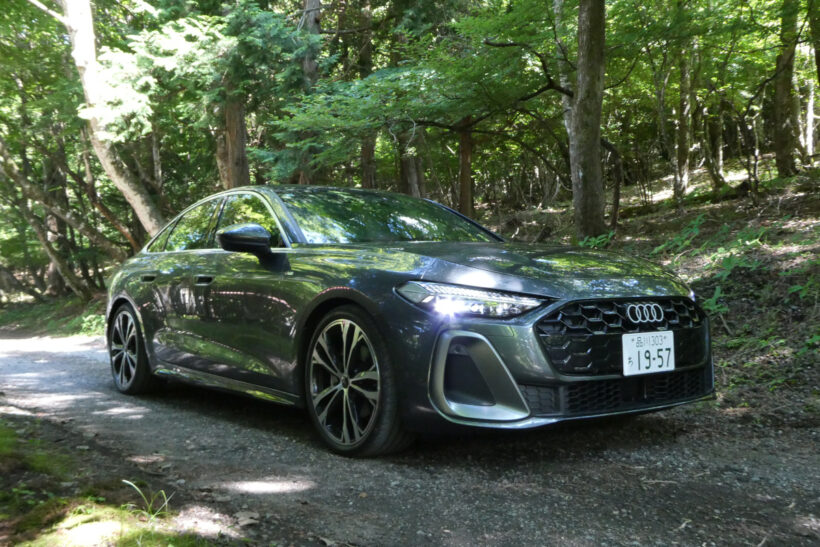

Audi A5 TFSI quattro 150kW
As a successor with a different name
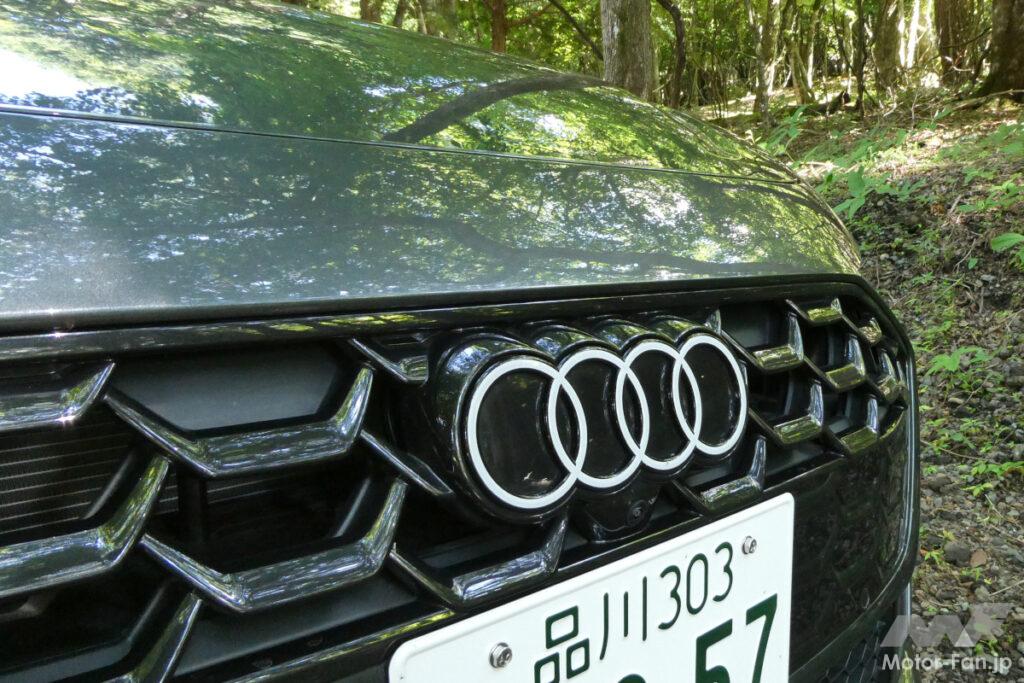
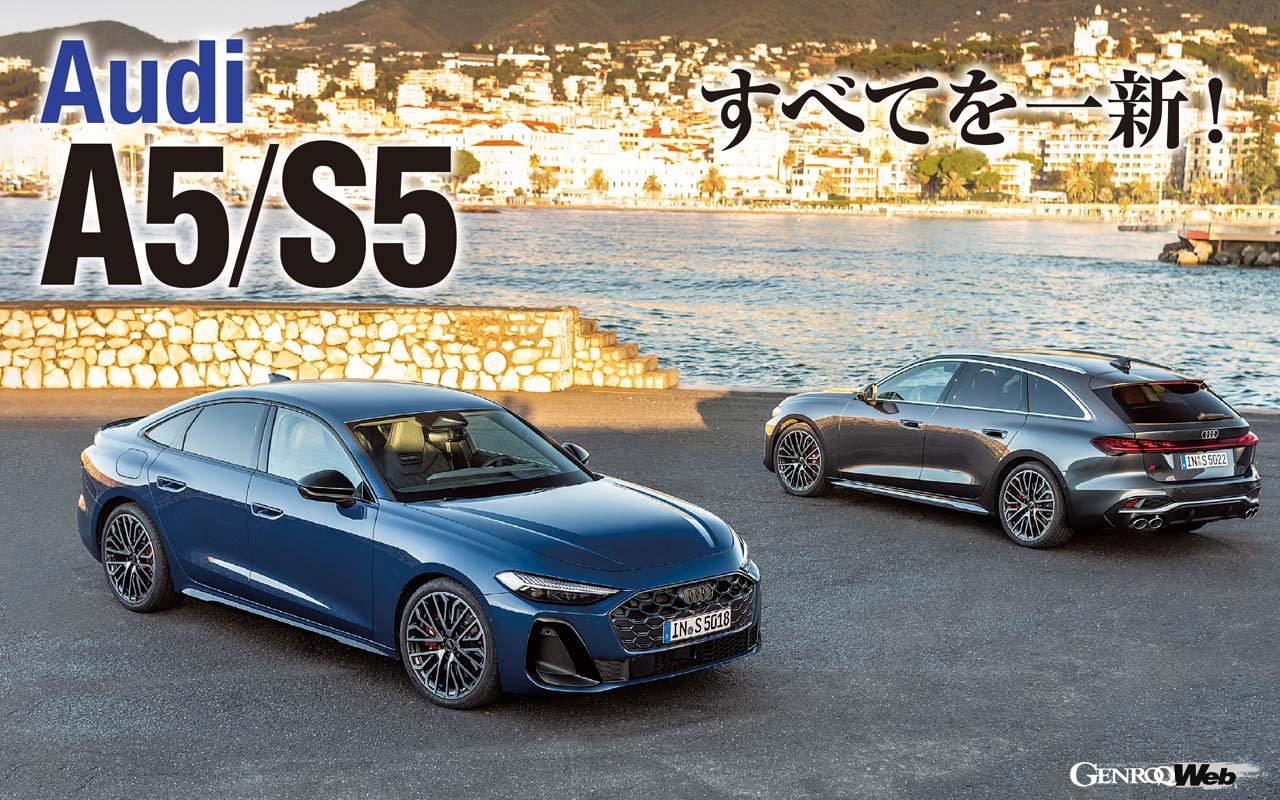
It features a classic design with a wide, flat single-frame grille and slim headlights.
I test drove the Audi A5, a new flagship model that had its world premiere in July 2024 and made its Japanese debut this year. The new A5 is positioned as the de facto successor to the mid-size saloon A4.
Why a successor with a different name? In 2023, Audi announced that starting with new models released in 2024, it would assign even-numbered model names (A4, A6, A8), which had been its mainstay in recent years, to fully electric vehicles, while engine-powered models would be odd-numbered (A5, A7, A9?), and indeed, last year it announced the engine-powered A5 and the fully electric A6. However, perhaps due to the resounding outcry from stakeholders around the world, the company reversed course with the launch of the engine-powered “A6” in March of this year.
From now on, both fully electric and engine-powered vehicles will use the same alphabet (A, Q) and number combination, along with the body shape (Avant, Sedan, Sportback) and powertrain code (electric = e-tron, hybrid = TFSI e, gasoline = TFSI, diesel = TDI). While the above is unrelated to the car itself, it explains the background of the A5 as a model that appeared during a period of confusion regarding car name rules.
It is the history accumulated over many years that shapes a brand. The Audi A4 has been around for 30 years since its debut in the 1990s, and there are probably fans who have continued to buy each model. Even if you say, “This time, it’s the A5, so please look forward to it,” it may be difficult for them to accept it.
Rear fender reminiscent of a WRC machine
[1]

[2]
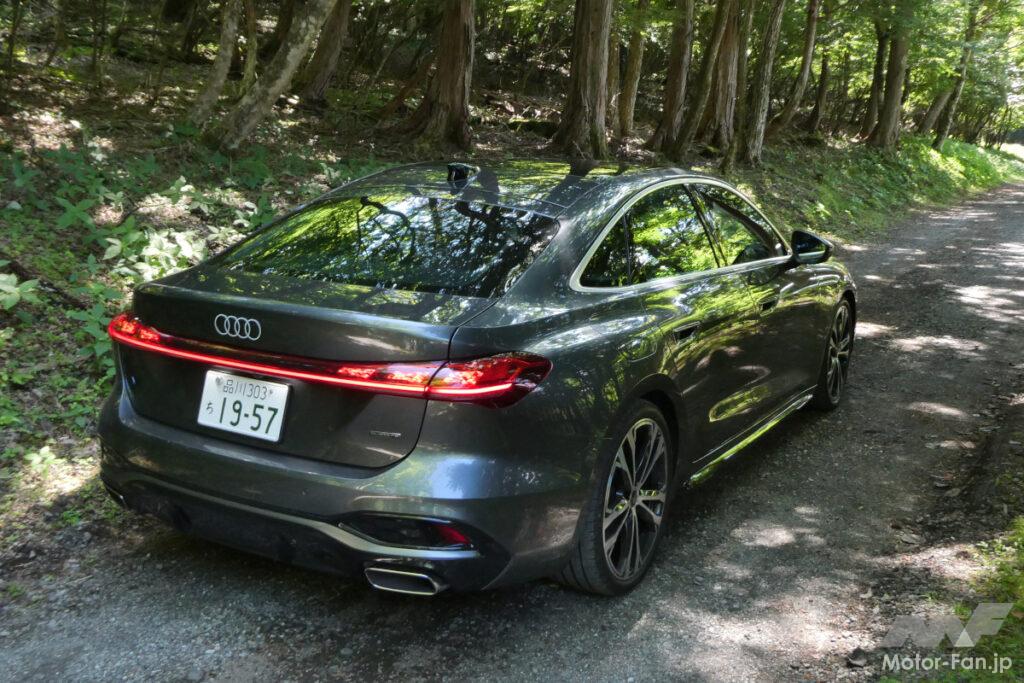
[1] The rear blister fenders are reminiscent of the WRC champion car, the Audi Quattro. [2] As it is described as a sedan type, it is actually closer to a sportsback with a rear gate.
So the new A5, which is essentially the sixth-generation A4, is a state-of-the-art saloon that uses the new PPC (Premium Platform Combustion) platform for engine vehicles. The body type is available in two types: a sedan with an electric rear hatch gate, and an Avant (station wagon).
I recall that the A5 was originally a model that could be considered a variant of the A4, with a lineup of coupe, convertible, and sportback models, but the A5 TFSI Quattro 150kW that I test drove this time is described as a sedan “type,” and in fact is a sportback with a rear gate, so it can be said to be A5-like in terms of sedans.
The body size has expanded in all directions, with a length of 4835mm (+75mm compared to the previous model), a width of 1860mm (+15mm), a height of 1455mm (+45mm), and a wheelbase of 2895mm (+70mm). In line with this, the weight has also increased by 180kg to 1800kg, a considerable weight class, when compared to the 2.0-liter gasoline turbo AWD (A4 45 TFSI quattro).
The front section has a classic design with a wide, flat single-frame grille and slim headlights. The rear blister fenders are said to be reminiscent of the WRC champion Audi Quattro, and the powerful shoulders jut out, making them simply cool.
Refined and advanced interior


A luxurious interior with Luxury Package S Fine Nappa Leather (770,000 yen). The optional panoramic glass roof (330,000 yen) is electrochromic, so it can be switched on instantly. The photo captures the moment it switches on.
The test vehicle was a luxurious model equipped with the optional Luxury Package S Fine Nappa Leather (770,000 yen), which includes high-quality leather S sport seats (heated, ventilated, and massage function) as well as Audi’s standard Bang & Olufsen sound system (3D premium sound and front headrest speakers).
The interior, which is said to have adopted a passenger-centric design tailored to the needs of the user, is equipped with a large screen all the way to the passenger seat, a trend that has become popular in German cars in recent years. In Audi’s case, this is called the Digital Stage, and consists of an 11.9-inch Audi Virtual Cockpit and a 14.5-inch MMI touch display. The test car also had the optional 10.9-inch MMI front passenger display and head-up display.
The car is equipped with a voice recognition system that can be activated by saying “Hi, Audi,” and it’s sensitive enough to respond to the passengers’ conversations. Voice commands are displayed on the instrument panel, which I like because it’s easy to understand how the commands were entered.
The steering wheel is slightly hexagonal, reminiscent of Audi’s single-frame grille. It’s a matter of personal preference, but I found it easy to drive. The light switches are compactly located next to the door mirror adjustment switches, and the selector lever has also been made smaller in line with the current trend, with an overall refined operating feel, including a click feeling. The test car was equipped with the optional panoramic glass roof (330,000 yen), which is electrochromic, so it can be switched on and off instantly, which is also advanced. On the other hand, the turn signal, wiper, and ACC levers, which are not much different from the previous models, felt a little outdated.
An engine with a full practical range near low revolutions

The 2.0-liter inline four-cylinder turbo engine has different output depending on the drivetrain: 110kW for FWD and 150kW for AWD.
The new A5 will be fitted with four engines, with output varying depending on the drivetrain: a 2.0-liter inline-four turbo (110kW for FWD, 150kW for AWD), a 2.0-liter inline-four diesel turbo and a 3.0-liter V6 twin-turbo. All models will be mated to a 7-speed S tronic (DCT) transmission.
The A5 TFSI Quattro 150kW that I test drove this time is a 2.0-liter inline-four gasoline turbo AWD model. Until the previous model, figures such as 35, 40, and 45 were used, which suggest the displacement of naturally aspirated engines from a while ago, but after the aforementioned period of confusion in the car names, they began to clearly state the maximum output. Incidentally, 150kW is 204PS and maximum torque 340Nm, which is halfway between the 35 (150PS, 270Nm) and 45 (265PS, 400Nm) of the previous gasoline model.
This time, I drove about 200km, including through mountainous areas, and due to the aforementioned increased weight, acceleration was sometimes frustrating on uphill highways. The redline starts at 6200rpm. The 2.0-liter gasoline engine does not have the new 48V MHEV Plus system that is available on the 2.0-liter diesel and 3.0-liter V6, and it inevitably lurches when restarting from idle stop. For better or worse, it feels like a practical engine, with a substantial range of practical use near low rpm. The 2.0-liter gasoline turbo is equipped with a turbocharger with VTG (variable turbine geometry), which allows for quick torque build-up at low rpm, giving it a diesel-like reliability. Fuel economy was recorded at 15km per liter, which exceeded my expectations.
The stability and braking feel are impressive.

[1]

[2]
[1] The optional massage function was very relaxing during the 200km journey. [2] The 10.9-inch MMI front passenger display allows passengers to enjoy entertainment even while driving.
Due to the increased weight, the power performance feels a little subdued, but the stability and brake touch on mountain roads are impressive. I haven’t test-driven the sports grade S5, but I can imagine it’s at an even higher level. The ride is also comfortable, and if you select Individual in the Drive Select, you can fine-tune not only the steering and suspension, but also the drive assist and virtual cockpit layout, but unless you’re looking for a very hard drive, you won’t be dissatisfied if you choose the standard Balanced mode.
It boasts a high-quality interior, excellent stability, and Audi’s traditional AWD, all for just 6.81 million yen. Considering the weak yen, it may be a bargain. However, the test car was equipped with options totaling 2.36 million yen, including the aforementioned Luxury Package S Fine Nappa Leather, as well as the Technology Package Pro (including the MMI passenger display, heated steering wheel, heated seats, damping control S sport suspension, and OLED rear lights, totaling 450,000 yen), bringing the price to over 9 million yen. While online quotes are fine, it’s best to visit a dealership frequently to assess the actual differences and determine whether or not you need these various options.
*The statement in the interior description that “the previous model used organ pedals” was incorrect and has been deleted. We sincerely apologize. (September 8, 2025)
PHOTO/GENROQ
SPECIFICATIONS
Audi A5 TFSI quattro 150kW
Body size: Length 4835mm, width 1860mm, height 1455mm
Wheelbase: 2895mm
Vehicle weight: 1800kg
Engine: Inline 4-cylinder DOHC turbo
Total displacement: 1984cc
Maximum output: 150kW (204PS) / 4300-6000rpm
Maximum torque: 340Nm (34kgm) / 2000-4000rpm
Transmission: 7-speed DCT
Drive system: AWD
Suspension type: Front and rear multi-link
Brakes: Front and rear ventilated disc Tire
size: Front and rear 225/55R17
Vehicle price: 6.81 million yen