
![Test drive the Land Rover Range Rover Sport SV, a circuit-friendly SUV, at Fuji Speedway [Video]](https://wheelfeed.com/wp-content/uploads/2025/04/1935-1761191509548.jpg)
Range Rover Sport
The top grade in the lineup
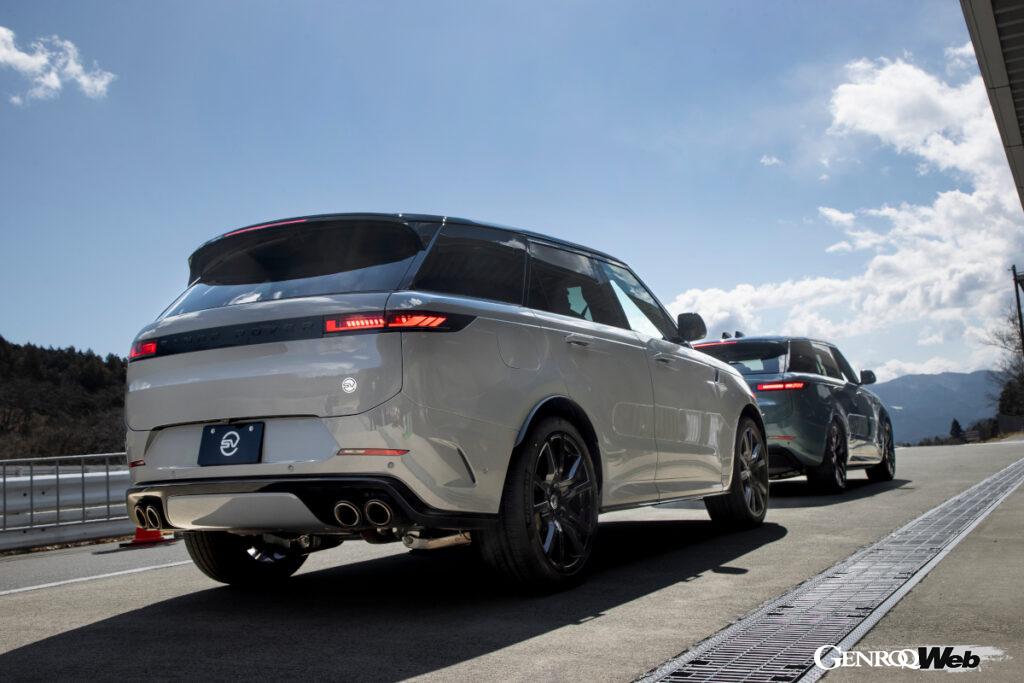
The Range Rover Sport SV is lined up in the pit lane. In front of it is the Range Rover Sport D300, which is being used for a comparison test drive.
Land Rover, a manufacturer specializing in 4WD vehicles, has three sub-brands: Range Rover, Defender, and Discovery. Each is given a clear role as a luxury vehicle, an off-roader, or a family car, and the luxury line and flagship Range Rover has a lineup of four models. Of these, the Range Rover Sport is the model with the highest power performance and enhanced sportiness.
The third-generation Range Rover Sport, which had its world premiere in May 2022, uses the same MLA-Flex platform for longitudinally mounted engines as the current Range Rover. Three powertrains are available: two gasoline engines (a BMW-made 4.4-liter V8 twin-turbo and a 3.0-liter inline-6 twin-turbo) and one 3.0-liter inline-6 twin-turbo diesel engine, and all vehicles are mated to an 8-speed automatic transmission.
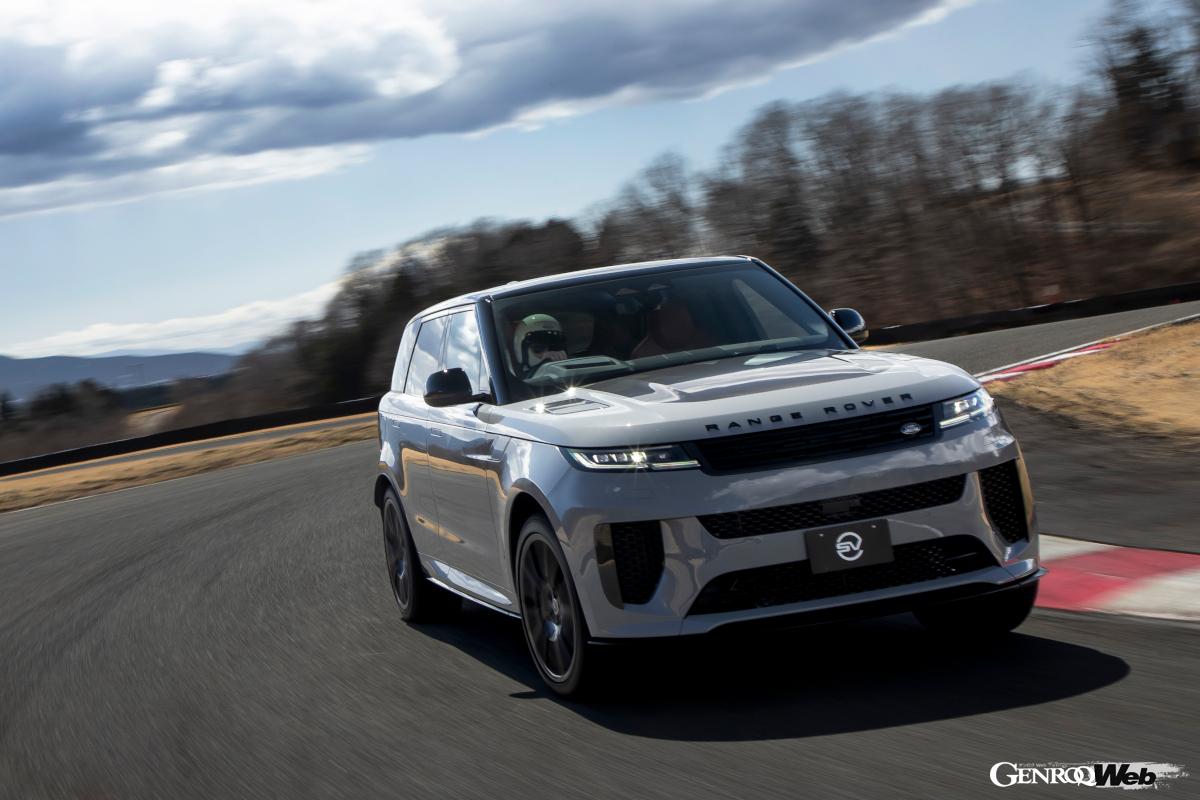
The Range Rover Sport SV, the model I test drove this time, is at the top of the Range Rover Sport lineup. The test drive took place on the short course at Fuji Speedway. It’s unusual for an SUV test drive to be held on a circuit, but on the flip side, it also means that the car has the performance to match.
Performance that surpasses even super sports cars

[2]

[3]
[4]
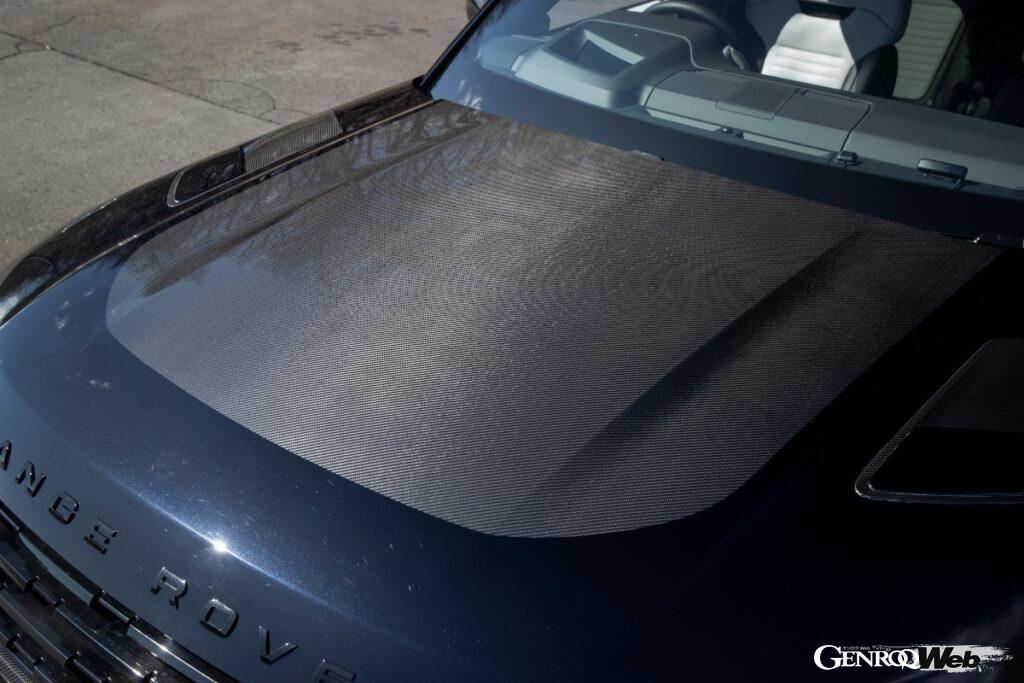
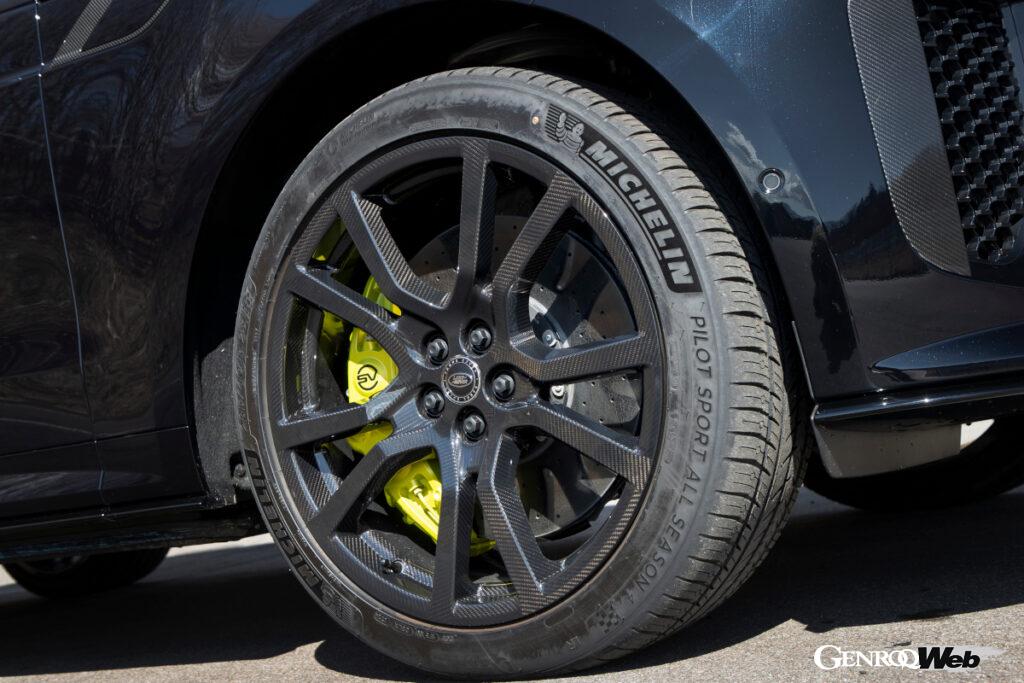
[1] Exposed carbon fiber bonnet. [2] The car is equipped with a 4.4-liter V8 twin-turbo engine that produces the most powerful output in Range Rover history, 635 PS, and a maximum torque of 750 Nm. [3] The SV is distinguished by its four-pipe exhaust system. [4] The SV’s tires are the first standard on an SUV, with Michelin Pilot Sport All Season 4 tires, different sizes for front and rear (285/40R23 in front, 305/35R23 in rear).
The Range Rover Sport SV has an imposing body with a total length of 4,970mm (+10mm compared to the standard vehicle, same below), a total width of 2,005mm, a total height of 1,815mm (-5mm), and a wheelbase of an astounding 3,000mm (+5mm). I understand that a wheelbase of 3m was the measurement for a saloon driven by a chauffeur some time ago, but that just goes to show how large an SUV it is. The total height is listed as 5mm in the Japanese specifications table, but in the home country, where specifications are measured in 1mm increments, it is apparently 10mm lower.
The SV is the top-grade model, combining the aforementioned 4.4-liter V8 twin-turbo with an 8-speed automatic transmission, and the new model’s technical topic is its 48V mild hybrid body control. The gray model waiting in the pit already exudes an extraordinary aura. It boasts the most powerful maximum output in Range Rover history of 635 PS and a maximum torque of 750 Nm. Acceleration from 0 to 100 km/h is said to be 3.8 seconds (when the lightweight option is selected), surpassing even super sports cars.
However, the exterior differences between the standard Range Rover Sport are modest. The only noticeable differences are the openings on the left and right sides of the front bumper, the decorative front fenders, and the four round exhaust pipes. This is likely to be a touching one for enthusiasts who love the idea of a wolf in sheep’s clothing. The car is fitted with 23-inch carbon ceramic wheels, which are also indistinguishable from the outside world. This alone has reduced the weight of all four wheels by 36 kg, and the carbon ceramic brake system has also reduced the weight by another 34 kg, resulting in a total weight reduction of 76 kg. Even so, the car weighs 2,570 kg, likely due to the adoption of a mild hybrid system in response to the trend toward electrification.
The car I test drove this time was the Range Rover Sport SV Edition 2, a limited edition of the Range Rover Sport SV. As the “2” in the name suggests, it is the successor to the Edition 1. The Edition 1 was a special limited edition car that only designated customers of Land Rover had the right to order when the SV debuted in 2023, but the Edition 2 is also a rare car introduced as a limited edition grade for the 2025 model year.
SV mode with flowing tail

[1]
[1]

[2]

[3]
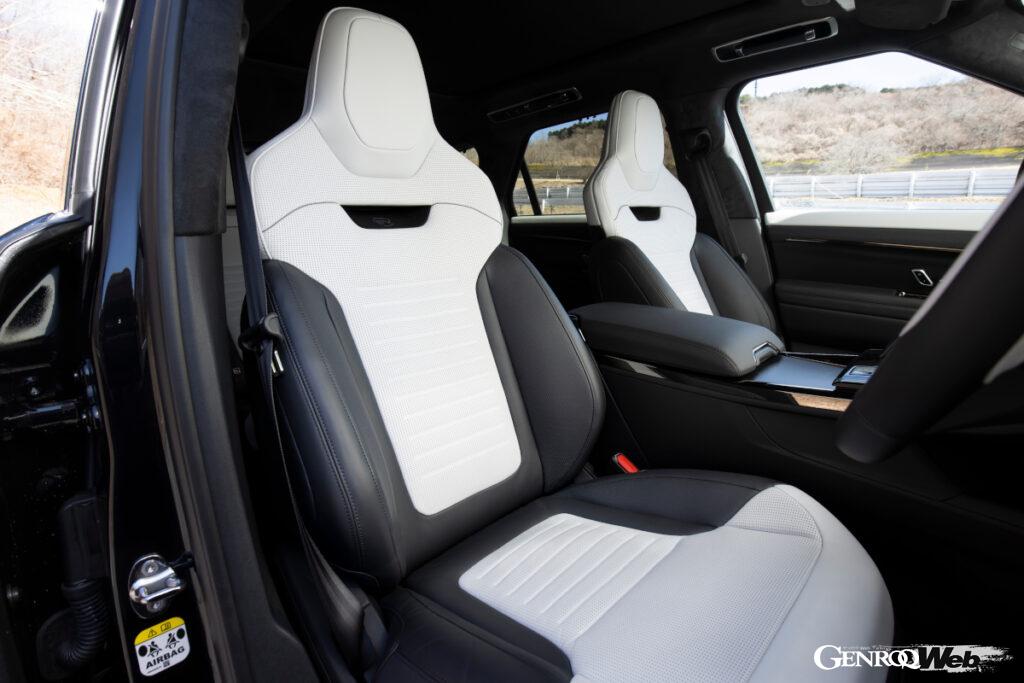
[1] The front and rear seats have a sporty design. The front seats are equipped with Body & Soul seats with overhanging shoulders, which were jointly developed with SUBPAC, a company famous for its gaming chairs. [2] The meter display changes when SV mode is selected. [3] The SV mode is located under the steering wheel horn pad.
I climb into the SVs lined up on the pit road. The Body & Soul Seats, developed in collaboration with SUBPAC, a company famous for its gaming chairs, make a strong statement, but the interior is not significantly different from the standard model. Aside from the overall black ceramic finish, the only other difference is the “SV Mode” driving mode located under the steering wheel horn pad, which fully utilizes the SV’s performance. There are five driving modes: “SV,” “Dynamic,” “Comfort,” “Config,” “Auto,” and “Off-road,” but since this was a circuit, I tried out the SV and Dynamic modes.
The tires are Michelin Pilot Sport All Season 4, which is apparently the first time an SUV has been fitted with them as standard. The size is a mixed size, a first for the Range Rover, with 285/40R23 in the front and 305/35R23 in the rear. This also shows the car’s enthusiasm.
We headed down the pit road and entered the course in Dynamic mode. The V8 twin-turbo engine revved up to 7250 rpm, making the sound even more ferocious and making the 2.5 ton weight dance effortlessly. This was enough to show the amazing driving performance of a sporty SUV, but what surprised me even more was when I switched to SV mode.
In SV mode, which is located above Dynamic mode, the vehicle height is lowered by 15 mm and various settings such as steering, transmission, throttle response, exhaust note, and suspension are optimized for sports driving. On this short course with a downhill main straight, the first corner goes downhill while turning left and right around an S-curve. Here, the SV surprisingly allows the tail to drift. With a wheelbase of 3 meters, the tail swings out so gently that it feels like a dragonfly is coming to a halt. The driving sensation is like that of a mature sports car.
The reason for the amazing cornering performance
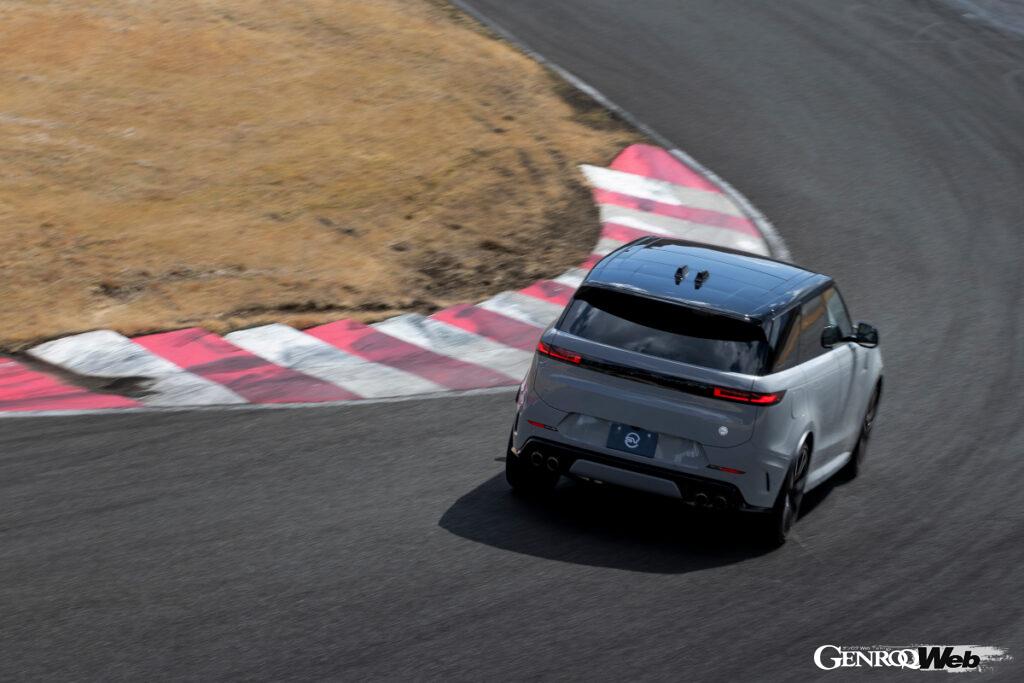
The first corner is a descending S-curve that turns left and right, and here the SV is surprisingly willing to let the tail slide.
Until a few years ago, cars with a high center of gravity, such as SUVs, were designed to limit the front wheels’ leverage to prevent increased lateral G-forces. I’ve heard that this was done to eliminate the risk of rollover, but the Range Rover Sport SV can swing the rear wheel around more than adequately for an SUV. The front wheel responds to steering inputs like a sports car. Of course, this is in SV mode, which can be considered combat mode; when you switch to Dynamic mode and the VSC stability control system is on, the brakes are firmly applied, preventing the tail from sliding out, so there’s no need to worry.
On the other hand, there are also times when you can feel the car manufacturer’s conscience. The VSC has a track mode between on and off, but if you try to swing the rear out too far for fun, the VSC will not turn off for a while, as if in punishment mode. It is only when this kind of control comes into play that you are reminded that you are driving a 2.5-ton SUV.
This incredible cornering performance is largely due to the adoption of advanced control devices such as the Integrated Chassis Control (ICC) that integrates chassis performance, a roll control system driven by a 48V system, rear-wheel steering, torque vectoring, and an active differential, as well as the SV’s exclusive rear subframe suspension link and 6D dynamic air suspension. While other companies have already achieved roll control, this is the first time that pitch control has been put to practical use.
Of course, all vehicles are equipped with air suspension as standard, and this new air suspension uses a new air spring called a “switchable volume air spring.” By changing the pressure inside the airbag, it is possible to achieve appropriate control over a wider range.
Experience a special SUV

Immediately after the SV’s circuit run, I was able to compare it with the 3.0-liter inline-six diesel “D300,” and its behavior was completely different. The Pirelli Scorpion MS tires give it a strong M+S orientation, but the front grip and VSC control are still designed to prevent excessive lateral G-forces, and are still within the realm of conventional SUV thinking. Through this comparison, I was able to really appreciate just how special an SUV this SV is. I’ve never seen an SUV like this. I was also able to test drive the D300 off-road, so I’d like to share my impressions in a separate article . This confirmed that the off-road driving capabilities inherent to an SUV are top-notch.
The latest Range Rover Sport SV demonstrates the incredible sporting talent of the Special Vehicle Operations (SVO) team, Land Rover’s special vehicle division. The test drive also left me in awe of just how far SUV performance could be pushed.
PHOTO/Kenji ICHI
Check out the video to see the Land Rover Range Rover Sport SV in action!
SPECIFICATIONS
Land Rover Range Rover Sport SV Edition 2 P635
Body size: Length 4970 x Width 2025 x Height 1815mm
Wheelbase: 3000mm
Vehicle weight: 2590kg
Engine: V8 DOHC twin turbo
Total displacement: 4394cc
Maximum output: 467kW (635PS) / 6000-7000rpm
Maximum torque: 750Nm (76.5kgm) / 1800-5855rpm
Transmission: 8-speed AT
Drive system: AWD
Suspension type: Front double wishbone, rear multi-link
Tire size: Front 285/40R23, rear 305/35R23
0→100km/h acceleration: 3.8 seconds
Top speed: 290km/h
Vehicle price: 24.74 million yen











![Test drive of Land Rover’s latest off-roader, the Defender Octa, on a dirt course [Video]](https://wheelfeed.com/wp-content/uploads/2025/08/1270-1761529533682.jpg)