

Volkswagen Golf TDI R-Line
There seems to be little change from the previous model.


Volkswagen’s flagship model and benchmark for European C-segment hatchbacks, the current Golf, has undergone a minor change, evolving from the 8th generation to the 8.5th generation, and a press test drive event was held in Tokyo. The gasoline version, known as the eTSI, has eliminated the 1.0-liter 3-cylinder engine from the previous Active Basic and is now a 1.5-liter 4-cylinder engine. In order to make full use of the assist from the 48V MHEV, various refinements have been made to the engine’s control, including cylinder deactivation, complete engine shut-off when coasting, Miller cycle operation, and variable geometry turbo.
As a result, the specs of the diesel version “TDI” – 150PS/3000-4200rpm, 360Nm/1600-2750rpm – appear to be little changed from the previous model, but the twin dosing with AdBlue (urea SCR) on both the intake and exhaust sides remains the same, and the mapping has been improved to maintain the efficiency of NOx decomposition over a wide range of conditions, from low temperatures to high-speed loads, while revamping drivability.
The latest “MIB4” infotainment system


The catchphrase for the 8.5th generation is “Made only of what’s important.” The accumulation of essentials is the hallmark of the Golf, which has continued to spread around the world for 50 years and sold over 37 million units, and this is strongly reflected in the 8.5th generation’s digitalization. Like higher-end models like the Passat and Tiguan, the infotainment system has been updated to the latest “MIB4,” featuring a large 12.9-inch touchscreen and IDA voice assistant as its interface. The touch slider bars for adjusting the air conditioning temperature and volume, which were criticized for being difficult to operate in the previous Golf 8 model, are now backlit, which is good news.
The layout from the digital meter panel in front of the driver to the central touchscreen has become larger compared to the previous model, which had a strong sense of unity. However, the larger screen makes it much easier to see, and the improved calculation speed makes operation feel even smoother.
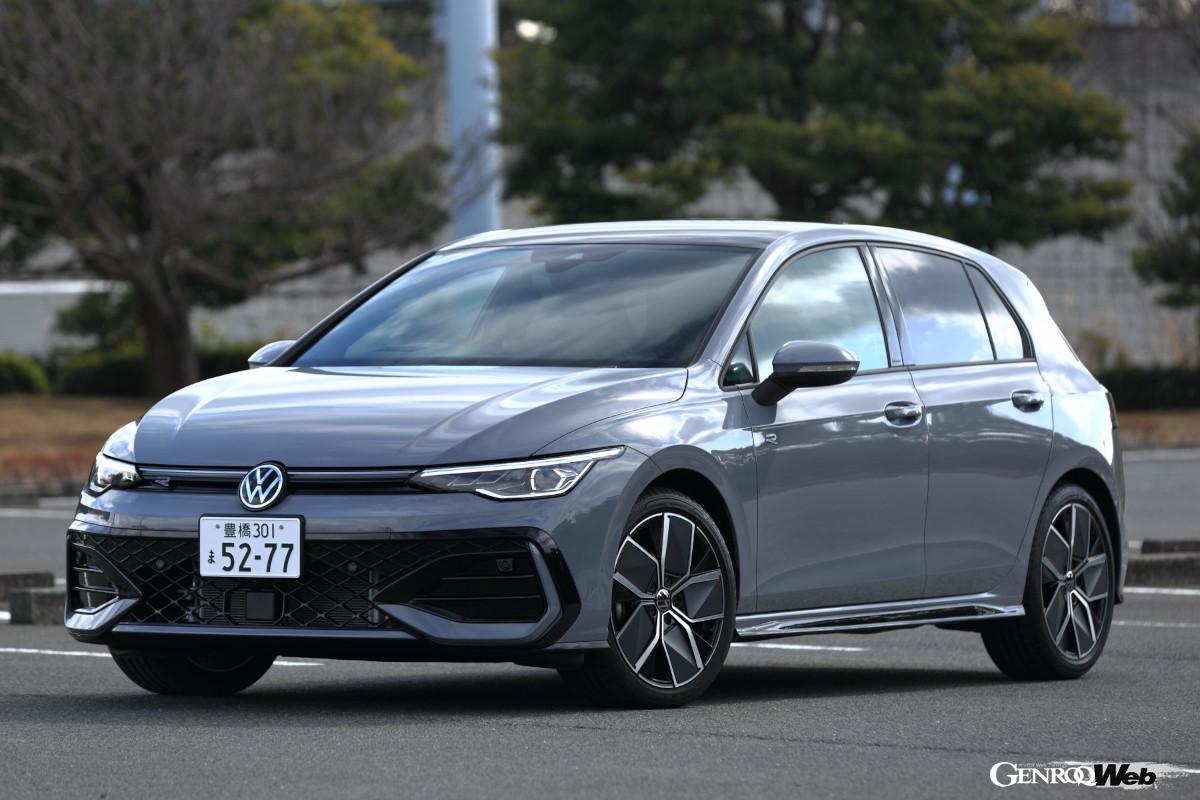
The test car we drove was an R-Line model, and on the exterior, the headlights have been upgraded from the previous four to two, with the “IQ Light” now offering a high beam range of 500 meters. The LEDs in the headlights and the upper edge of the front grille bar, which lights up in a straight arc, are the same, but the central emblem is now illuminated as well. The LEDs in the rear combination lamps have also been simplified, and the front and rear bumper designs have been completely redesigned, but apart from the glossy black frame and the unique under-grille pattern, they are almost identical to the GTI. The two-tone black roof paint is also a feature exclusive to the R-Line and GTI. The 18-inch “Leeds” wheels, which look extremely aerodynamic, and the white and gray leather seats with perforations and an R logo that exudes a luxurious sporty feel are also exclusive to the R-Line.
Quick throttle response and overwhelmingly smooth power


The large, enveloping sports seats are neither too hard nor too soft, and you can feel the sense of unity that is unique to a well-tuned car from the first few meters. From city driving to highways, even under the limited conditions of Tokyo, the more you drive, the more the new Golf 8.5 TDI R-Line quietly asserts its grand tourer-like character. However, this is a little different from the traditional diesel driving feel, with its solid steering feel and powerful, powerful torque. In fact, the car’s weight of 1,430 kg is slightly lighter than the previous model’s 1,460 kg, and the catalog fuel economy has also been improved, from the previous 20.1 km/L to the new 20.8 km/L, showing a significant improvement.
Perhaps due to the effectiveness of the progressive steering, the steering is generally very neutral from the start of a turn, the gain is natural, the reaction is not too heavy, and you don’t have to search for neutral when going straight. The days when VW was the epitome of weak understeer are long gone. However, while these flavors play a supporting role, the smoothness of everything from the powertrain to the manner of the 7-speed DSG (DCT) stands out. The exhaust note is by no means a sultry sound, and it doesn’t hide the fact that it’s a diesel, but the response to accelerator operation is quick, and the sense of power is overwhelmingly smooth. It’s not a premium car, but it’s as close as you can get to it, and that’s how a high-quality long-distance tourer should be.
Perhaps because the ODO hasn’t yet clocked up 1,500 km, there was a bit of nervous pitching at low and medium speeds in terms of ride comfort. However, this was a symptom of the car faithfully conveying road surface information, and was also proof that the rear four-link suspension was doing a good job. I imagined that the best TDI car would be the Variant, which I didn’t drive this time, but that car is 80 kg heavier and the TDI hatchback’s fuel tank capacity is 51 liters. Its highway driving range easily exceeds 1,000 km, yet its vehicle price is 4,753,000 yen. As a practical ICE hatchback, the Golf 8.5 TDI remains the ultimate choice for heavy drivers.
REPORT/Kazuhiro NANYO
PHOTO/Kazuhiro NANYO, GENROQ, Volkswagen AG
SPECIFICATIONS
Volkswagen Golf TDI R-Line
Body size: Length 4295, Width 1790, Height 1475mm
Wheelbase: 2620mm
Vehicle weight: 1450kg
Engine: Inline 4-cylinder diesel turbo
Total displacement: 1968cc
Engine maximum output: 110kW (150PS) / 3000-4200rpm
Engine maximum torque: 360Nm / 1600-2750rpm
Transmission: 7-speed DCT
Drive system: FWD
Suspension: Front MacPherson strut, rear 4-link
Brakes: Front ventilated disc, rear disc
Tire size: 225/40R18
Environmental performance: Fuel consumption rate 20.8km/L (WLTC)
Vehicle price: 4,753,000 yen