

Lotus Emeya R
The front motor is 306 PS and the rear is 612 PS.

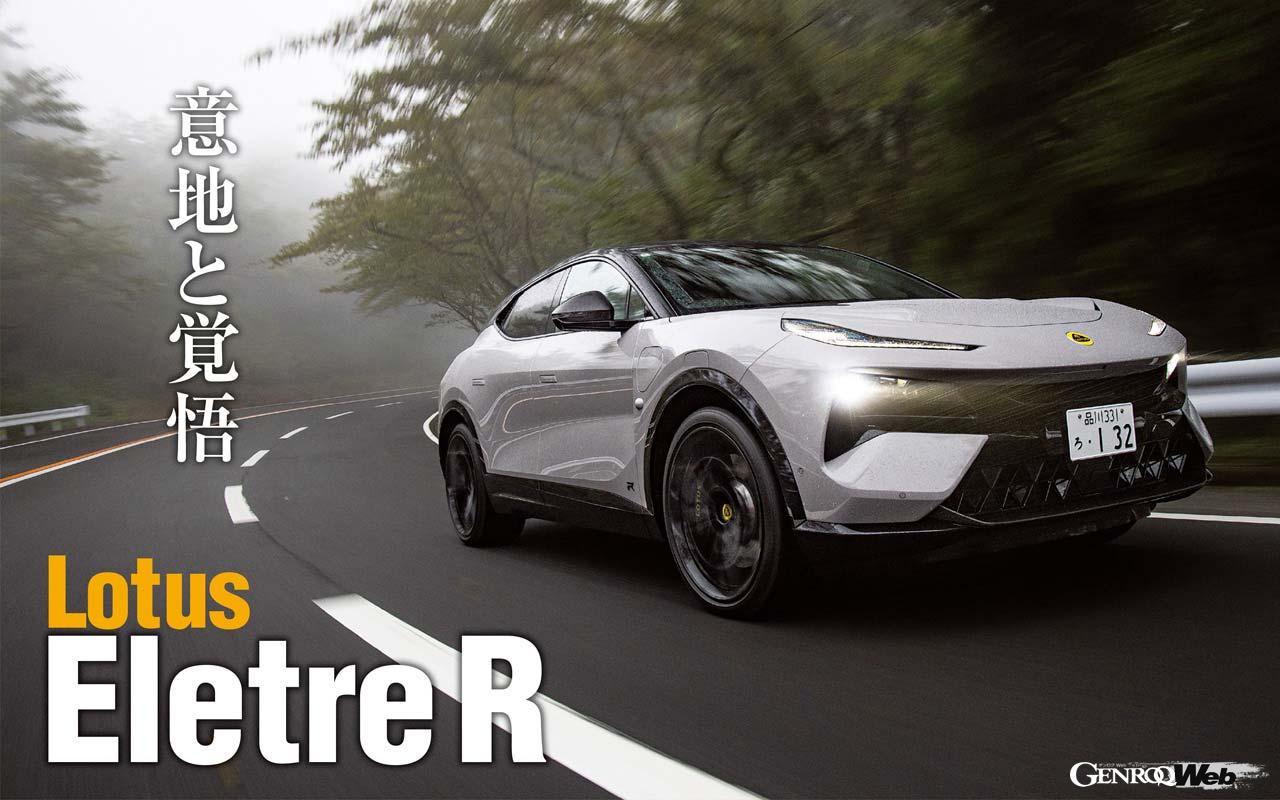
Compared to the EleTre, the overall length and width are almost the same, but the overall height is 172mm lower. On the other hand, the wheelbase is 50mm longer, which may be why it looks more stretched out.
The EleTre I drove last month was an R grade, so I was hoping to get the base grade Emeya this time, but once again it was an R!
Lotus sports cars have always focused on the lightest base grade, but with electrification, the story is different. This time, let’s enjoy the overwhelming acceleration of the system’s total 918 PS.
The reason for wanting a model other than the R was spec-wise. The SUV-style Eletra and the five-door sedan Emeya have quite a few things in common inside. In particular, the motors on the front and rear of the vehicle have the same output settings, with the R producing 306 PS in the front and 612 PS in the rear. In comparison, the base model produces 306 PS in both the front and rear. If you want to get to the heart of the Emeya, isn’t it normal to first check out the feel of the base model before immersing yourself in the excitement of the high-performance model?
Another reason I gave this time was that the EleTreR’s acceleration was quite violent. Last month I tried to describe it in a positive way, calling it a “warp feeling,” but to be honest, I felt that it was a performance I would like to try out in a wide space like a runway. EleTreR’s senior is gentle around the edges, but he seems scary when he loses his temper. I’d be lying if I said that my colleague wasn’t scary.
Another reason I gave this time was that the EleTreR’s acceleration was quite violent. Last month I tried to describe it in a positive way, calling it a “warp feeling,” but to be honest, I felt that it was a performance I would like to try out in a wide space like a runway. EleTreR’s senior is gentle around the edges, but he seems scary when he loses his temper. I’d be lying if I said that my colleague wasn’t scary.
Excellent manufacturing quality
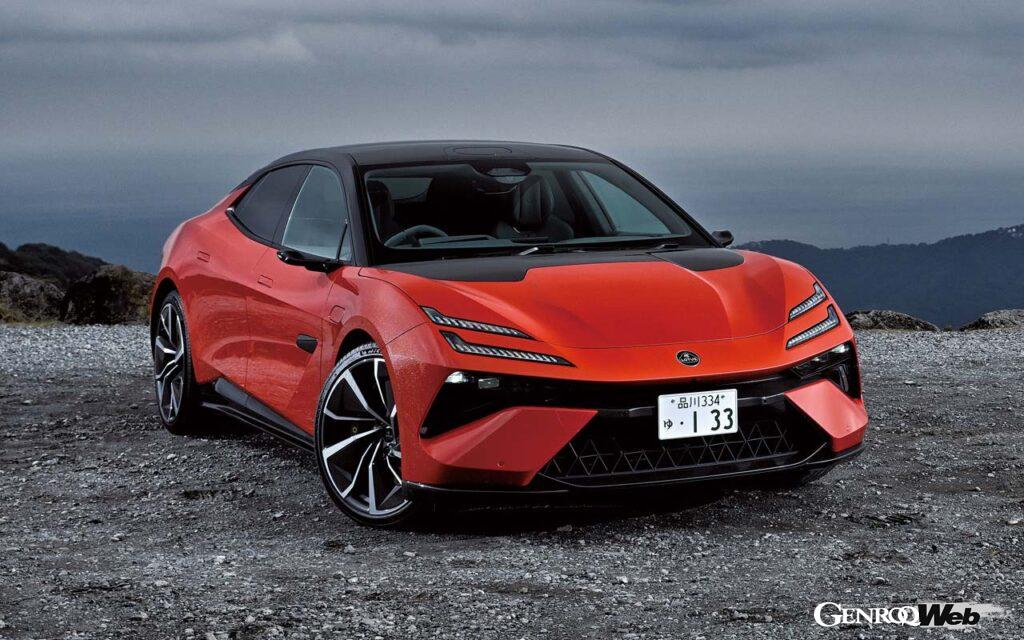
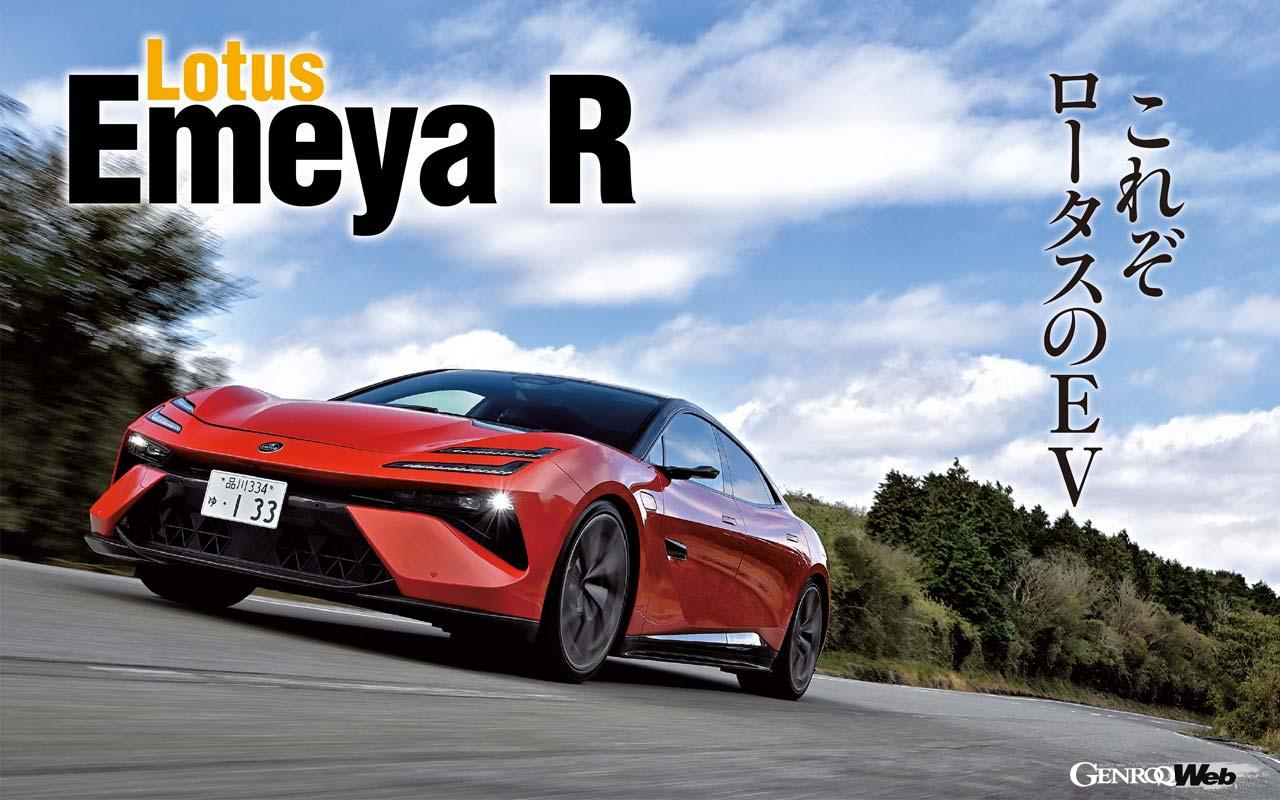
The design direction is the same as the SUV EleTre, and the Emeya is a 5-door saloon version of it. The body color of the test car is “Fireglow Orange”.
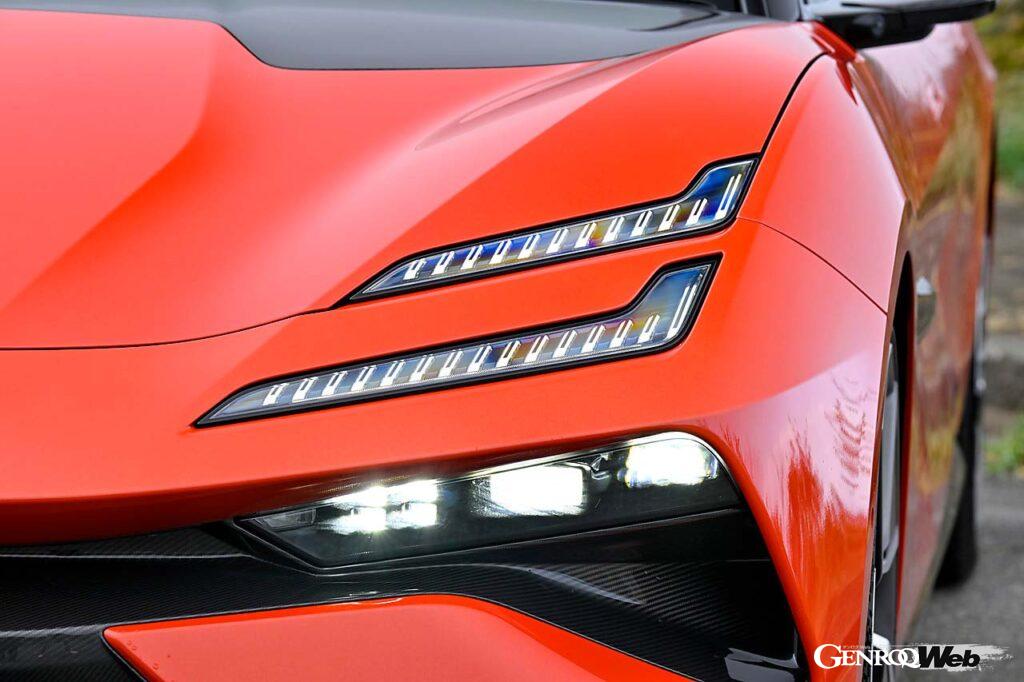
Now, the Emeya R. The design direction seems to be exactly the same as the Eletra. The long, thin double eyes are like eyebrows and eyelashes, and the actual lamp units are hidden in the blacked-out area below. Last month’s Eletra R was painted in a modest and stylish Kamui Gray, but this time it’s painted in a Fireglow Orange with a coarse metallic grain and a brilliant sparkle. I felt that the paint color also effectively expressed the car’s fearless performance and Lotus identity.
I didn’t feel this way with the Elettre, but am I the only one who feels a nostalgia for the second-generation Elite or Eclat from the 1970s in the design of the Emeya? The traditional Lotus bloodline can be seen in the styling, which is neither Italian nor German.
Moreover, the more I look at it, the more I realize how amazing the quality of the body and the precision of the panel construction are. The panels and glass, which form beautiful streamlines from the nose to the rear end, have been made perfectly smooth, which is impressive. It’s on a level that would rival Audi. It may have been the same with the EleTre, but I was too tall to get a bird’s-eye view of the roof, so please excuse me.

[1]
[1]
[2]

[3]
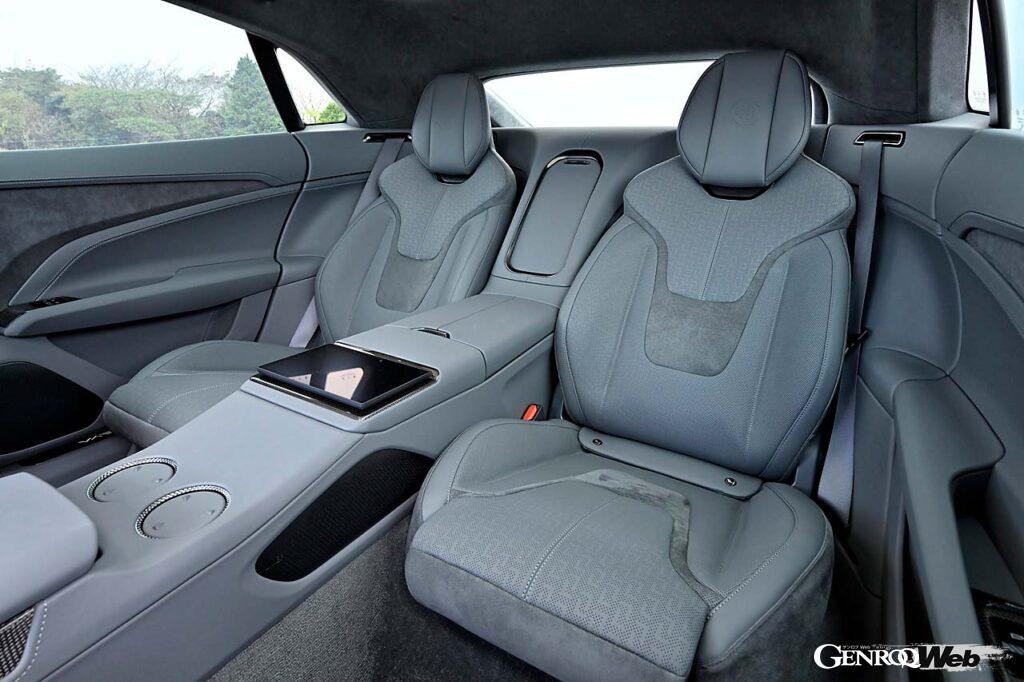
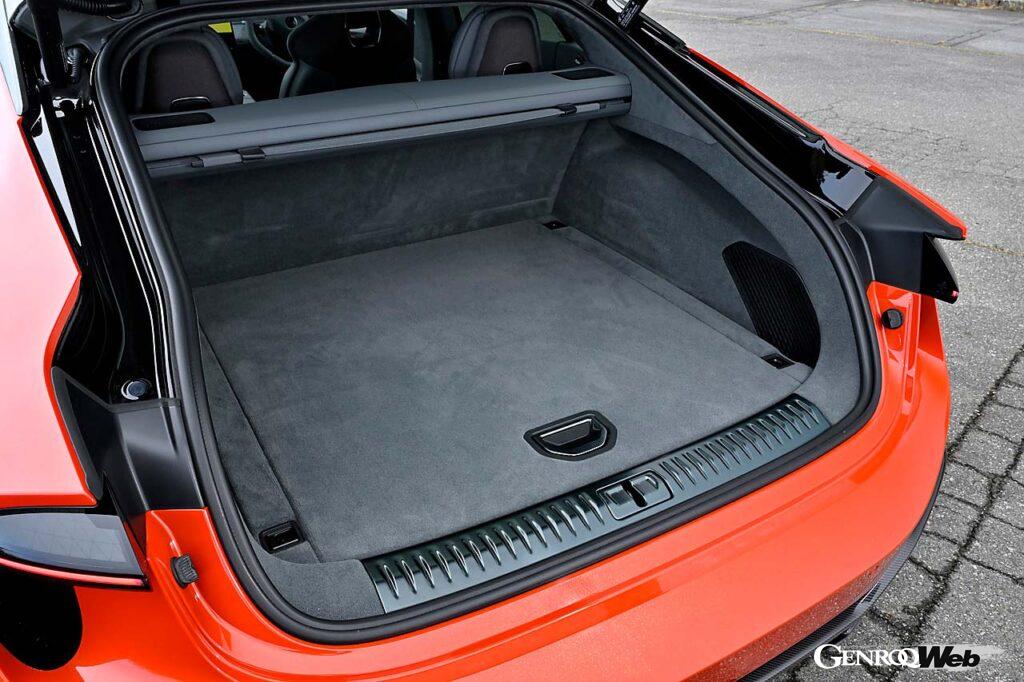
[1] Normally, it seats five people, but if you select the optional “Executive Pack,” the rear seats become separate seats, making it a four-seater. Due to its long wheelbase, rear seat livability is surprisingly not bad. [2] The Emeya is actually a five-door hatchback with a huge tailgate at the rear. The luggage room capacity is 509 liters. There is also a small space of 31 liters under the front hood. [3] The design direction is the same as the EleTre, but the shapes of the instrument panel and center console are slightly different and unique. The test car was equipped with optional camera-type side mirrors.
When I got into the driver’s seat, I noticed that the floor was raised, but once I sat down, it didn’t feel strange. The dash panel and even the seat design look the same as the EleTre. Even in the EleTre, the cockpit looked like a thin, sporty car, so it could be said that the sedan-type Emeya has a more harmonious design that doesn’t feel out of place.
Meanwhile, the rear seats are similar to those of the Aston Rapide and Panamera, with the front seats being used in the rear as well, giving the impression that “this is what happens when a sports car manufacturer makes a four-door model.” But even so, it looks far more impressive than its rivals, and than the Elettre R from last month. Come to think of it, this may be because the Elettre R has a dark leather interior and is a five-seater.
The only thing that bothered me was that my feet wouldn’t fit under the front seats when I stretched them out from the rear seats. This exposed the weakness of the thick floor, but other than that I didn’t notice any other negative aspects. The rear seats are comparable to those in full-size German saloons.
Is the potential rival the Porsche Taycan Turbo S?
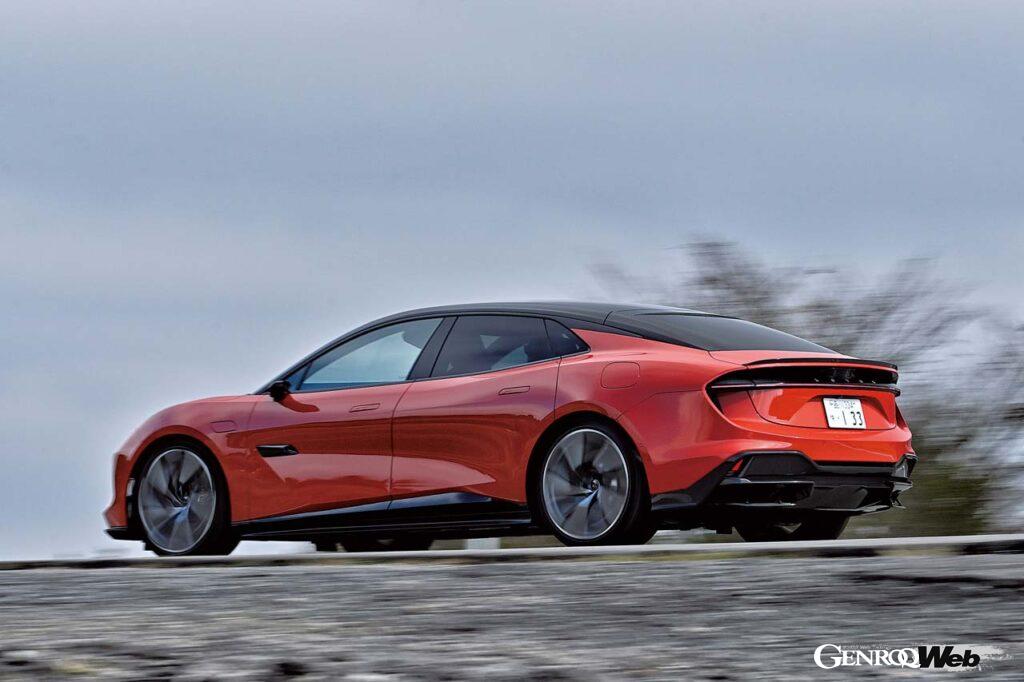
The battery capacity is 102kWh, and the range on a single charge is said to be 435-485km (WLTP integrated). Charging is compatible with 200V standard charging and CHAdeMO rapid charging. The connector is located on the left rear fender.
This time, I left the Tomei Expressway and drove on the winding roads that weave along the ridgeline of Hakone. In terms of driving, the Emeya R was subtly, or rather quite different from the Eletre R. Although the basic behavior is similar, it was the Emeya R that immediately made me feel that “this one is better!”
After realizing this, I began the test drive pondering, “Why is that?” The stroke and air suspension settings are obviously different, but it’s unlikely that they were completed by a different engineering team. If that’s the case, the only thing that could be explained is the laws of physics, right? I
had an idea. When I took corners a little harder, the Eletra R’s air suspension felt like it was working to its full potential, while the Emeya seemed to dodge before the full lateral G force was applied. Its handling was reminiscent of Lotus models like the Elise and Evora.
This time too, I tried a quick burst of full acceleration, and with the Eletra R, there is a brief moment before the actual acceleration begins as traction is concentrated on the rear tire and it sinks, but with the Emeya R, the rear starts moving forward before it has time to sink completely.Then, the two-stage rear spoiler is raised and the car accelerates quietly like an arrow.


Aerodynamics is Lotus’ specialty, with active grille shutters and an active rear spoiler that deploys in two stages depending on speed.
While the Eletra R’s behavior at the start of acceleration is very impressive, the Emeya R has a calm look. That’s why it’s easy to keep your foot on the throttle with the Emeya R, and it’s not scary. In other words, the output characteristics of a BEV are such that power rises sharply at the start of acceleration, and the power curve thereafter is flat, so even if it’s impressive, it’s only at the beginning. Moreover, the R grade is equipped with a two-speed gearbox on the rear wheel side, and if this is set to ultra-low + standard gear like the Taycan, it will be even more “biased at the start of acceleration.”
To be honest, I didn’t expect the Emeya R to be so well made, so I’m truly surprised. The Emeya R’s direct rival would be the Taycan Turbo S, but when I compare it to that car, I feel that the difference between the two is more the Porsche’s compactness and the Lotus’s lightness, rather than the difference in design years. It’s inevitable that the Emeya R will be added to the list of cutting-edge models.
[1]

[2]
[3]
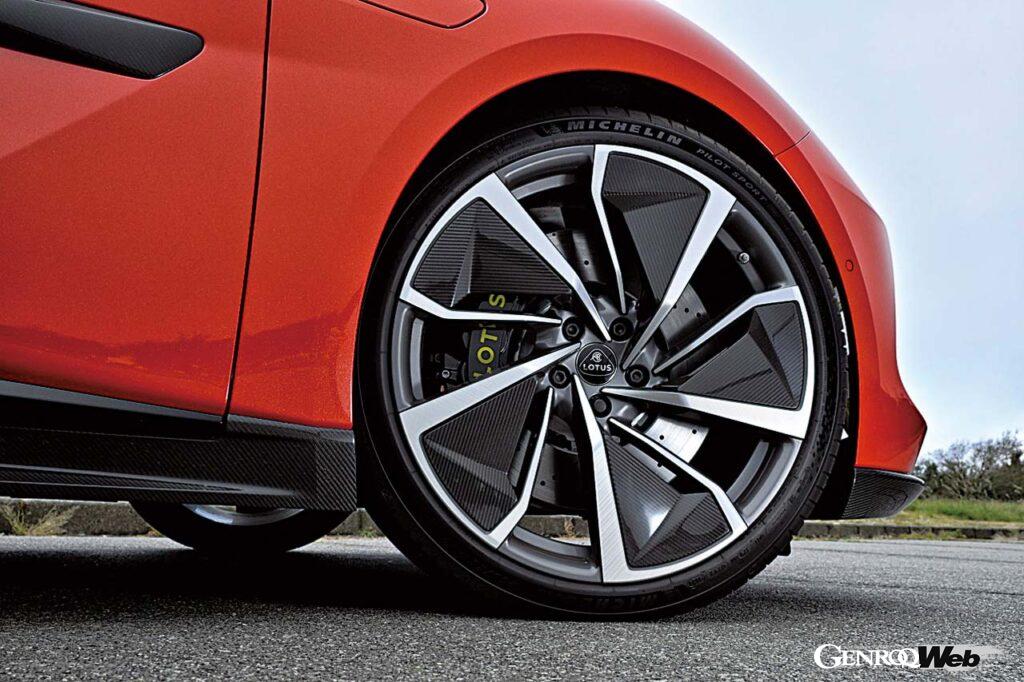
[1] The L-shaped daytime running lights are a design element shared with the EleTre. The headlights are hidden in the black area below. [2] With an eye toward future autonomous driving, the Emeya is equipped with four LiDAR sensors, 18 radars, and nine cameras. This is the LiDAR sensor stored in the roof. Its recognition status of surrounding people, cars, pylons, etc. is displayed on a monitor. [3] While 21-inch wheels are usually standard, the test car was fitted with optional 22-inch wheels. The tire sizes are 265/35R22 in the front and 305/30R22 in the rear. The brand was Michelin Pilot Sport EV.
REPORT / Takuo Yoshida
PHOTO / Satoshi Kamimura
MAGAZINE / GENROQ January 2025 issue
SPECIFICATIONS
Lotus Emeya R
Body size: Total length 5139mm, total width 2005mm, total height 1464mm,
wheelbase: 3069mm,
vehicle weight: 2575kg
, system maximum output: 675kW (918PS),
system maximum torque: 985Nm (100.4kgm)
, transmission: 2-speed
, drive system: AWD,
suspension type: front and rear multi-link
, brakes: front and rear ventilated discs,
tire size: front 265/40R21, rear 305/35R21,
maximum speed: 256km/h,
0-100km/h acceleration: 2.78 seconds,
vehicle price: 22,682,000 yen
[Inquiries]
Lotus Call
TEL 0120-371-222
https://www.lotus-cars.jp