

Porsche 911 Carrera
The driving performance brought about by the fully-ripened horizontally opposed turbo

The nose responds very nicely to steering inputs, and it felt as if we were back in the 997 era.
It’s always exciting to drive a new Porsche 911, because over its 60-plus year history, the 911 has always steadily evolved, replacing the previous generation.
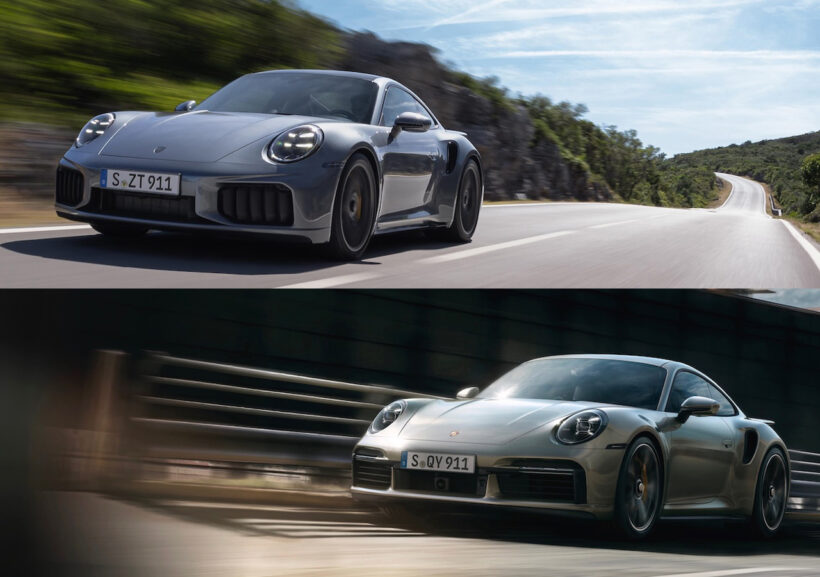
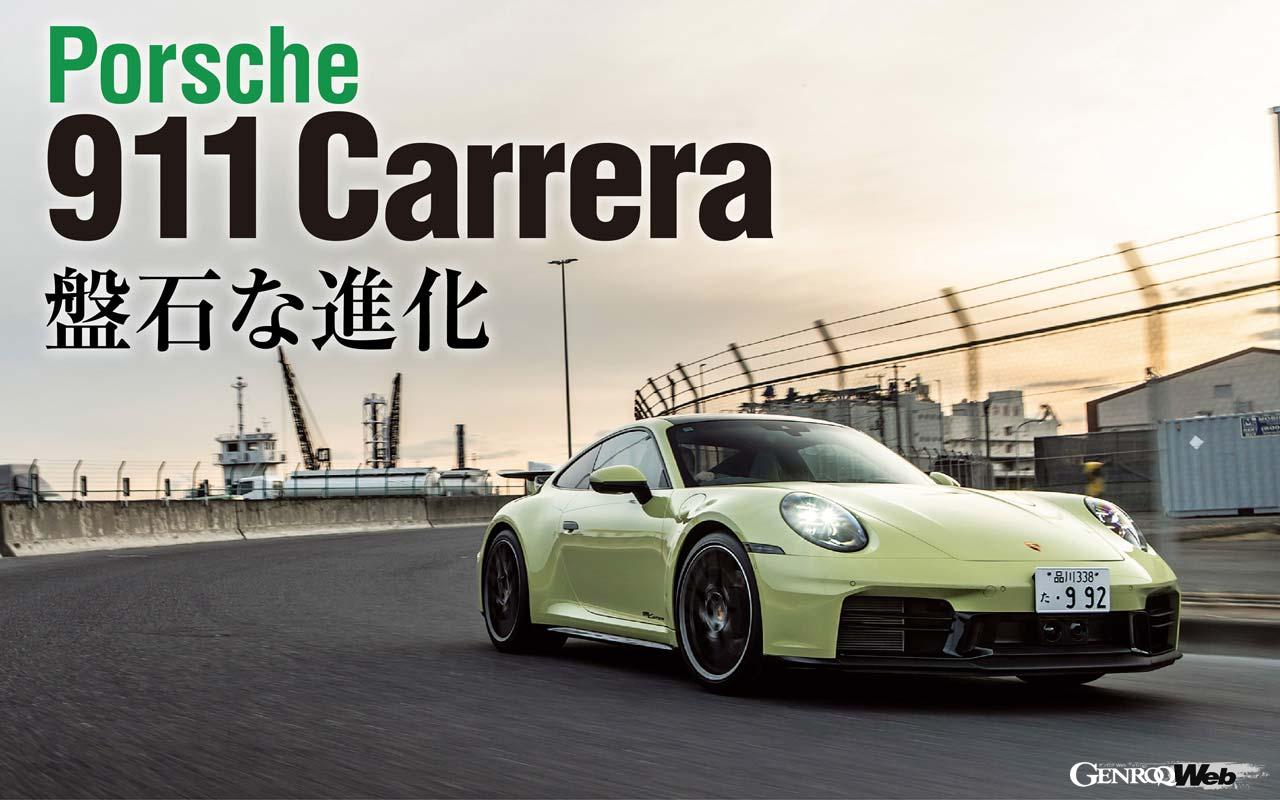
The car we’ll be driving this time is the late-model 992 911, known as the 992II, which has just arrived in Japan. However, instead of the 911 Carrera GTS, which is the 992II’s biggest talking point and features a T-Hybrid that combines a 3.6-liter water-cooled flat-six electric single turbo with an electric motor, we’re driving the basic ICE model 911 Carrera, which is equipped with a 3.0-liter water-cooled flat-six twin turbo.
Moreover, according to the press release, the 3.0-liter flat-six engine has been improved with twin turbos inherited from the previous 911 Carrera GTS and an intercooler installed directly under the rear grid grille, but it only achieves a maximum output of 394 PS and a maximum torque of 450 Nm, a mere 9 PS increase over the previous model, and its performance has also improved by 0.1 seconds to 4.1 seconds from 0 to 100 km/h (3.9 seconds for the Sport Chrono Package model).The top speed has also only increased by 1 km/h to 294 km/h.
The evolution of the appearance that 911 fanatics can see

[1]

[1]
[1] The new car features matrix LED headlights, and the front design and taillights have been redesigned, resulting in a more stylish design.
Other than that, the main changes are to the interior and exterior, with the adoption of matrix LED headlights that integrate functions such as turn signals, which has changed the design around the front and enlarged the intake opening, and the design around the rear, including the taillights, rear garnish, and number plate position, has also been renewed.
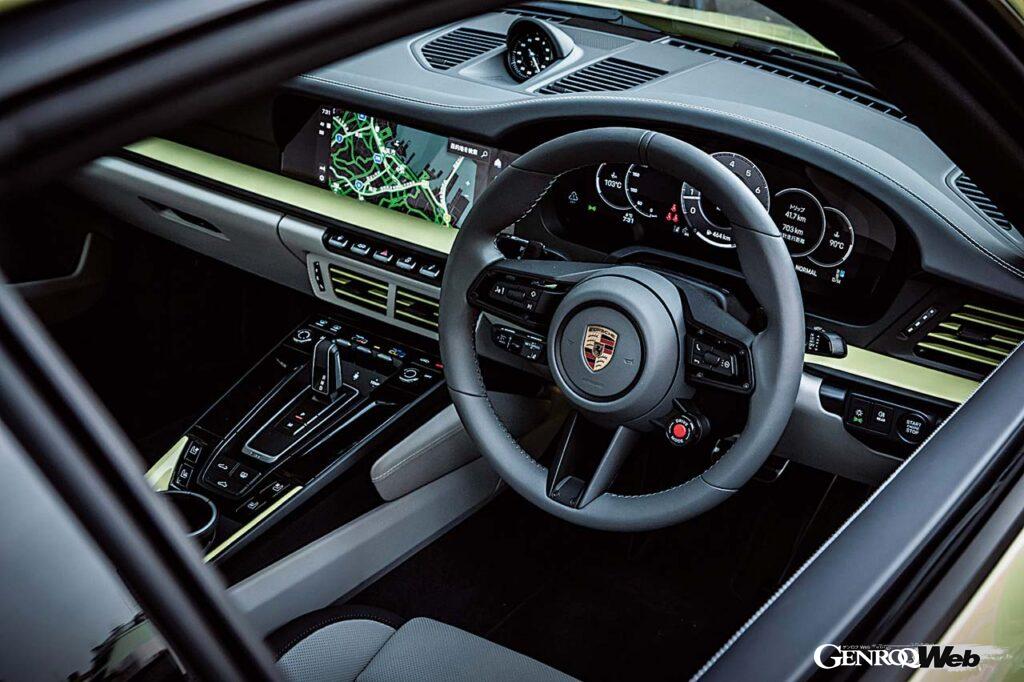
The main changes to the interior include the change from a key-operated starter to a push button, the upgrade to a 12.6-inch curved display instrument panel, and the disappearance of the analogue rev counter that had remained in the centre.
The first test drive took place at the Porsche Experience Center Tokyo (PEC Tokyo) in Kisarazu City, Chiba Prefecture.
I immediately took it out to the handling track, and the first thing I noticed was the change in handling. Simply put, it feels “lighter.”
One of the features of the 992 was the adoption of a wide body, which resulted in wider front and rear treads. This significantly improved rear stability, but the front also became more stability-oriented to match, which personally gave me the impression that the edge, or delicacy, that was slightly reminiscent of the rear-wheel drive vehicle that was present in the 991 was gone. This was an evolution that the 911, which had made it its mission to overcome the imbalance that comes with a rear-wheel drive, was looking to address, but at the same time, it was true that it left me feeling somewhat lonely.
However, the new 911 Carrera’s nose responds very responsively to steering inputs, providing a lightness and sharpness that’s reminiscent of the 997 era. And yet, the rear’s firm grip remains unchanged, making S-curve movements extremely controllable and stable. Changing the driving mode from “Sport” to “Sport Plus” tightens the dampers, making the impression even stronger and more intense, and making the car’s movements feel smaller.
An interior with a modern feel
[2]

[2]
[2] The latest 12.6-inch curved display offers excellent visibility. Another feature of the Type II is that the starter has been changed to a push button. The seats still fit well.
However, there have been no announcements regarding any changes to the suspension, other than the tire brand being changed to Goodyear Eagle F1, and the vehicle weight remains unchanged at 1,520 kg (DIN).
So, although I can’t say anything for sure, when I turned off the ESC in a drift circle, the weight of the rear became apparent, and the car easily went into spin mode with just a tap on the accelerator pedal, whereas with the ESC on, the car’s movement was natural and well-balanced, and it was very easy to control the slide. Of course, it’s not hard to imagine that such electronic assistance adds a spice to the 992 II’s driving experience.
On the other hand, when it comes to the powertrain, even when I stepped on the gas as hard as I could, I couldn’t feel the difference between the 9PS power increase and the 1km/h increase in top speed, but I was able to fully experience the pleasure of revving up straight to the redline, as well as the more than sufficient power and good response.
The true purpose of GT
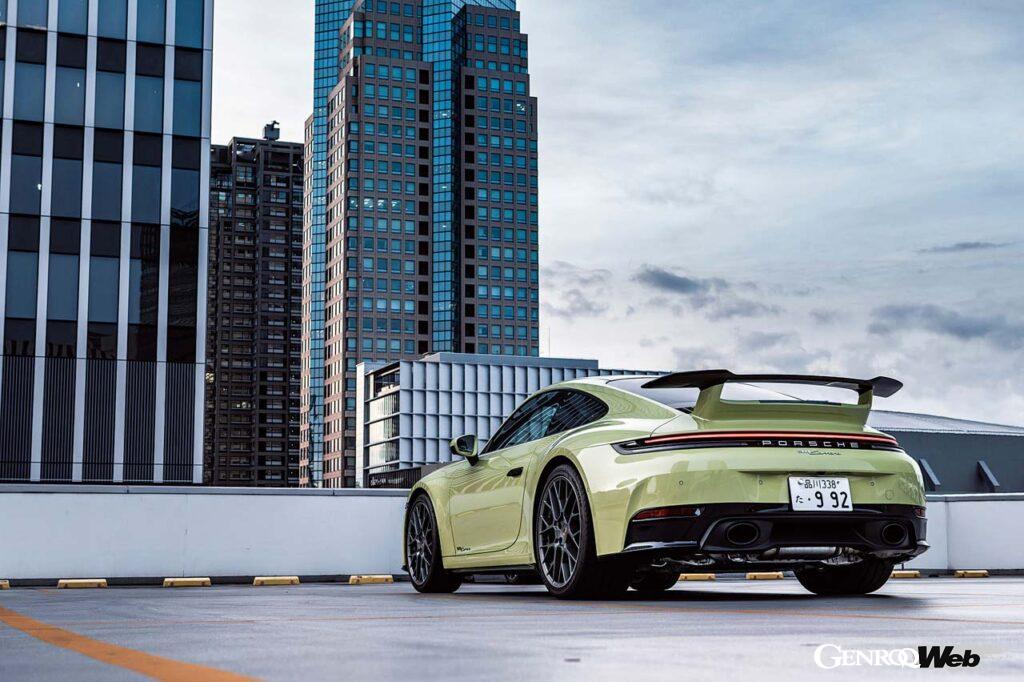
The 992 II seems to have evolved in terms of the GT-like quality of the 911 and its supple ride.
When I covered the Porsche Turbo 50th anniversary event last June, I was told that “The history of the Porsche Turbo is also the history of eliminating turbo lag.” In that sense, the new 3.0-liter twin-turbo may have reached such a level of perfection that there is no need for additional power.
Afterwards, I took a different car out on the public roads, and my impression was the same as I had at PEC Tokyo. Rather, I was able to confirm that its merits remained intact, and that the 911’s true essence, its comfortable ride and suppleness as a GT, remained.
With that in mind, rather than the fact that there were no major changes in specs, I think we should honestly welcome the fact that the 911 Carrera has survived by further improving the 992I. And if this is the bottom line, I feel even more strongly that the Carrera GTS, Carrera T, and GT3 should have improved as well.
REPORT / Yoshio Fujiwara
PHOTO / Kunihisa Kobayashi
MAGAZINE / GENROQ February 2025 issue
SPECIFICATIONS
Porsche 911 Carrera
Body size: Length 4542, Width 1852, Height 1302mm
Wheelbase: 2450mm
Engine: Horizontally opposed 6-cylinder DOHC turbo
Total displacement: 2981cc
Maximum output: 294kW (394PS) / 6500rpm
Maximum torque: 450Nm (45.9kgm) / 2000-5000rpm
Transmission: 8-speed DCT
Drive system: RWD
Suspension type: Front MacPherson strut, rear multi-link
Brakes: Front and rear ventilated disc
Tire size: Front 235/40ZR19, rear 295/35ZR20
Vehicle price: 16.94 million yen
[Inquiries]
Porsche Contact
TEL 0120-846-911
https://www.porsche.com/japan/