
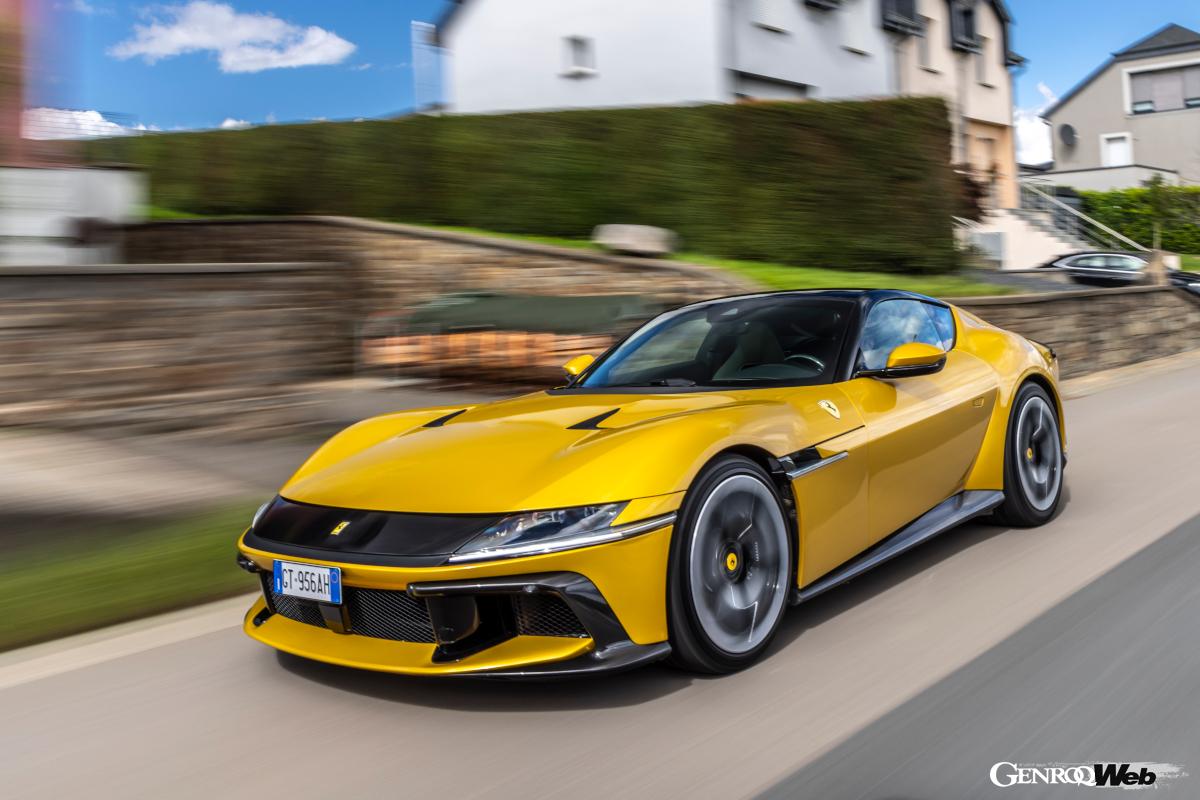
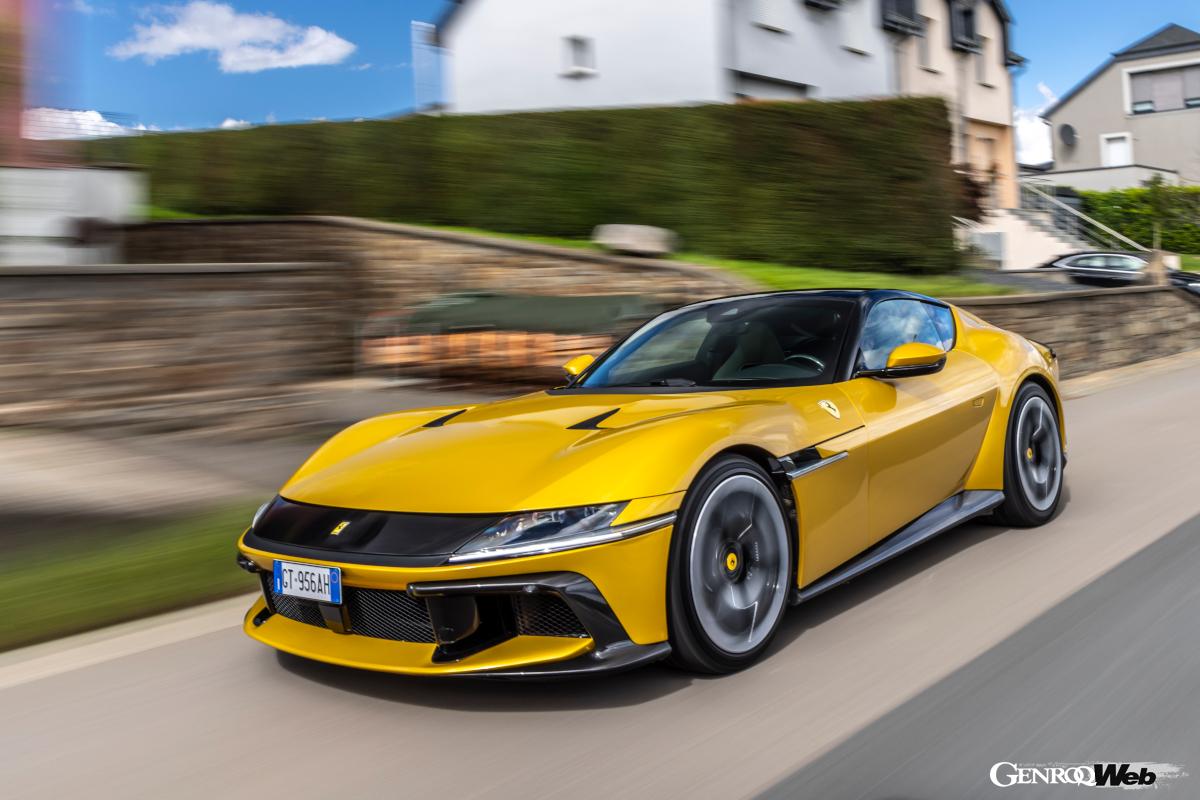
Ferrari 12 Cilindri
The car name “Ferrari 12-cylinder”
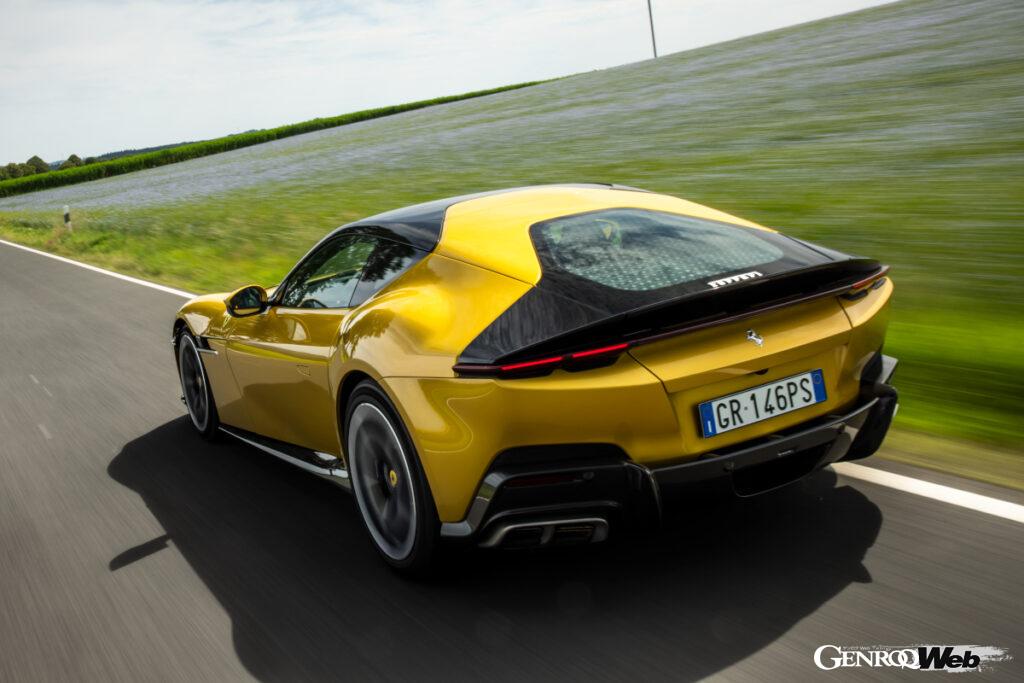
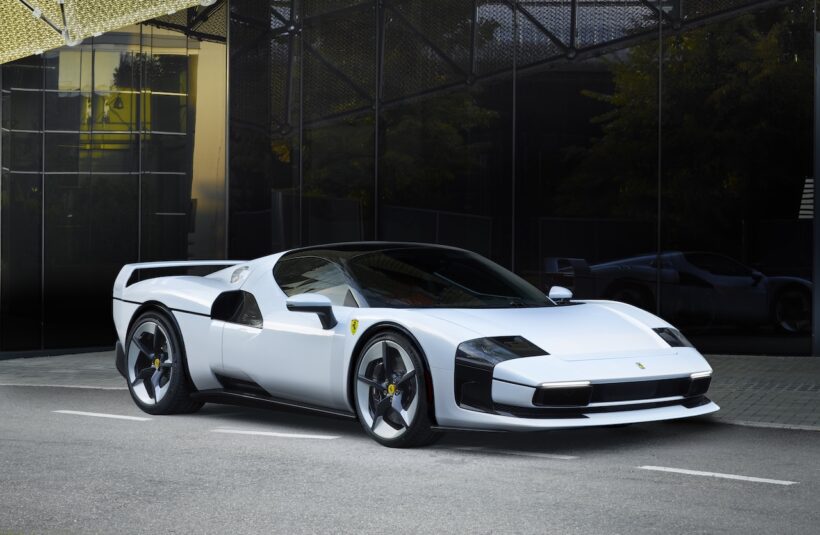
The rear of the roof has a V-shaped line, and the taillights have the same design as the Purosangue and 296GTB.
“12Cilindri.” This is the name of Ferrari’s latest 12-cylinder super sports car. Cilindri means cylinder in Italian. In other words, the name of the car is exactly “Ferrari 12-cylinder.” Since 12 is pronounced “dodici” in Italian, the name of this car is pronounced “Ferrari Dodici Cilindri.”
Although the name is quite straightforward, it is a Ferrari tradition to use numbers related to the number of cylinders or displacement as the name of their cars. This time, they have incorporated not only numbers but also words to bring the engine to the forefront. It seems that Ferrari’s aim is to emphasize the excellence of the engine.
Recent Ferrari 12-cylinder engines use a front-mounted engine that drives the rear wheels, a so-called FR configuration. The 65-degree V12 engine used in the 12 Chilindori is based on that of the limited-production 812 Competizione, which has undergone significant improvements in every aspect. The F140 engine used in the 812 Superfast is fitted with titanium connecting rods, aluminum pistons, rebalanced camshafts, and F1 technology in the valvetrain, further reducing weight, friction, and improving efficiency. As a result, the engine’s maximum rotation speed has been increased to 9,500 rpm, achieving a maximum output of 830 PS.
The design is inspired by past masterpieces

[1]

[2]

[3]
[1] The front design is reminiscent of the 365GTB/4. It is believed that ADAS sensors are built into the panel between the lights. [2] The active aero on both sides of the rear operates between 60km/h and 300km/h. [3] The hood takes up almost half of the overall length. The front and rear fenders are bulging and powerful.
The engine is mounted in the front mid-mounted position, completely inside the front axle, and the 8-speed DCT continues to use a transaxle system mounted on the rear axle. The front-to-rear weight distribution of 48.4 to 51.6 is ideal. The body that encases this mechanism is also a major feature and attraction of the 12-inch Chirindori.
The long nose, typical of a multi-cylinder, FR machine, has generously bulging fenders, giving it the elegance of a cruiser. The headlights are housed in acrylic covers at the tip of the nose, with a black panel connecting the left and right lights. The atmosphere is reminiscent of the 365GTB/4, also known as the Daytona, and in fact Ferrari mentioned the name 365GTB/4 Daytona during its presentation. Designs inspired by classic cars of the past were also seen in the 296GTB/GTS, and this may be a theme of the Ferrari Styling Centre in recent years.
Meanwhile, the rear of the car is a new venture. The line from the roof to the rear fender forms a triangle with the roof at its apex, and small, movable rear spoilers are built into both sides below the rear window. The rear design created by this black panel and triangular roofline is quite innovative. Both the front and rear have a more mature feel, setting them apart from the macho designs that emphasize the sportiness of the previous F12 and 812 Superfast.
Behavior unique to FR

[1]

[2]

[3]

[1] The instrument panel has a symmetrical design. The central display is large and easy to operate. All meters are digital and panel-mounted. [2] The interior is a two-seater, but there is space behind the seats for storing luggage. [3] The lever for switching between reverse and other gears is designed to resemble an old metal shift gate. The Ferrari emblem on the side is a remote control key.
When I opened the door and got in, I was greeted by a scene common to recent Ferraris. The center console is equipped with a large 10.25-inch display, a feature not found in other models, and after operating it casually, I discovered that the seat adjustment section even has a massage function.
As soon as you start driving, you’re surprised at how comfortable it is. The suspension is incredibly supple, with no rough jolts or unpleasant vibrations. Gear changes are also incredibly smooth, so smooth that when driving around town, you might mistakenly think you’re driving a luxury saloon. At first, you’re taken aback by the length of the front nose stretching out in front of you, but it’s surprisingly easy to maneuver, and the car turns just as you want, even around tight corners. The wheelbase is 20mm shorter than the 812 Superfast, and the effect of the four-wheel drive system must be quite significant. The 12-cylinder engine is surprisingly quiet, and it responds instantly to even the most subtle torque changes at low revs, making it a stress-free way to get to the convenience store.
As I entered the winding roads and increased my pace, the previously gentle 12-cylinder engine gradually revealed its true character. Its sharp pickup, linear power response, and rock-solid body rigidity despite its relatively large size, plus brakes that allow for exquisite speed control, all made for a driving experience that felt like it was gripping the road. That said, it was a little different from the exhilarating feeling you get from the SF90 Stradale or 296GTB, which made me want to push it to its limits. This was likely due to the FR-specific behavior that made me feel the distance between the front wheels and the suspension, which offered a smooth ride. The 12-cylinder engine seemed to have an even stronger GT-like character than the previous 12-cylinder FR super sports car. This was also evident in the fact that I didn’t feel fatigued at all, even after driving about 130km straight on public roads.
The 12-cylinder is the soul of Ferrari

[1]

[2]
[1] On the circuit, you can enjoy surprisingly extreme driving with ease. The lightweight body of about 1.5 tons also helps. [2] The F140 V12 engine has been refined for over 20 years. By reducing the weight of moving parts, it has been possible to achieve a speed of 9,500 rpm. The sound at high revolutions is also sensual.
However, that doesn’t mean the 12-cylinder engine isn’t good at hard sports driving. A test drive on a closed course was also available, where the Ferrari 12-cylinder engine excelled. The tachometer shot up to 9000 rpm, and even at the end of a not-so-long straight, it reached over 280 km/h, marking a top speed on par with that of Fuji Speedway. Even in tight corners, the nose lurched inward, and even when the throttle was opened and the tail slid, the car’s movements were easy to grasp and control. This was, of course, thanks to the excellent control, including the Side Slip Control (SSC) 8.0, but its operation was so natural that I was able to immerse myself in maneuvering the car.
While focusing on improving GT performance, it also further enhances performance at the limit. Ferrari has given its latest FR machine an impeccable evolution. Surrounded by the sound of the 12-cylinder naturally aspirated engine at 9000 rpm, I ponder the true meaning behind Ferrari’s choice to name the car “12-cylinder.” Could this really be the final commemorative moment…? No, no, 12-cylinder is the soul of Ferrari. That can’t be. But perhaps there won’t be much time left to enjoy 12-cylinder engines in pure engine cars without a motor. Is that what “Dodici Chilindori” means?
SPECIFICATIONS
Ferrari Dodici Chilindori
Body size: Length 4733 x Width 2176 x Height 1292 mm
Wheelbase: 2700 mm
Vehicle weight: 1560 kg
Engine: V12 DOHC
Total displacement: 6496 cc
Maximum power: 610.5 kW (830 PS) / 9500 rpm
Maximum torque: 678 Nm (59.7 kgm) / 7250 rpm
Transmission: 8-speed DCT
Drive system: RWD
Brakes: F & R ventilated disc (carbon ceramic)
Tire size: F 275/35R21 R 315/35R21
Top speed: 340 km/h
Acceleration from 0 to 100 km/h: 2.9 seconds