

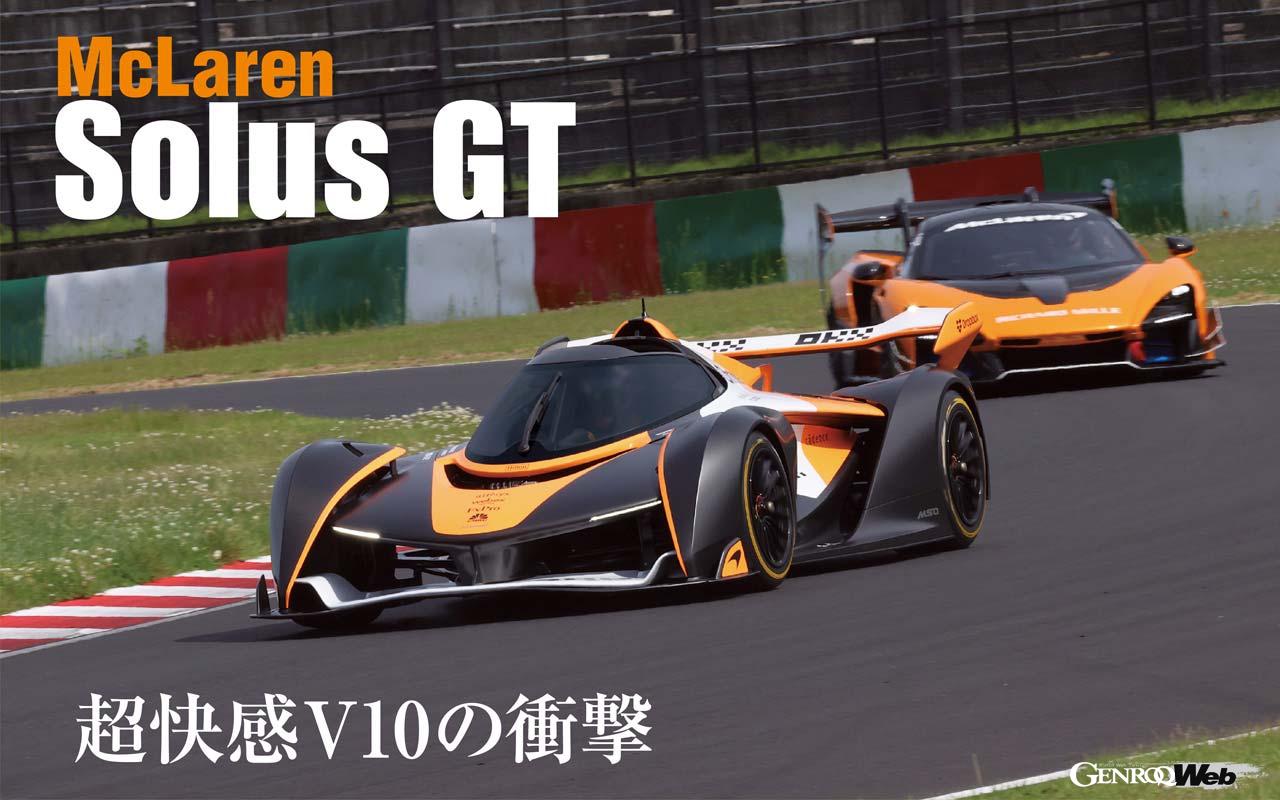
McLaren Solus GT
A McLaren in the center position after a long time
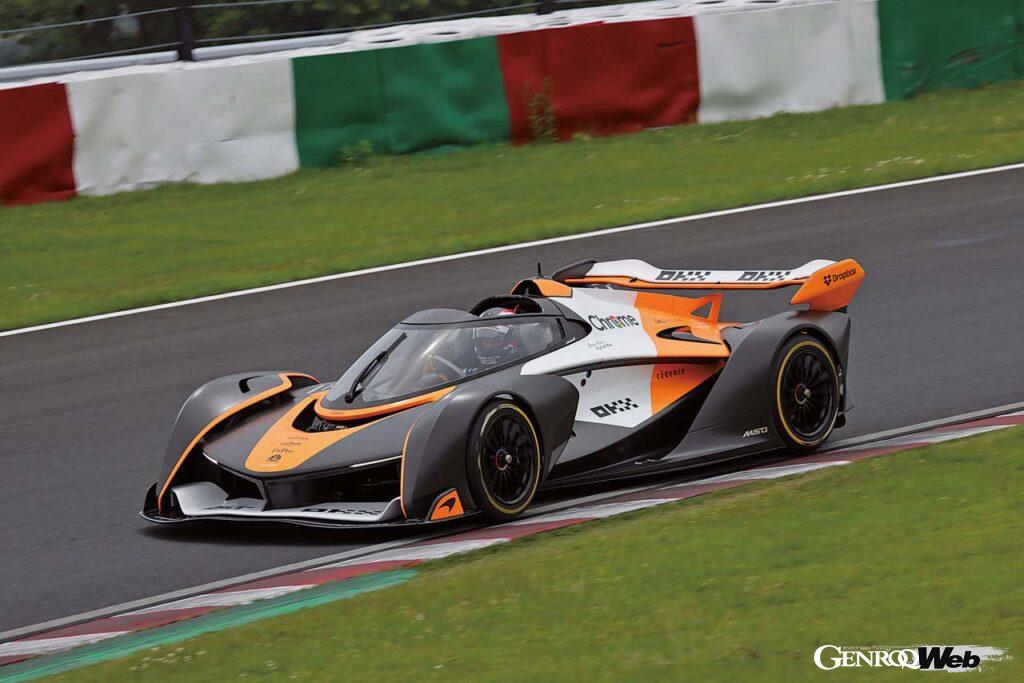
The naturally aspirated V10 engine reaches 10,000 rpm and produces 840 PS. The camshaft is driven by a gear rather than a chain. The transmission is a 7-speed sequential.
I remember it was in 1998, when I participated in the Suzuka 1000km race in a McLaren F1 GTR, and came in second overall. The McLaren F1 GTR was a special car among the GT cars of the time, and what really impressed me was how easy it was to handle. The seat was positioned in the center, so coming from a formula car background, I was able to adopt a very natural driving position.
And now, for the first time in a long while, I’ll be driving a McLaren in the “center position.” It’s the Solarus GT. It’s a special machine, only for the circuit, of which only 25 exist in the world. It weighs just 1,000 kg including the driver, but has 840 PS of power. Just hearing those specs makes me excited. In fact, the owner of the Solarus GT asked me to do a shakedown, so I’ll be driving it for the first time at Suzuka Circuit. It’s a great honor, but at the same time, I’m incredibly nervous. I was so nervous that I couldn’t sleep well the night before.
The fighter jet-like body has a downforce of 1,200 kg
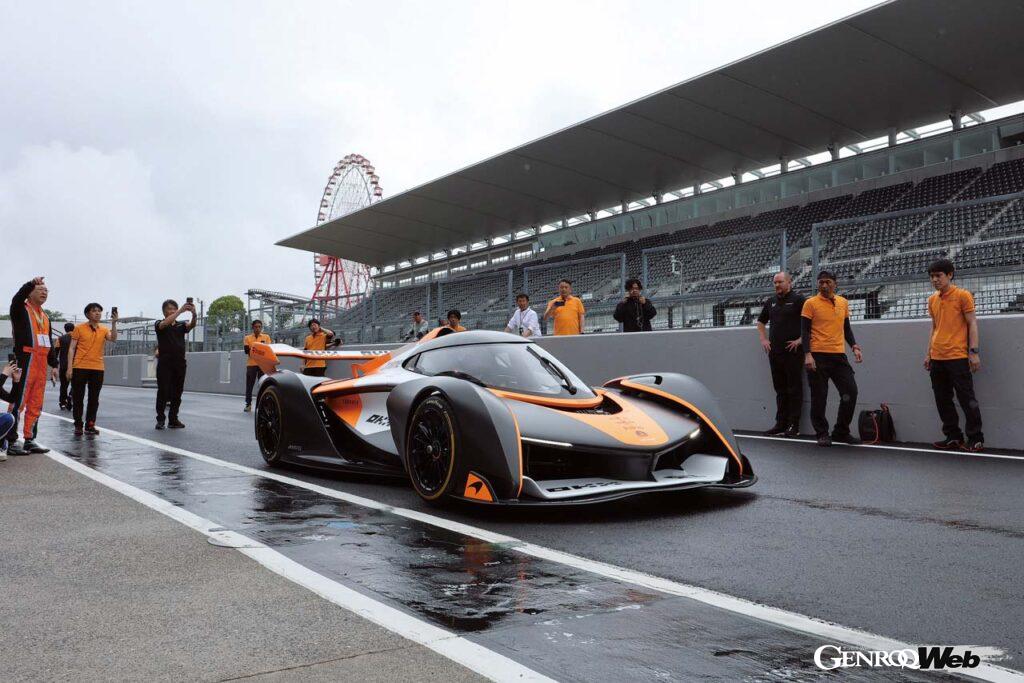
The Solarus GT has a futuristic look, being a real-life version of a virtual machine, but it cannot be driven on public roads.


The shakedown was conducted by the familiar Tetsuya Tanaka. He said that the engine is high-powered yet very easy to handle. The large rear wing and tunnel-like diffuser are visible. Downforce is 1,200 kg.
When I first saw the Solarus GT in the pit at Suzuka Circuit, my first impression was that it felt more like a fighter jet than a car. The cockpit is designed so that you slide it forward to get in, just like a fighter jet canopy. Another distinctive feature is the aero parts. The body, which is made up of mostly curved surfaces rather than parts, looks like a giant wing, and it’s a body design that looks like it will generate a lot of downforce. I heard that the downforce is 1,200kg (!). It generates more downforce than its own weight.
With a car like this, “seat alignment” is important. Once I decided on my position, I realized it was 100% Formula car, not GT car. Adjusting the steering position, pedal position, etc. to my best position made me feel like I was sitting in a McLaren F1 car. This was all the more true because of the tight monocoque with the carbon fiber completely visible.
After deciding on my position, I received a cockpit drill from a McLaren staff member who had come to Japan from the UK for this shakedown. The switches and buttons are similar to those on McLaren road cars, so they’re easy to use. The car is also properly equipped with air conditioning. I’ve always thought that “a car that is comfortable for the driver is a car that can be driven quickly,” and that seems to be true of the Solaris GT.
The most powerful V10 engine ever

Although it has 840 PS, Tetsuya Tanaka says that the throttle is not too sensitive, making it easy to handle.
I started the race feeling quite nervous, but by the time I approached the first corner, my nerves had vanished. This was because the steering and rear end provided clear information about the car’s grip and behavior, and I didn’t feel any engine peakiness. As I increased my pace while warming up the tires, the V10 engine, with its 10,000 rpm rev limit, revved up smoothly. The power, crystal-clear smoothness, and exhilaration in the ultra-high rev range from 7,000 to 10,000 rpm were of a level of excellence that can only be experienced with a racing V10 engine. This feeling, which made me wonder how far it would rev if there was no 10,000 rpm limiter, was something I haven’t experienced since driving the Ferrari F1 V10 in 2003 and the Toyota Group C V10 engine I tested in 1992. I think this V10 engine is of the highest level, and the word “impressive” is appropriate.
Yet, the beauty of this V10 engine is that it is easy to handle. It may be misleading to say that 840 PS is easy to handle, but the setting is not too sensitive to throttle work. This significantly reduces the worry of the rear sliding when exiting a corner.
You can also feel the lightness of the car and the strength of the downforce. These two elements have a big impact on cornering and braking, and the SOLUS GT feels like a Formula car in both respects. I increased my pace with each lap, but the downforce in particular felt like there was “excess” and no understeer or oversteer occurred. Because it is a valuable car, I tried to control my emotions and drive carefully to avoid making any mistakes, but I was able to drive completely within the grip range. Even with such careful driving, I was able to easily get under two minutes, so I wonder what kind of time I could get if I drove at full throttle?
Power, engine characteristics, drivability, and sound. The Solarus GT delivered impressive levels in all aspects. McLaren’s super sports cars have always incorporated racing machine know-how, and the Solarus GT could be said to be the ultimate expression of that.
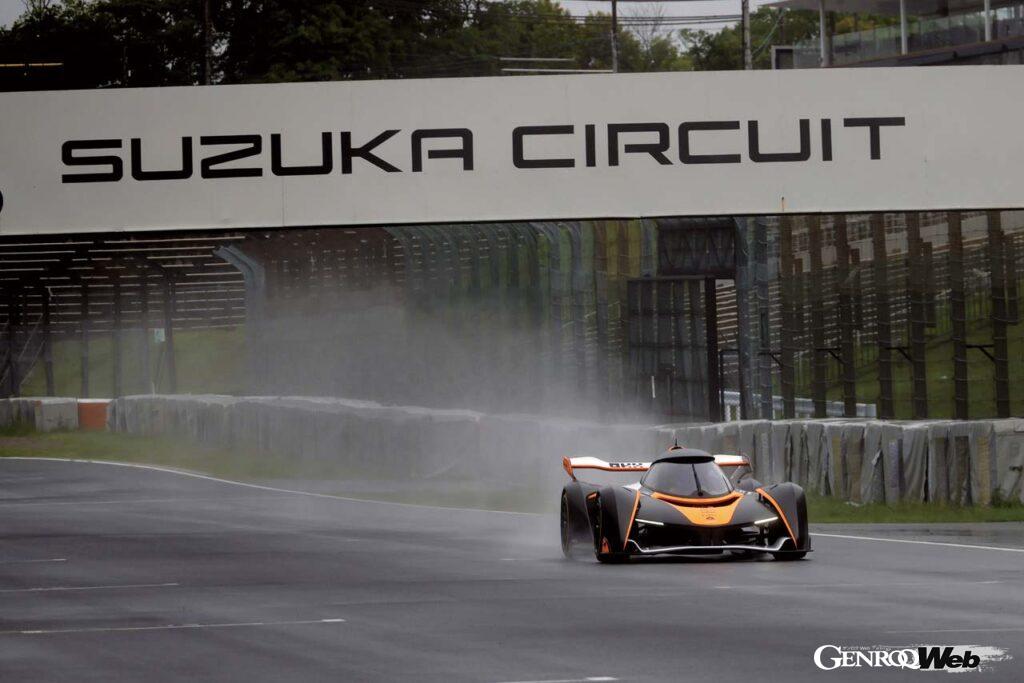
The V10, with a rev limit of 10,000 rpm, produces a clear sound at high revolutions.


The steering is like that of an F1 car, with all switches and meters located on the steering wheel. The seat is made to fit the owner, and the position is adjusted by adjusting the pedals. When viewed from above, the silhouette is reminiscent of a formula car. Like an F1 car, the engine itself is part of the monocoque and provides rigidity.
REPORT / Tetsuya Tanaka
PHOTO / McLaren Osaka (OSAKA McLaren)











![Test drive of Land Rover’s latest off-roader, the Defender Octa, on a dirt course [Video]](https://wheelfeed.com/wp-content/uploads/2025/08/1270-1761529533682.jpg)