
![“Retro yet high-tech?” The latest developments in the evolution of classic cars [Retromobile 2025] Part 2](https://wheelfeed.com/wp-content/uploads/2025/02/2329-1761197119855.jpg)

A return to the basics: a restomod

[1]

[2]
[1] “La Squadra x Zagato AGTX Twin Tail.” [2] The tail section removed. At Shanti Arts & Elegance in 2024. (Photo: La Squadra)
The first is the AGTX Twin Tail, a new sports car developed by La Squadra, a Polish supercar dealership established in 2013, and Zagato, a prestigious Italian coachbuilder.
The AGTX twin tail is inspired by the 1968 sports prototype “Alpine A220,” but is made by wrapping a carbon fiber body over the mechanism of the current “Alpine A110.” It also incorporates Zagato’s iconic double bubble roof. The tail section can be removed in just a few minutes to transform it into a short tail. The removed section is worthy of being displayed as an object in the garage, the team is proud of.
After a prototype was exhibited at the Concorso del Fori in Como in the early summer of 2024, it was shown in action at the Goodwood Festival of Speed in the same summer. Meanwhile, at Retromobile, the first car to be delivered to a customer was unveiled. 19 units will be produced. The price was listed as negotiable at the venue, but European media reports suggest it will be around 650,000 pounds (approximately 125 million yen). It will also be possible to choose the A110S as the base model.
Based on the Ferrari 550 Maranello

[1]

[2]
[1] “Touring Superleggera Veloce 12.” The 5.5-liter V12 engine has been upgraded to 503 PS compared to the 485 PS of the “550 Maranello.” It is paired with a standard 6-speed manual transmission. Acceleration from 0 to 100 km/h is 4.4 seconds, and the top speed is 320 km/h. [2] Veloce 12 interior.
Meanwhile, Touring Superleggera, which, like Zagato, is based in the suburbs of Milan, exhibited the Veloce 12, which attracted a lot of attention.
It was first unveiled at the 2024 Montreal Car Week in the United States and is based on the Ferrari 550 Maranello, which was produced from 1996 to 2002, and reflects a new interpretation by Touring’s chief designer, Matteo Gentile.
The interior is covered in hand-finished leather. Only 30 units are planned to be produced. To become an owner, you must first secure the funds for the 550 Maranello. For reference, as of February 2025, when this article was written, Auto Scout 24, a leading European used car search site, lists 37 cars ranging from 119,900 euros (approximately 19.24 million yen) to 150,000 euros (approximately 24 million yen). By adding 690,000 euros (approximately 110 million yen) to that, you can make this Veloce 12 a reality.
In recent years, this type of modification has come to be called a restomod, a portmanteau of the words “restoration” and “modification.” It is a customization method that incorporates the latest technology and parts while maintaining the original design and atmosphere, and improving performance and comfort.
Nowadays, when we think of Italian coachbuilders, we imagine them providing design and development support for manufacturers and creating one-offs for the wealthy. However, in the past, they also frequently carried out small- to medium-sized customizations. In that sense, restomods are an old business, and if successful, they could be a way for coachbuilders to survive.
Mercedes-Benz Heritage for sale

Mercedes-Benz Heritage Division booth. The 1970 “C111-II” was, of course, not for sale, but rather an exhibition car…
The eye-catching exhibit in the Mercedes-Benz Heritage section was the 1970 four-rotor rotary engine experimental car, the C111-II. The car was meticulously restored by the company and caused a stir when it was shown off at the Pebble Beach Concours d’Elegance in August 2024.
Meanwhile, the 1955 300SL Coupe (W198) is a US-spec car that was exported to New York when it was new. After passing through the hands of several owners, it returned to Germany in 2011, still in its original condition but inoperable. It was acquired by Mercedes-Benz Heritage in 2023. The body has now been restored and is awaiting a silver-gray paint job. Restoration of the interior and drivetrain is also underway.
Other cars on display included the 1971 600 Short Wheelbase (W100) owned by the legendary opera singer Maria Callas, and a 1988 300SL (R107) in the extremely rare Surf Blue paint color with only 3,587 km on the odometer.

[1]

[2]
[1] A 1971 600 Short Wheelbase, formerly owned by Maria Callas and restored by Mercedes-Benz Heritage. Along with the 1955 300SL shown in the opening photo, it was exhibited with the intention of being sold. (Photo: Mercedes-Benz Heritage) [2] A showcase of genuine Mercedes-Benz Heritage parts. A lamp unit for the R107 is displayed like an ornament.
Incidentally, there’s a legend about the aforementioned C111. Despite being a concept car, immediately after its unveiling, customers began to express their desire to purchase it for personal use. One avid collector even presented a blank check to Daimler-Benz (at the time), stating, “I’ll buy it for whatever price you want.” However, the manufacturer still refused to sell the C111. The company, which advocated “the best or nothing,” could not sell a vehicle that wasn’t yet complete.
This time too, the C111-II on display had no price tag attached. On the other hand, both the Karasu 600 and the 1988 300SL were displayed with the status “For sale,” as was the unfinished 1955 SL.

In the “Porsche Classic Partners” corner, a “964RS” currently under restoration was on display.
These German brands’ heritage departments have been further enhancing their services in recent years. At the venue, next to Mercedes, we were also able to see a Porsche 964RS being restored. Porsche Classic Partners has been operating its classic service center in Vélizy, a suburb of Paris, for 10 years now. “There’s no doubt that there are highly skilled craftsmen in this world, especially in bodywork,” acknowledged one staff member. “On the other hand, we use genuine parts and can carry out restorations based on the archives of the manufacturer’s headquarters,” he said, emphasizing the benefits of choosing them.
Vampire GT appears
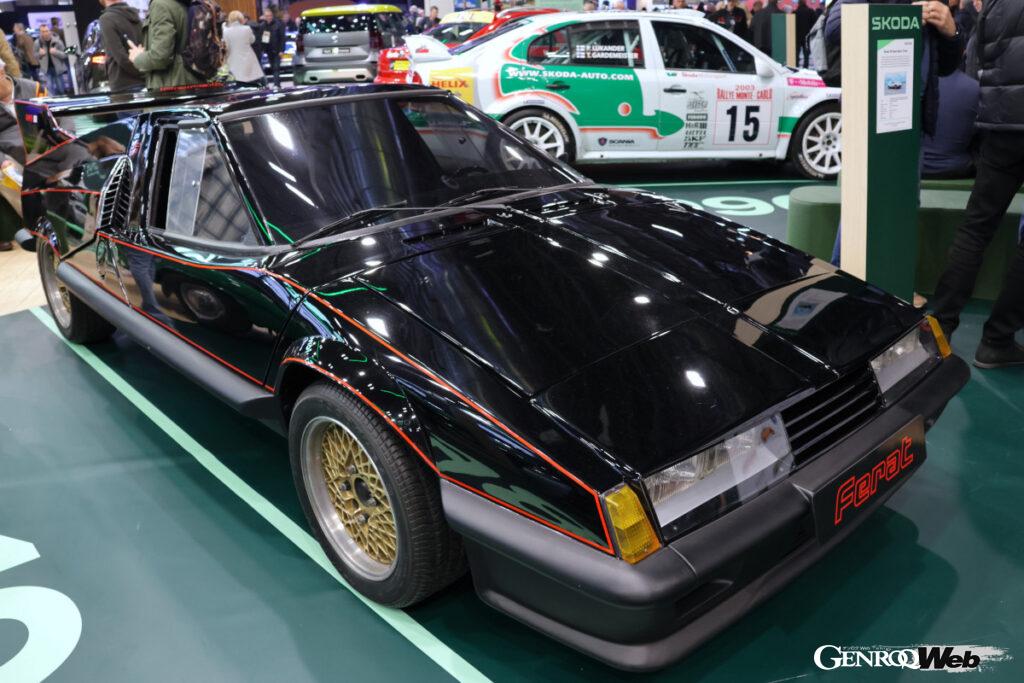
1971/1981 Skoda Sport 110 Ferrato.
Like Porsche, Skoda, a brand of the Volkswagen Group based in the Czech Republic, is also a regular at Retromobile. What caught my eye at their booth this time was a strange coupe.
The exterior design is neither American nor European. Its ostentatiousness is somewhat reminiscent of the DeLorean DMC12 from the movie “Back to the Future,” although the body color is different.
It was called the Skoda 110 Super Sport and was developed in Czechoslovakia in 1971 during the socialist era. After being exhibited in Czechoslovakia, it was also exhibited at the London Motor Show in 1971. Some sources state that the car was intended for export to Western countries, but it remained a concept car.
Later, its appearance caught the eye of Teodor Pisztek, the Oscar-winning costume designer for the film Amadeus, and in 1982 it was chosen as the car for the German horror sci-fi film Ferrat Vampire.
For the photoshoot, Pisztek changed the body color of the 110 Super Sport from the original white to black, changed the front and rear lights, and added a huge rear spoiler.
The plot of the film goes like this: Dr. Marek, a physician, investigates a series of mysterious deaths involving high-performance sports cars developed by Ferrato. He soon becomes concerned when he learns that Mima, a nurse and race-loving car enthusiast, has signed a contract with Ferrato to be a rally driver. As he investigates, Marek makes a shocking discovery: it appears that the cars run on the driver’s blood rather than fuel. Ferrato officials dismiss his claims as absurd, but…

[1]

[2]
[1] A scene from the movie “Ferrato Vampire.” (Photo: Škoda Auto) [2] A scene from the filming of “Ferrato Vampire.” On the left is a Czech-Slovakian Tatra, and the camera car following is a former Soviet luxury car, the Chaika. A Škoda 742 is parked on the side of the road in the oncoming lane. (Photo: Škoda Auto)
This 110 Super Sport is currently housed in the manufacturer’s museum in Mlada Boleslav, Czech Republic. Its specs contrast sharply with its suspicious appearance and scary movie story. The engine, mounted longitudinally mid-mounted on the rear axle, is an 1107cc four-cylinder OHV borrowed from the mass-produced Skoda 110R, and produces just 75 PS. The transmission is also a four-speed manual. On the other hand, it weighed just 898 kg, and its top speed reached 190 km/h. If this is true, it was a fairly efficient car.
Some sources state that the 110 Super Sports was intended for export to Western countries, but even so, it’s hard to imagine that a GT like this was being produced on the other side of the Iron Curtain during the Cold War.
You can sense the prestige of the Czech Republic, which was one of Europe’s leading industrially advanced countries during the Austro-Hungarian Empire. This contrasts with its neighboring country, the former East Germany, which exclusively produced two-stroke vehicles such as the Trabant and Wartburg, which were descended from Auto Union before World War II. It’s the sudden appearance of these intriguing vehicles that makes Retromobile a place you’ll want to visit again and again.
Report/Akio Lorenzo OYA
Photo/Akio Lorenzo OYA, La Squadra, Carrozzeria Touring Superleggera, Mercedes-Benz Heritage, Škoda Auto)












![Hyundai unveils music-driven fully electric concept model in collaboration with MIYAVI [Tokyo Auto Salon 2026]](https://wheelfeed.com/wp-content/uploads/2026/01/4741-1768026274388.jpg)