
Ferrari 849 Testarossa
×
Ferrari SF90 Stradale
A tribute to the racing prototype of the 1970s

849 Testarossa

SF90 Stradale

849 Testarossa
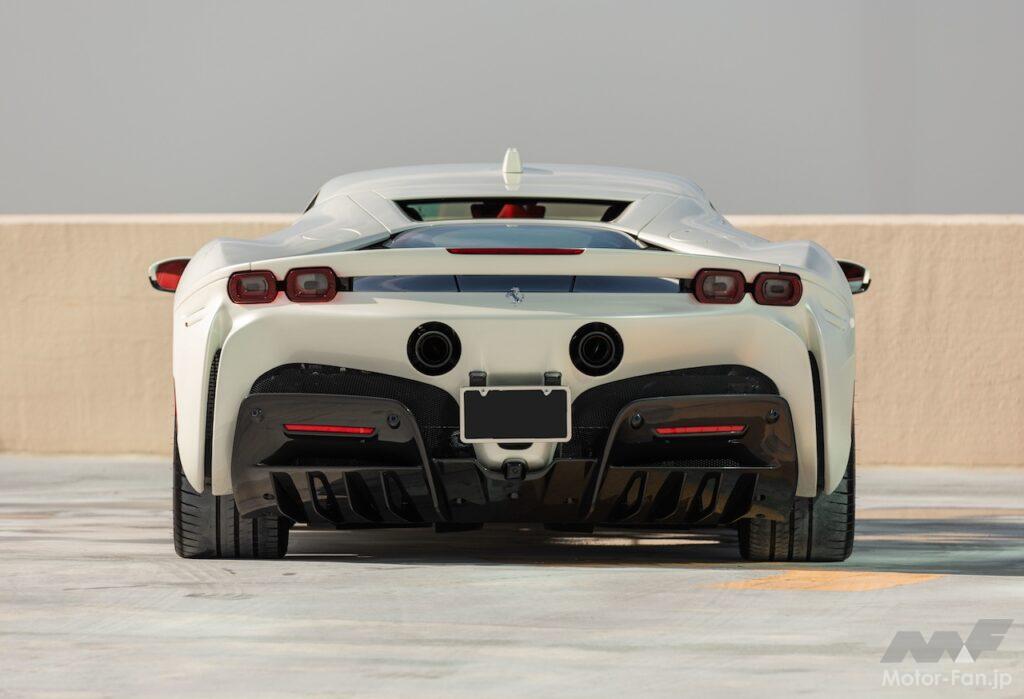
SF90 Stradale
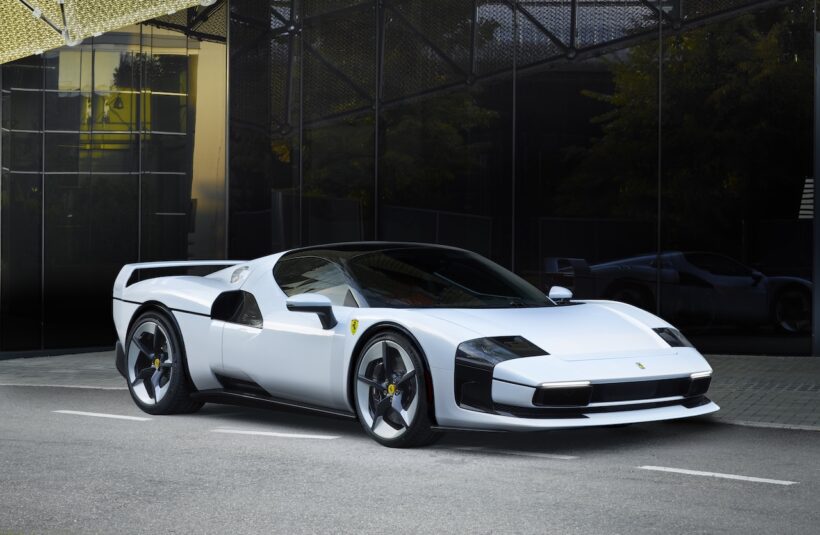
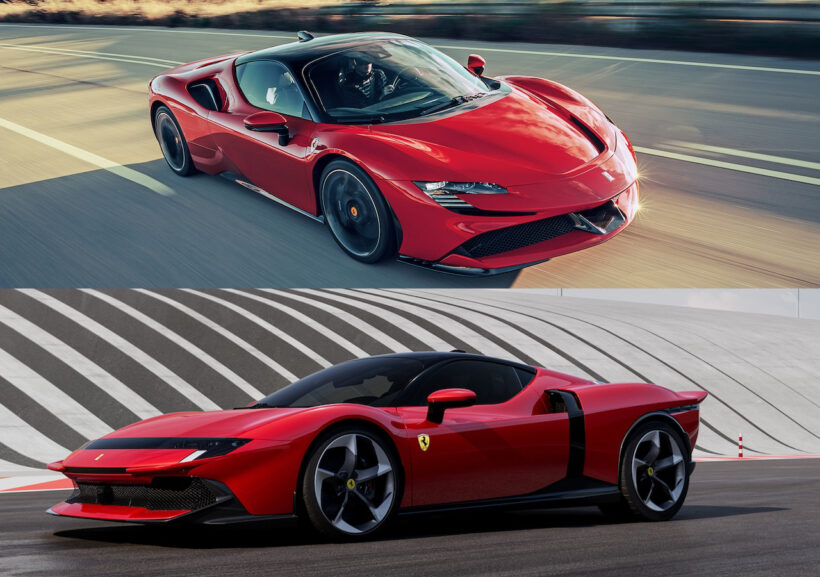
The Ferrari flagship super sports car, the 849 Testarossa, has already been announced for introduction in Japan. As the successor to the SF90 Stradale, the first mass-produced PHEV, Ferrari chose the name “Testarossa,” which comes from the red cam cover of the racing engine.
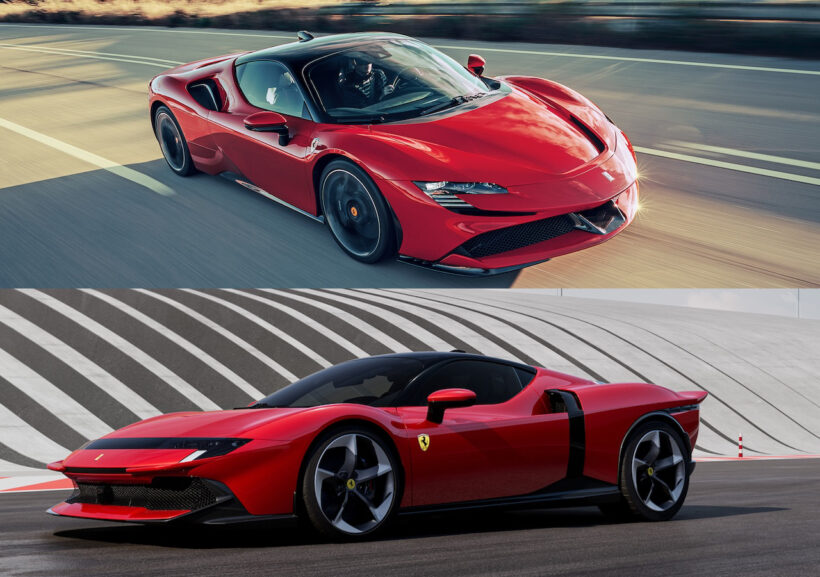
The exterior of the 849 Testarossa follows on from the 12 Chirindori and F80, adopting Ferrari’s latest design, with a black band covering the headlight units. The rear section incorporates twin tails and a movable rear wing that pay homage to the 1970s sports prototype “512S.” Furthermore, the shape of the side sections has been significantly changed to optimize cooling performance and increase downforce.
The 849 Testarossa has been completely reborn from the glamorous SF90, with a more linear impression, but the wheelbase remains the same and the overall length has only been extended by 8mm. Although various components have been updated, extensive weight reductions, including the power unit, have resulted in a vehicle weight of 1,570kg, the same as the SF90.
Ferrari 849 Testarossa
Body size = Length 4718mm x Width 2304mm (including mirrors) x Height 1225mm
Wheelbase = 2650mm
Vehicle weight = 1570kg
Tire size = 265/35R20 (front), 325/30R20 (rear)
Ferrari SF90 Stradale
Body size = Length 4710mm x Width 1972mm x Height 1186mm
Wheelbase = 2650mm
Vehicle weight = 1570kg
Tire size = 255/35ZR20 (front), 315/30ZR20 (rear)
Extensive updates to the 4.0-liter twin-turbo V8

849 Testarossa

SF90 Stradale

849 Testarossa

SF90 Stradale
The 4.0-liter V8 twin-turbo engine mounted in the rear mid of the 849 Testarossa has been improved with improvements to the cylinder head, engine block, exhaust manifold, intake plenum, titanium portholes, and valvetrain system. The engine alone has a power increase of 50 PS from the SF90, achieving a maximum output of 830 PS. The plug-in hybrid system has two motors located in the front and one in the rear, achieving an output of 220 PS with the motors alone. The system’s maximum output reaches an astonishing 1050 PS.
Although the top speed has been reduced by about 10km/h, the 0-100km/h acceleration time is 0.2 seconds faster than the SF90. The lithium-ion battery capacity remains the same as the SF90 at 7.45kWh, and the EV mode range is the same as the SF90 at 25km.
Ferrari 849 Testarossa
Engine type = V8 twin turbo
Displacement = 3990cc
Maximum output = 830PS / 7500rpm
Maximum torque = 842Nm / 6500rpm
Motor output = 220PS
Maximum system output = 1050PS
Transmission = 8-speed F1 DCT
Drive system = AWD
Top speed = 330km/h
0-100km/h acceleration = 2.3 seconds
Ferrari SF90 Stradale
Engine type = V8 twin turbo + hybrid
Displacement = 3990cc
Maximum output = 780PS / 7500rpm
Maximum torque = 800Nm / 6000rpm
Motor output = 220PS
Transmission = 8-speed F1 DCT
Drive system = AWD
Top speed = 340km/h
0-100km/h acceleration = 2.5 seconds
Price increased by approximately 10 million yen from the SF90

849 Testarossa

SF90 Stradale

849 Testarossa

SF90 Stradale
The cockpit design has also been significantly revised from the SF90. Instead of a large display on the center console, a band integrating the main controls and passenger screen has been installed between the top and bottom of the horizontally-oriented dashboard. Trim with a ship’s sail motif has been added to the bottom of the dashboard, and the shift gate is positioned there as if it is floating.
Recently, Ferrari Japan announced the domestic price of the 849 Testarossa, which has a price tag of 64.65 million yen, more than 10 million yen higher than the SF90.
The revival of the iconic name “Testarossa” shows how much importance Ferrari places on this model. Considering the interior and exterior redesign that resembles a full model change, and the updates not only to the power unit but also to the chassis, aerodynamics, and cooling performance, the price is probably justified.