
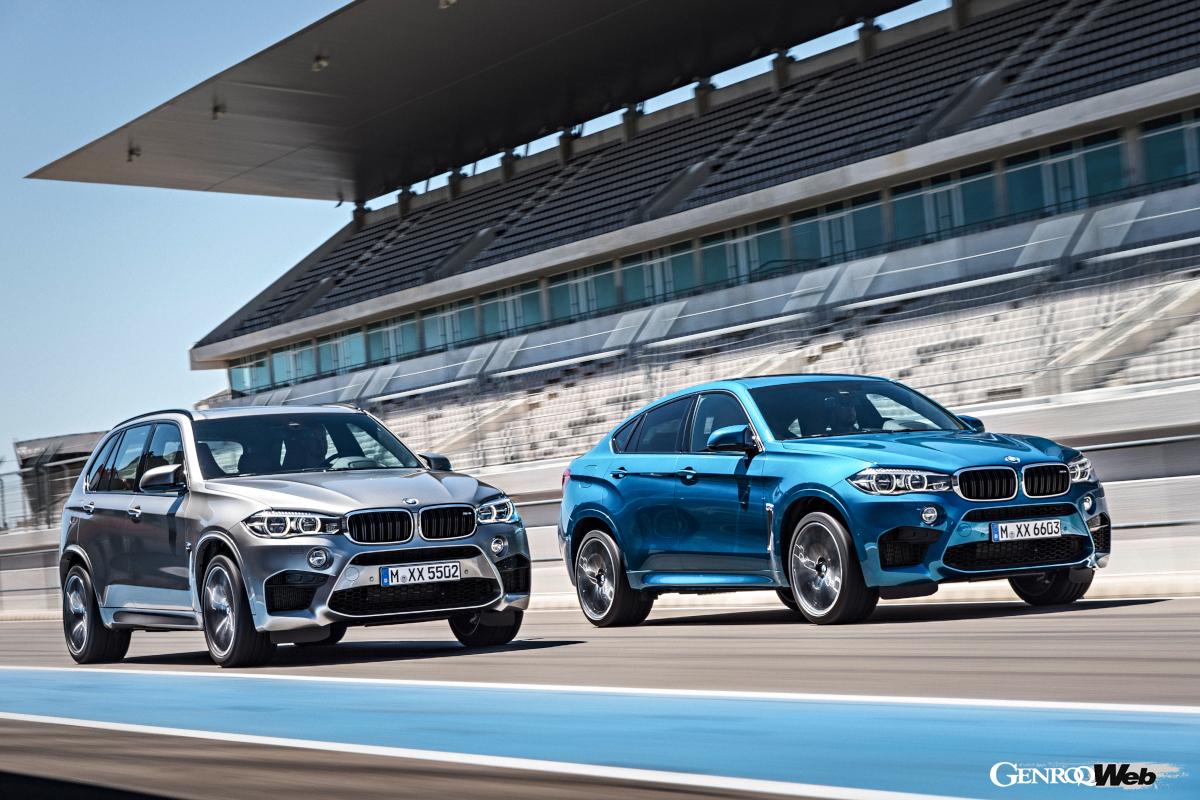
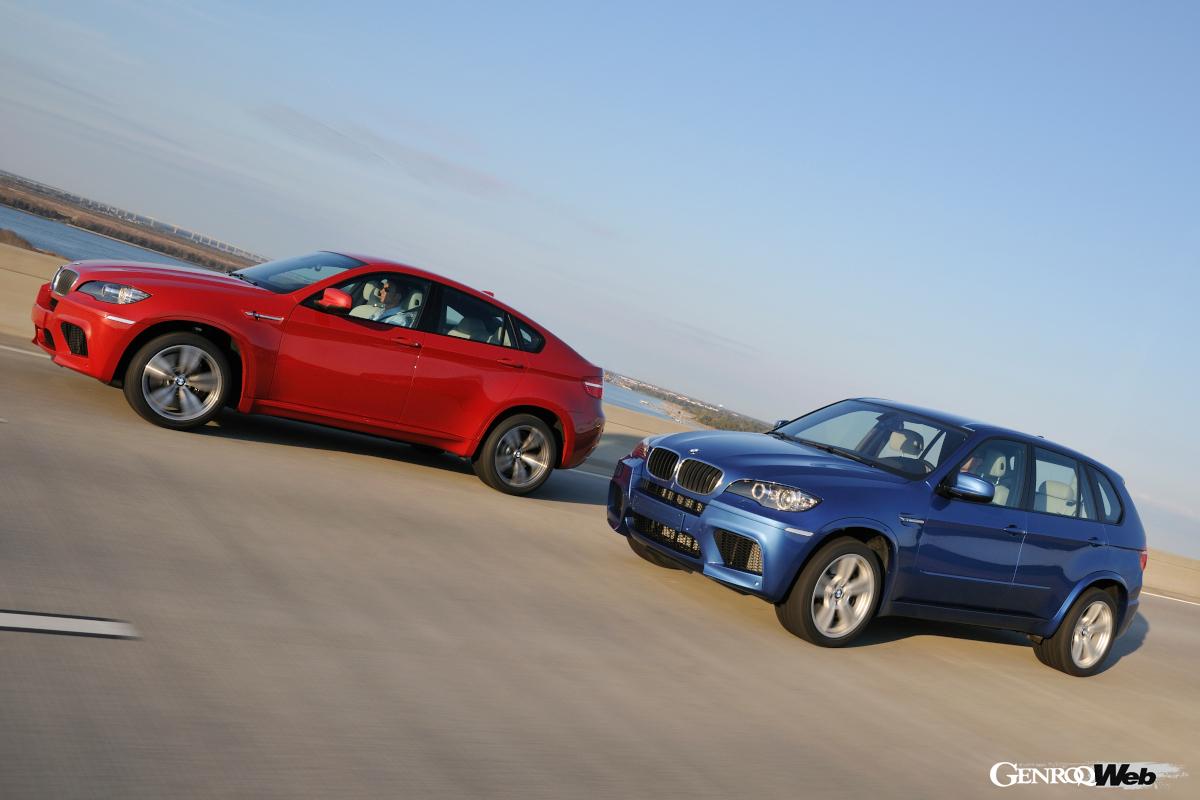
X5 M (F85)
X6 M (F86)
Performance competition among high-end super SUVs


Thanks to the successful launch of the X5 M and X6 M in 2009, the high-end super SUV scene, which had drawn in rivals, entered an era of power and performance competition that rivaled even super sports cars.
Meanwhile, BMW unveiled the third-generation X5, the F15, at the 2013 Frankfurt Motor Show. While the basic structure itself hasn’t changed much from its predecessor, as can be seen from the 2935mm wheelbase and the same front and rear treads, the body design, designed by Joji Nagashima, has evolved significantly into BMW’s latest style, including a new front mask that integrates the headlights and kidney grille. Furthermore, weight reduction efforts were made in various areas, resulting in a weight loss of nearly 100kg, and aerodynamic improvements, such as the addition of air breathers behind the front fenders, have also led to improved drivability, which has also been a hot topic.
The coupe version of the X6 (F16 model) will debut at the Paris Motor Show in October 2014, and BMW will announce the 2015 models, the X5 M and X6 M, at the Los Angeles Motor Show in November.
Incredible performance despite weighing over 2.3 tons

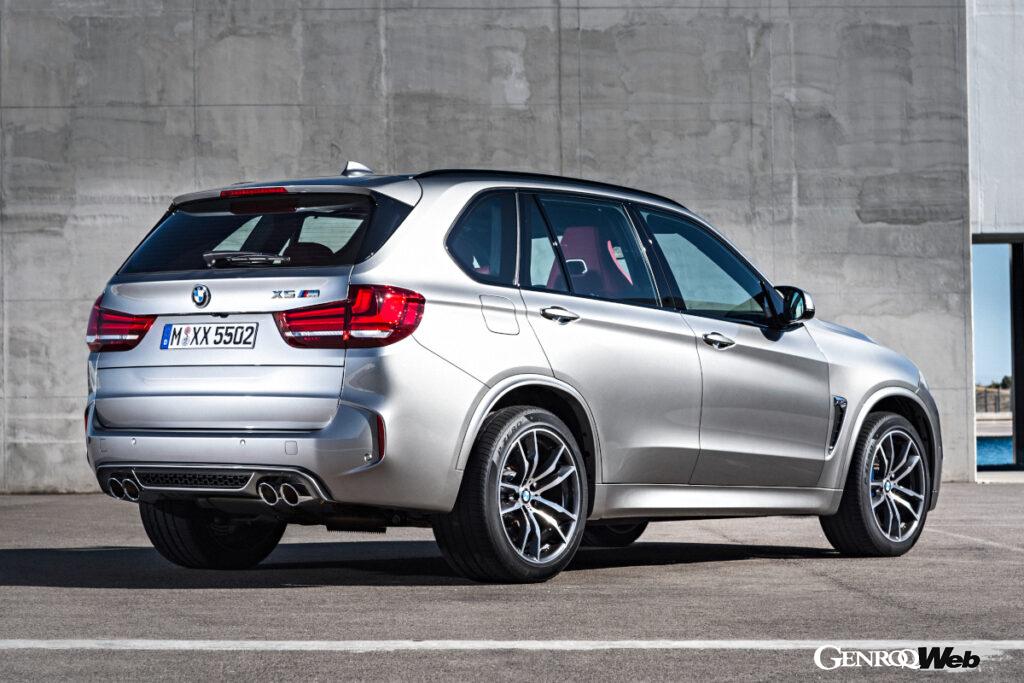
Its greatest feature is its 4,395cc V8 DOHC turbo “S63B44T2” unit manufactured by BMW M GmbH. This is an improved version of the V8 turbo with M TwinPower (twin-scroll) turbo and Valvetronic that was installed in the M5 and M6, producing a maximum output of 575 PS/6,000 rpm and a maximum torque of 750 Nm/2,200-5,000 rpm, exceeding the M5. It is also the most powerful engine ever used in a BMW four-wheel drive model, and is coupled with an eight-speed torque converter automatic transmission, a first for an M model. Despite their massive weight of 2,360 kg, both the X5 M and X6 M achieved astonishing performance, with 0-100 km/h acceleration in 4.2 seconds.
Despite this, the car is also environmentally friendly, with fuel economy improved by 20% thanks to the addition of an auto engine start/stop function and improvements to the efficiency of each part. CO2 emissions have also been reduced by 20% to 258g/km.
Meanwhile, the chassis is equipped with a specially tuned BMW xDrive that can distribute drive between the front and rear axles in the range of 0-100% (and can also be optimized for left and right through Dynamic Performance Control). Furthermore, improvements have been made to the front double wishbone suspension to increase the camber angle and strengthen the bearings, among other improvements to withstand the high power and weight.
A sporty and luxurious M model worldview


The interior comes standard with an M-specific meter panel using black panel technology, M sports seats in BMW Individual Merino leather, and a leather-finish dashboard, creating a sporty and luxurious M model-like atmosphere.
Another feature is the extensive safety equipment, including collision avoidance and damage mitigation braking with pedestrian detection, forward vehicle approach warning, lane departure warning, BMW head-up display, and BMW SOS call, which connects via the vehicle’s communication module.
These improvements were also made to the X6 M. The X5 M was given an F85 model, and the X6 M was given an F86 model, both of which were given separate model numbers.
Both the X5 M and X6 M were introduced to the Japanese market immediately after their launch. Sales continued until production ended in 2019, and they were well-received for being able to select the steering wheel position on either the left or right side, which was unusual for an imported car.











![The S-Type, widely regarded as Bentley’s masterpiece post-war saloon [Bentley 100 Years of Car History]](https://wheelfeed.com/wp-content/uploads/2025/11/4703-1762127546348.jpg)