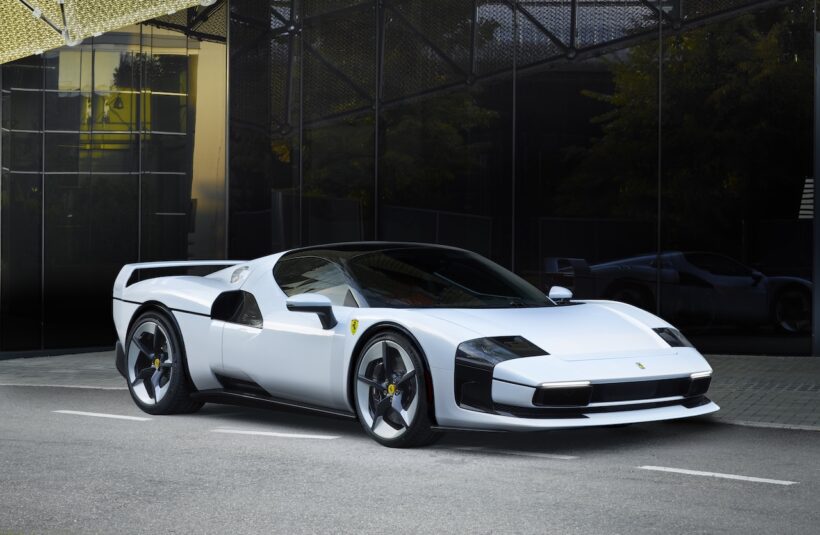


Ferrari Daytona SP3
Ferrari 812 Competizione A
Ferrari Purosangue
Immerse yourself in the sensual sound of the F140 unit
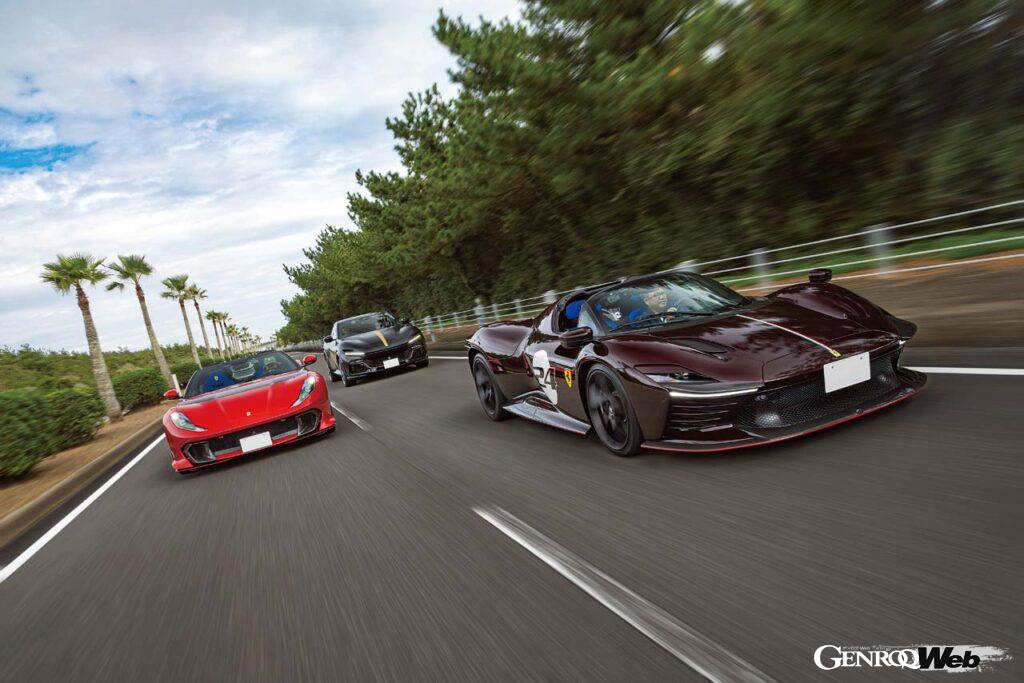
All of the cars on display are owner-owned vehicles, including a rare Daytona SP3, a limited-edition 812 Competizione A, and the latest model, the Prosangue. There will likely never be another opportunity to see such a diverse lineup of 12-cylinder Ferraris.
The legendary F140 naturally aspirated V12 engine originated in the Ferrari Enzo. For road cars, it began with the B series (Enzo), and has now progressed through eight generations, starting with the H series (812 Competizione, Daytona SP3, 12 Chilindori) and then the I series (Purosangue) in alphabetical order (however, the D series was for the FXX. See separate article for details). It is clear that the H series is the pinnacle of the fierce yet sensual V12.
Ahead of the 12 Chilindori’s arrival in Japan, we were fortunate enough to be able to test three of the latest models, equipped with a Maranello-made 65-degree V12 engine, in the order of their debut: the 812 Competizione A (Aperta), Daytona SP3, and Purosangue, all together at the same time. This was the perfect “three-way show” to see the progress of the F140, the most popular V12 engine in Ferrari history. Incidentally, all of these cars are owner-owned vehicles, and this was their first “owner-approved” media appearance.
Even so, these three Prancing Horses are in a class of their own. Any enthusiast will immediately understand that they are all tailor-made, and the “meticulous attention to detail” that will be described later for each model even suggests a personal intimacy with the design team in charge. I have accompanied several tailor-made configurations in the spacious dedicated room at Centro Stile, but I have never witnessed such meticulous and detailed orders. These are valuable examples that not only demonstrate the trust between the owner and the team, but also the owner’s “uncompromising love for the Prancing Horse.”
Ultra-premium Daytona SP3

[1]

[2]

[2]

[3]
[1] It is equipped with the F140HC engine with a maximum output of 840 PS, which is also installed in the 812 Competizione. Manzoni’s signature is on the intake! [2] The instrument panel design is said to be inspired by the 330 P3/4 and 312P. The seats are integrated into the chassis, so the driving position is adjusted from the pedal box. [3] The chassis and body shell are made of carbon composite, incorporating technology from F1. The beauty of the design is breathtaking.
“Well, feel free to start with any one you like,” the owner said after we had finished taking photos for the magazine. Of course, that was what I had come all the way there for, so I was itching to ride it, but when he said it so simply, I was taken aback. “Let’s start with the ‘tame’ one…” What an extravagant request!
First, I climbed into the modern yet classic Purosangue, finished in Nero Opaco (matt) Galaxy (with flakes) with a gold center line. Although I’d already test-driven the Purosangue for over 2,000 km, once I decided on my driving position, buckled my belt, and gripped the carefully designed steering wheel, my “motivation switch” was naturally flipped on. Just because the seating position is high and there are many doors, this is still a Maranello-made sports car.
However, the I-series F140 reduces its power at high revs slightly, but instead uses that power to increase torque at low revs. Maranello would never call the Purosangue an SUV, but with a vehicle weight of over 2 tons and owners who use it like an SUV (for example, pulling a dolly with a hitch member and a 250LM), the settings were designed to prioritize practical use. The engine feel is light and smooth, and the sound is assertive but understated. However, a pleasant vibration is constantly transmitted to the sole of your right foot, and the feeling of being directly connected to the engine further enhances the feeling of switching it on.
The sensual 812 Competizione A makes you think you can die.

[4]

[5]

[5]
[4] The 65-degree V12 engine has been fully evolved to achieve 830 PS/9,500 rpm. Its sound is both ferocious and sensual. [5] The sporty instrument panel design is reminiscent of the 812 Superfast. The door panels have been redesigned to reduce weight.
When it comes to steering, your hips and buttocks become one with the rear wheel through the seat, and combined with the sense that you can position the front wheel wherever you want with your arms, you feel an ultimate sense of oneness with the car. The Puro Sangue is positioned the furthest from the GT in the road car lineup, but once you head out onto a country road, it transforms into one of the best sports cars of the modern era.
I switched to one of the 599 812 Competizione A’s in the world, featuring a vibrant gradation from red metallic to black galaxy. This particular car also boasted what could only be described as a “fiercely tailor-made” spec. The spec plate on the back of the rear trunk contained an unprecedented number of characters. It was so small I could barely read it, so I had to take a photo and enlarge it. Many of the items lacked names, simply labeled “Extra Range.” Incidentally, the name of the main body color was also unique: “Rosso Knob.” Number 23, of course, was the 1967 Daytona 24 Hours champion number (330P4). The carbon fiber roof panel had been removed beforehand, and the top was stored in a compartment. This was my first time driving the car with the top down; in fact, it was my first time driving the 812 Competizione A since I tested the Berlinetta in the rain at Fiorano three years ago.
With the roof removed, various noises, including the engine roar, poured relentlessly into the cabin. Switching from the Pro Sangue, I was impressed by its lightness from the first roll of the tires. And of course, despite the extremely high degree of freedom of the front legs, there was a sense of having one’s feet firmly planted on the ground. I put my strength into my right foot, remembering how impressed I was by the ingenuity of the chassis control in the rain at Fiorano.
What an engine! With its bottomlessly sharp rotation feel from 4000 rpm onwards and the sound of it cooperating with all its might as it reaches the peak, this is surely the best Maranello engine symphony of all time in a road car. Not only is the sweet screaming in the high rev range pleasant to the ears, but even the “chirp” in the low rev range is pleasing to the ear. I’ll go ahead and say it, I think the 812 Competizione A is the model that best allows you to experience the sensuality of the F140.
Pro Sangue provides the ultimate ride comfort

[6]

[7]

[7]
[6] The F140IA V12 engine is set to produce torquey characteristics from low revolutions. It produces a maximum output of 725 PS at 7,750 rpm. [7] It features a modern cockpit design, typical of the latest Ferraris. The 10.2-inch front passenger display is also full of playfulness.
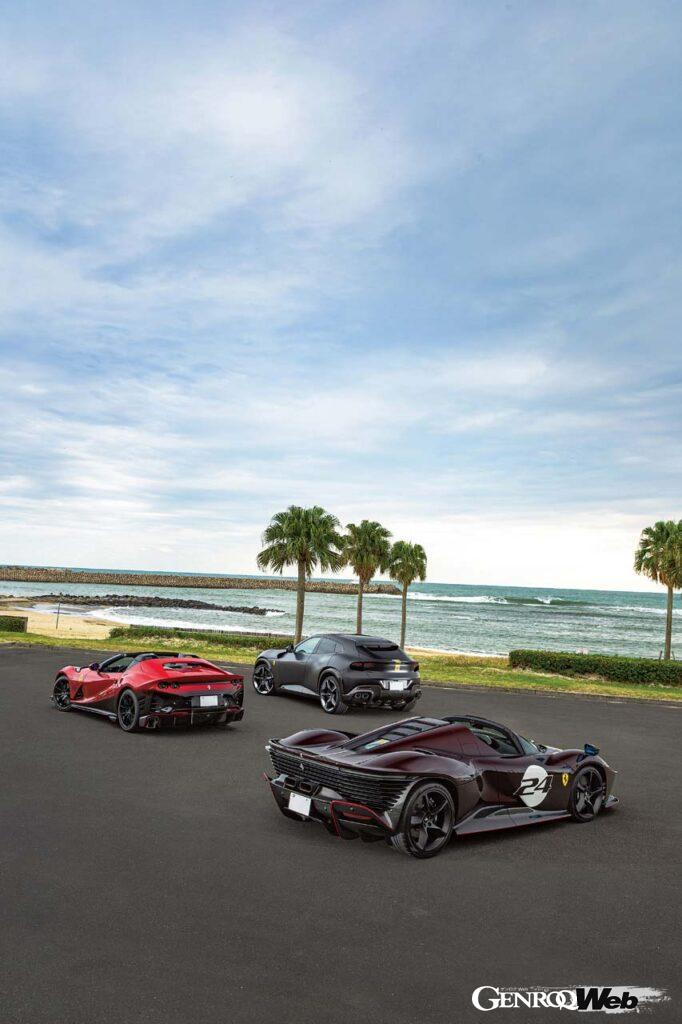
The SP3, which is a hypercar but is extremely easy to drive, the 812 Competizione A, which produces an extremely exciting sound, and the Purosangue, a stunning super sports car. The differences in their personalities are remarkable.
Finally, the much-anticipated Daytona SP3, also being tested in Japan for the first time. The level of tailoring on this particular car was simply amazing. Its body color (glossy red carbon fiber) gradually changes from deep red visual carbon fiber to black toward the roof, the narrowest tricolore stripes ever drawn to match the width of the emblem, and even the number 24, the car’s second-place finish at Daytona, are just some of the special touches. It’s impressive to hear that some of these touches were approved by Centro Stile boss Flavio Manzoni.
Naturally, I had the roof panel removed. As there was no storage space, I temporarily evacuated it to the Pro Sangue. I climbed in, excited by the bright blue seat fabric, reminiscent of sports racers from the 1950s and 1960s. The seating position, which was completely different from the two front-engine cars, and the tight feeling that came from the tension had me on the edge of my seat even before starting the engine. It was as if my motivation switch had been flipped on; my heart was beating so fast that I was worried the switch would be pushed in and never turn back on.
Compared to the previous two cars, which had ample freedom in the front wheels due to their front-mid position, this one has an incomparably greater sense of freedom. It’s light, well-controlled, and incredibly reassuring. And of course, it moves precisely and sharply. This is what it means to “ride as you want,” and what’s more, the rear-mounted powertrain, together with the rear wheels, gives the feeling of being one with your back and hips, so you can almost feel as if you’re moving. With a well-designed rear-mid engine car, body size is irrelevant. Naturally, the engine feel itself is the most extreme. Combined with the lightness of the body, the power is impressive, leaving no room for enjoyment at high revs.
To my surprise, I thought the ride was better than the 812 Compe A. It felt more integrated and lighter, making it easier to handle. In addition, although the sound was the loudest, it had a more subdued extension and a shorter, fuller aftertaste. In terms of the sensuality of the engine, the front-mid layout was definitely an advantage.
REPORT / Jun NISHIKAWA
PHOTO / Kiyoshi NISHINO
MAGAZINE / GENROQ March 2025 issue
SPECIFICATIONS
Ferrari Daytona SP3
Body size: Length 4686, Width 2050, Height 1142mm
Wheelbase: 2651mm
Dry weight: 1485kg
Engine type: V12 DOHC
Total displacement: 6496cc
Maximum power: 618kW (840PS) / 9250rpm
Maximum torque: 697Nm (71.1kgm) / 7250rpm
Transmission: 7-speed DCT
Drive system: RWD
Suspension: Front and rear double wishbone
Brakes: Front and rear ventilated disc
Tire size: Front 265/30ZR20, Rear 345/30ZR21
Top speed: Over 340km/h
Acceleration from 0 to 100km/h: 2.85 seconds
Vehicle price: ──
Ferrari 812 Competizione A
Body size: Length 4696mm, width 1971mm, height 1276mm
Wheelbase: 2720mm
Dry weight: 1487kg
Engine type: V12 DOHC
Total displacement: 6496cc
Maximum power: 610kW (830PS) / 9500rpm
Maximum torque: 692Nm (70.6kgm) / 7000rpm
Transmission: 7-speed DCT
Drive system: RWD
Suspension: Front and rear double wishbone
Brakes: Front and rear ventilated disc
Tire size: Front 275/35ZR20, rear 315/35ZR20
Top speed: Over 340km/h
Acceleration from 0 to 100km/h: 2.85 seconds
Vehicle price: ──
Ferrari Purosangue
Body size: Length 4973, width 2028, height 1589mm
Wheelbase: 3018mm
Dry weight: 2033kg
Engine type: V12 DOHC
Total displacement: 6496cc
Maximum output: 533kW (725PS) / 7750rpm
Maximum torque: 716Nm (73.0kgm) / 6250rpm
Transmission: 8-speed DCT
Drive system: AWD
Suspension: Front double wishbone, rear multi-link
Brakes: Front and rear ventilated disc
Tire size: Front 255/35ZR22, rear 315/30R23
Top speed: Over 310km/h
0-100km/h acceleration: 3.3 seconds
Vehicle price: 47.66 million yen