
Hyundai IONIQ 9
The third model in the Ionic series

The Ioniq 9 had its world premiere at Goldstein House in Los Angeles, USA. It was developed as the third model in Hyundai’s fully electric model line, the Ioniq.
Hyundai Motor Company has unveiled the Ioniq 9, a spacious, three-row crossover SUV that combines cutting-edge design with innovative fully electric powertrain technology.
Hyundai held a launch event for the Ioniq 9, its third model following the Ioniq 5 and Ioniq 6, at the Goldstein House in Los Angeles, a building known as a representative example of mid-century modern architecture. At the event, Hyundai reiterated its intention to launch 23 EV models into the market by 2030.
The Ioniq 9 features three rows of seats that can accommodate seven people and was developed for customers who want practicality and versatility in an EV. Hyundai Chairman and CEO Chang Jae-hoon explained the Ioniq 9 concept as follows:
“The Ioniq 9 embodies Hyundai Motor Company’s deep commitment and confidence in the electrification of its lineup. Developed based on the highly acclaimed Electric Global Modular Platform (E-GMP), it delivers superior driving performance and spacious interior space. It will provide unique value to our customers and solidify our leadership in the global EV market.”
Aerodynamic exterior
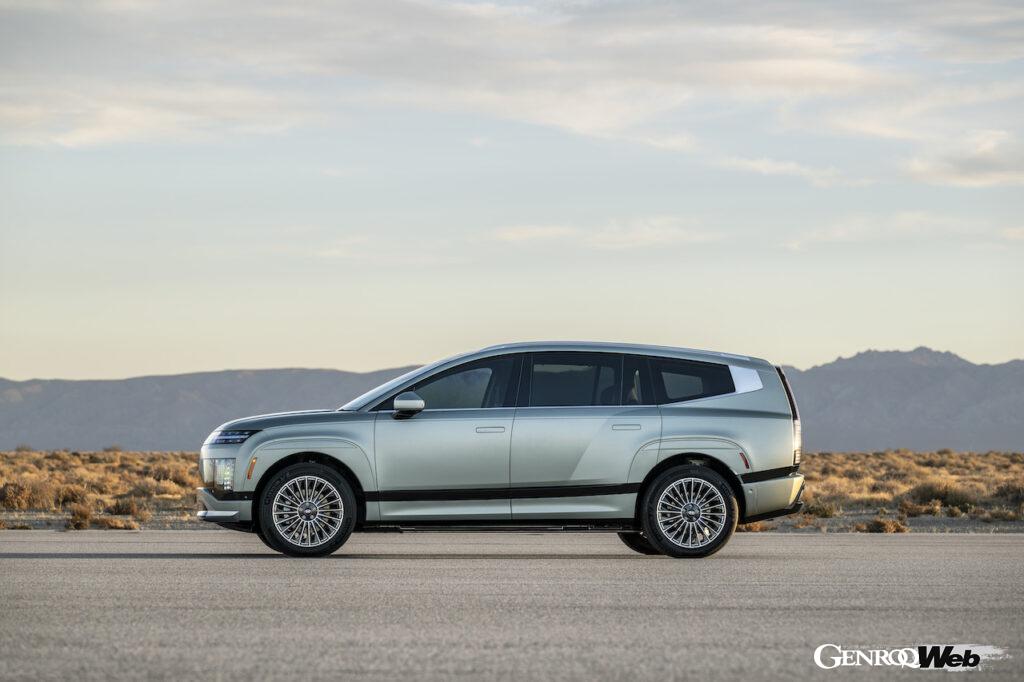
By eliminating protrusions, including antennas, from the body, the model equipped with digital side mirrors achieves a Cd value of 0.259, achieving the improved efficiency required for a fully electric model.
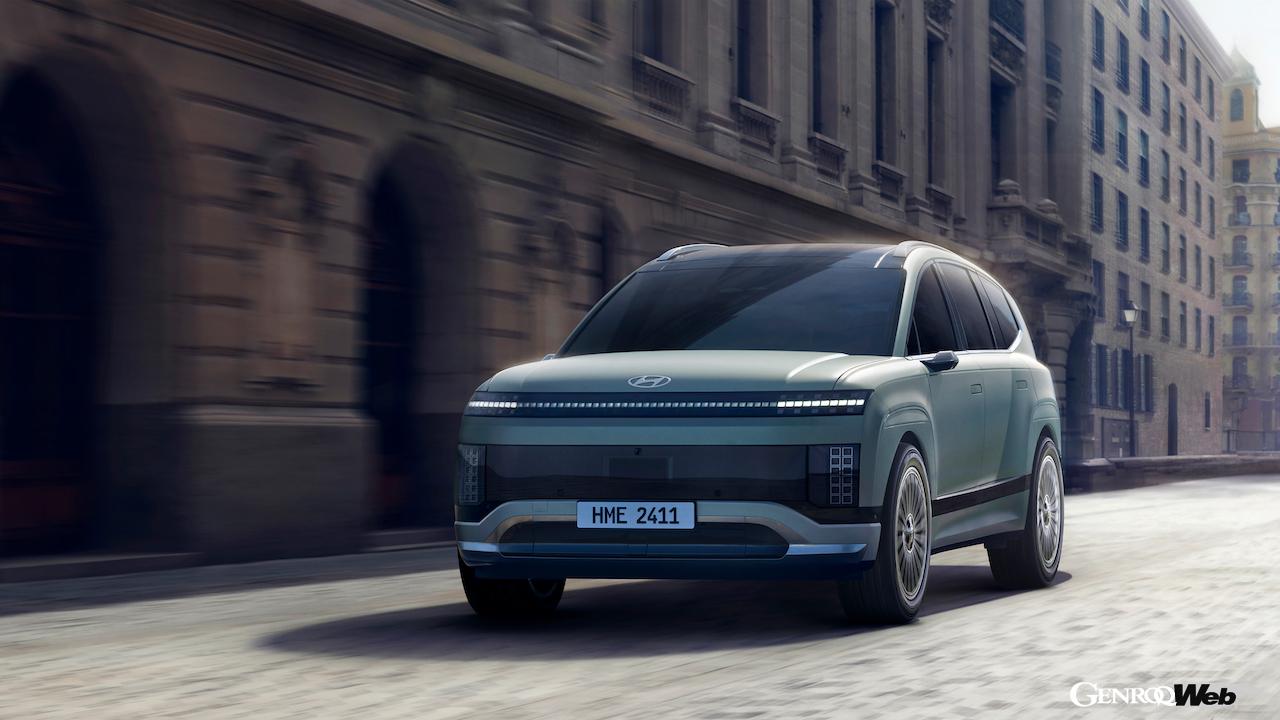
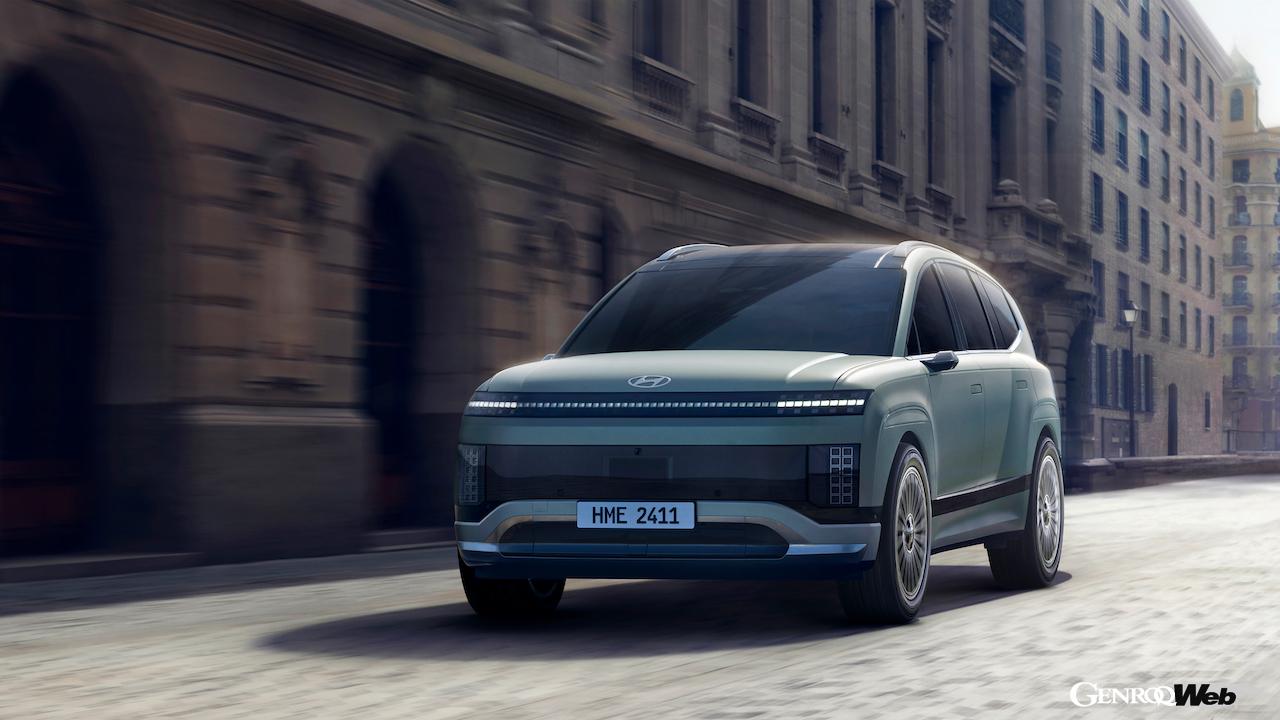
The front section features LED light units called “Small Cube Projection Headlights” and “Parametric Pixel” on the lower fascia. The silhouette created by the smoothly curved roofline is aerodynamic, and models equipped with digital side mirrors have achieved a Cd value of 0.259.
By smoothly directing airflow to the underbody and reducing air resistance at the wheels and tires, energy efficiency is significantly improved. Hyundai’s proprietary Dual Motion Active Air Flap (AAF) system is installed for the first time in a commercial model. In addition, a 3D underbody cover and aerodynamic wheels have been introduced to optimize aerodynamic levels.
The rear section, reminiscent of the tail of a speedboat, expresses a seamless sense of unity through parametric pixels while at the same time introducing a design that maximizes aerodynamics. The streamlined roofline and raised lower line create an exquisite balance, giving the silhouette a smooth yet dynamic look.
The Ioniq 9 does away with the roof antenna, and for the first time in Hyundai’s history, the antenna functions are split between the windshield cover (for GPS and satellite radio), the instrument panel (for connected car services), and the tailgate glass (for FM/AM and digital multimedia broadcasting). By eliminating protrusions from the body, an advanced, minimalist design has been achieved.
The exterior color lineup will include 16 colors, including the new colors Celadon Gray Matte, Celadon Gray Metallic, Ionosphere Green Pearl, Sunset Brown Pearl, and Cosmic Blue Pearl.
A spacious interior space where you can enjoy a variety of arrangements
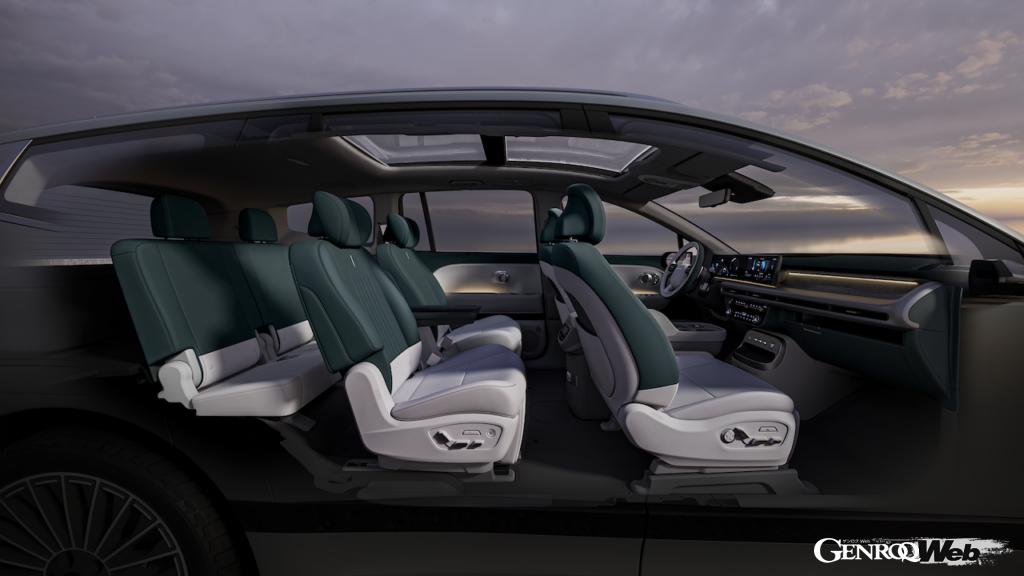
The long wheelbase of 3130mm ensures comfortable living space for all three rows of passengers. The “Universal Island 2.0 Console” has also been introduced, which allows for a variety of seating arrangements.
The long wheelbase of 3130mm provides a spacious and relaxing interior space for second and third row passengers. The interior design features oval elements and a subdued color scheme, creating an atmosphere reminiscent of a hotel lounge. A panoramic sunroof is placed on the roof, allowing soft natural light to pour into the interior.
The flat floor, made possible only by the fully electric model, can accommodate a seating arrangement for six to seven people. The second-row relaxation seats, equipped with leg rests, have been given a full reclining function. The third row also offers ample headroom and legroom, providing passengers with the highest level of relaxation.
The Universal Island 2.0 console with sliding function is installed between the first and second row seats. The two-way armrest Universal Island 2.0 slides up to 190mm. It can be opened and closed from the front and rear, allowing easy access to the console from the second row seats as well. The upper tray has a storage space of 5.6L, and the lower sliding tray has a storage space of 12.6L.
Standard features include a panoramic curved display, floating dashboard, slim air ventilation, and ambient interior lighting. Sustainable materials such as eco-process leather, recycled PET fabric, wool fabric, bio-TPO/PU skin, bio-PET/SUEDE fabric, and bio-paint are used.
The luggage compartment has a capacity of 620 L with seven occupants, and by folding down the third row seats, the capacity can be increased to a maximum of 1323 L. In addition, the frunk (front trunk) offers storage space of 88 L in the RWD model and 52 L in the AWD model.
The steering wheel in the cockpit displays the charging status with a green dot, clearly informing the driver of the remaining electrical energy. The car is equipped with the Hyundai AI Assistant, an AI-enabled voice recognition system similar to virtual assistants like Amazon’s Alexa.
Three types of powertrains available
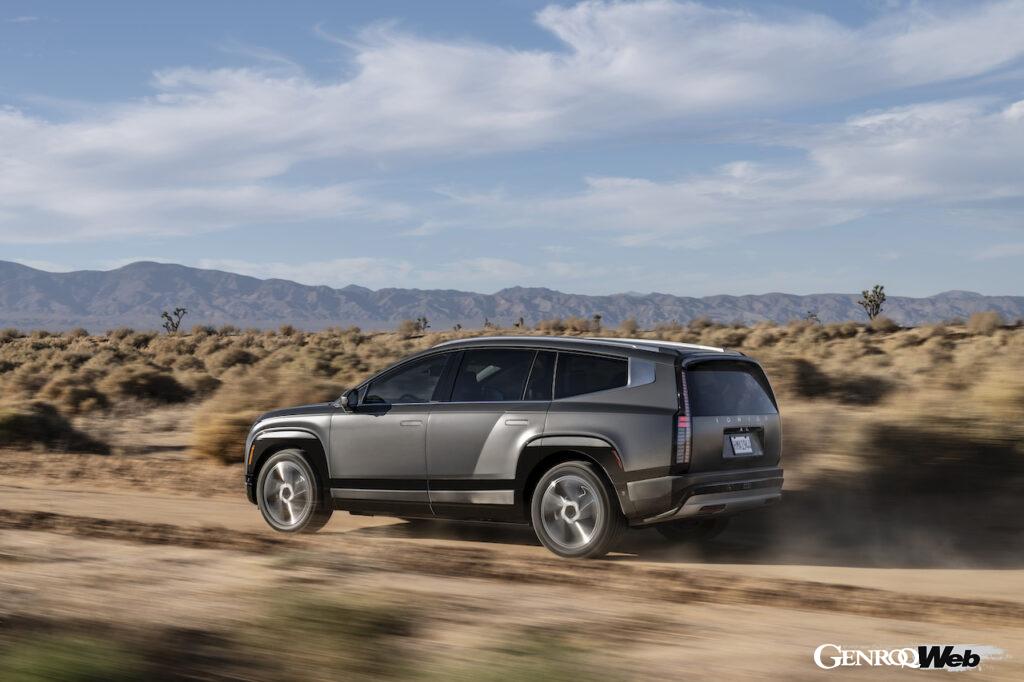
The Ioniq 9 is available with three powertrains, each with a different drive system and battery size. The Long Range RWD model has a maximum range of 620km.
The powertrain lineup includes “Long Range FR,” “Long Range AWD,” and “Performance AWD.” The Long Range FR is equipped with a highly efficient motor on the rear axle that delivers a maximum output of 160kW (217PS). The Long Range AWD is equipped with a front motor with an output of 70kW (95PS), while the Performance AWD is equipped with 160kW motors on both the front and rear.
Acceleration from 0 to 100 km/h takes 5.2 seconds for the Performance AWD, 6.7 seconds for the Long Range AWD, and 9.4 seconds for the Long Range RWD. On highways and other intermediate speeds, the Performance AWD accelerates from 80 km/h to 120 km/h in 3.4 seconds, while the Long Range AWD takes 4.8 seconds and the Long Range RWD takes 6.8 seconds.
Powering the advanced fully electric powertrain is a 110.3 kWh high-voltage NCM lithium-ion battery. The Long Range RWD model is targeted for a maximum range of 620 km (WLTP cycle) and energy consumption of 194 Wh/km. Using 350 kW fast charging, the car can be charged from 10% to 80% in just 24 minutes.