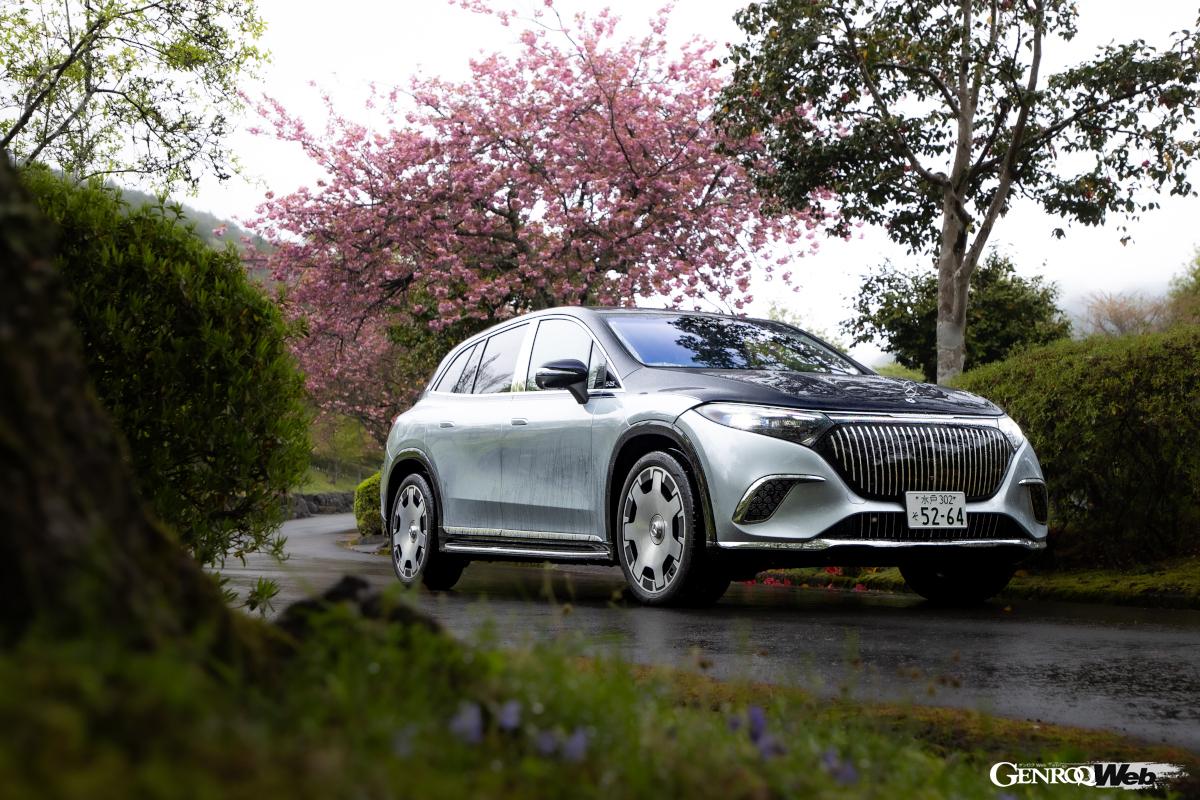

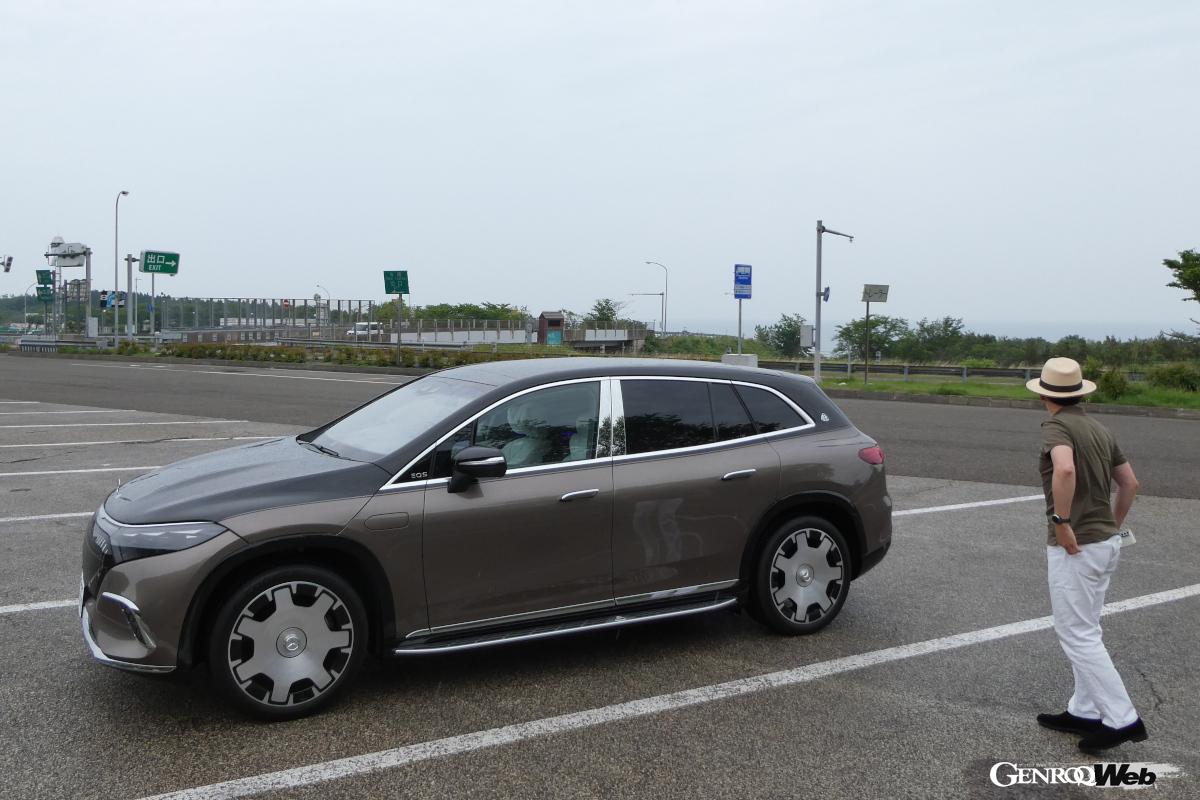
Mercedes-Maybach EQS 680 SUV
Long trip to Toyama in a BEV


We departed Tokyo in the Mercedes-Maybach EQS 680 SUV.
The current consensus is that BEVs are better suited to urban and suburban areas with frequent stop-and-go traffic than for long-distance driving. However, this cannot be said for major car-consuming countries like the United States and China, as well as Germany, which has long operated Europe’s leading highway network, the Autobahn. In Europe, it is said that electricity is more energy efficient and can produce roughly five times the energy of fossil fuels. This is why the idea is that electricity is advantageous for reducing energy consumption globally.
However, when you see the actual Mercedes-Maybach EQS 680 SUV, its imposing body and lustrous two-tone exterior make all those urgent matters disappear. The BEV is merely a proactive choice to guarantee absolute quietness and isolation from the outside world, and there’s a strong ego that seems to be aimed at allowing you to immerse yourself in luxury and composure even at the end of the world. This time, I took it for a long drive to Toyama and tried it out.
Sport, Running Economy, and the Environment


We start driving on the Kanetsu Expressway from Tokyo, heading towards the Sea of Japan and Toyama.
On the morning of the beginning of the weekend, I set off on the crowded Tokyo Kan-nana Expressway in the EQS 680 SUV, and the overwhelming body, measuring 5135mm in length, 2035mm in width, and 1725mm in height, felt so easy to handle, as if it was fitting right into my hand. This wasn’t because other cars didn’t approach, but because the rear steering, which improves maneuverability at low speeds and stability at medium and high speeds, felt natural, allowing me to control the vehicle without feeling overwhelmed.
This grand tour actually involved my first attempt at a full marathon. There was a stark contrast between Mercedes’s latest high-end BEV and my frail, fifty-year-old body, but I thought it would be just right for a run that was conscious of sport, running economy, and the environment.
The concept of relaxation on the move


We tried out the Energizing Comfort program available for both front and rear seats, which helps rear-seat passengers get some unfinished business done.
Cruising on the Kanetsu Expressway in the EQS 680 SUV is a completely different experience from driving an average luxury car. With 955 Nm of torque, the massive vehicle weighing over 3 tons accelerates with ease. Even at cruising speed, there is no wind noise at all, and although there is some road noise, conversations inside the car carry beautifully well.
It’s easy to change the strength of the regeneration with the paddles at hand, but the long coasting makes it feel as though the weight of the car is justified. And yet, the ACC control is gentle, and there are no quirks or sharpness when accelerating/decelerating G or keeping the lane, and it just smoothly covers the distance.
In Eco mode, the initial acceleration is rounded, and the slightly electronically controlled air suspension seems to have less vibration damping than in Comfort mode, so you feel a bit shaken up and down on the Kanetsu Expressway’s patchy roads. But as I was enveloped in the elegant white seats and the elegant piano black interior with stripes, and tried out the massage function and various energizing comfort programs while driving, I was able to clearly see that the concept of relaxing while traveling is not an absurd idea.
The first class package comes with a cooler, or rather a real refrigerator, and rear seats that can recline up to 43.5 degrees, so I’ll stock them with water or sports drinks and enjoy the massage function after finishing the journey.
Low level of civility in the recharge environment


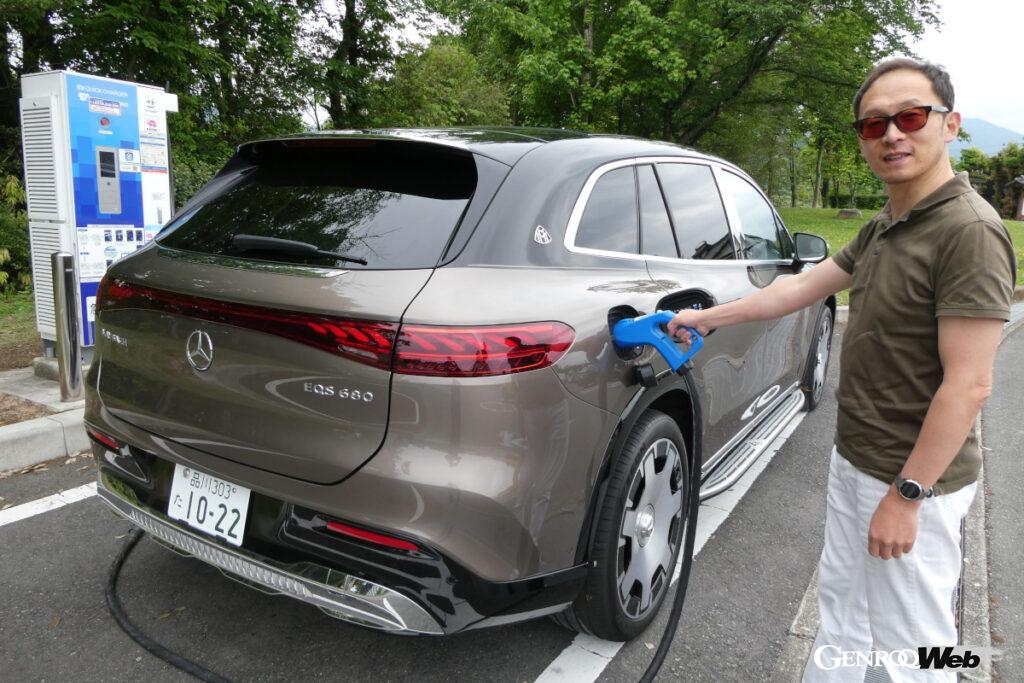
BEVs should be given priority when it comes to charging spaces at transit points.
The 640km range on a single charge is truly reliable. Even at just under 85% battery capacity at the start, the expected range was just over 550km. The distance from Tokyo to Toyama was roughly 350km, and with a 30-minute mid-speed charge of 40-45kWh at Obuse PA along the way, I still had just under 40% remaining by the time I arrived in Toyama. With this level of fuel economy, even overcoming the altitude difference around Karuizawa, the ride is slightly less comfortable than in Comfort mode, which fully utilizes the electronic air suspension, but it was worth driving in Eco mode.
However, things started to go awry after I arrived. I had checked a standard charger in a coin parking lot in Toyama City, and found that a Japanese-made PHEV sedan had been parked there for over 420 minutes, or more than seven hours. If the car had been parked there for that long on a 6kW charger, theoretically it should have stored more than 40kWh, so I thought maybe there was something wrong with either the car or the charger.
In the first place, there is a logic that BEVs, which cannot run without electricity (i.e. are more vulnerable), should be given priority when it comes to charging spaces at transit points, but unfortunately, the current situation is dominated by users who just park their cars casually, which is a reflection of the low level of civility in Japan’s recharging environment.
Traveling long distances in a BEV is down to luck


The marathon, which was the purpose of this trip, was successfully completed. However, the return journey was significantly delayed due to not being able to charge the phone as planned.
Although I managed to complete the marathon, the gradual uphill route from Kurobe to Unazuki Onsen was tough on my adult male body, which has significantly less torque than the EQS 680 SUV. On the way back, my editor and I took turns leaning back in the rear seat, enjoying the various massage and Energizing Comfort functions, and making full use of the ADAS. Since we weren’t able to leave Toyama with a full charge, we were forced to charge twice along the way. It was a shame that the inflow speed on the first charge was less than 40kW, but we were saved by the fact that the second charge produced nearly 90kW.
As you can see, there is still an element of luck involved in going on a long trip in a BEV. However, BEVs can show you a different world, or give you the feeling of taking a step forward that you have never taken before. In the case of the Mercedes-Maybach EQS 680 SUV, this is summed up in the outstanding comfort and wellness it offers.
BEVs require infrastructure, and people need training. I felt like I gained that through experience and realization.