
GMA T.50
The greatest supercar of all time

[1]

[2]

[3]
[4]
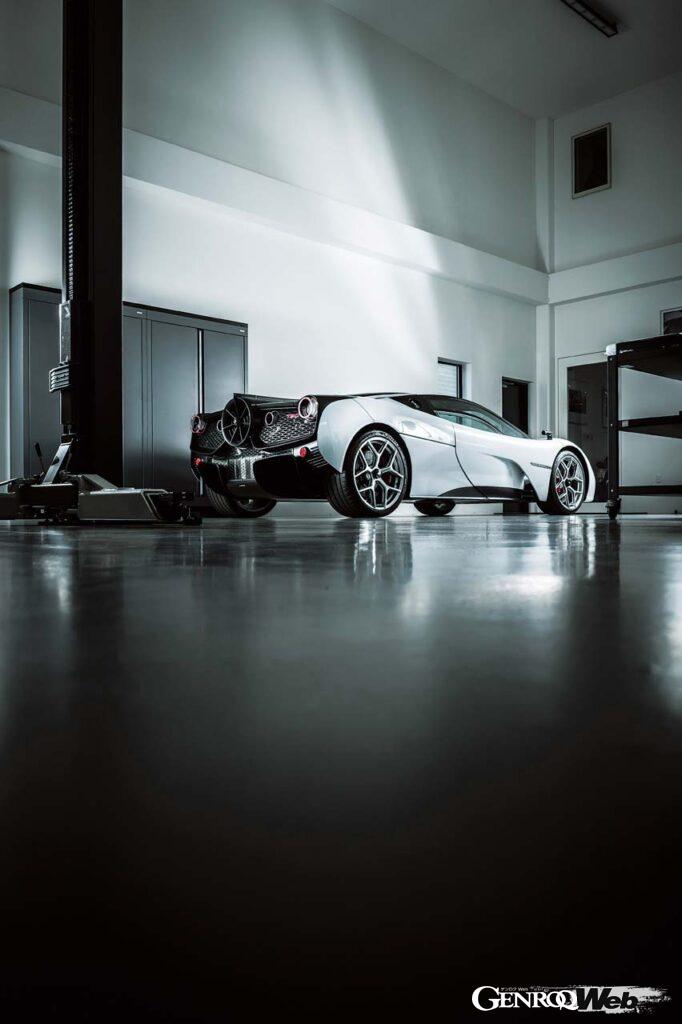
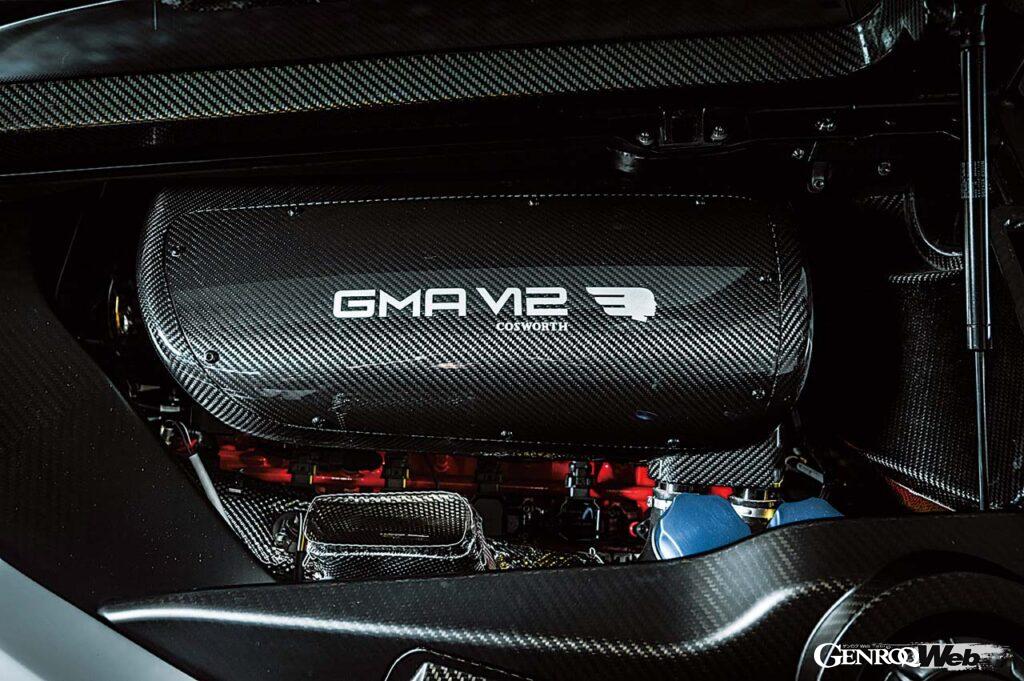
[1] The rear fan is a symbol of the T.50. It draws in air from the boundary layer on the floor and straightens the air flowing to the diffuser. [2] The key incorporates a pedal design. The doors open with the push of a switch, but close manually. [3] Pushrod-operated double wishbone suspension. Gold leaf is applied around the exhaust system to combat heat, just like the McLaren F1. [4] The mid-mounted engine is a 65-degree V12 designed by Cosworth. It has a displacement of 4.0 liters and produces 670 PS at 11,000 rpm.
If the supercar began with the Lamborghini Miura, it has been 58 years since then. Numerous supercars have been born in that time, but if you were to choose the best one from among them, the McLaren F1 would almost always come out on top. In the world of supercars, where the prevailing idea was that a car should be cool, powerful, and have a high top speed, the McLaren F1’s philosophy of speed was shocking.
More than 30 years have passed since then, but no car has ever surpassed the McLaren F1. However, about five years ago, Gordon Murray suddenly announced a new supercar, causing a stir in the industry. After all, it was Gordon Murray. There was no way he would build something half-baked. In fact, considering the various technological advances that have taken place over the past 30-plus years, it seemed possible that a supercar could be made that would surpass the McLaren F1. Or rather, if that weren’t the case, there would be no point in Gordon Murray going to the trouble of building a new supercar.
It’s hard to believe that it has a mid-mounted V12.

[1]

[2]

[3]

[4]

[4]
[1] It has a three-seater design with the driver positioned in the center, just like the McLaren F1. The delicate construction of the frame is impressive. [2] The pedals are perfectly hollowed out. The linkage construction is just like that of a Formula car. [3] The rear fan can be operated at will with the switch on the left side of the meter. [4] A functional instrument panel with an analog tachometer in the center and monitors on both sides. The engine start button is located in front of the shift lever.
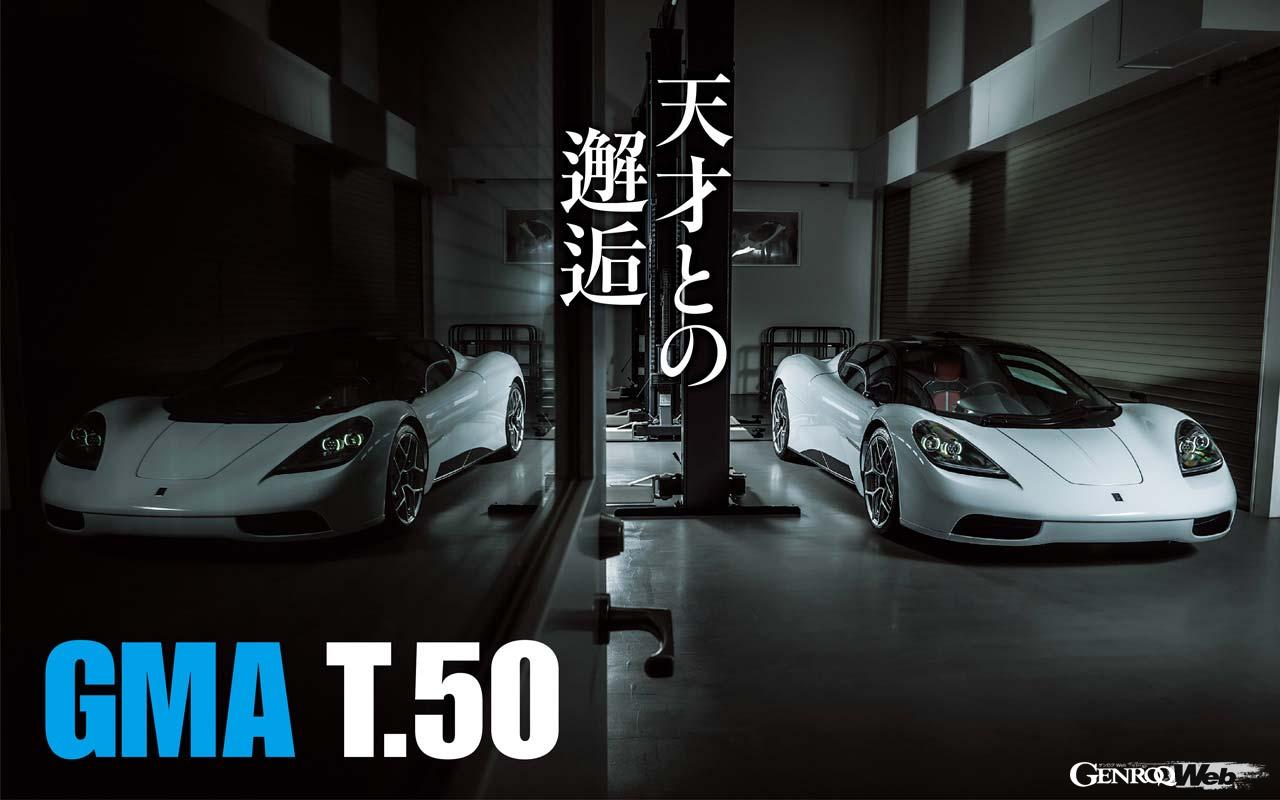
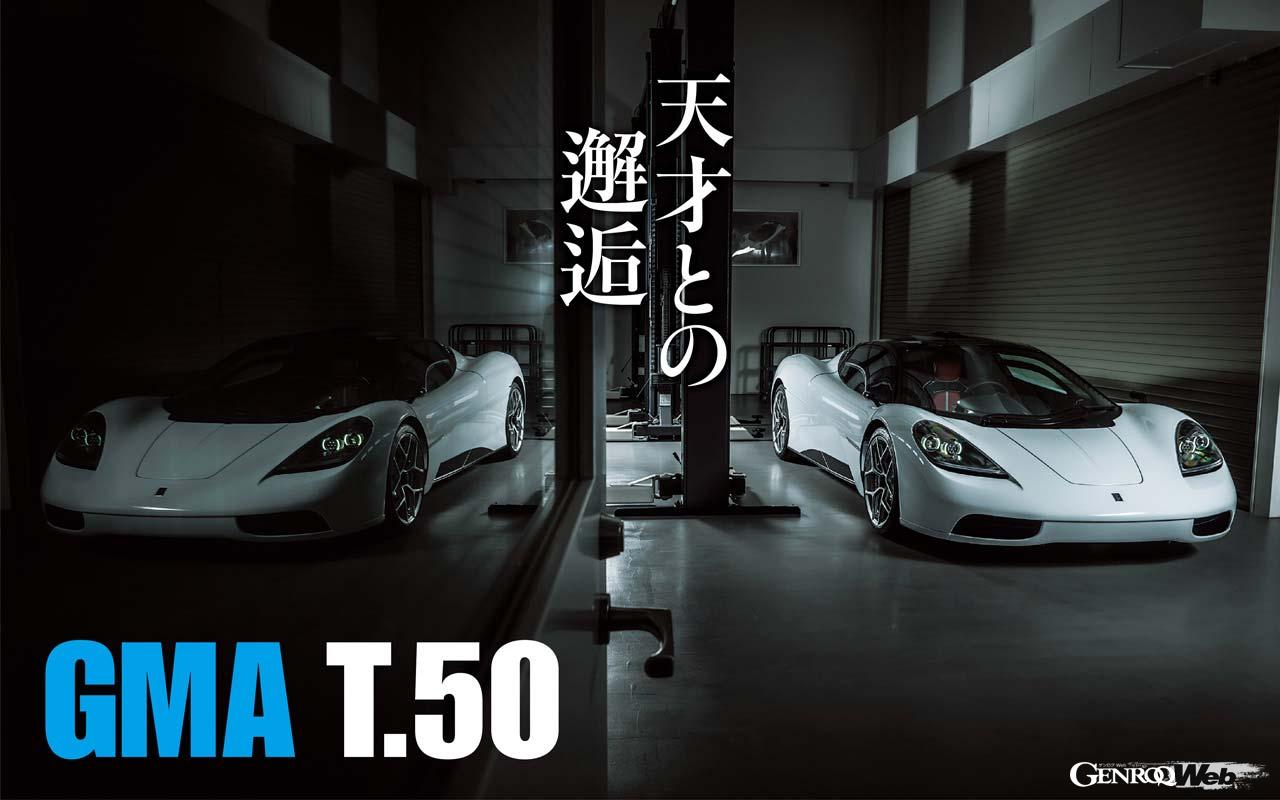
The first car of this supercar, named the “GMA (Gordon Murray Automotive) T.50,” to arrive in Japan is right before my eyes. Seeing the T.50 in the garage of PROSLINK, GMA’s service center in Japan and the PDI company, gives the impression of a plain, sleek sports car, with no ostentatious appeal to the public as an ultra-high performance supercar.
Even so, it’s small. It’s hard to believe that the V12 engine is mid-mounted. Looking at the specs again, the overall length is 4,352mm and the overall width is 1,850mm. Compared to today’s V12 mid-engine supercars, it’s probably 400-500mm smaller in length and 200mm smaller in width. And it weighs an astounding 997kg. This is already two-thirds the weight of other 12-cylinder supercars. Just looking at these figures makes it clear that the T.50 is a car in another dimension.
The doors are dihedral, and the engine cover also hinges in the center and flips up in a gull-wing style. If you hold down the button on the remote key, the doors and engine cover will slowly flip up at the same time, creating a “theatrical effect.” If you think about it, the 12-cylinder engine and manual transmission may be just a way to entertain supercar fans.
Technology once developed in F1

[1]
[2]

[2]
[3]

[4]
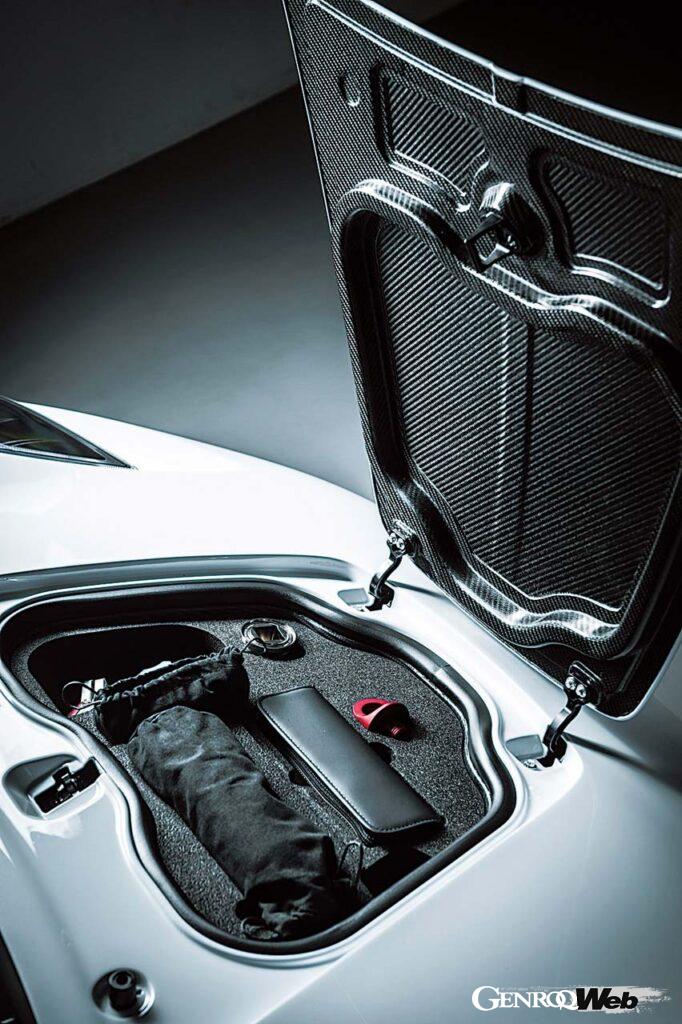
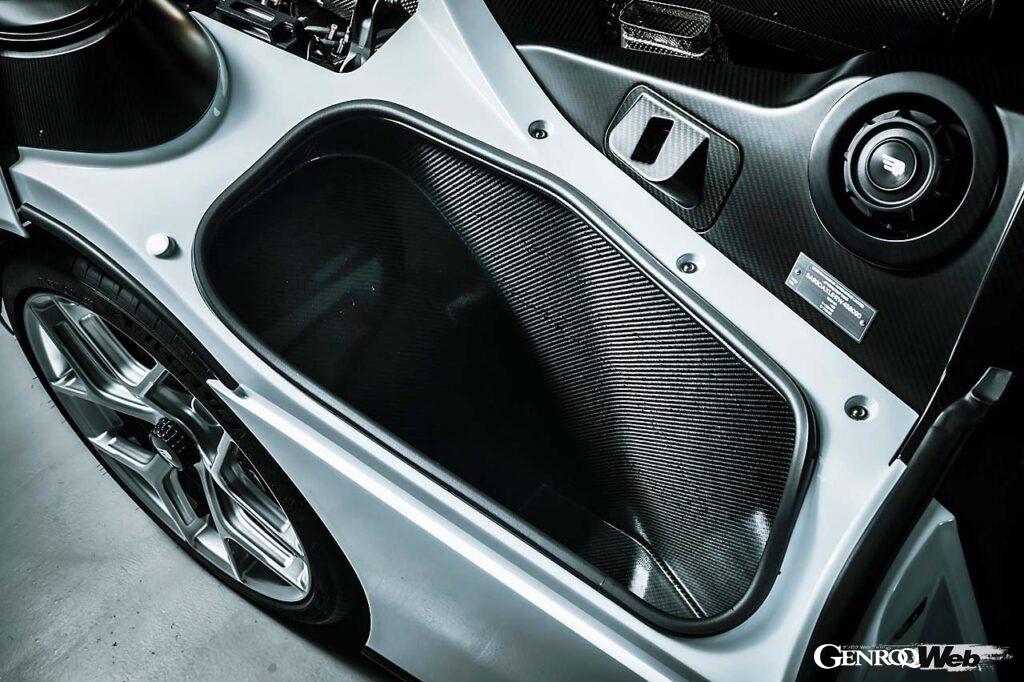
[1] The door mirrors are CCD cameras. The doors open when you press the button on the inside. [2] The space at the front can hold a central lock adapter, tire compressor, tools, etc. The tools are made of titanium. [3] There is a luggage space in front of the rear tires. It is quite deep and practical, but I wonder if it will handle heat. [4] The brakes have carbon ceramic rotors, with 6-pot calipers at the front and 4-pot at the rear. The logo of the supplier, Brembo, is included as is.
One eye-catching feature on the exterior is the large fan at the rear. The idea of sucking out the air in the boundary layer under the floor to streamline the airflow and enhance the effectiveness of the diffuser is something only Gordon Murray, who once created the fan car for F1, could come up with. When we lifted the car up, we could see the air intake in front of the rear suspension. It’s even slightly moving to see how Gordon Murray’s philosophy has been thoroughly implemented in every detail, from the underfloor and suspension, which are meticulously crafted from carbon fiber like a racing machine, to the pedals, which have been beautifully hollowed out.
I never thought that a pure supercar with such a deep and passionate creator would be born in this day and age. It seems that the only person who could surpass Gordon Murray was Gordon Murray.
REPORT/Gensuke NAGATA
PHOTO/Kunihisa KOBAYASHI
MAGAZINE/ GENROQ December 2024 issue
SPECIFICATIONS
GMA T.50
Body size: Length 4352, Width 1850, Height 1164mm
Wheelbase: 2700mm
Vehicle weight: 997kg
Engine: V12 DOHC
Total displacement: 3994cc
Maximum output: 614kW (670PS) / 11000rpm
Maximum torque: 479Nm (48.8kgm) / 8000rpm
Transmission: 6-speed MT
Drive system: RWD
Suspension type: Front and rear double wishbone
Brakes: Front and rear ventilated disc (carbon ceramic)
Tire size (rim width): Front 235/35ZR19 (8.5J) Rear 295/30ZR20 (11J)
Top speed: 360km/h