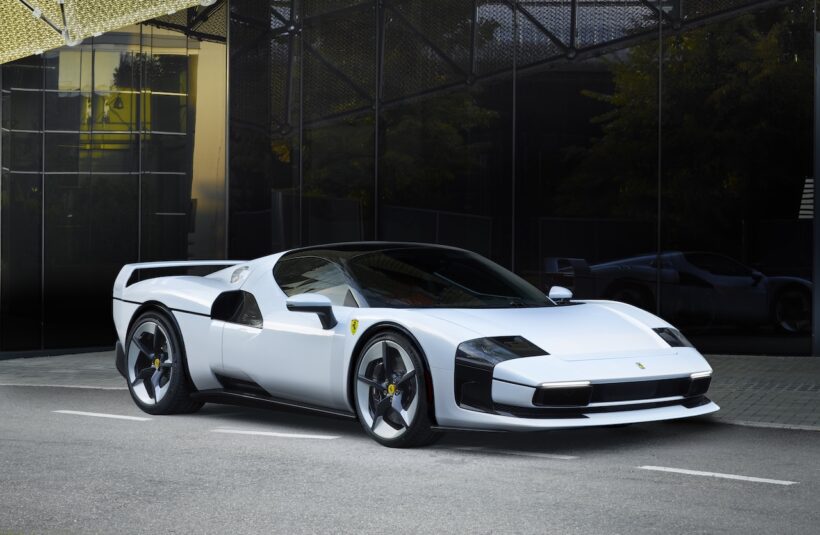

Ferrari F80
Ultimate driving performance and comfort at a high level
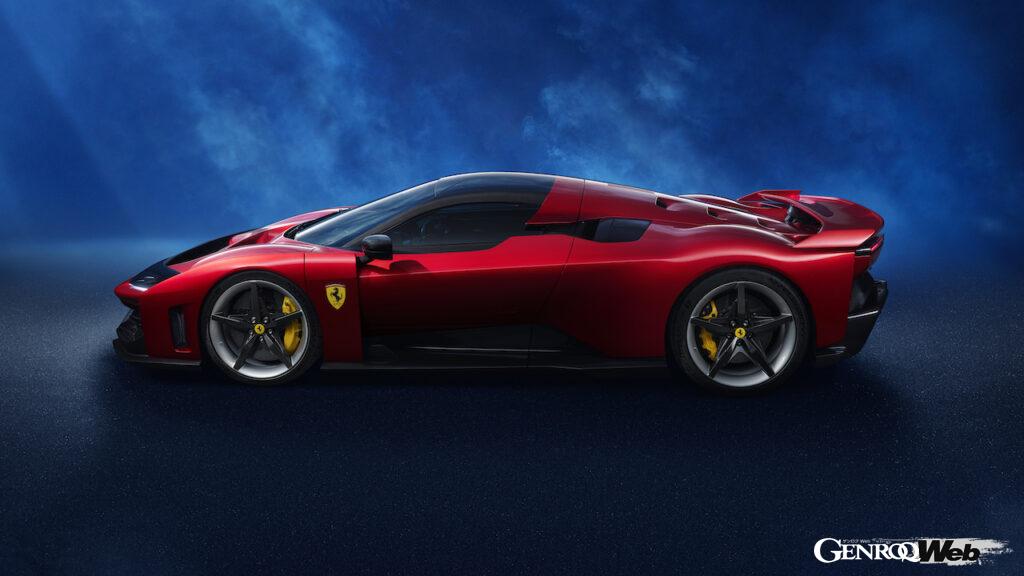
The development of the latest special edition, the Ferrari F80, required a super sports car that would offer the world’s best driving performance on public roads while also being comfortable to drive.
The Ferrari F80’s development goal was to combine the ultimate internal combustion engine with new-generation hybrid powertrain technology to deliver unparalleled power and torque. This road-going performance is achieved through a carbon fiber chassis, extreme aerodynamics, and a newly developed active suspension optimized for extreme racing on the race track.
The F80 was also required to have performance that would surpass any other super sports car on the planet, but also ease of use that would allow it to be driven easily on public roads. The goal was to achieve a seemingly impossible goal: a circuit-oriented super sports car that is as easy to drive as a production model.
Despite the tight cabin that is driver-centric, passenger space and comfort are ensured. Although it seats two people, the cockpit has a formula car-like atmosphere, creating a package that Ferrari calls “1+”. By minimizing the width of the car, drag and weight reduction have been achieved. This can be said to be the result of Ferrari’s experience in motorsports activities.
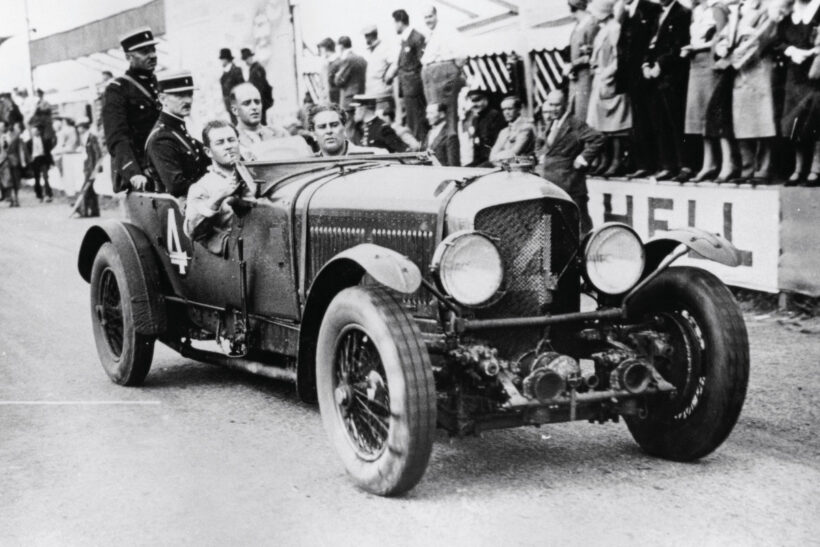
The powertrain combines a V6 gasoline engine, currently used in F1 and the World Endurance Championship (WEC), with an 800V hybrid system. Ferrari has specifically chosen the same architecture for the F80 as the 499P prototype racing car, which won the 24 Hours of Le Mans. It also features the first-ever electric turbo technology, e-Turbo, incorporating an electric motor between the turbocharger’s turbine and compressor, enabling powerful output and good response from low engine speeds.
The aerodynamics of the car are a systematic combination of aerodynamic solutions, including an active rear wing, rear diffuser, flat underbody, triplane front wing and S-duct, which together generate 1,050 kg of downforce at 250 km/h, with the active suspension fine-tuning added.
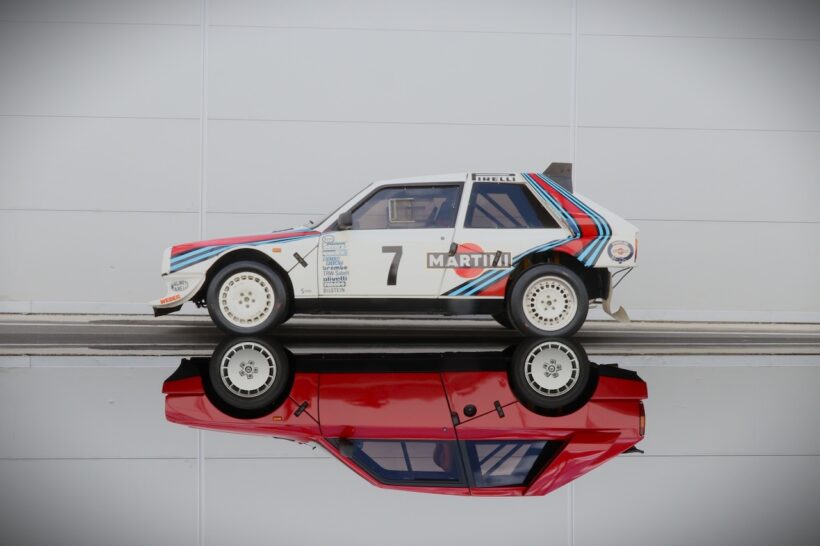
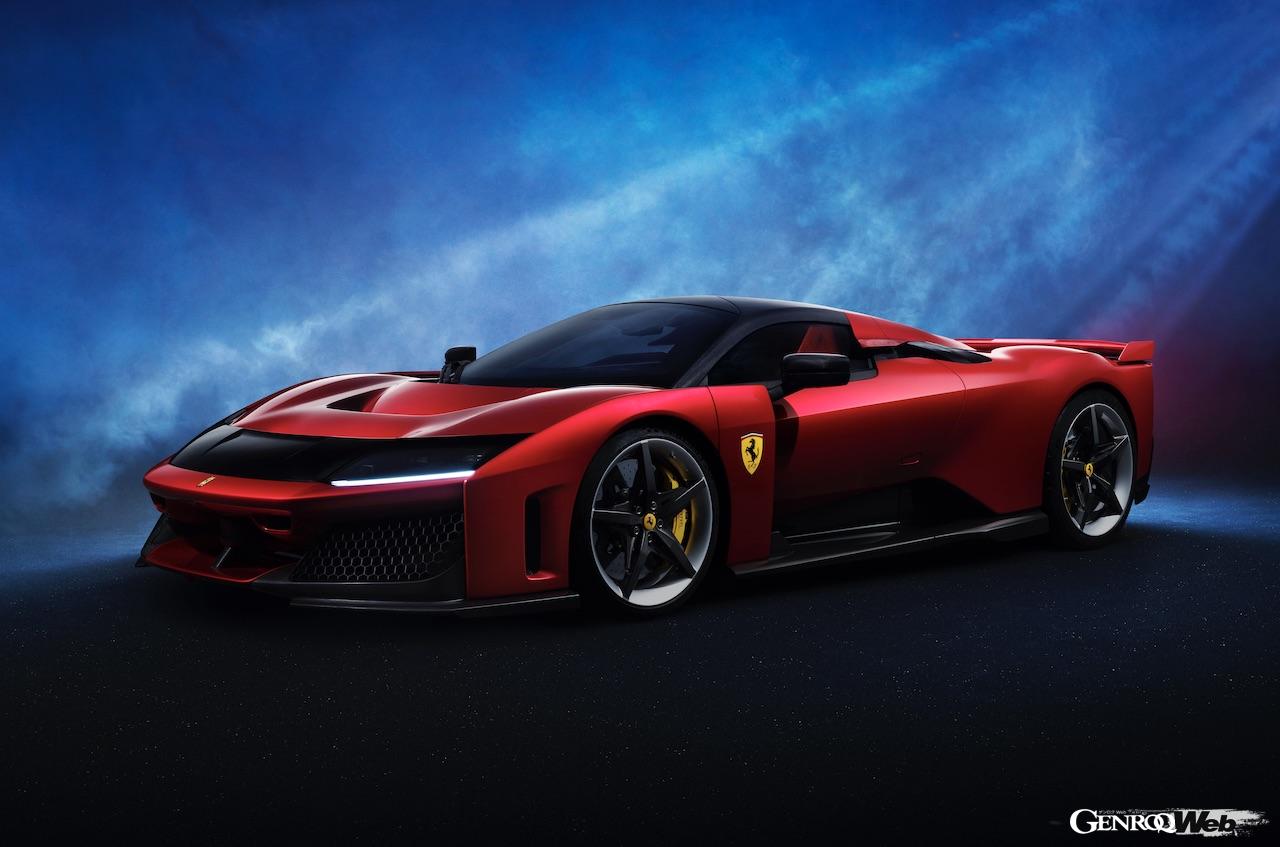
Like all previous Speciale models, the F80 will usher in a new era of Ferrari design. Its taut, aggressive exterior clearly asserts that the F80 is a super sports car born from motorsport. It also incorporates numerous components from the aerospace industry and pays homage to its predecessor.
3.0-liter V6 twin-turbo engine incorporating 499P technology
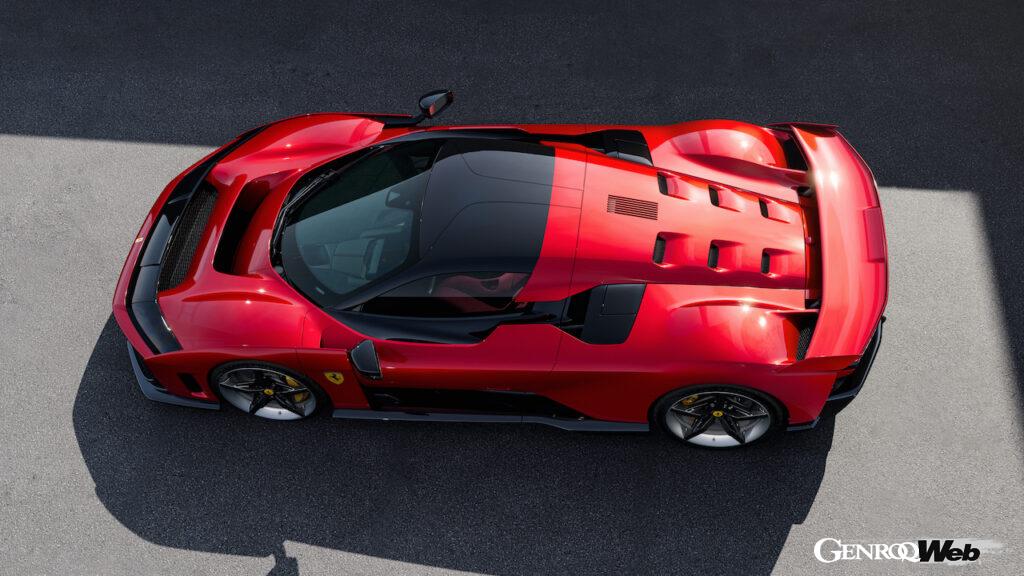
The rear-mounted 3.0-liter V8 “F163CF” gasoline engine is heavily based on technology from the Ferrari 499P, which competes in the WEC, and is combined with hybrid technology honed in F1 and WEC.
The F80 is equipped with a 3.0-liter V6 “F163CF” twin-turbo gasoline engine with a 120° bank angle. Developed as the ultimate form of the six-cylinder engine that Ferrari has ever manufactured, the engine alone produces a maximum output of 900 PS, and its specific output to displacement is 300 PS/L, the highest in the history of Ferrari engines. This is further enhanced by the electric front axle “e-4WD” and a hybrid system using the F1-derived rear motor “MGU-K,” which adds another 300 PS to the power.
The car has strong ties to motorsport, particularly endurance racing, and many of its engine components are closely related to the power unit of the 499P prototype racing car, which competes in the WEC. Commonalities with the 499P include the architecture, crankcase, timing system layout, drive chain, oil pump recovery circuit, bearings, injectors, and GDI pump.
The Inconel exhaust manifolds are designed to minimize pressure loss and are specially tuned to deliver the distinctive Ferrari V6 sound. To lower the vehicle’s center of gravity, the engine is mounted as close to a flat undertray as possible. To reduce engine weight, components such as the cylinder block, crankcase, and timing cover have been redesigned, and titanium screws have been introduced. This has resulted in an output increase of 237 PS without increasing weight compared to the 296 GTB’s V6 engine.
The electric motors installed in the F80 are the first electric unit developed, tested and manufactured entirely by Ferrari in Maranello. Two motors are installed on the front axle and one on the rear, and their design makes use of Ferrari’s motorsport experience in F1, WEC and other sports.
The high-voltage battery at the heart of the energy storage system has been designed to have high power density, and incorporates lithium battery technology inherited from F1, a monocoque casing that makes extensive use of carbon fibre, and “cell-to-pack” techniques to minimise the weight and volume of the unit.
The battery pack is mounted low in the engine bay, lowering the vehicle’s center of gravity and further improving handling. The battery pack’s 204 cells are connected in series and divided equally into three modules. The total battery capacity is 2.3 kWh, with a maximum output of 242 kW.
Advanced aerodynamics that defy conventional wisdom for road cars
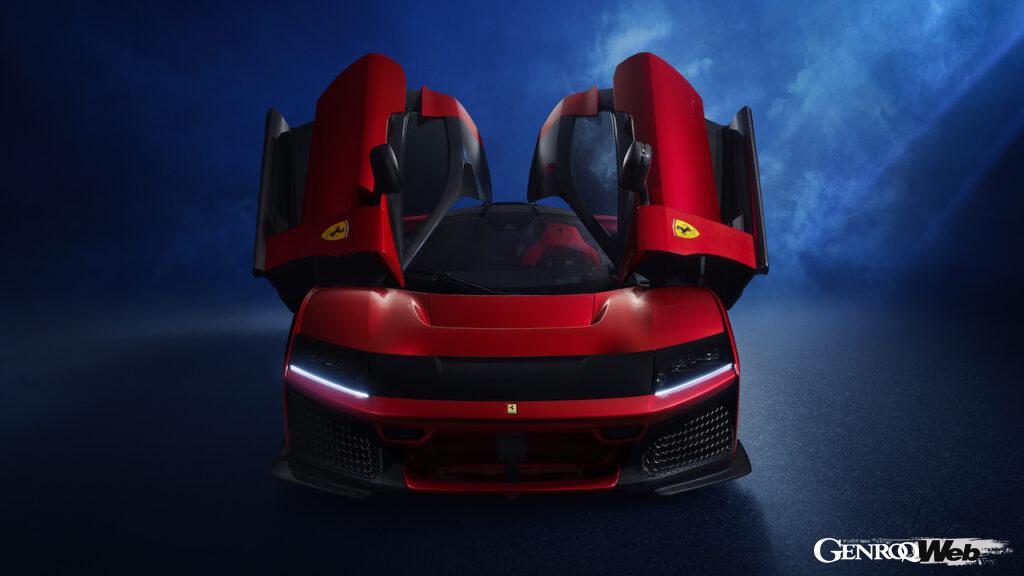
The F80 features aerodynamics at a level that is simply unheard of for a road-legal production model, with the aerodynamic concept actively incorporating know-how from racing cars in F1 and WEC.
When deciding on the exterior of the F80, the Ferrari Styling Centre, led by Flavio Manzoni, made radical changes to Ferrari’s visual elements, seeking design elements that would connect the past and the future. First, they looked to the beauty of F1 cars and introduced a level of advanced aerodynamics that overturned the conventional wisdom of Ferrari road cars to date, generating 1,050 kg of downforce at 250 km/h.
The front section generates 460 kg of total downforce at 250 km/h. Based on the aerodynamic concept used in F1 and WEC, it has been specially adapted for the F80. The driving position is tilted back like a racing car, allowing the center keel of the chassis to be set high. In addition, the layout of the cooling system has been optimized, and the center of the vehicle has been completely opened up, freeing up space that can be used for other functions.
The center of the nose, finished in the body color, functions as the main plane of the vast front wing. Two flaps exist inside the S-duct, which, together with the main plane, form a tri-plane wing. The curvature and blower slots are based on technology from the 499P.
These aerodynamic devices work together to powerfully expand the airflow from the underbody and bumper vertically, before being directed back to the front bonnet by ducts. This powerful upward flow creates a powerful low-pressure zone below the underbody. This generates 150 kg of downforce, but because this is a very delicate behavior, the active suspension ensures aerodynamic balance. The active suspension controls the vehicle’s behavior in real time, adjusting the distance between the underbody and the road surface according to the driving situation.
The rear section generates 590 kg of downforce through the interaction of the rear wing and diffuser system. In the F80, in order to maximize the performance of the diffuser, the expansion space of the diffuser itself was maximized. By moving the point where the diffuser begins to curve upwards forward, the diffuser length reached 1,800 mm.
Active wing controls the behavior of the F80
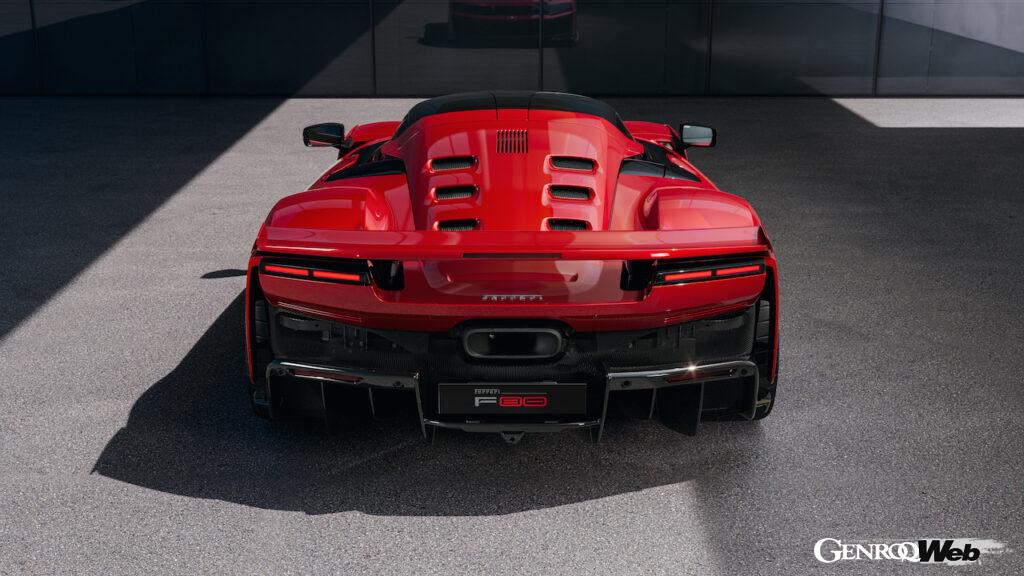
The car is equipped with an “active rear wing” that adjusts downforce and drag to suit the driving environment, such as prioritizing high downforce when cornering or top speed on straights.
The F80’s most visually distinctive aerodynamic component is its active rear wing, which uses actuators that continuously adjust not only its height but also its angle of attack to precisely control downforce and drag.
“High Downforce (HD)” is selected during braking, turning in, and cornering, and the wing is tilted 11 degrees to the airflow angle, generating over 180 kg of downforce at 250 km/h. Meanwhile, “Low Drag (LD)” prioritizes top speed, with the tip tilted upward, significantly reducing drag.
The active rear wing monitors and evaluates driving conditions in real time through various vehicle control systems. Based on driver demands such as acceleration, speed and steering angle, the system determines the optimum blend of downforce, aerodynamic balance and drag, then sends instructions to the active suspension and active aero systems to achieve the ideal behavior.
The Active Reverse Gurney has two flap positions, allowing for front downforce and drag control. In the closed position, the flaps generate maximum downforce, while in the open position, the flaps are angled appropriately against the airflow to stall the underbody in a manner similar to F1’s DRS system, reducing drag and increasing top speed.
Closed-cockpit F1 car
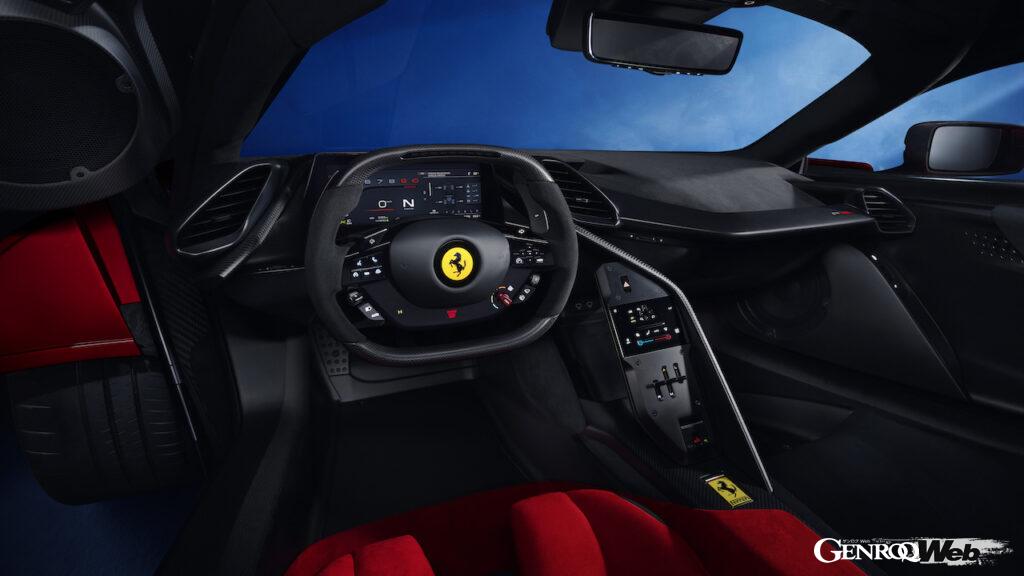
The interior of the F80 is tight and driver-oriented, just like the cockpit of an F1 car. The development team imagined an F1 car with a closed cockpit. The newly developed steering wheel has also brought back physical switches.
The compact cabin was inspired by single-seater F1 cars and was developed with the image of a closed-cockpit F1 car in mind. After a long period of development, designers, engineers, ergonomics specialists, and color and trim experts have succeeded in transforming the car into a “1+” model while putting the driver at the center.
The cockpit is centered around the driver and completely envelops him, with a form that converges towards the instrument panel, which is ergonomically oriented towards the driver, creating the impression of being inside a cocoon.
The comfortable passenger seat is perfectly integrated into the cabin trim. The driver’s seat and passenger seat are offset forward and backward, with the passenger seat positioned further back than the driver’s seat, ensuring comfort while narrowing the interior space. This also made it possible to reduce the cabin size and minimize the frontal projection area.
The steering wheel, developed exclusively for the F80, is slightly smaller than the previous model, with flatter upper and lower rims. The steering boss has also been reduced in size, improving visibility and enhancing the sporty feel while driving. The shape of both sides of the rim has been optimized to provide a firm grip, regardless of whether driving gloves are worn or not. Physical buttons are located on the left and right spokes, changing from the fully digital layout introduced in recent Ferraris to easy-to-use buttons that are immediately identifiable at a touch.
SPECIFICATIONS
Ferrari F80
Internal combustion engine
type: 120° V6, dry sump,
total displacement: 2992cc
, bore and stroke: 88mm x 82mm,
maximum power: 900PS/8750rpm,
maximum torque: 850Nm/5550rpm,
maximum engine speed: 9000rpm,
compression ratio: 9.5:1
, output: 300PS/L,
rear electric motor (MGU-K),
operating voltage: 650–860V,
regenerative braking: 70kW (95PS),
ICE assist: 60kW (81PS),
maximum torque: 45Nm,
maximum engine speed: 30000rpm
, weight: 8.8kg
Front axle electric motor
Operating voltage: 650–860 V
Maximum power output: 105 kW (142 PS) each
Maximum torque: 121 Nm
Maximum speed: 30,000 rpm
Weight: 12.9 kg
High-voltage battery
Maximum voltage: 860V
Maximum output (charge/discharge): 242kW
Capacity: 2.28kWh
Maximum current: 350A
Power density: 6.16kW/kg
Weight: 39.3 kg
Dimensions & Weight
Overall length: 4840mm
Overall width: 2060mm
Overall height: 1138mm
Wheelbase: 2665mm
Front tread: 1701mm
Rear tread: 1660mm
Dry weight: 1525kg
Dry power-to-weight ratio: 1.27kg/PS
Weight distribution: 42.2:57.8
Fuel tank capacity: 63.5L
Trunk capacity: 35L
Tires: Front 285/30 R20 Rear 345/30 R21
Front brakes: 408x220x38mm (6-piston caliper)
Rear brakes: 390x263x32mm (4-piston caliper)
Transmission: 8-speed dual-clutch F1 DCT
Performance
Top speed: 350km/h
0–100km/h: 2.15 seconds
0–200km/h: 5.75 seconds
100–0km/h: 28 minutes
200–0km/h: 98 minutes