
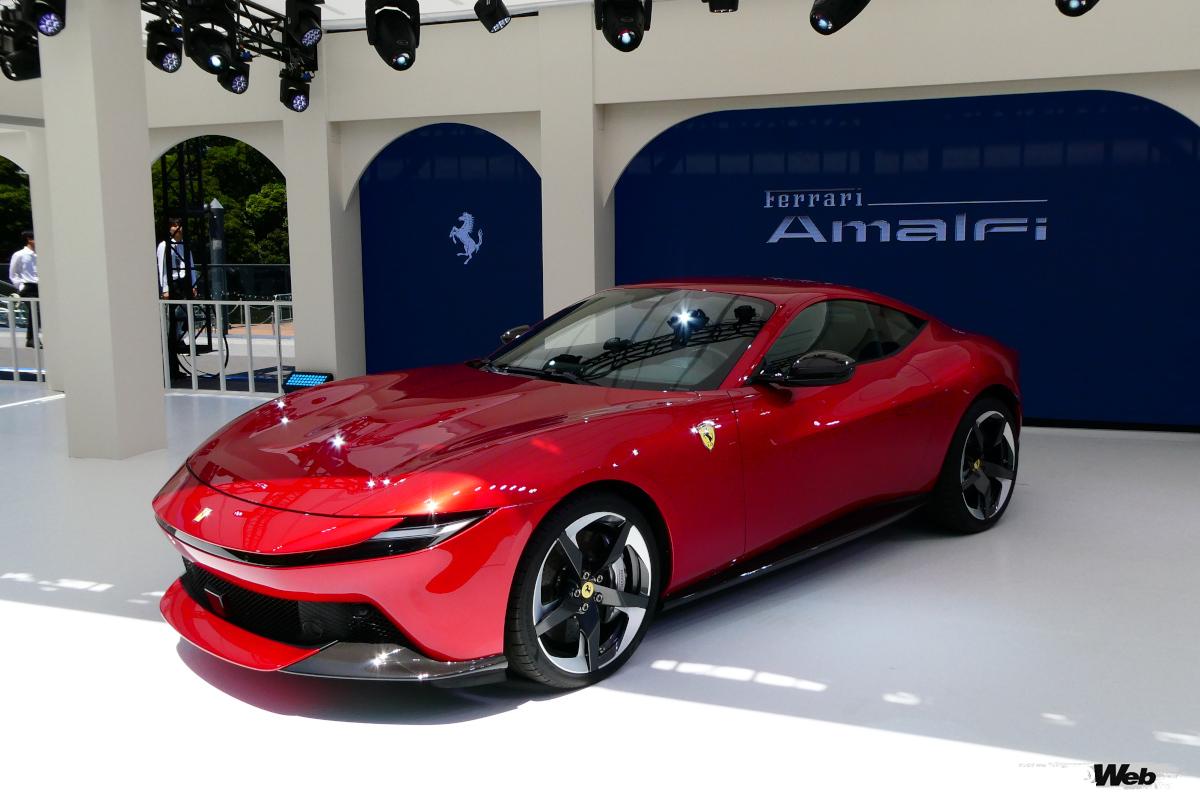
Ferrari Amalfi
Even more elegant
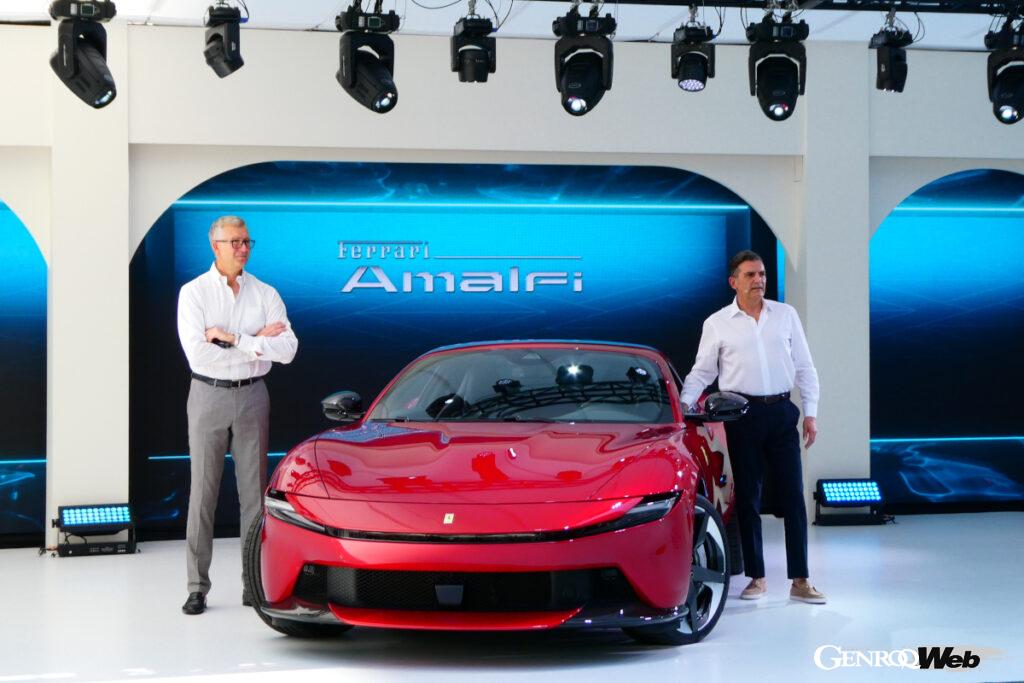
Emanuele Calando (left), Head of Product Marketing, who visited Japan from the Maranello headquarters, and Donato Romaniello, President and CEO of Ferrari Japan.
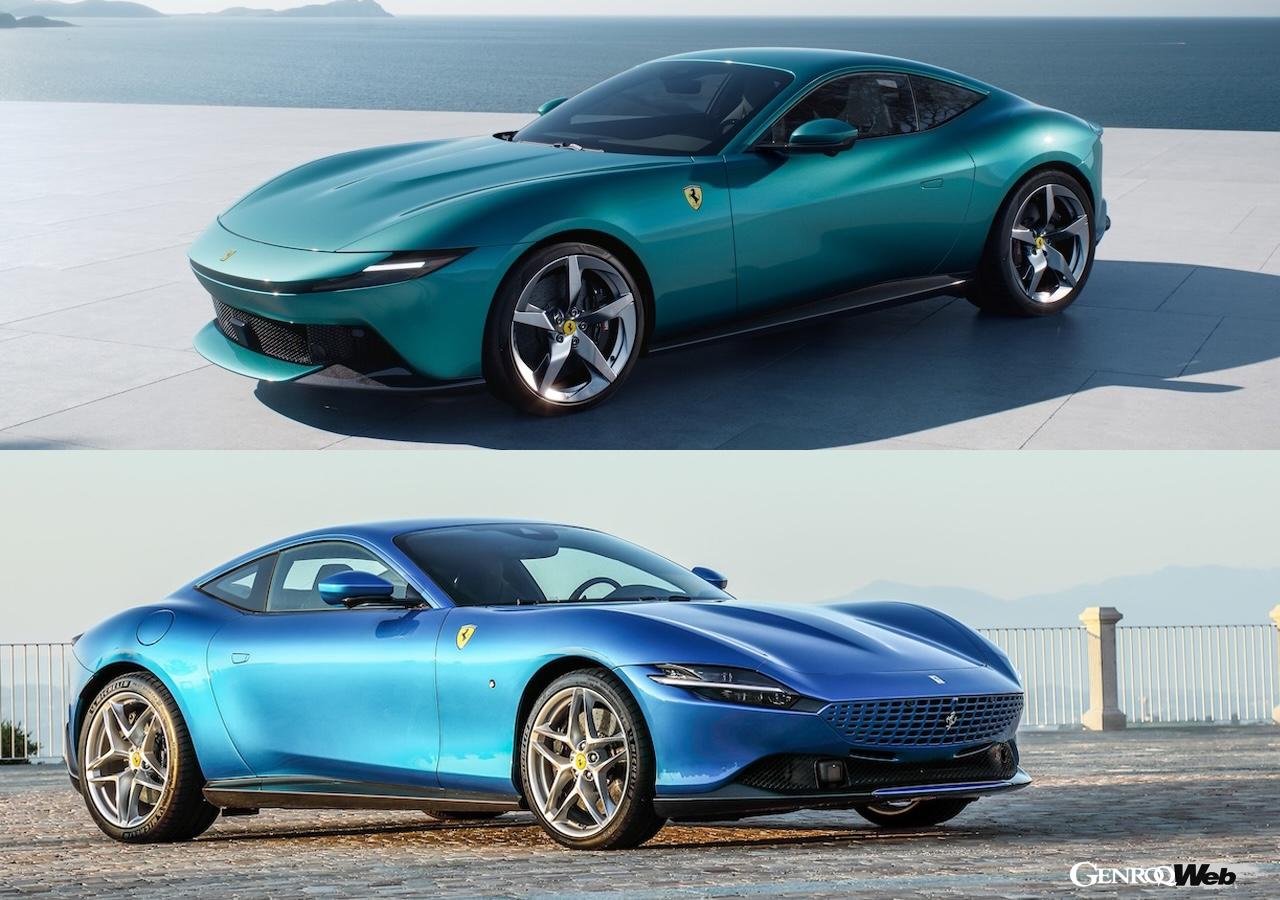
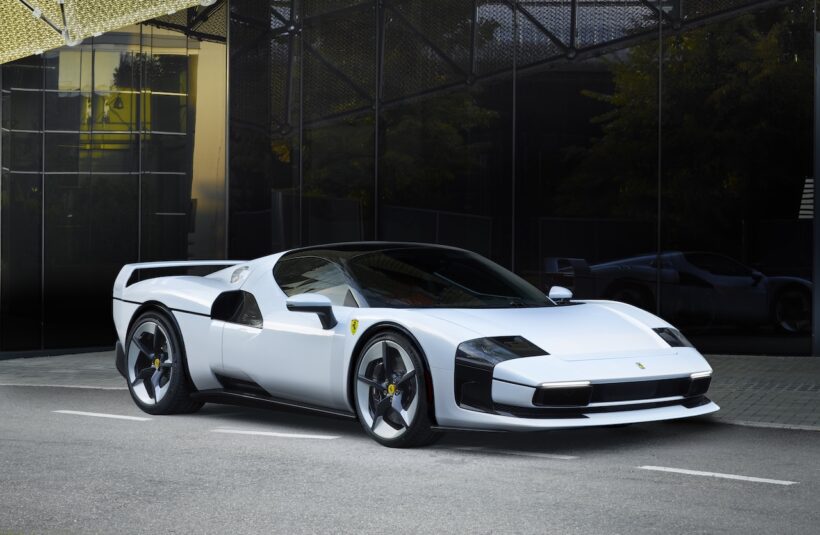
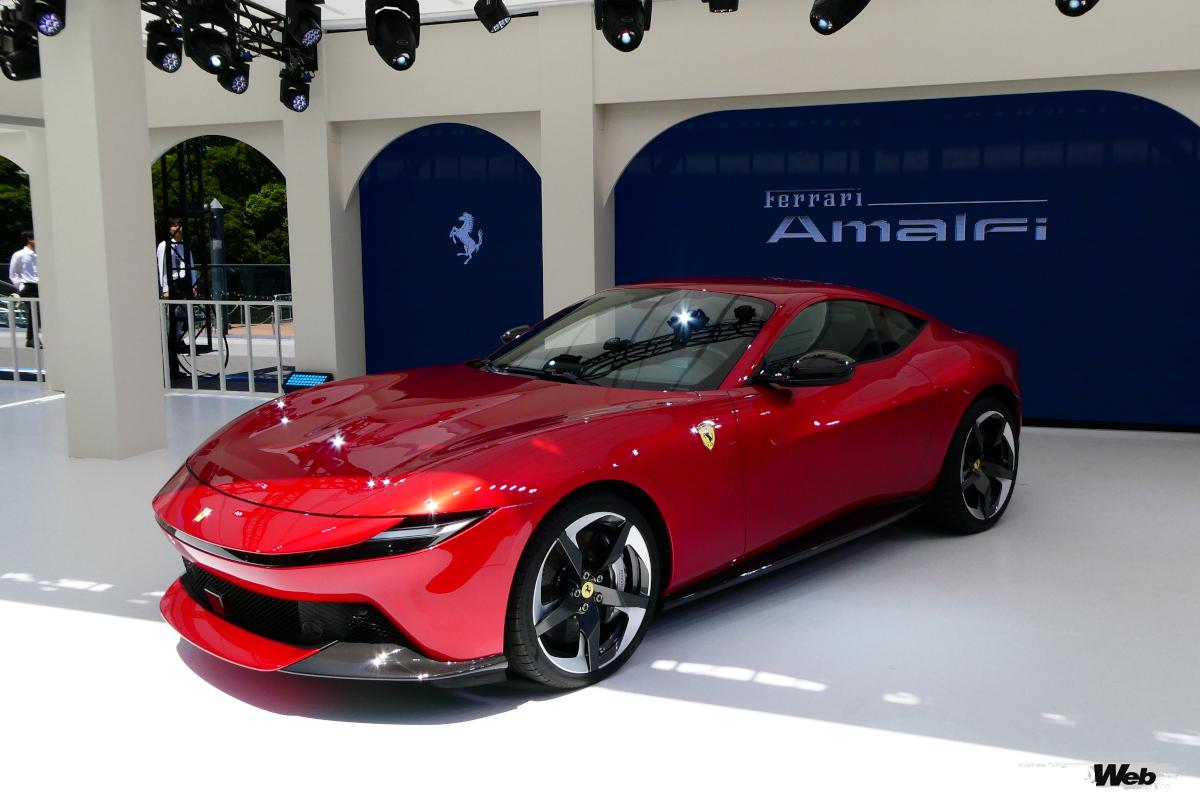
The new Ferrari Amalfi, unveiled this time in Takeshiba, Tokyo, is a 2+ Berlinetta boasting “sculpted forms and clean surfaces.” It is the successor to the Roma. It only had its world premiere in Italy on July 2nd, but its early arrival in Japan is testament to the car’s track record and future potential in the Japanese market. The launch event on July 29th was held at a special venue by the sea, in keeping with the origin of the car’s name.
The exterior, which incorporates the latest design elements since the 12 Chilindori, is said to pursue Ferrari’s signature minimalist aesthetic standards. Specifically, anthropomorphic elements such as human eyes, noses, and mouths have been eliminated. In fact, when compared to the previous Roma, it is clear that this approach has changed significantly. For example, the front section is now grille-less, whereas the Roma had a distinctive grille. Under the long front hood, which houses the 3.9-liter V8 twin-turbo engine, a dark band is designed to divide the car into upper and lower sections when viewed from the front, and sensors and headlights are housed within it to avoid being conspicuous.
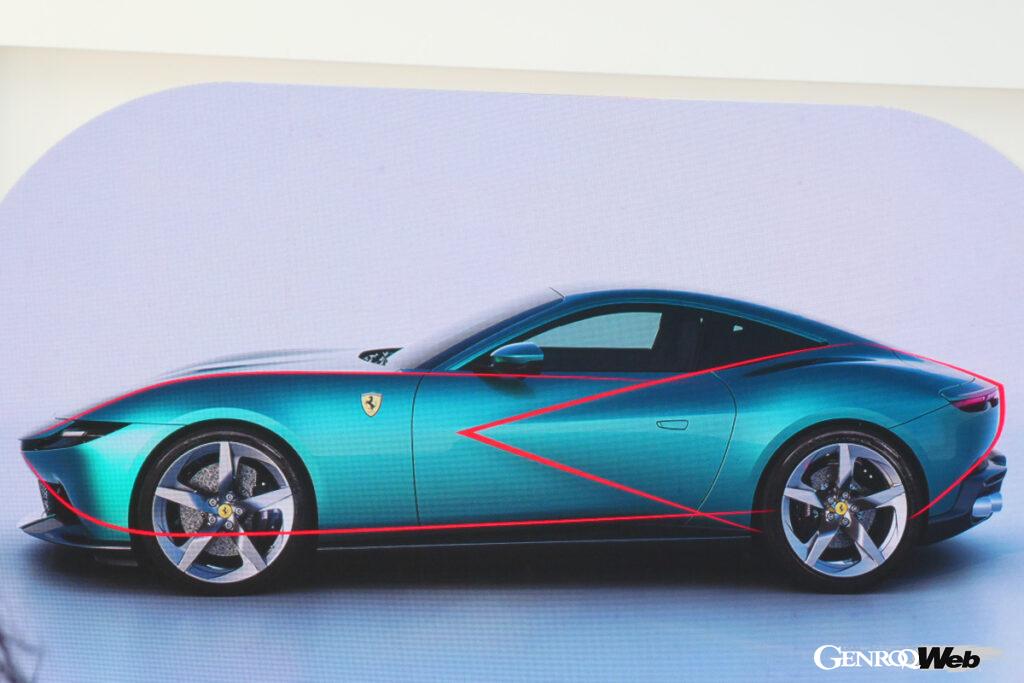
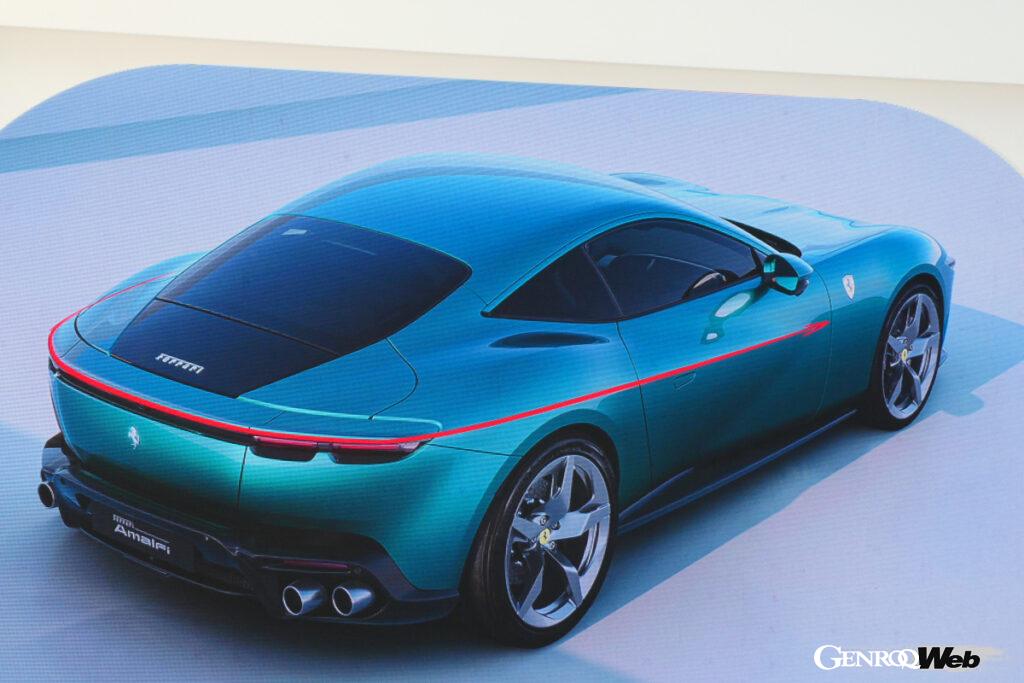
The side sections have more pronounced rear fender overhangs than the Roma, continuing all the way to the front of the door panels, emphasizing the sense of width. The taillights are housed in a dark belt that creates a sense of continuity with the front, which is said to be a homage to classic Ferraris while also being a modern visual element. The lower rear features a large rear diffuser that is highly functional and sporty in design. The active wing integrated into the rear screen can be adjusted in three stages, and at its highest downforce, it is said to reach 110 kg at a speed of 250 km/h. The body size is the same as the Roma, except for the overall length, which has increased by 4 mm, so there is likely to be no change in maneuverability.
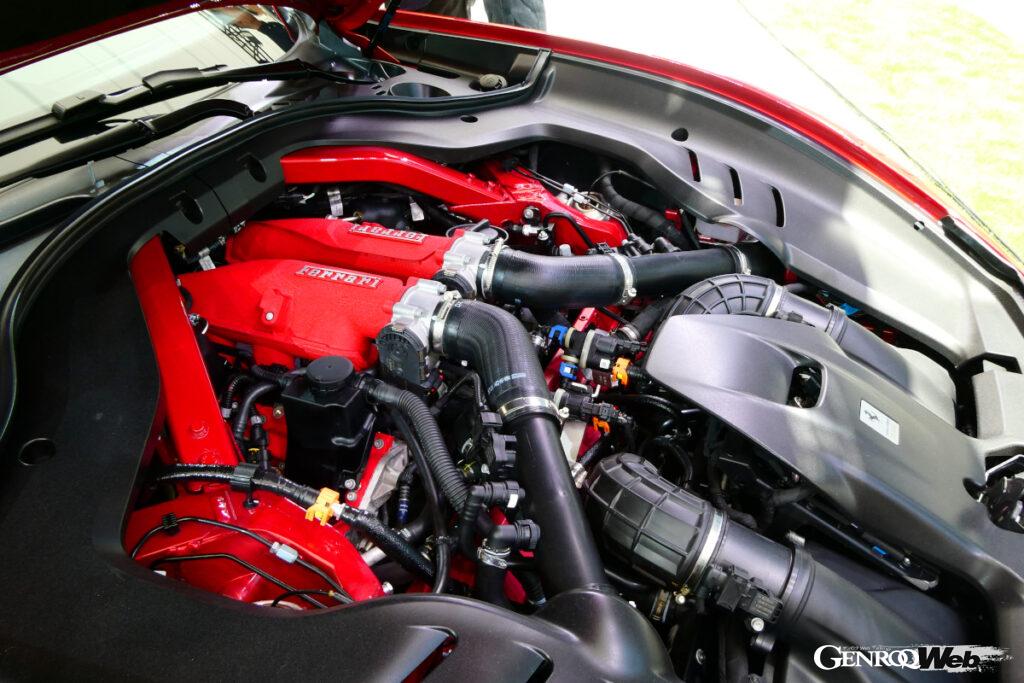
The latest evolution of the F154 V8 engine
[1]
[1]

[2]
[3]

[1] The design emphasizes the overhang of the rear fender. [2] Amalfi design elements. He visited Japan with Mr. Caland. [3] A 3855cc V8 twin-turbo engine, an evolution of the proven F154 engine.
The 3855cc V8 twin-turbo engine mounted in the front mid-mounted position is an evolution of the proven F154 engine, boasting a maximum output of 640 PS and a maximum torque of 760 Nm. Compared to the Roma, maximum output has increased by 20 PS. The transmission is the same 8-speed DCT as the previous model, but the control unit has been upgraded in power and its integration with the engine software has been improved, resulting in smoother gear changes and faster shifts, with acceleration from 0 to 100 km/h now at 3.3 seconds, 0.1 seconds faster. Top speed remains unchanged at 320 km/h.
The latest engine management, also introduced in the 296 GTB, Purosangue, and 12 Chilindori, maximizes the engine’s potential. At the same time, weight reduction has been pursued, with a new lightweight camshaft saving 1.3 kg and a redesigned engine block with precision machining achieving a weight reduction of approximately 1 kg. This is the first time a Ferrari engine has used low-viscosity oil. Low-temperature resistance has been reduced by 30% compared to previous models, significantly improving efficiency during warm-up. The exhaust system features three metal coatings (rhodium, platinum, and palladium) and a ceramic-based catalytic converter. Furthermore, reduced thermal inertia has significantly improved starting times.
Although it is not a hybrid, the brake system uses a by-wire system, similar to the 296GTB. This shortens the pedal stroke, makes it easier to adjust using the manettino, and is said to enable a sportier driving experience. According to a source, brake-by-wire will be adopted in future new models.
Easy communication with the passenger seat
[1]
[1]
[2]
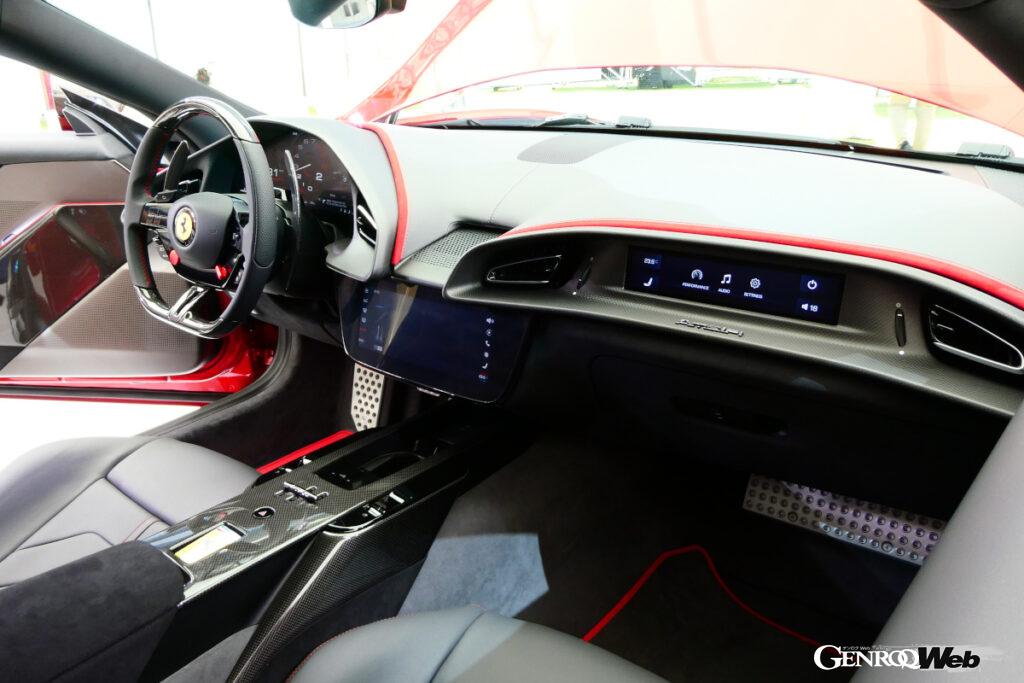
[3]
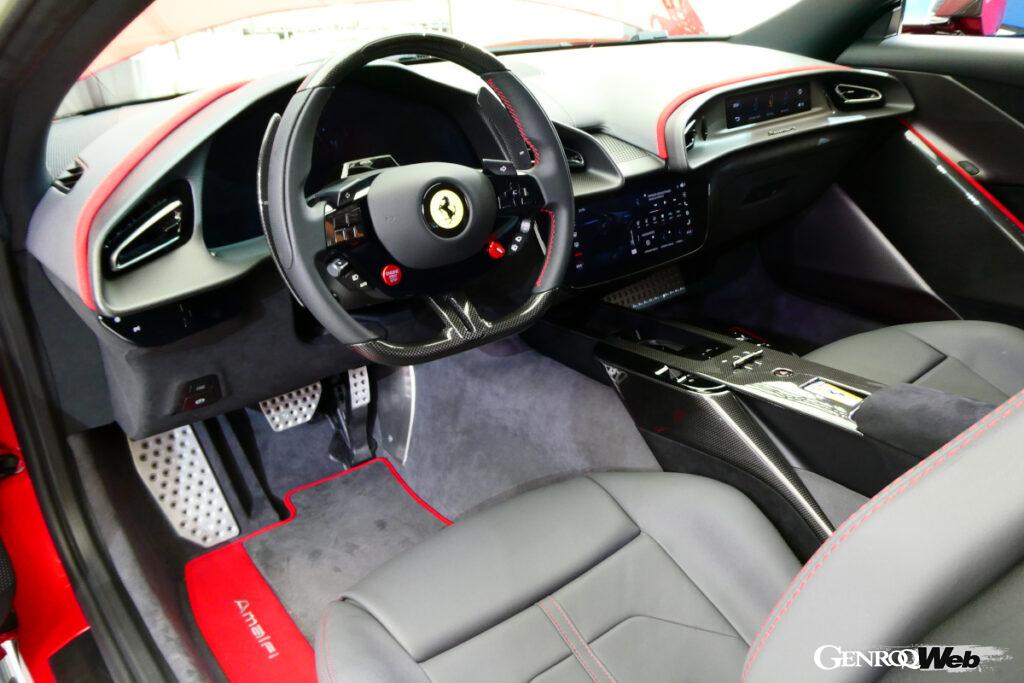
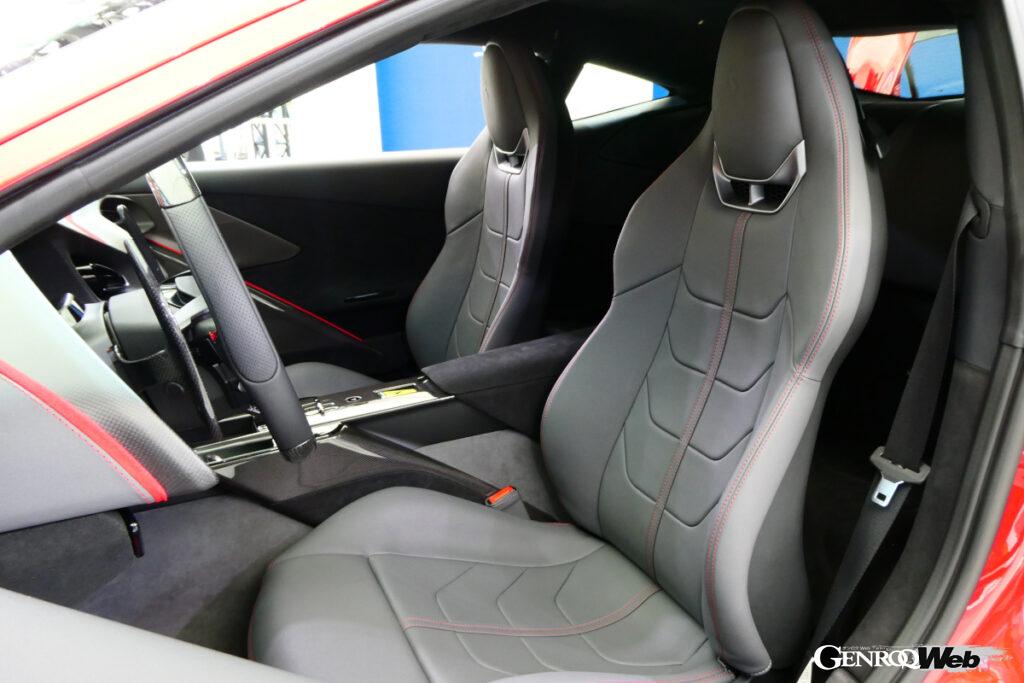
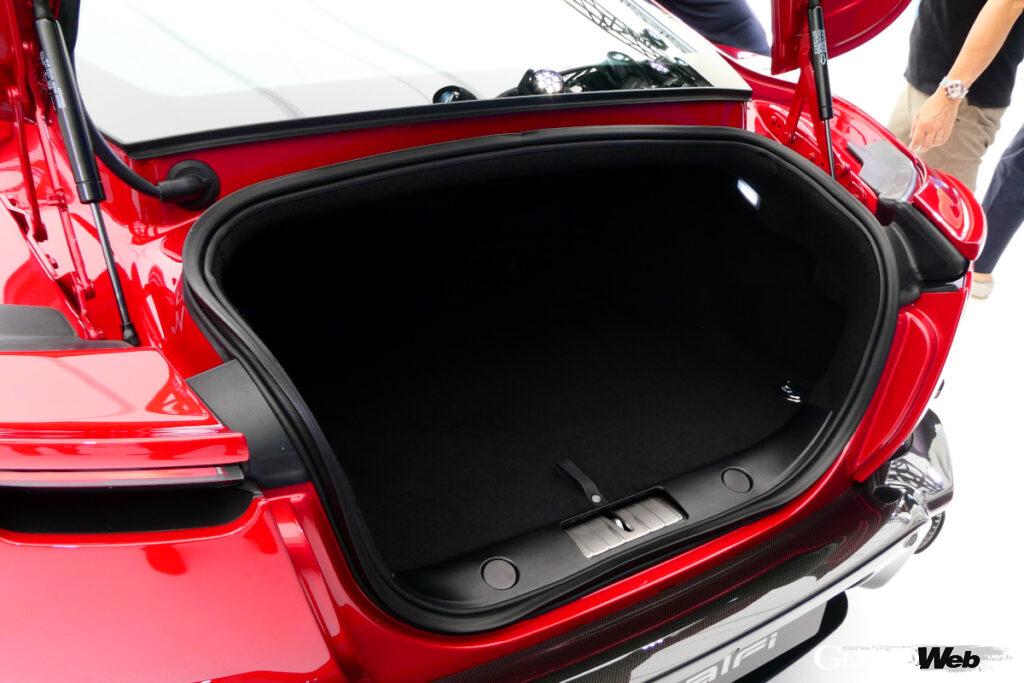
[1] The car adopts a “dual cockpit layout.” The center tunnel has been lowered, increasing interior comfort. [2] The rear trunk, with its large opening and excellent usability, remains intact. [3] It is equipped with an 8.8-inch display for passengers.
The interior boasts a “dual cockpit layout” that envelops the driver and passenger in two separate spaces. In the previous Roma, the 8.4-inch portrait display and gear selector were placed in the center, creating a high wall and a layout that divided the driver’s seat and passenger seat symmetrically. In contrast, the display is now 10.25 inches horizontal, the gear selector is lower, and the asymmetrical layout gives the impression of easier communication with the passenger. The 8.8-inch passenger display once again displays data such as G-forces and engine revolutions, providing an experience similar to that of a rally co-driver.
The steering wheel features easy-to-use physical buttons, including a physical start button. The infotainment system is fully equipped with the latest connected features, including Apple CarPlay and Android Auto compatibility, as well as wireless smartphone charging.
The vehicle’s base price is 34.18 million yen, which is a bargain considering the European price of 240,000 euros, but as you’d expect, there is already a long line of customers. Ferrari Japan’s recommended realistic option is to start with a certified pre-owned Roma.
PHOTO/GENROQ
SPECIFICATIONS
Ferrari Amalfi
Body size: Length 4660mm x Width 1974mm x Height 1301mm
Wheelbase: 2670mm
Vehicle weight: 1470kg (Dry)
Engine: V8 DOHC twin turbo
Total displacement: 3855cc
Maximum output: 640PS/7500rpm
Maximum torque: 760Nm/3000-5750rpm
Transmission: 8-speed DCT
Drive system: RWD
Tire size: 245/35R20 (front) 285/35R20 (rear)
Top speed: 320km/h
0-100km/h: 3.3 seconds
0-200km/h: 9.0 seconds
100-0km/h: 30.8m
200-0km/h: 119.5m
Fuel tank: 80L
Vehicle price: 34.18 million yen