

Porsche Carrera Cup
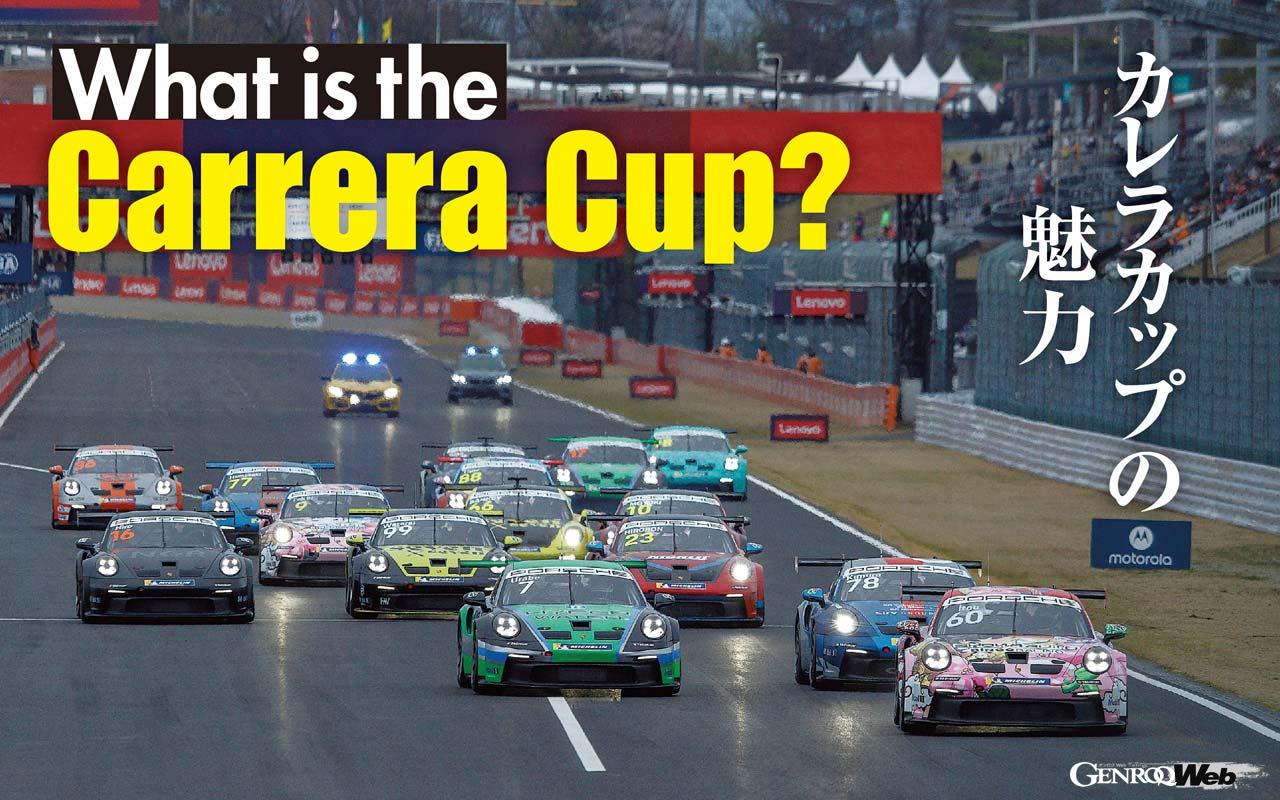
One-make race using 911 GT3 Cup cars
![[Pro Class] 2025 Drivers: 7 Kazuhisa Urabe, 60 Reimei Ito, 78 Iori Kimura, 91 Itsuki Sato, 99 Taichi Torai](https://motor-fan.jp/wp-content/uploads/sites/2/2025/04/2504grqw_CarerraCup_02-1024x682.jpg)
The Carrera Cup is contested on equal terms
There’s a saying that “racing is a laboratory on wheels.” This refers to the way that automakers feed technology developed on the racetrack back into their production cars. Against this backdrop, Porsche was one of the first to create a system known as customer racing, where the company sells its own race cars to customers and runs a race series, making it a viable business. This system has also enabled the world to produce amateur drivers, or gentleman drivers, who, while not professional drivers, are no less skilled. Incidentally, Porsche respectfully refers to the adventurous drivers who compete in the Carrera Cup as “Carrera Cup pilots.”
The Porsche Carrera Cup began in Germany in 1990 as a one-make race for the then-Porsche 911 (Type 964). During the 964 and 993 eras, the cars were based on the Carrera RS, but from the 996 onwards, when the engine changed from air-cooled to water-cooled, race-specific vehicles based on the GT3, commonly known as “Cup Cars,” were used.
In 1993, the Porsche Supercup was launched as a support race for the European Formula 1 Grand Prix. It is still held as a support race for F1 in eight European countries, and the one-make race using the Porsche 911 has attracted worldwide attention.
Started in Japan in 2001
![[ProAm Class] 2025 Drivers: 9 Shinji Takei, 10 MOTOKI, 66 BANKCY, 77 Dai Hamasaki, 88 Tiger Wu, 98 IKARI](https://motor-fan.jp/wp-content/uploads/sites/2/2025/04/2504grqw_CarerraCup_03-1024x682.jpg)
This year marks the 25th anniversary of the Carrera Cup Japan, which also hosts races in step-up categories.
The Carrera Cup began in Japan in 2001, starting as the Porsche Carrera Cup Japan (PCCJ) during the Type 996 era. The race has continued with the Type 997 since 2006, the Type 991 since 2014, and a cup car based on the current Type 992 since 2022, marking its 25th anniversary this year. Also, starting in 2019, the Porsche Sprint Challenge Japan was launched as a step-up category to the Carrera Cup, allowing participants to compete with older Cup Cars and Cayman GT4s. This category is also a good way for those with no racing experience to hone their skills, as they may find it difficult to jump straight into the Carrera Cup.
Currently, the PCCJ allows spot entry for any domestic A-class license holder, regardless of whether they are professional or amateur, to compete in non-international competitions. The series is divided into three classes: the “Pro Class,” “Pro-Am Class,” and “Amateur Class.” Series rankings are determined by the points earned in each class. The Pro Class features both professional drivers and Porsche Japan Junior Drivers, a scholarship program sponsored by Porsche Japan, creating a fierce battle for the skills that only a one-make race can offer. Previous series champions include Ryo Hirakawa, who currently competes in the WEC for Toyota and serves as a reserve driver for Haas F1, as well as other drivers active in Super GT, making this an important step up in the sport. For both pro-am and amateur drivers, racing alongside professional drivers provides an unparalleled opportunity to hone their driving skills and racing tactics.
Support for overseas challenges
![[The 2025 season will kick off as a prelude to the F1 Japanese Grand Prix] This season's PCCJ opening race was held as a double-header, with the first race on Saturday and the second race on Sunday, as a support race for the F1 Japanese Grand Prix in April. In the first race, #7 Urabe Kazuhisa of the Pro Class won his first victory. In the second race, #78 Kimura Iori won his first victory. There was also the exciting opportunity to stand on the podium used in F1.](https://motor-fan.jp/wp-content/uploads/sites/2/2025/04/2504grqw_CarerraCup_05-1024x682.jpg)
[The 2025 season will kick off as a prelude to the F1 Japanese Grand Prix] This season’s PCCJ opening race was held as a double-header, with the first race on Saturday and the second race on Sunday, as a support race for the F1 Japanese Grand Prix in April. In the first race, #7 Urabe Kazuhisa of the Pro Class won his first victory. In the second race, #78 Kimura Iori won his first victory. There was also the exciting opportunity to stand on the podium used in F1.
Many of the gentleman drivers who compete in the Carrera Cup are accomplished businessmen. They work from morning until night during the week, practice in their free time, and race on the weekends. Their passion and toughness are extraordinary. Sharing time with such people is sure to be an irreplaceable experience. In addition, if a driver wishes to challenge an overseas Carrera Cup series, there is a backup system in place to make that happen. There is no other one-make race held on a global scale like the Porsche Carrera Cup, and it is truly one of the highest levels of racing in which amateurs can compete.

The Porsche Carrera Cup is also known as the “world’s fastest one-make race.” In fact, anyone with a domestic Class A license, professional or amateur, can participate. Why not try to become the coveted “Carrera Cup pilot”?
![[Scholarship program to develop talent capable of competing on the world stage] Porsche Japan has been running a scholarship program since 2009 to develop young drivers. Each year, one junior driver is selected and given the right to compete in the professional class. This year, Sato Tatsuki, who will be the series champion in the JAF-F4 Championship in 2022, was selected. His performance will be closely watched.](https://motor-fan.jp/wp-content/uploads/sites/2/2025/04/2504grqw_CarerraCup_06-1024x683.jpg)
Porsche Japan has been running a scholarship program since 2009 to develop young drivers. Each year, one junior driver is selected and given the right to compete in the professional class. This year, Sato Tatsuki, who will be the series champion in the JAF-F4 Championship in 2022, has been selected. His performance will be closely watched.
Entry
Pro Class (Pro)
Number: White
Pro class entries are for drivers who have experience as a professional racing driver, or drivers who the PCCJ committee judges to have an equivalent background. There are no race-based or series prizes for the Pro class based on individual rankings.
Pro-am class (ProAm)
Number: Yellow
To enter the Pro-Am class, you must meet all of the following conditions:
(1) You have no past or present experience as a professional racing driver.
(2) The PCCJ Committee has approved your entry into the Pro-Am class or has determined that you have the experience necessary for that class.
Amateur Class (Am)
Bib number: Orange
To enter the Amateur class, you must meet all of the following conditions:
(1) You have no past or present experience as a professional racing driver.
(2) The PCCJ Committee has approved your entry into the Amateur class or has determined that you have the experience necessary to enter that class.
(*) Main careers that qualify for the Amateur class
: (1) If the driver has participated in the PCCJ series between 2022 and 2024: The average overall (overall ranking) points earned during that season (total overall points divided by the number of races completed) must be less than 8 points (rounded up or down to the nearest whole number). If the driver has participated in multiple seasons between
2022 and 2024, this must not have been exceeded in any one season. (2) In cases other than (1) above: Documents verifying all race series and race results participated in during each season between 2022 and 2024 must be submitted to the PCCJ Committee. The PCCJ Committee reserves the right to determine whether or not the driver can be registered in the Amateur class based on the documents and its own independent verification.
License
driver
Participants must hold a valid domestic driver’s permit (A grade or higher) issued by the Japan Automobile Federation (JAF) or their ASN for the current year, a medical certificate, and have paid the series entry fee. Participation in the F1 Japan Grand Prix support races requires an international driver’s permit (C grade or higher). Employees of Porsche Japan and their affiliates are not eligible to participate.
Entrants
Participants must hold a valid domestic or international license issued by the JAF or their ASN for the current year and have paid the participation fee. However, to participate in the F1 Japan Grand Prix support races, participants must hold an international license.
Age restrictions
18 years of age or older (in accordance with the JAF domestic competition rules – Competition Permit Regulations in effect this year)
Entry conditions for non-domestic participants
Entrants and drivers who hold a valid license for the current year and this series issued by an ASN other than JAF have the right to apply to participate in this series, and if they participate, they will be entitled to earn points as stipulated in these regulations.For all events, foreign entrants/drivers must submit an “Overseas Race Participation Certificate” issued by applying to the ASN to which they belong.
Regulations
Participating vehicles
Porsche 911 GT3 Cup (Type 992). This vehicle is certified by the PCCJ Committee. To ensure strict equality, the engine, transmission, and shock absorbers are sealed, and no modifications or alterations are permitted.
Annual cost
MY2025 Porsche 911 GT3 Cup (Type 992)
Vehicle price: 37,025,000 yen (tax included)
2025 series entry fee: 4,950,000 yen (tax included)
Other, maintenance costs + tire costs, etc.
2025 Porsche Carrera Cup Calendar
| Round | Date | Circuit | Event Name |
| Joint Test | March 18th (Tuesday) – 19th (Wednesday) | Fuji Speedway | |
| Rounds 1-2 | April 4th (Fri) – 6th (Sun) | Suzuka Circuit | F1 Japanese GP |
| Rounds 3-5 | May 24th (Sat) – 25th (Sun) | Okayama International Circuit | Okayama Challenge Cup |
| Rounds 6-7 | July 19th (Sat) – 20th (Sun) | Fuji Speedway | Super Formula |
| Rounds 8-9 | August 9th (Sat) – 10th (Sun) | Sportsland Sugo | Super Formula |
| Rounds 10-11 | September 26th (Friday) – 27th (Saturday) | Fuji Speedway | WEC World Endurance Championship |
REPORT/Taichi FUJINO
PHOTO/PORSCHE JAPAN
MAGAZINE/ GENROQ June 2025 issue