
![Examining the second-generation Porsche Cayman, which aimed to rival the 911 in performance [Porsche Chronicles]](https://wheelfeed.com/wp-content/uploads/2025/02/2395-1761198040491.jpg)

Cayman / Cayman S / Cayman GTS / Cayman GT4 (Type 981C)
A larger body

Porsche Cayman S

Porsche Cayman S
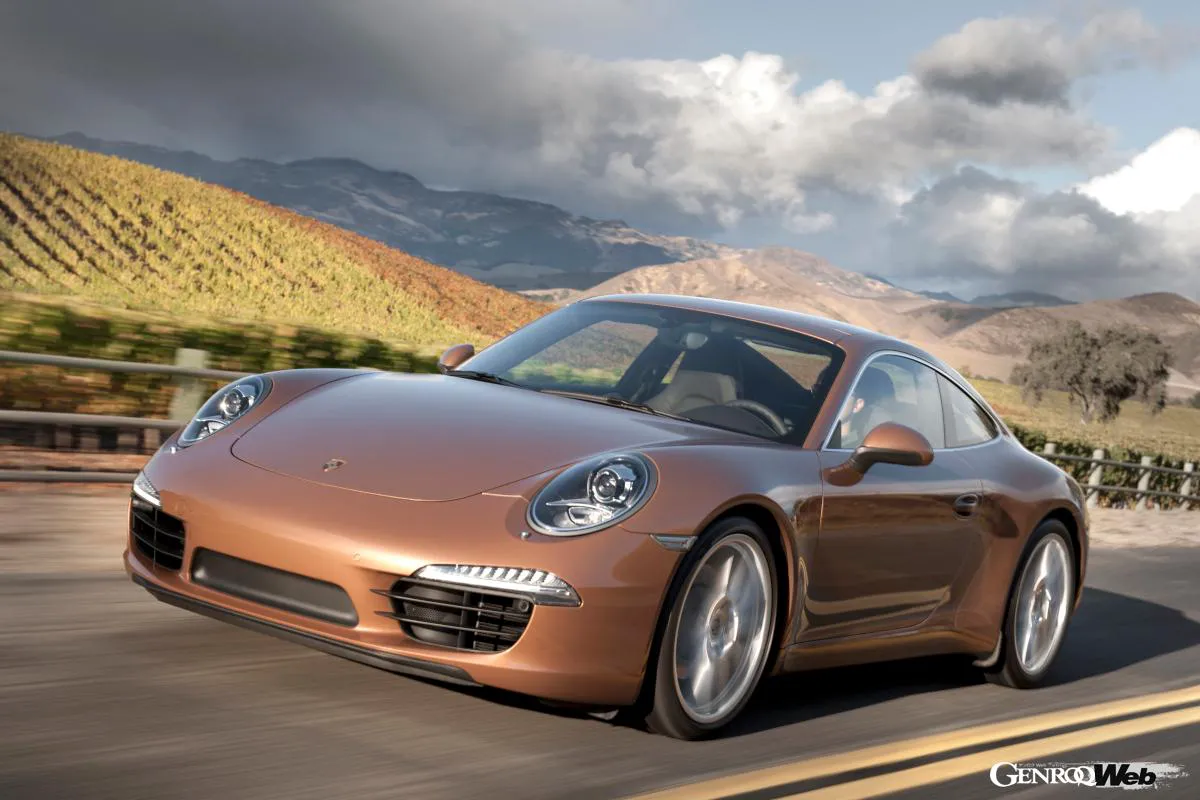
With the introduction of the two-seater open-top Boxster and its coupe version, the Cayman, Porsche’s lineup, which had long suffered from a lack of a bottom-end model to support the 911, finally saw a completion. Therefore, it was only natural that the second-generation Cayman (981C) was released in 2012, one year after the Boxster underwent a full model change to the 981.
Like the 981 Boxster, the body is slightly larger, with an overall length of 4,380 mm and a wheelbase of 2,475 mm. The front and rear treads have also been widened, but the overall height has been reduced by about 9 mm thanks to the adoption of a design that slanted the A-pillars. The car has also been completely revamped, achieving a weight reduction of about 30 kg compared to its predecessor through the extensive use of aluminum and magnesium components, while also achieving twice the torsional rigidity of the 981 Boxster. The aerodynamics have also been refined, with a Cd value of 0.30, and ample downforce is ensured thanks to the retractable rear spoiler, underfloor, and airflow in various areas.
Performance comparable to the 997 911

Porsche Cayman S interior
Along with this full model change, the interior design has also been changed, and a sloping center console has been adopted, following the 911 and Boxster. Not only has functionality and usability been improved, but the quality of the interior has also been greatly improved.
The engine is a standard flat-six with direct injection and displacement reduced from 2.9 liters to 2.7 liters. Like its predecessor, it produces a maximum output of 275 PS, higher than the Boxster. Meanwhile, the Cayman S’s displacement remains at 3.4 liters, and thanks to improvements to the ECU and other components, it produces 325 PS, 5 PS higher than the previous model. The gearbox remains the same, either a 6-speed manual or a 7-speed PDK (DCT), but the Cayman accelerates from 0-100 km/h in 5.7 seconds and has a top speed of 266 km/h, while the Cayman S accelerates from 0-100 km/h in 4.9 seconds and has a top speed of 281 km/h (both with PDK), demonstrating performance comparable to that of the 997 911 Carrera.
Furthermore, all vehicles are equipped with an energy regeneration system and an idling stop mechanism. Also, vehicles with PDK are equipped with a coasting function that disengages the clutch and puts the engine into idling mode when idling. As a result of these measures, the Cayman manual transmission is 12.2km/L, the PDK transmission is 13.0km/L, the Cayman S manual transmission is 11.4km/L, and the PDK transmission is 12.5km/L (all in the NEDC combined mode), showing an improvement of about 15%, which is also a major feature.
High-performance “GT4” also available

Porsche Cayman GTS

Porsche Cayman GT4
In 2014, at the same time as the Boxster, a sports version called the “GTS” was released, equipped with a 3.4-liter unit tuned to 340 PS, the Sport Chrono Package, a 20mm lowered sports suspension as standard, and specially designed front and rear skirts.
In 2015, the wheelbase was extended to 2484mm, and the chassis, which had been customised by the motorsport department in Weissach, included the transplant of the suspension and brakes from the 911 GT3, and was fitted with a 385 PS 3.8-liter flat-six engine inherited from the 911 Carrera S. Furthermore, the high-performance GT4, which could be described as the younger brother of the 911 GT3, was announced, equipped with a large carbon rear wing and a special rear diffuser. In 2016, the GT4 Clubsport, a circuit-only version of the GT4, was also released, marking the company’s entry into motorsports.
The 981C Cayman, which represented a huge leap forward from its predecessor, was produced until 2016, after which it evolved into the 718 Cayman, equipped with a flat-four direct-injection turbo.













![The S-Type, widely regarded as Bentley’s masterpiece post-war saloon [Bentley 100 Years of Car History]](https://wheelfeed.com/wp-content/uploads/2025/11/4703-1762127546348.jpg)