

CHEVROLET CORVETTE
×
PORSCHE 718 CAYMAN
It’s not the most user-friendly, but the MR Corvette has a special feel.

Chevrolet Corvette

Porsche 718 Cayman
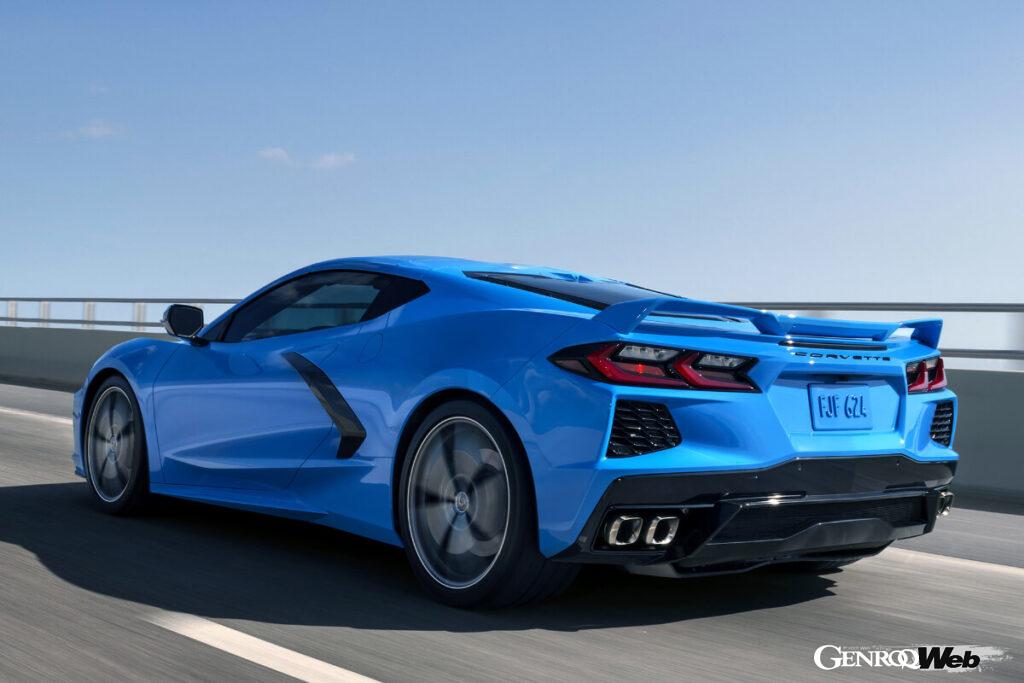
Chevrolet Corvette

Porsche 718 Cayman
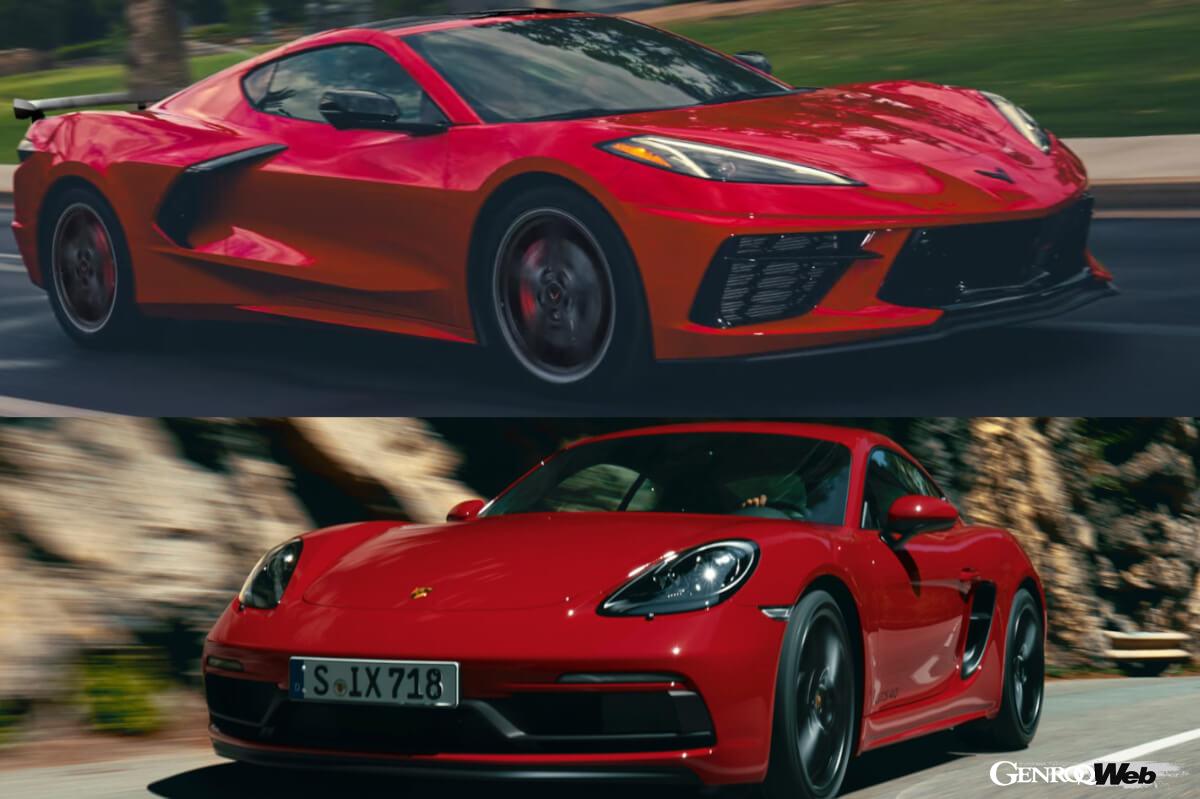
Both the Chevrolet Corvette 2LT and the 718 Cayman GTS 4.0 have the wide and low proportions typical of a two-seater mid-engine layout, but the Cayman’s body size is more compact. Getting in and out of both cars isn’t easy due to their wide side sills and long doors, but the Corvette is particularly difficult. But the cockpit-like interior design and the special feeling you get when you sit in the driver’s seat are exceptional.
Both cars have small luggage compartments in the front and rear, and the Corvette has a relatively large capacity in the rear trunk to store the removed roof. However, it is important to note that both the Corvette and the Cayman tend to transmit heat from the engine and muffler into the luggage compartment.
Also, the Cayman has a small storage space behind the seats, while the Corvette only has a small storage space between the left and right seats, making it difficult to find a place to store small items. Although the difference is small, the Cayman seems to be more convenient and practical.
Chevrolet Corvette 2LT
Body size = Length 4630mm x Width 1940mm x Height 1225mm
Wheelbase = 2725mm
Vehicle weight = 1670kg
Tire size = 245/35ZR19 (front) 305/30ZR20 (rear)
Porsche 718 Cayman GTS 4.0
Body size = Length 4405mm x Width 1801mm x Height 1276mm
Wheelbase = 2475mm
Vehicle weight = 1435kg (PDK)
Tire size = 235/35ZR20 (front) 265/35ZR20 (rear)
American V8 and Flat 6

Chevrolet Corvette

Porsche 718 Cayman
The engines of the two cars are quite symmetrical: the Corvette is equipped with a V8 engine that is characterized by a rough exhaust sound, while the Cayman is equipped with a horizontally opposed 6-cylinder engine that is low-vibration and smooth.
With a larger engine, a larger rear wheel load, and wider rear tires, the Corvette accelerates from 0 to 60 mph (approximately 96 km/h) in 2.9 seconds, while the Cayman accelerates from 0 to 100 km/h in 3.8 seconds, a big difference in acceleration performance.
The midship design is not only characterized by its traction performance, but also by the small moment of inertia during cornering that is obtained by placing the engine, which is the heaviest part, in the center of the vehicle. In terms of cornering performance, the Cayman’s horizontally opposed engine, which is shorter in length and lighter in weight, and has a lower center of gravity than a V8 engine, gives it an advantage.
Chevrolet Corvette 2LT
Engine type = V8 gasoline engine
Displacement = 6156cc
Maximum output = 502PS/6450rpm
Maximum torque = 637Nm/5150rpm
Transmission = 8-speed DCT
Drive system = RWD
Porsche 718 Cayman GTS 4.0
Engine type = Horizontally opposed 6-cylinder gasoline engine
Displacement = 3995cc
Maximum output = 400PS/7000rpm
Maximum torque = 430Nm/5500rpm
Transmission = 8-speed DCT
Drive system = RWD
Two distinctive and symmetrical MR super sports cars

Chevrolet Corvette

Porsche 718 Cayman
The Corvette’s cheapest grade, the 2LT, is priced at 14.2 million yen. In contrast, the Cayman’s premium grade, the GTS 4.0, is about 1.6 million yen cheaper at 12.62 million yen. The GTS 4.0 comes standard with the PASM sports suspension and the Sport Chrono Package, so there are few options to add. Another plus is the option of a 6-speed manual transmission.
Both cars are special mid-engine models that offer performance not possible with FR or RR. Both can be called true super sports cars. However, even though they are both MR, their characters are contrasting. Both have high performance as MR sports cars, and the Corvette excels in straight-line acceleration thanks to the powerful sound and high torque of its American V8, while the Cayman with its horizontally opposed engine boasts exhilarating throttle response and cornering performance.