

VOLVO XC90
×
AUDI Q7
Volvo is simple and sturdy, Audi is sporty

Volvo XC90

Audi Q7

Volvo XC90

Audi Q7
SUVs are popular worldwide, but in Japan, they are becoming larger and more accommodating for more passengers. Toyota’s latest SUVs, the Land Cruiser 300 and Land Cruiser 250, can accommodate up to seven people, and Mazda’s CX-80 can also seat seven people.
In Japan, minivans are generally used to accommodate large numbers of passengers. However, in other countries where minivans are not popular, this role is filled by SUVs. The Volvo XC90 and Audi Q7 we will compare here are exactly that, large, multi-passenger SUVs that each brand is proud of.
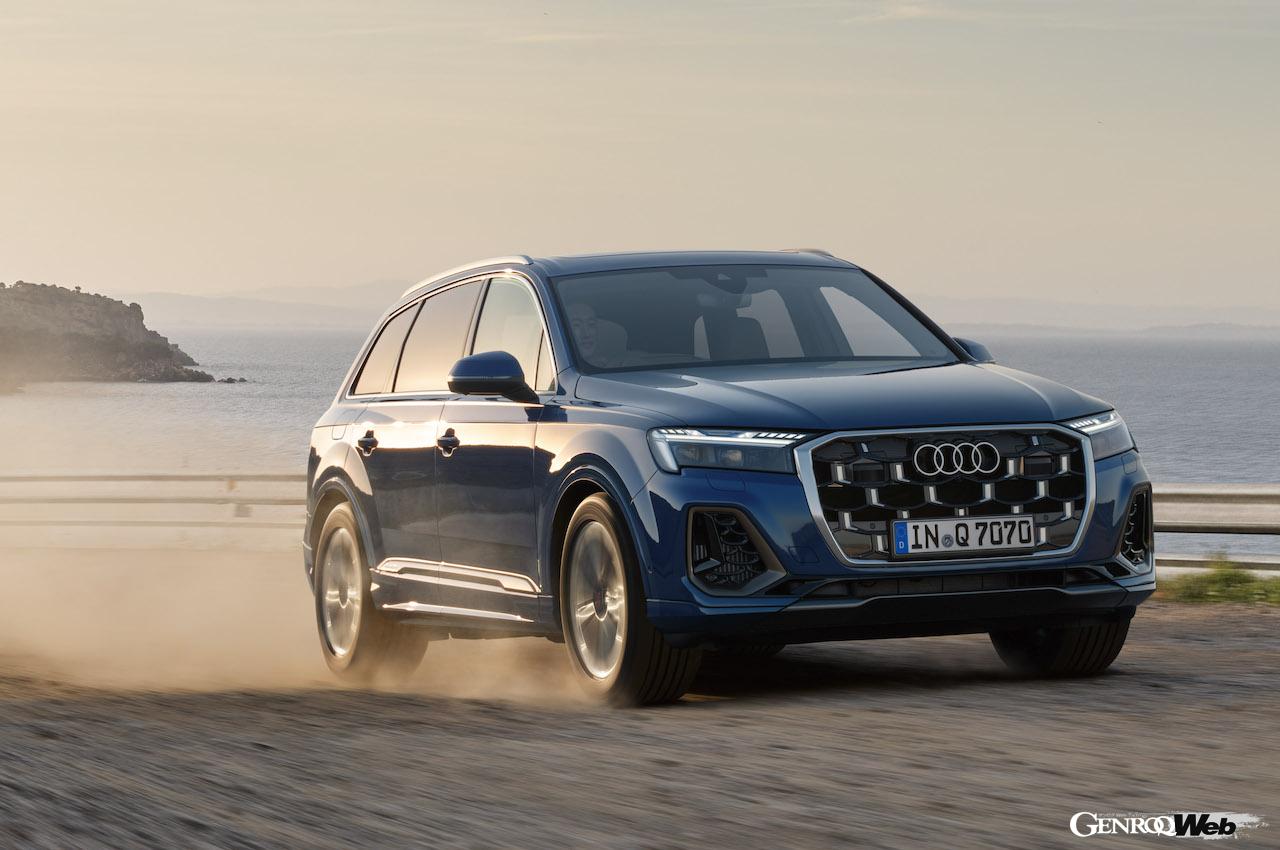
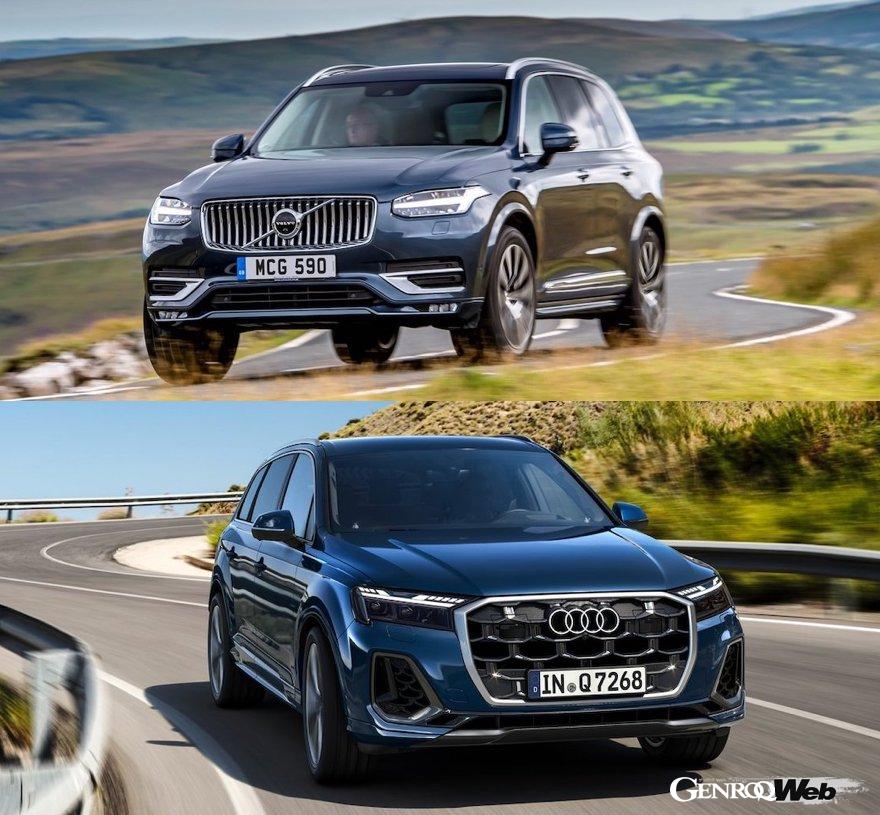
Comparing the styling of the two cars, the XC90 looks larger at first glance, but when comparing specs, the Q7 is actually longer and wider.
The reason for this is likely due to the difference in design approach. The XC90 has a square design based on straight lines and is tall, while the Q7 incorporates sports sedan and coupe techniques, such as a slant nose and a sloping roof.
For many people, Volvo is known for its sturdy and no-nonsense touring wagons, while Audi is known for its luxury sports sedans. The company has incorporated these elements into its SUVs.
Volvo XC90 Plus B5 AWD
Body size = Length 4950mm x Width 1930mm x Height 1775mm
Wheelbase = 2985mm
Vehicle weight = 2110kg
Tire size = 235/55R19
Audi Q7 50 TDI quattro
Body size = Length 5070mm x Width 1970mm x Height 1735mm
Wheelbase = 2995mm
Vehicle weight = 2220kg
Tire size = 255/55R19
The difference between the simple and robust approach and the sporty approach is also in the engine.

Volvo XC90

Audi Q7

Volvo XC90

Audi Q7
The two cars being compared here are base grades, but the difference is that the XC90 is a gasoline engine and the Q7 is a diesel engine.
Here again we can see the difference in the approaches of the two brands. A simple comparison of the specs reveals that the Q7 is superior in all respects, but perhaps the most noteworthy aspect is its fuel economy. The XC90 has a gasoline turbo engine and achieves a WLTC mode fuel economy of 11.4km/L. On the other hand, the Q7 has a diesel turbo engine and achieves 11.7km/L. Since diesels are usually considered to have an advantage in fuel economy, it can be said that the XC90 is doing well.
Across the entire lineup, the XC90 is thought to be pursuing eco-friendly performance, while the Q7 is pursuing sporty performance. As proof, the top-of-the-line model in the Q7 series, the SQ7, is equipped with a 4.0-liter V8 twin-turbo engine with 507 PS. Meanwhile, the flagship XC90, the Ultra T8 AWD, is equipped with a 2.0-liter inline-4 turbocharged plug-in hybrid. Its WLTC mode fuel economy is 13.3 km/L.
Volvo XC90 Plus B5 AWD
Engine type = Inline 4-cylinder DOHC Turbo
Displacement = 1968cc
Maximum output = 250PS / 5400-5700rpm
Maximum torque = 350Nm / 1800-4800rpm
Transmission = 8-speed AT
Drive system = AWD
Audi Q7 50 TDI quattro
Engine type = V6 DOHC turbo
Displacement = 2967cc
Maximum output = 272PS / 3500-4000rpm
Maximum torque = 600Nm / 1750-3000rpm
Transmission = 8-speed AT
Drive system = AWD
Is Volvo a better value when comparing safety and comfort features?

Volvo XC90

Audi Q7
The price difference between the two cars is about 1 million yen. Both are veteran models that arrived on the Japanese market in 2016, but the Q7 has undergone several minor changes since then, with major changes to its interior and exterior. It seems that the Audi brand and these circumstances are reflected in the price.
However, the XC90 also comes equipped with the latest driver assistance features as standard, and many people will be attracted to the XC90’s high value.