
![Compact and sporty “Mark VI” for the owner-driver era [Bentley 100 Years of Car History]](https://wheelfeed.com/wp-content/uploads/2025/10/1075-1761629654496.jpg)

Mark VI
Only 11 Mark Vs were made
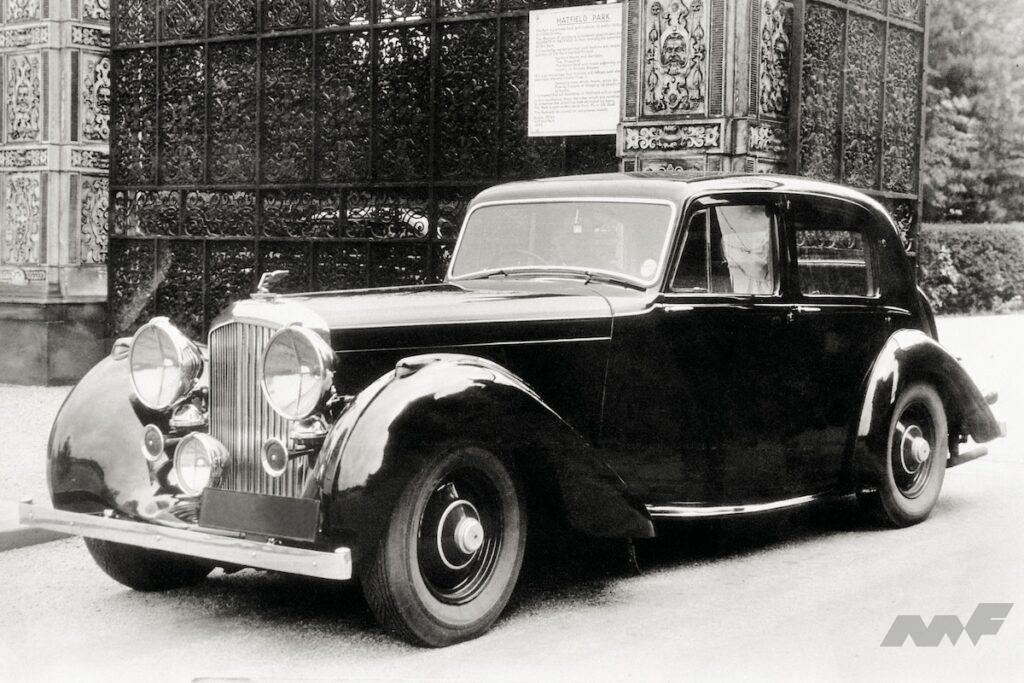
“Bentley Mark V”
In 1939, Bentley developed the Mark V, which featured a ladder frame chassis with an X-shaped cross frame for added rigidity and a front double wishbone suspension. It was scheduled to be unveiled at the London Show that same year, but the outbreak of World War II meant that the project was canceled. Only 11 Mark Vs were produced and the car was shelved.
At the time, Rolls-Royce, anticipating an increase in demand for aircraft engines amid a darkening situation in Europe, built a large 60-acre factory in Crewe, Cheshire, and began manufacturing the liquid-cooled V12 Merlin engine in 1939.
When the war in Europe ended in May 1945, Rolls-Royce moved production of aircraft jet engines to Derby, and the vast Crewe factory was converted into a car factory.
The first car produced at the Crewe factory, which had now restarted as an automobile factory, was the Bentley Mark VI, which appeared in 1946.
Anticipating an increase in demand for owner-drivers

“Bentley Mark VI”
Its greatest feature was that, unlike previous models which had been shipped on rolling chassis, it was fitted with a standard four-door steel saloon body at the Crewe factory. Designed by John Polwell Blatchley, the body was compact and sporty in anticipation of increasing demand for owner-drivers. It was manufactured at Pressed Steel in Cowley and then transported to Crewe, where the interior, consisting of Connolly leather seats, walnut dashboard and door trim, and Wilton pile carpet, was fitted before being assembled to the chassis.
The chassis, developed under the direction of chief engineer Ivan Evenden, was based on the Mark V, with a wheelbase shortened to 120 inches and featured double wishbone suspension with coil springs at the front.
The inline-six OHV engine had the same displacement as the pre-war 4 1/4 liter, 4257cc, but it was a newly designed B60 engine with an integrated cylinder head and block for increased rigidity. This engine, which was also used in Army armored vehicles, was designed to last for 100,000 miles, so it was also characterized by its high durability. The transmission that was paired with this was a 4-speed manual with synchromesh, with a floor shift on the right side for right-hand drive vehicles and a column shift for left-hand drive vehicles.
Evolved into the R-Type in 1952
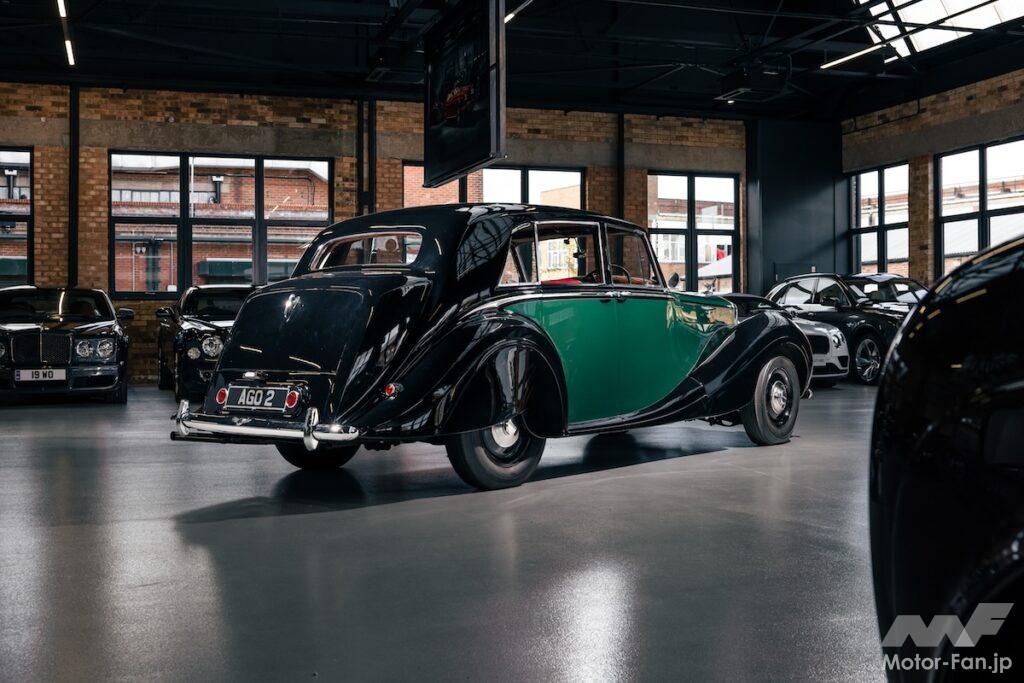
“Bentley Mark VI”
A total of 5,208 Mark VIs had been produced by 1952, of which 4,196 had saloon bodies made by Crewe, and the rest were various coachbuilt models such as the Park Ward two-door drophead coupe, the James Young four-door sports saloon, and the HJ Mulliner four-door saloon.
The Mark VI itself evolved into the R-Type in 1952, with the rear extended by 6 inches to increase luggage space. The Hydra-Matic 4-speed automatic transmission also became an option, and by 1955, 2,500 units had been produced, far exceeding the production of its sister car, the Rolls-Royce Silver Dawn.
The model that helped Bentley recover after the war
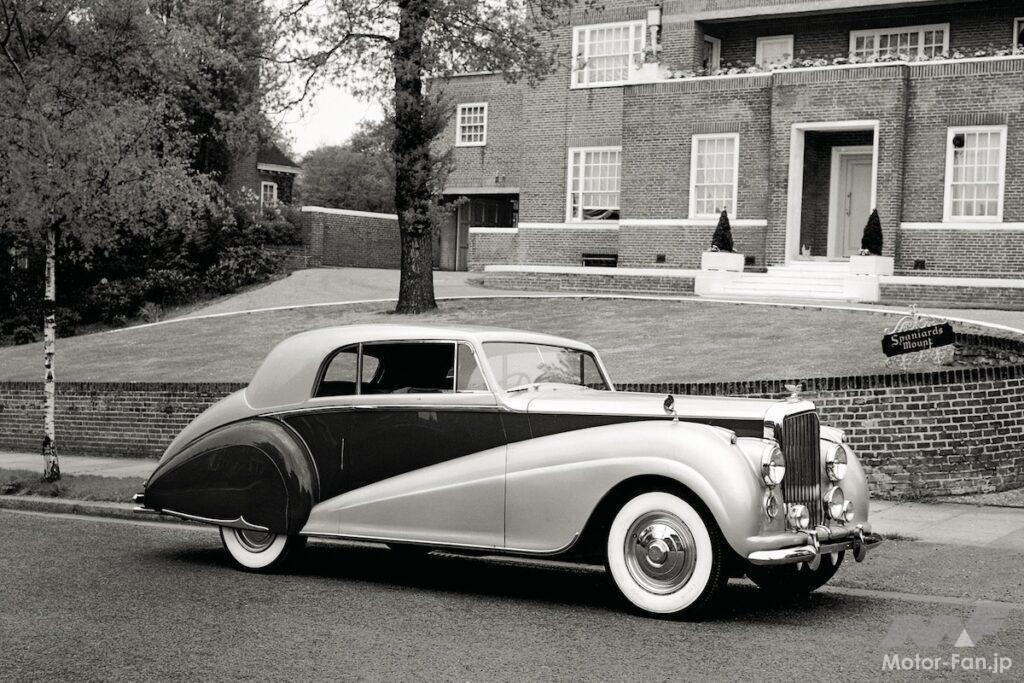
“Bentley Mark VI”
With such a dramatic increase in production, the Mark VI and R-Type played an important role in supporting Bentley’s post-war recovery. However, due to the steel shortage caused by Britain’s strict rationing system and the poor quality of the steel itself, the company suffered from serious production shortages and quality issues.
The Mark VI currently owned by Bentley Motors is one of 241 coachbuilt four-door six-light saloons produced by HJ Mulliner. After being delivered to its first owner, William Laund of Alabasterine, in January 1950, it passed through the hands of several owners before returning to the Bentley Heritage Collection in 2021. It has since been thoroughly restored, bringing it back to its former glory.












![The S-Type, widely regarded as Bentley’s masterpiece post-war saloon [Bentley 100 Years of Car History]](https://wheelfeed.com/wp-content/uploads/2025/11/4703-1762127546348.jpg)