

PORSCHE 963 RSP
A vivid writing style

Veto’s writing style attempts to directly convey his own sense of excitement to the reader.
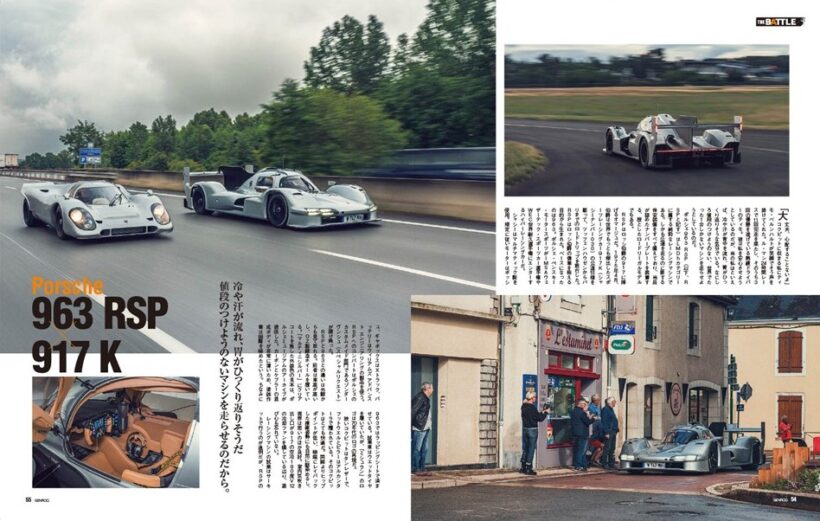
Last time, we looked at three metaphors that appear in French journalist Sylvain Vétaux’s test drive report of the Porsche 963 RSP: “hit the jackpot,” “chicken in front of a knife,” and “piranhas on a bleeding mud flap.” These metaphors are particularly difficult to understand when translated literally. What these expressions have in common is that they go beyond simply describing the specifications and driving impressions, and instead attempt to directly convey to the reader the author’s excitement, tension, and emotional “driving experience.” This time, as a follow-up to that article, we will introduce two even more striking metaphors.
Pilot fish?

The Porsche 911 GTS has been likened to a “pilot fish” (photo is for illustrative purposes only).
Veto’s test drive was led by professional racing driver Timo Bernhard in a Porsche 911 GTS. Bernhard pushed the GTS relatively hard to let Veto experience the 963 RSP’s performance. He described the 911’s hard braking as, “My pilot fish is shooting the GTS’s brake pads.”
“Pilot fish” is a fish of the Carangidae family, and its Japanese name is “Burimodoki.” Its official scientific name is “Naucrates ductor,” derived from the Greek word “Naucrates” (one who guides a ship) and the Latin word “ductor” (guide). It is called this because it has the habit of swimming as if accompanying large fish such as sharks, and looks like a guide, or pilot.
In this context, it metaphorically describes how Bernhard and his 911 GTS, taking the lead, are like small fish swimming around a big shark (963 RSP). It’s a unique metaphor, and while its slightly poetic tone may be appealing in English, a direct translation into Japanese makes it difficult to understand, so it’s important to read it with an understanding of its true meaning. In Japanese, it would be something like, “Timo, in the lead, is overworking the brakes of his GTS.”
A whip-like shift?

There seems to be a sense of unity in the controls, including the shift feeling.
Regarding his impressions of the controls, he describes the gear shift feeling as “The gears snap like a whip, with just the right amount of jolt to feel involved.” Literally, it means “The gears snap like a whip, and you can feel just the right amount of shock that gives you the feeling that you are involved (operating).”
The expression “snap like a whip” describes the shock of shifting sequential gears as “a whip-like sensation of snapping.” It is thought to be a metaphor for conveying the feeling that the driver feels one with the transmission’s responsiveness.
In Japanese, the metaphor of using a whip is generally difficult to understand. To imagine what Veto was feeling, a more appropriate expression would be, “The crisp shift feel is so satisfying!”
What Veto’s metaphorical expressions, introduced in two articles, have in common is that they are not simply a description of the car’s specifications, but rather a description of the reporter’s experience of becoming one with the car, incorporating his psychological and physical reactions. By understanding these expressions as accurately as possible, you will be able to appreciate the realism and energy contained in his original writing. Test drive reports that include metaphors have the power to appeal to the reader’s emotions more than technical explanations.