
![BMW’s first crossover models, the X5 M and X6 M, are based on the second generation. [BMW M’s history]](https://wheelfeed.com/wp-content/uploads/2025/05/1775-1761189207680.jpg)
X5 M/X6 M
BMW’s first crossover SUV


BMW X5 M
In 1999, BMW announced the X5, its first crossover SUV, also known as an SAV (Sports Activity Vehicle). The catalyst for this was the acquisition of Rover in 1994. BMW then launched a crossover development project using Rover’s technology. The E53 X5 was developed using components from the E39 5 Series, including the powertrain, and the off-road system from the third-generation Range Rover.
One of the features of the E39 X5 was that it used a monocoque chassis, which was rare for an SUV at the time (and the first for a luxury SUV), and it also featured an AWD system with a 38:62 front-to-rear torque split, DSC (Dynamic Stability Control), automatic differential braking, hill descent control, etc. It was praised for its emphasis on on-road performance over off-road performance, and it became a hot topic as it was a favorite of F1 drivers of the time.
In 1999, to commemorate the car’s victory at the 24 Hours of Le Mans, a one-off “X5 LM” was produced, featuring a detuned V12 unit from the LMP car “V12 LMR,” and attempted to break the lap record at the Nürburgring, but no sports model was ever produced.
BMW M’s first crossover model is based on the second generation


In July 2006, the X5 underwent a model change to the second-generation E70 model. The body dimensions were 4855mm long, 1935mm wide, 1650mm high, and had a wheelbase of 2935mm, making it a size larger than its predecessor, with three rows of seats. Meanwhile, the interior was essentially an evolution of the previous model, with BMW xDrive, which was introduced in the later stages of the first generation and allows on-demand adjustment of front and rear torque distribution.
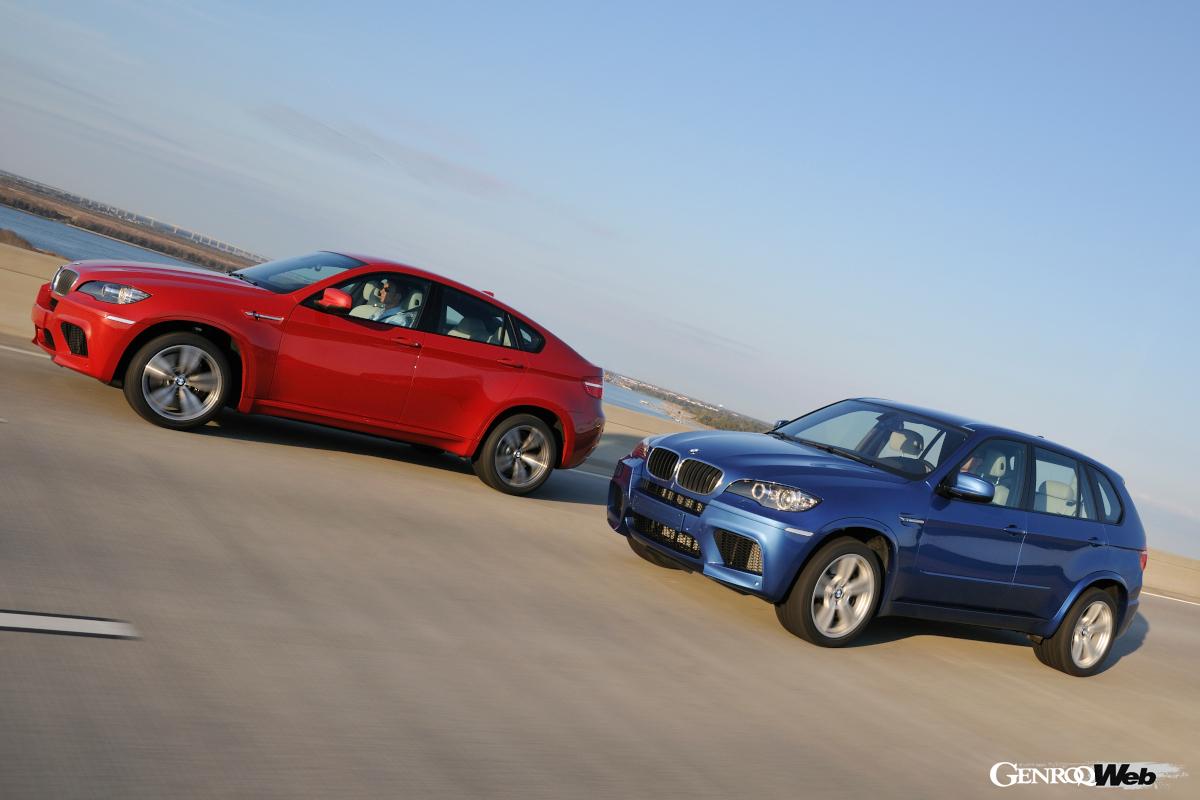
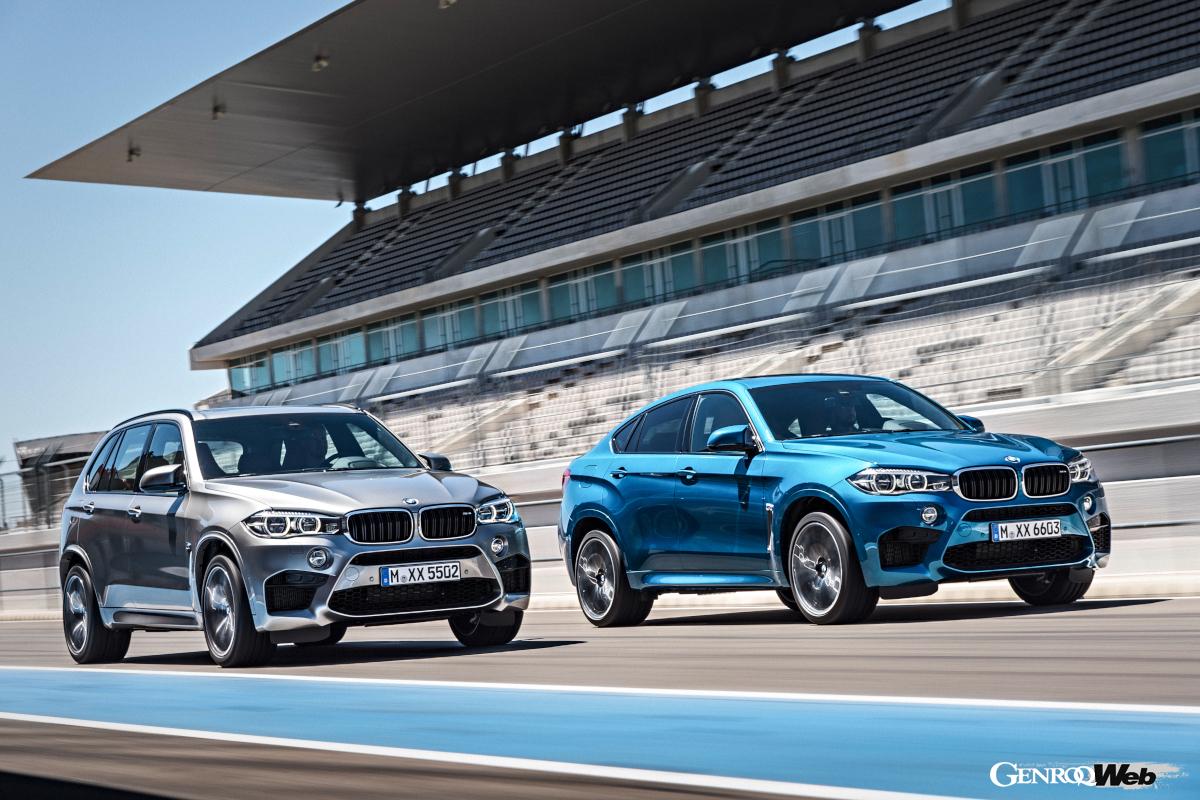
A notable feature of the second-generation X5 is that the X6, a derivative model that could be considered a pioneer of coupe SUVs, debuted in 2008, and in 2009 the X5 M and X6 M were added to the lineup as BMW M’s first crossover models.
Both the X5 M and X6 M are equipped with a 4.4-liter V8 DOHC 32-valve twin-scroll twin-turbo “S63” unit with a cylinder bank comprehensive manifold (CCM) in the front. It produces a maximum output of 555 PS/6000 rpm and a maximum torque of 680 Nm/1500-5650 rpm. Despite their massive 2.4 tonne bodies, both cars accelerate from 0 to 100 km/h in just 4.7 seconds via a 6-speed M Sport automatic transmission.
The car’s exterior features wide fenders, a specially designed front bumper with a wide intake, and exclusive parts such as side steps, rear bumper, and exhaust pipes, creating a powerful styling. It also features special wheels with tires of different sizes, 275/40-20 in the front and 315/35-20 in the rear, as well as ventilated disc brakes, the largest of any BMW production car, measuring 395mm x 36mm in the front and 385mm x 24mm in the rear.
High stability and nimble handling

BMW X6 M
On the other hand, the chassis is equipped with not only xDrive, but also air suspension with a self-leveling function, Dynamic Performance Control that distributes drive force to the left and right rear wheels, Adaptive Drive that maintains a flat posture in combination with electronically controlled dampers, and Dynamic Stability Control, all of which are specially set as standard equipment. This achieves handling that combines high stability with the controllability of a FR vehicle.
Furthermore, in 2010, the brake energy regeneration system Micro Hybrid Technology was made standard equipment, and in 2012, a minor change was made to refine the interior and exterior, including the adoption of newly designed LED headlights and kidney grille.
In addition, from the 2013 model, the xDrive35i and xDrive50i were equipped with the same wide fenders and sports suspension as the X5 M, and the M Performance Package was also introduced, which increased engine power, and this crossover designed by M received a great response both domestically and internationally.











![The S-Type, widely regarded as Bentley’s masterpiece post-war saloon [Bentley 100 Years of Car History]](https://wheelfeed.com/wp-content/uploads/2025/11/4703-1762127546348.jpg)