

BMW 320i M Sport
A sense of security brought by the basic grade
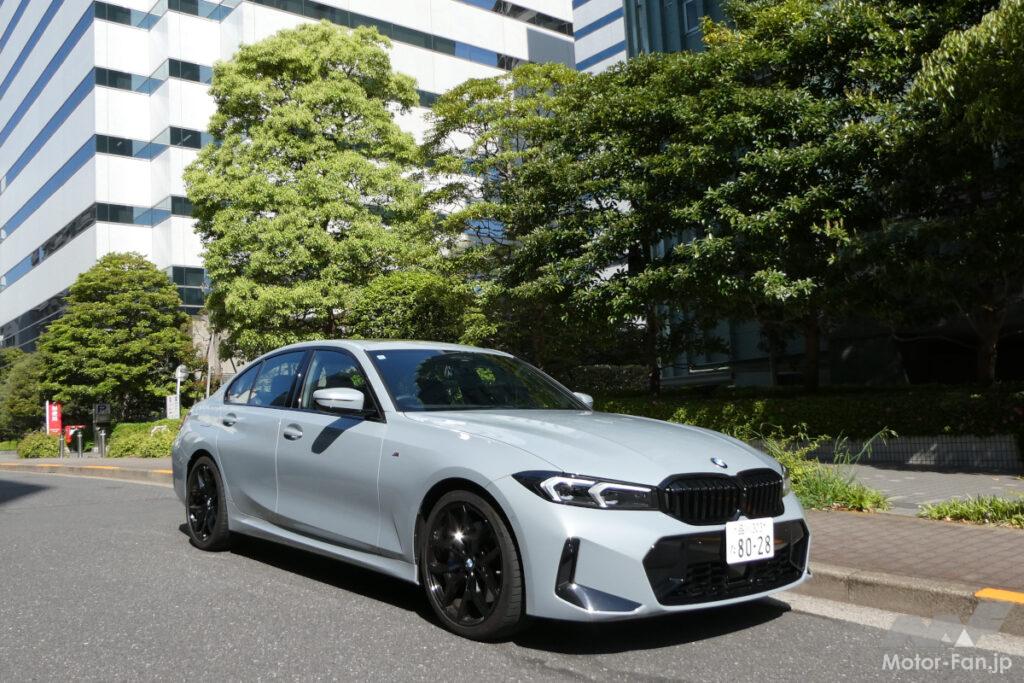
The “almost” entry-level grade “320i” of the G20 3 Series
When buying a car, many people are troubled by which grade to choose. In many cases, the choice is based on a single grade, but when you ask a serious car journalist who test drives hundreds of cars a year, they usually recommend the basic grade.
The reason is clear: with a model that has a wide lineup, there is a sense of satisfaction in being able to get the same styling as a higher-grade model at a lower price, and the higher-grade model may feel too much like a match, so the basic grade’s “this is good enough” vibe may even give a sense of security.
There may be pros and cons to that opinion, but honestly, I think the basic grade is fine. Especially if I were buying a family car, I would choose the cheapest grade. Based on that premise, the model I test drove this time was the “almost” entry-level grade “320i” of the G20 3 Series, the current model of BMW’s entry-level saloon “3 Series.” I wanted to test drive the 318i, the true cheapest grade, but there were no test drive cars available.
A design that appeals to conservative car enthusiasts
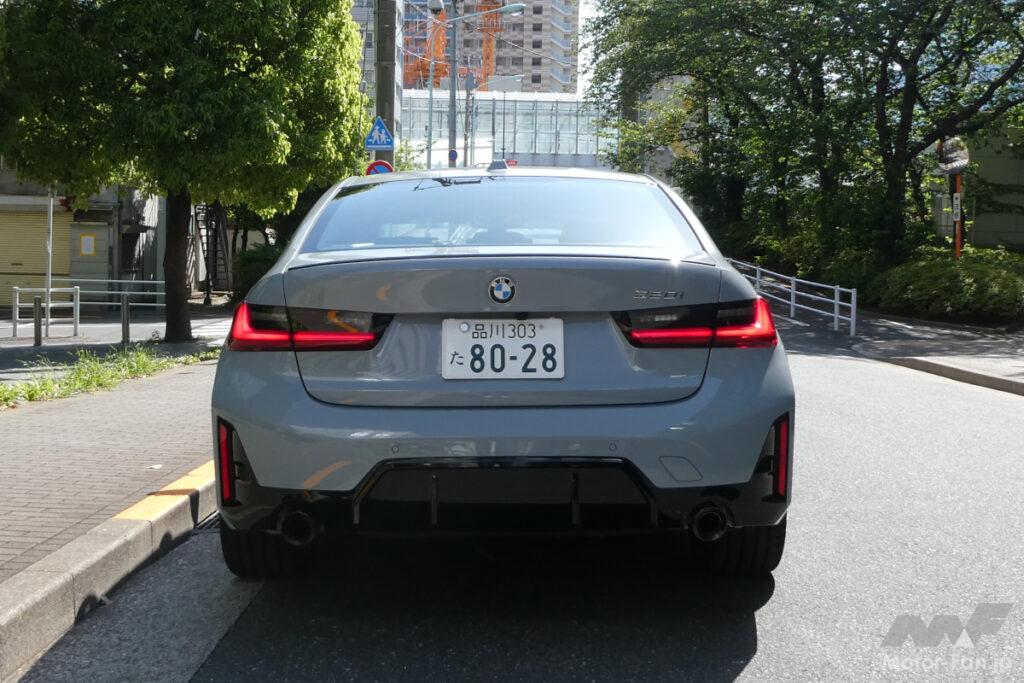

Compared to the previous model, the overall length has increased by 70 mm (wheelbase by 40 mm) and the overall width has increased by 25 mm.
The seventh-generation 3 Series G20 model debuted in 2019, so six years have already passed. The 3 Series undergoes a full model change roughly every seven years, so it can be said that this is the most mature period.
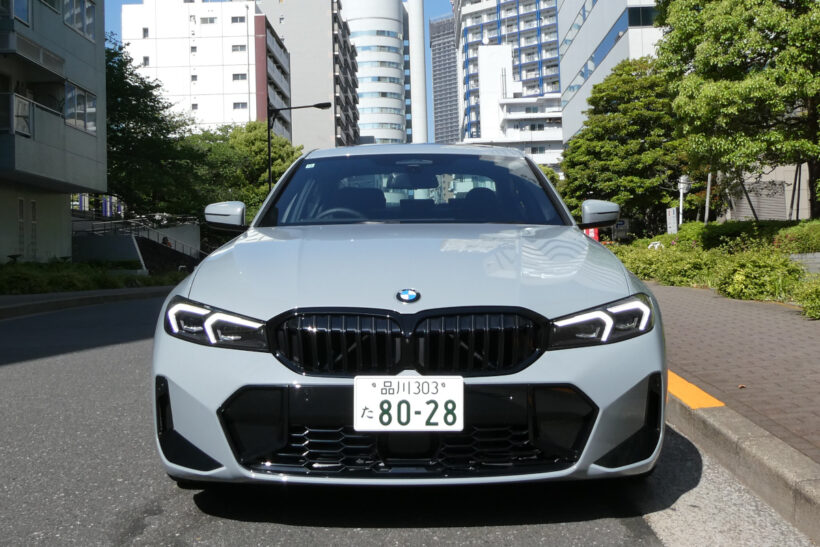
Compared to its predecessor, the G20 model has been enlarged to reflect the trends of the time. The overall length has been increased by 70mm (wheelbase by 40mm) and the overall width by 25mm. The 320i I test drove was an M Sport, so it was nicely lowered and simply looked cool. The center of gravity of the standard model is said to be 10mm lower. Just this appearance alone is enough to make a strong impression on me, a conservative car enthusiast in his 50s (that’s me).
The test car was also equipped with the optional Fast Track Package (400,000 yen), which includes 19-inch alloy wheels, M Sport brakes, adaptive M suspension, and variable sport steering. The M Sport Package Pro (139,000 yen) was also added, bringing the total options to a whopping 1,468,000 yen. While this detracts from the intended purpose of exploring the car’s basic qualities, it’s unavoidable given the circumstances of the test car. Incidentally, the vehicle’s base price was 6,900,000 yen at the time of the test drive, but this rose to 7,240,000 yen this July.
The interior feels old-fashioned


The test drive vehicle was equipped with the M Sport Seat Package (388,000 yen). The moderate protrusion was sporty and comfortable. The interior, featuring the latest BMW curved display, is the same whether it is a high-grade or basic grade.
You get in by pulling the grip-type door handle, which is rare these days. Recently, there are many flush surfaces that emphasize air resistance, and while this may contribute to fuel efficiency, many doors do not open and close smoothly. This grip handle is a blessing.
The first thing that catches your eye in the interior is the latest BMW curved display. This level of innovation is the same whether you choose the top or base grade. The infotainment logic based on BMW OS 7.0, which was introduced in the 8 Series, was reminiscent of the original iDrive that debuted in 2001 due to its inaccessibility, but it has now become so familiar that it makes previous generations seem outdated. The 3 Series underwent a minor change in 2022, upgrading to OS 8.5, further improving usability. However, the upcoming release of the new generation Neue Klasse and the next 3 Series are likely to see another major evolution, a third era of “inaccessibility.”
Equipped with the M Sport Seat Package (388,000 yen), it has a large side support and is sporty yet comfortable. The driving position has a wide range of adjustment for seat height and steering tilt, so if you carefully adjust it, it will be perfect.
While the selector lever has been made smaller in the minor change, there are many physical switches, including the steering wheel switches, and there were moments during the test drive when it felt a little outdated. I was surprised that I found physical switches to be outdated, but I think that the fact that they have retained physical switches that can be operated by touch without taking your eyes off the wheel is actually a sign of consideration for the driver.
Tuning that captures the essence of the Japanese market


Grip-type door handles make it easy to open and close. A 2.0-liter inline 4-cylinder turbo engine delivers a maximum output of 135kW (184PS) at 5000rpm and a maximum torque of 300Nm at 1350-4000rpm.
The engine is a 2.0-liter inline 4-cylinder turbo with a slightly modest maximum output of 135kW (184PS) at 5000rpm. This is a special tune prepared for the Japanese market, but it still has a maximum torque of 300Nm at 1350-4000rpm and is paired with the usual ZF 8-speed automatic transmission, so it’s easy to drive and can be said to be a well-tuned car. Incidentally, the tachometer is in the yellow zone from 6500rpm and the red zone from 7000rpm.
The vehicle weighs a surprisingly light 1,550 kg. The test vehicle was equipped with a sunroof and the vehicle inspection certificate stated it weighed 1,590 kg, but that is still light by modern standards. With this weight, 300 Nm is enough to climb a hill. There were times when the engine seemed a little old when starting from idle stop, with a thud, but this may have been because I had just driven a 48V mild hybrid vehicle.
The test car was equipped with Adaptive M suspension, so the ride quality was worthy of the M Sport name, with a firmness that matched the low vehicle height. It wasn’t unbearable in urban areas, but it would be more comfortable to drive a little faster on the highway rather than on regular roads. Even though it’s the basic grade of the standard model, the 3 Series has now become a luxury saloon priced at over 7 million yen. However, considering the current weak yen, this price is unlikely to fluctuate for the time being.
SPECIFICATIONS
BMW 320i M Sport
Body size: Length 4720, Width 1825, Height 1440mm
Wheelbase: 2850mm
Vehicle weight: 1550kg
Engine: Inline 4-cylinder DOHC turbo
Total displacement: 1998cc
Maximum output: 135kW (184PS) / 5000rpm
Maximum torque: 300Nm / 1350-4000rpm
Transmission: 8-speed AT
Drive system: RWD
Suspension type: Front strut, rear multi-link
Brakes: Front and rear ventilated disc Tire
size: Front 225/40R19, rear 255/35R19
Vehicle price: 7.24 million yen