

Incredibly comfortable and quiet ride

Mercedes-Maybach EQS 680 SUV exterior
The Mercedes-Maybach EQS 680 SUV was released on August 1, 2024. I test drove it at a press test drive event held alongside the Mercedes-Benz GLC Core at the end of April 2025.
I’ve had the opportunity to drive the base Mercedes-Benz EQS SUV several times since its release, but the Maybach-branded EQS 680 SUV is not only worthy of its 27.9 million yen price tag, but also exceptional in terms of its incredibly comfortable ride and quietness. The suppleness, which doesn’t feel the unevenness of the road at all, gives you a dreamy feeling, like riding on a flying carpet (although I’ve never ridden in one). At the same time, it also provides a sense of security and stability when cornering on highways and mountain roads.
These high-powered models, which at first glance seem to offer a soft ride, often seem to induce car sickness, but they probably won’t induce car sickness in the rear seat passengers (we didn’t have a chance to sit in any seat other than the driver’s seat while driving).

Mercedes-Maybach EQS 680 SUV rear view
Compared to the base vehicle’s maximum system output of 400kW (544PS) and maximum torque of 858Nm, the new car’s maximum system output is 484kW (658PS) and maximum torque of 955Nm, which is a tremendous increase in power and torque. Not only does it easily accelerate a vehicle weighing over 3 tons, but the tuning of the regenerative brakes and mechanical brakes is also perfect.
The base vehicle, the Mercedes-Benz EQS 580 4MATIC SUV Sports, is priced at 20.32 million yen (2025 model), but I was truly envious of those who think that it is reasonable to be able to experience the world of Maybach for an additional 7.6 million yen.
Why I thought “GTI” was better than “R”

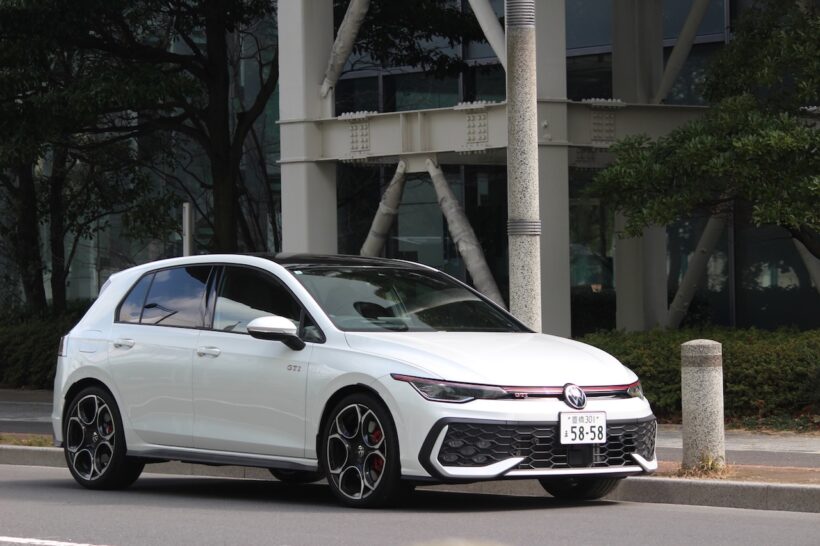
Appearance of the Volkswagen Golf GTI
The eighth-generation Volkswagen Golf, the 8.5 generation, was announced in July 2024 and went on sale in January 2025. The high-performance Golf R was unveiled at the Tokyo Auto Salon 2025. The most impressive car was not the R, which is overwhelmingly fast, but the Golf GTI. The 8.5 generation GTI’s maximum output has increased by 20 PS to 195 kW (265 PS), making it more than sufficient for driving on public roads.
In sport mode, it may even be more courageous than the R!? When you put it in sport mode, it roars and the acceleration continues to increase even on steep uphill gradients. At the same time, it’s not overly peaky, which is a plus, as it delivers a maximum torque of 370Nm from a low rev range of 1600-4500rpm (the R’s is 420Nm/2100-5500rpm), making it easy to handle. The adaptive chassis control “DCC” is optional, and the wheels are upgraded from 225/40R18 to 235/35R19, but the “Comfort” mode with “DCC” even gives off a sense of suppleness that is characteristic of the GTI.

Volkswagen Golf GTI rear
The GTI is priced at 5,498,000 yen, but there’s no need to look down if you happen to be waiting at a traffic light and the R, priced at 7,049,000 yen, comes alongside it. The R is a hard, sports car, so it’s exciting and fun, but for everyday driving, there are surely many people who prefer the GTI, which also offers comfort, along with its traditional tartan check.
The finished product of BYD’s first PHEV introduced in Japan
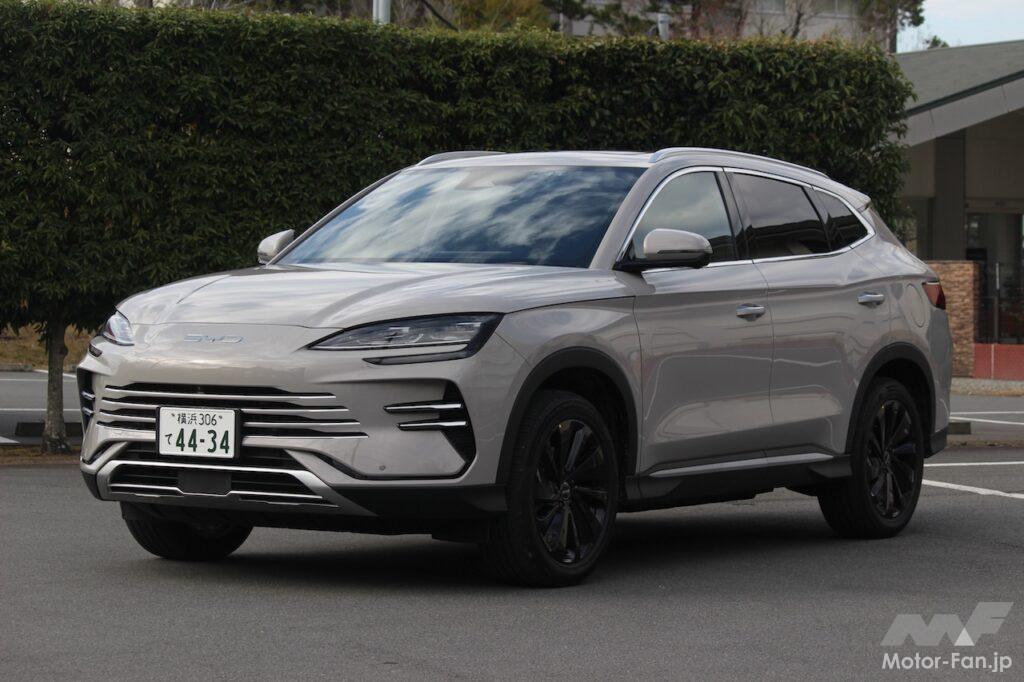
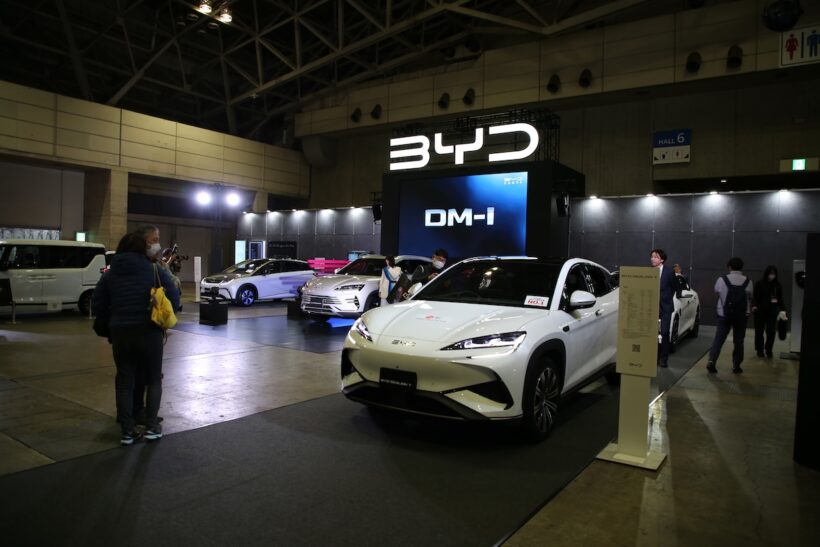
BYD Sealine 6 plug-in hybrid
The Sea Lion 6, BYD’s first plug-in hybrid model for Japan, is called a super hybrid and has been released first as a FWD. The FWD model is capable of 100km of EV (motor) driving on a full charge, so we were curious to see if we could hear the sound and vibrations when the engine starts.
Indeed, in the city, it drives quietly and smoothly as an EV for the most part. When you enter the highway, increase your speed, or try to accelerate suddenly, the engine starts, but the noise and vibration when starting the engine are well suppressed.
Equipped with a 1.5-liter naturally aspirated engine (using regular gasoline), the engine’s maximum output is 72kW (98PS) and maximum torque is 112Nm, which is not surprising, but the motor specifications are 145kW (197PS) and 300Nm, which is powerful enough that it was able to easily lead the pack even at 120km/h on the Shin-Tomei Expressway.
The comfortable ride with a sense of stroke is also a plus, but on the other hand, it seems to fall a little short of the Mitsubishi Outlander (5,294,300 to 6,716,600 yen), which is said to be one of the benchmarks in terms of smoothness and quietness during acceleration and braking.

Although it is an advanced design, frequently used equipment is operated by hardware switches.
However, it is no exaggeration to say that the Outlander after the minor change is approaching the EV level, quietness, and ride quality of a 10 million yen SUV, so it is not at all that the Sea Lion 6 is lacking. Rather, the ride quality and quietness are surprisingly average.
I’m not sure if it’s BYD’s policy, but like other EV models, there is no regenerative brake selector (shift), and you can only select the regenerative braking level on the center display (even at high, the amount of regenerative braking, or rather the regenerative braking force, is not that strong), which makes it seem like you’re missing out on the benefits of driving an electric vehicle, but on the other hand, it would be less of a shock to switch to an internal combustion engine such as a gasoline car.The Sea Lion 6 boasts a range of 1,200 km on a full tank of gas, and the price of the FWD is 3,982,000 yen (CEV subsidies have not yet been announced), which is a striking price-cutting move typical of BYD.










![The appeal of British cars stands out in these chaotic times [My personal favorite cars of 2025]](https://wheelfeed.com/wp-content/uploads/2026/01/4758-1768026507061.jpg)