



Tips for improving your sleep score

If you wake up in the morning tired from the previous day and your body battery is low, unable to sleep, it may warn you that you should give up on running that day.
In this personal column aimed at improving sleep, I set the goal of maintaining a high body battery before going to bed (20% remaining when going to bed) and achieving a sleep score of 80 points for recovery. To achieve this goal, I would like to briefly introduce the improvement techniques I learned from Professor Kakutani’s lecture, which I felt were important.
First of all, Dr. Kakutani’s coaching suggests three key points for improving sleep.
①Ensure deep non-REM sleep time
②Improve sleep score
③Reduce the number of times you wake up during the night
① Specifically, you need to get at least 30 minutes of deep sleep, ideally at least 1 hour and 30 minutes. This means that if I average 6 hours of sleep, I should spend at least 25% of my time in deep sleep. By the way, before the trial session, I thought my ideal sleep time was 7.5 hours, but apparently the average sleep time for Japanese people is 7 hours and 20 minutes, and the government’s target sleep time is 6 hours. In fact, I was able to get about 75 points even with 6 hours. If the quality of my sleep is good, 6 hours may be enough.
For ②, a minimum score of 60 is recommended, with 80 being ideal. To achieve a high sleep score, deep sleep should account for 16-33%, light sleep 30-64%, and REM sleep 21-31%. It’s recommended to sleep for the recommended amount of time with minimal stress and no awakenings. As I mentioned last time, my sleep score of 50-70 was just barely within the acceptable range. In my case, REM sleep tends to increase toward the end of my sleep, specifically after about four hours, so it seems I won’t be able to achieve a high score unless I increase my sleep time to some extent. Incidentally, scores in the 90s are apparently not something business people aim for. Does that mean 100 is impossible…? I’ll aim for it when I lose my job and have nothing to do.
Regarding 3), if you wake up in the middle of the night and accidentally look at your cell phone, you will be awakened, so try to get as much quality sleep as possible so that you don’t wake up, or create an environment where you can patiently fall back asleep even if you do wake up. Caffeine before bed is a big no-no. I love coffee and drink 3-4 cups every day, but after Professor Kakutani’s lecture, I refrained from drinking coffee after 4pm and found it to be effective.
The key to improving your sleep: what you do when you wake up
[1]

[2]
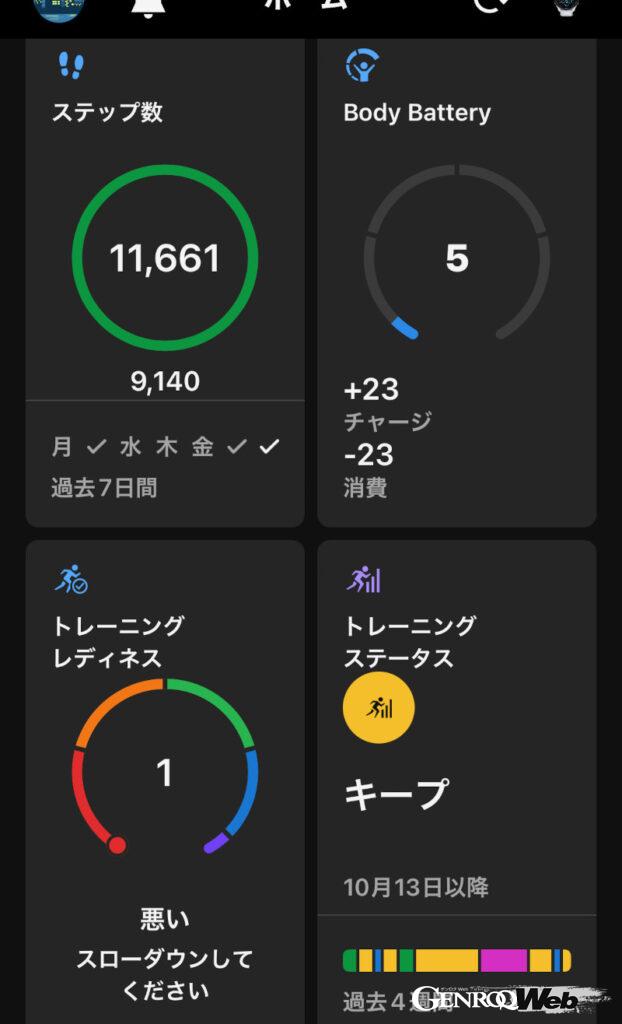
[1] Garmin’s features include not only sleep score and Body Battery, but also step count and training status. [2] Body Battery doesn’t reach 100% easily, but it can reach that level on the morning of a good night’s sleep without feeling too exhausted the night before.
To achieve these goals, the sleeping environment is important, but preparing for that night’s sleep when you wake up is just as important. In other words, rather than waking up lazily in the morning, it’s better to wake up quickly in the morning so you can get a good night’s sleep. There are other things to consider, such as a pre-bedtime routine (drinking herbal tea is good), improving your intestinal environment and nutrition, but I felt that the points for improvement that were taught at this trial session, focusing on waking up, were very important.
Tip 1: Expose yourself to light
First, what do you do when you wake up in the morning? The key is to expose yourself to strong light. When I mentioned earlier that it’s not good to wake up lazily in the morning, I was referring to actions like playing with your smartphone in bed with the curtains closed.
Tip 2: Have breakfast and drink hot water
And while the amount varies from person to person, it’s important to eat a good breakfast and drink warm water. The gastro-colic reflex stimulates the bowel movement center, which is the buttocks and stomach, and this raises body temperature.
Tip 3: Move your body
It’s also good to clean first thing in the morning. Instead of using a vacuum cleaner, it’s effective to use a Swiffer or similar tool to wipe away dust that has accumulated overnight when everyone is asleep. Other good ways to wake up your body include strength training, stretching, and taking a shower.
Other tips to help you sleep well at night include walking more than 7,000 steps a day, taking a bath, stretching using a stretch pole, reading a book you don’t like, and taking a different route than usual. I also learned some other great tips, such as not taking naps after the evening, and as I mentioned earlier, not drinking coffee.
Practice and its results

[1]

[1]

[2]
[1] The app screen when I recorded my highest score ever, 95 points. Everything about sleep duration, balance, and quality was perfect. This rarely happens. [2] As an aside, it was Garmin that celebrated my birthday first thing in the morning.
In fact, this trial session was held in June, and nearly half a year has passed since then. During that time, it was difficult to carry out everything perfectly, so I just tried one or two things that I could do, and my sleep score improved dramatically. I only did basic things like “drinking hot water (a warm drink) first thing in the morning” and “avoiding coffee after the evening,” but I was surprised at how effective they were.
My sleep score, which had been in the 50-70 range, has now reached the 80s, and I’ve managed to hit the 90s twice in six months. However, the only times I’ve scored above 90 were on the morning of a weekend when I had no work and could simply rest, and when other conditions were met, such as not drinking heavily the night before. The amount of alcohol consumed varies from person to person, so it’s important to understand for yourself how much alcohol is damaging enough to lower your sleep score.
On the other hand, maintaining your body battery is quite difficult. There’s a limit to the amount of energy you can recover through sleep, so I realized it’s important to relax as much as possible to avoid draining it. I found that desk work doesn’t drain the battery as much as you’d expect, but driving actually uses up a lot of battery. I feel like I’m putting the cart before the horse when I say, “I’ll just stay in the editorial office and work as quietly as possible!”
As I spent my days staring at my Body Battery and Sleep Score, I explained Body Battery and Sleep Score to the cameraman on an interview, who said, “Aren’t you relying too much on numbers?” But even if my work doesn’t go well, as long as I’m getting enough sleep, I can be satisfied with that as part of my performance. The profound world of sleep is still difficult to reach, but when you consider that we spend 20-30% of our lives sleeping, I thought it might be something we should strive to improve.