
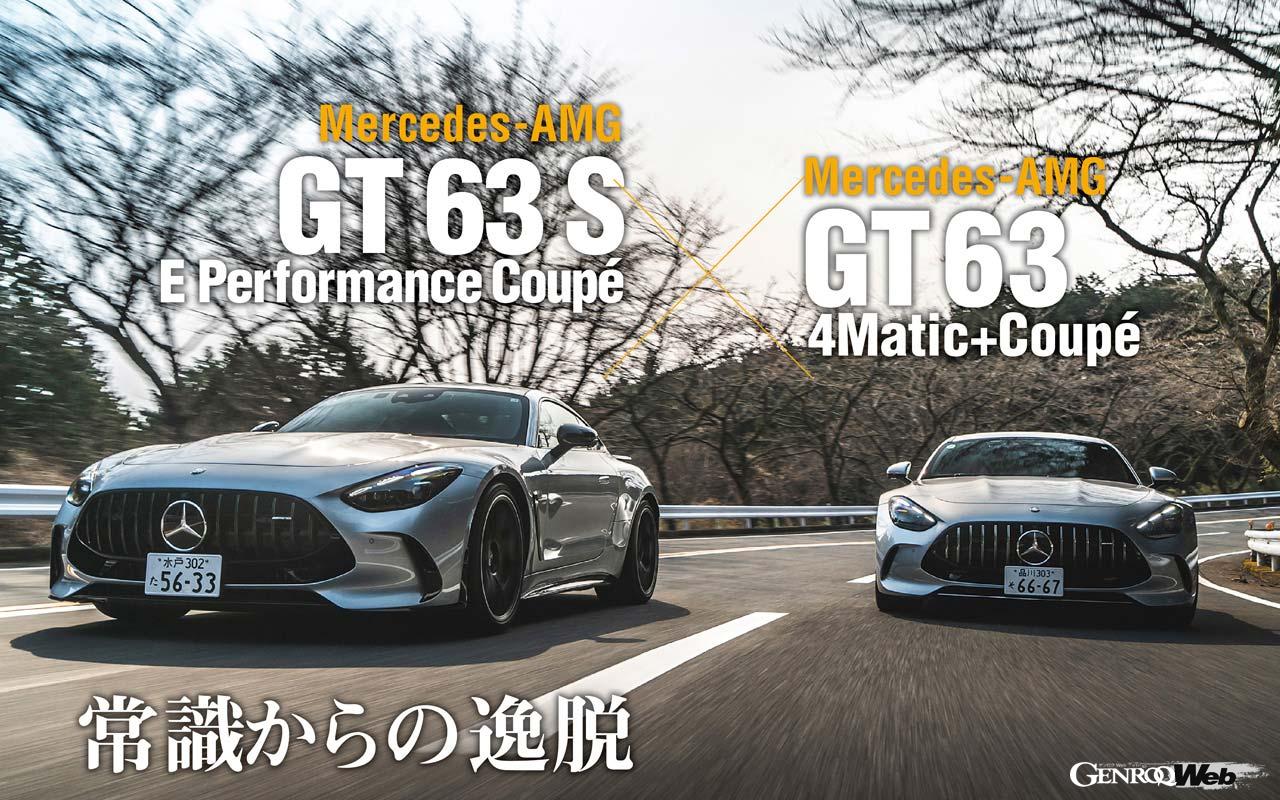
Mercedes-AMG GT 63 SE Performance Coupe
X
Mercedes-AMG GT 63 4Matic+Coupe
E Performance or Normal?!
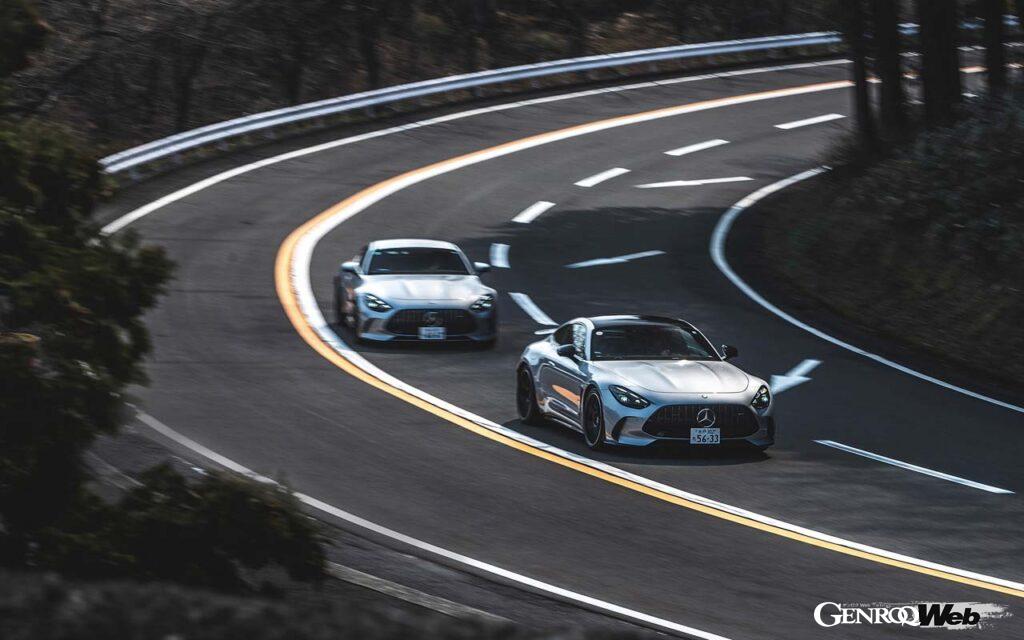
While the GT63 SE Performance boasts an enormous system output of 816 PS/1,420 Nm, the GT63 4Matic+ Coupe is equipped with a 4-liter V8 twin-turbo engine that produces 585 PS/800 Nm.
The AMG GT, which launched in April 2024 with the 4.0-liter V8 twin-turbocharged GT 63 4Matic+ Coupe (hereafter referred to as the GT 63), has now completed its basic lineup with the 2.0-liter 4-cylinder turbocharged rear-wheel drive GT 43 Coupe in November, and the top-of-the-line GT 63 SE Performance Coupe (hereafter referred to as the GT 63 S) in February of this year. While the AMG GT also has a GT 63 Pro in its home country, which boosts the V8’s maximum output to 612 PS and maximum torque to 850 Nm (the base GT 63’s are 585 PS and 800 Nm), the basic hardware configuration is the same as the original GT 63.
Currently, AMG, which calls itself “E Performance” (hereafter referred to as “E Perform”), has four models and five variations: the GT 63 S, the C 63~ sedan and wagon, the S 63~, and the SL 63~. Of these, only the GT and SL have an “S” at the end because these two models also have pure engine vehicles with the same 63 name, and the E Perform is positioned even higher.
E-Performance is a system that combines an electric drive unit (EDU) on the rear axle that combines a 204 PS, 320 Nm (for up to 10 seconds) drive motor, a two-speed automatic transmission, and an electronically controlled limited slip differential (LSD), to provide EV driving, engine assistance, regeneration, and more. The 400V lithium-ion battery that powers the EDU was also developed in-house by AMG, making full use of its F1 know-how. Official documentation states, “This battery was designed with a focus on rapid discharge and charging rather than maximizing driving range.”
Two cars equipped with exquisite units

[1]

[2]
[1] The 4.0-liter V8 twin-turbo engine installed in the GT 63 SE Performance produces 612 PS/850 Nm. It is truly a gem of a unit. [2] Both the GT 63 4Matic Coupe and the GT 63 SE Performance Coupe are fitted with Michelin Pilot Sport 5S tires.
The rear EDU, including the motor performance, is currently the same for all E-Performers. However, the total power output of the engine and battery combined with it varies for each vehicle. The GT 63 S is equipped with a 4.0-liter V8 twin-turbo engine. Its maximum output of 612 PS and 850 Nm and maximum torque are the same as the aforementioned GT 63 Pro, with a system output of 816 PS and 1420 Nm. These torque figures are the highest among the currently available E-Performers, along with the SL 63 S and later (the S 63 and later has a maximum torque that is 10 Nm higher).
The battery, with a total capacity of 6.1 kWh, is small for an E-Performer, and although it is a plug-in hybrid that can be charged externally, the EV range is only up to 13 km (WLTC mode). Moreover, the capacity is so small that it can be fully charged by regenerative braking in no time at all when driving on winding roads with many ups and downs.
Incidentally, the GT 63 S was also fitted with optional rear seats, but the cabin space is comparable to that of the pure-engine GT 63. However, the luggage compartment floor has a shelf-like bulge, reducing capacity. As you might expect, this is because the EDU and lithium-ion battery are located under the floor.
Rear seats are available as an option

[3]

[3]
[3] The test car was equipped with the optional folding rear seats (262,000 yen). For the GT 63 SE Performance, which also has the qualities of a GT, the rear seats are a must-have option.
If the GT 63 S is set to its basic hybrid mode, the engine will naturally shut off when starting or cruising at low loads. However, to be clear, reducing fuel consumption and CO2 emissions in this way is not the purpose of the E-Performance. After all, the E-Performance’s true potential is only realized when the V8 twin-turbo and motor are operating at full capacity.
What’s most impressive about the E-Performance is its acceleration response, which is virtually lag-free (!), and its powerful kick. Even in the gentlest Comfort mode, the moment you step on the accelerator…or rather, the moment the thought crosses your mind to put more power into your right foot, it feels as if the car has already started accelerating. Acceleration from 0 to 100 km/h has been reduced from 3.2 seconds for the GT 63 to 2.8 seconds. With such a big difference, it really feels faster. It’s like you’re being sucked into the acceleration.
Furthermore, even when repeatedly accelerating and decelerating violently on winding roads, there is no shortage of breath (i.e., battery life), and the car always delivers acceleration that seems to spring from the depths of the earth, perhaps thanks to the high charging and discharging characteristics of the AMG-designed battery.The V8 sound is also more intense than that of the GT 63, a pure engine car.
Modern and luxurious GT 63 4Matic+ Coupe

[4]

[4]
[4] The GT 63 Coupe’s dashboard features a tablet-like media display in the center console, creating a modern and luxurious space.
…And while the E-Performer’s true strength lies in its powerful response and kick, it also rolls smoothly and without any jerks, even in situations where high-powered sports cars are usually weak, such as slowly going uphill, which is another advantage of the E-Performer’s electric powertrain. Also, while the car’s efficiency isn’t particularly noteworthy on winding roads or on the highway, it’s a real pleasure to see the sudden improvement in fuel economy in urban areas where gentle acceleration and deceleration are repeated.
In contrast, the GT 63, a pure-engine car with a 4.0-liter V8 twin-turbo, is undoubtedly still one of the world’s fastest and most maneuverable high-end sports coupes. Driving it alone, there’s no lack of response or power. However, when compared to the GT 63 S, you can’t help but notice the lag between accelerator operation and actual acceleration G, a lag that’s unique to internal combustion engines.
Also, the Speedshift MCT shifts incredibly sharply, but the engine feel itself is rational, for better or worse. If you think about it, the Aston Martin, which uses the same engine, has a potential of over 700 PS and 900 Nm, so the GT63’s 585 PS and 800 Nm (?) are still plenty. Even when actually driving, there is a sense of a slight limit at the top end, and rather than pushing it all the way to the 7000 rpm limit, it is clearly smoother and faster to shift up earlier and take advantage of the thick mid-range torque.
EV driving range of just 13km
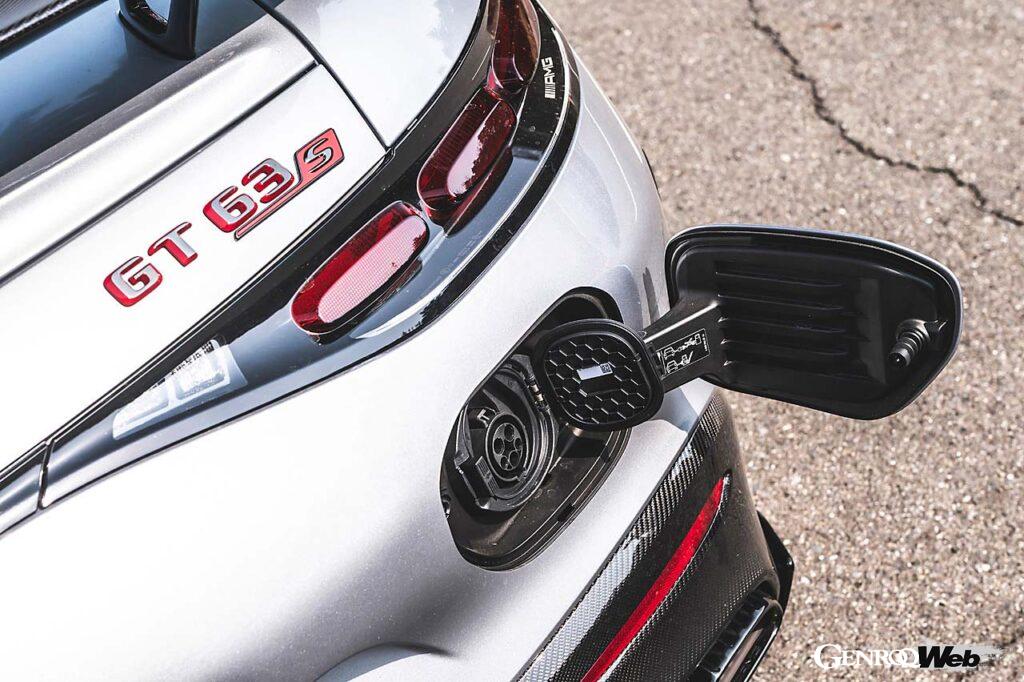
The GT 63 SE Performance’s power outlet is located on the right side of the rear.
The GT 63 has that V8 twin-turbo under complete control. In Comfort mode, where the damping is at its softest, it’s supple, and even when you head straight into winding roads, it handles effortlessly without any unnecessary up and down movement. However, even when you shift up the mode to Sport, which clearly tightens up, or Sport+/Race, which is the stiffest, the steering becomes even more agile, but the ride never becomes violent, with an exquisite sense of just being on the brink of being stopped just enough. The GT 63 has plenty of power in both its engine and its chassis.
Because it’s a GT, there’s no way it would sag even with the E-Performance, which adds 620Nm (!) of instantaneous maximum torque and 240kg (!!) of weight. As expected, the suspension is clearly firm, and depending on the road surface, it conveys unevenness obediently, but as speed and input increase, it becomes more supple, as expected.
What’s interesting is that, as you can imagine from the structure of the E-Performance, most of the GT 63 S’s 240kg weight increase over the GT 63 is concentrated at the rear. As a result, the front-to-rear weight distribution according to the vehicle inspection certificate has been reduced from 55:45 for the GT 63 to an ideal 49:51. The GT 63 S’s unstoppable, ferocious kick is likely due to the response unique to the E-Performance electric drive, as well as the benefit of the weight being firmly placed on the rear tires. Also, perhaps thanks to the excellent four-wheel steering, the GT 63 S is surprisingly agile and nimble considering its weight.
Speedy SE Performance, light and nimble 4Matic+

I’m drawn to the sheer speed of the GT 63 SE Performance, but I’m also drawn to the sharp cornering of the GT 63 4Matic+. The GT63 is a no-brainer choice…
Until now, AMGs with an “S” at the end were basically highly tuned models with the same powertrain. So, for enthusiasts, the S was the obvious choice. However, with the new GT, the 63 and 63 S have clearly different characters and flavors. The GT 63 S with E-Performance is, of course, the absolute fastest, but the GT 63’s suppleness and the sharpness of the suspension and gear changes that only a pure engine car can offer are hard to give up. Also, no matter how agile the GT 63 S is, the 240kg weight difference cannot be completely hidden. The more you drive these two cars, the more the dilemma grows…
REPORT / Hiromune SANO
PHOTO / Kunihisa KOBAYASHI
MAGAZINE / GENROQ June 2025 issue
SPECIFICATIONS
Mercedes-AMG GT 63 SE Performance Coupe
Body size: Length 4730, width 1985, height 1355mm
Wheelbase: 2700mm
Vehicle weight: 2180kg
Maximum system output: 600kW (816PS)
Maximum system torque: 1420Nm (144.8kgm)
Engine type: V8 DOHC twin turbo
Total displacement: 3982cc
Maximum output: 450kW (612PS) / 5750-6500rpm
Maximum torque: 850Nm (86.7kgm) / 2500-4500rpm
Transmission: 9-speed AT
Drive system: AWD
Suspension: Front and rear multi-link
Brakes: Front and rear ventilated disc
Tire size: Front 295/35R20, rear 305/30ZR21
Vehicle price: 30.85 million yen
Mercedes-AMG GT 63 4Matic+ Coupe
Body size: Length 4730, Width 1985, Height 1355mm
Wheelbase: 2700mm
Vehicle weight: 1940kg
Engine type: V8 DOHC twin turbo
Total displacement: 3982cc
Maximum output: 430kW (585PS) / 5500-6500rpm
Maximum torque: 800Nm (81.6kgm) / 2500-5000rpm
Transmission: 9-speed AT
Drive system: AWD
Suspension: Front and rear multi-link
Brakes: Front and rear ventilated disc
Tire size: Front 295/35R20, Rear 305/30ZR21
Vehicle price: 27.5 million yen
[Inquiries]
Mercedes Call
TEL 0120-190-610
https://www.mercedes-benz.co.jp/