


Aston Martin DB12
×
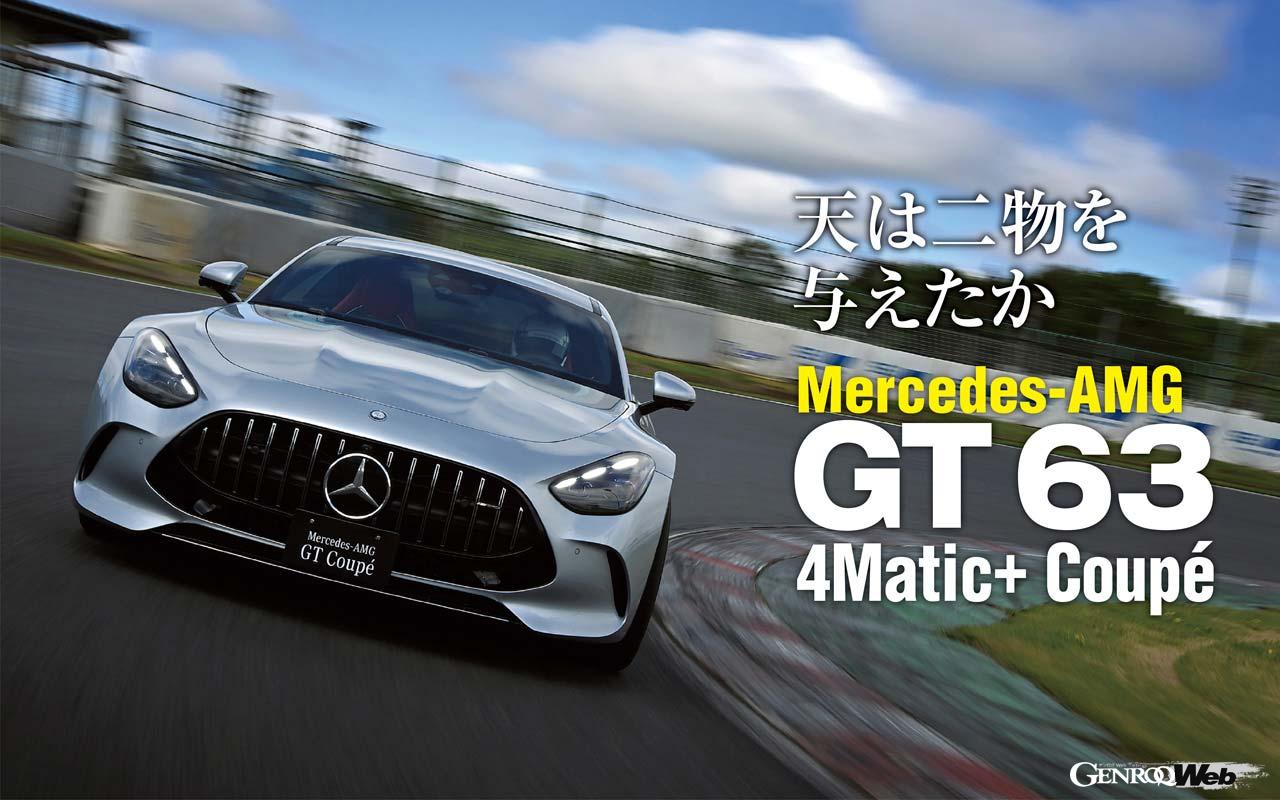
Mercedes-AMG GT 63 4 Matic+ Coupe
A 4.0-liter V8 with the same origins
When talking about Aston Martin’s current state, it is impossible to leave out the presence of Mercedes-AMG (hereinafter referred to as AMG). It is well known that Aston Martin’s F1 car, which has been competing since 2021, is equipped with an AMG power unit (it is scheduled to be switched to Honda from 2026). However, as readers of this magazine know, the relationship between Aston Martin and AMG that continues to this day dates back approximately 11 years.
In July 2013, Aston Martin and AMG entered into a joint development agreement for the V8 engine and electrical system…or rather, in essence, a supply agreement from AMG. The results of this agreement were seen in the DB11, which debuted in the spring of 2016. Mercedes-Benz parts were used in some of the infotainment system and switches. Furthermore, in 2018, the DB11 and the then-new Vantage were equipped with an AMG-made 4.0-liter V8 twin-turbo engine, tuned by Aston Martin.

[1]

[2]
[1] The DB12’s 4.0-liter V8 twin-turbo engine, with its original head cover, is mounted rearward, recessed into the dash panel to improve weight balance. The transmission is an 8-speed automatic made by ZF. [2] For installation in the GT 63, the 4.0-liter V8 twin-turbo engine underwent many improvements, including a new oil pan and a change in the intercooler mounting position. The transmission is a 9-speed automatic made in-house.
Aston continues to produce its own V12 engine as a unique engine, but its mainstay in terms of numbers has now become the AMG V8. There’s no doubt that this is a bit sad, but if you think about it, the new Aston engines that have appeared since the company became a subsidiary of Ford in 1987 were originally designed by Jaguar and Ford, and not purely developed in-house. Given that, it makes perfect sense to equip a production Aston with the AMG engine used in F1 cars.
Packaging is very different

So, this time, we decided to bring out the latest sports coupes from Aston and AMG: the DB12 and the GT63 4Matic+ Coupe. Not only are both cars the latest models that have just arrived in Japan, but they are also virtually identical in length and width (only a 5mm difference in Japanese specifications), and are priced at around 30 million yen. And, naturally, under the front hood sits a 4.0-liter V8 twin-turbo engine with the same pedigree.
In stark contrast to its predecessor, the DB11, which featured a sleek, thin design, the DB12 is eye-catching with its voluptuous proportions, common to the latest Aston Martins. However, the distinctive rear quarter design, which appears to have a floating roof, still retains the look of the DB11.
On the other hand, the AMG GT63 looks like it has classic long-nose proportions. This is a common theme for all AMG-made super sports cars, including the previous GT, SLR McLaren, and SLS. However, upon closer inspection, the driver’s seating position is similar to that of the DB12, and the GT63’s long-nose feel is actually largely due to clever design techniques.
As proof of this, the DB12 (Aston)’s package layout is in some ways clearly more stoic than that of the AMG. The DB12, with its V8 twin-turbo relegated further back in the engine bay, also stubbornly adheres to a transaxle system that integrates an 8-speed automatic with the rear differential. As a result, the DB12’s front-to-rear axle load distribution according to the vehicle inspection certificate is 48:52. Despite being a rear-wheel drive vehicle, the weight distribution is slightly biased towards the rear wheels.
In contrast, the GT, which in its predecessor was a purer sports car than the Aston, has subtly shifted its position in this new second-generation model, officially billed as “a performance luxury model that combines extremely dynamic driving performance and exceptional sportiness with superior comfort.” While retaining structural technologies such as the aluminum space frame, the platform design itself is shared with the SL. The transaxle, which is difficult to crush (?), has also been abandoned, with traction secured instead by 4WD. The front-to-rear weight distribution has also become slightly more front-wheel-dominant. While the previous model was a full two-seater, this time an optional +2 rear seat is available.
The interior of the GT has also become more luxury-oriented. The interior furnishings, with leather upholstery throughout, are now comparable to those of Aston’s luxury model, the DB12.

[1]

[2]

[3]
[1] Two-seater is standard, but there is space at the rear of the cabin, and rear seats can be installed as an option. The AMG performance seats with integrated headrests that were on the test drive vehicle are also an option. [2] The GT 63 has six driving modes: “Slippery,” “Comfort,” “Sport,” “Sport+,” “Race,” and “Individual.” Adjustments can be made using the touch panel in the center of the instrument panel as well as the dial located under the center pad of the steering wheel. [3] The interior is the same as the SL. The seats, dashboard, and door panels are covered in high-quality nappa leather. Hard switches have been eliminated as much as possible, and most functions are operated using the touch screen in the center of the instrument panel.
Meanwhile, the interior of the DB12 also shows some signs of the times. Developed shortly after the aforementioned 2013 partnership, Aston Martin’s infotainment system was also supplied by AMG (i.e. Mercedes), and the distinctive control dials were heavily influenced by Germany. However, starting with this DB12 generation, the infotainment system was also developed in-house. Now, only the small switches and other details hint at the relationship.

[1]

[2]

[3]
[1] The DB12 has a 2+2 cabin. The test drive vehicle was fitted with sports seats with diamond pattern stitching. Comfort seats and carbon performance seats are also available. [2] The DB12 has five driving modes: “Wet,” “GT,” “Sport,” “Sport+,” and “Individual.” Adjustments are made using the starter button in the centre of the centre console and the dials around it. The suspension, ESC, and exhaust can also be adjusted using individual switches. [3] The interior is covered in hand-stitched leather by the long-established Bridge of Weil. The infotainment system was developed in-house by Aston. A reasonable number of hard switches remain, making it easy to operate.
Not only the engine but also the handling is contrasting
What really impresses me is the smoothness of the AMG V8 twin-turbo engine, which is hand-built one by one. Both the DB12 and GT rev up to their 7000 rpm limit without any hesitation.
However, as can be seen from the specs, the DB12, which is tuned to maintain maximum torque up to higher revolutions, also has a higher maximum output. The DB12’s power feel is smooth across the entire range, but it picks up significantly around 3000 rpm, and then even more at around 5000 rpm. Conversely, the GT has a somewhat limited feel, perhaps to leave room for future development (in fact, the recently added “Pro” model has increased torque and power). However, in return, it is very easy to handle with flat torque across the entire range.
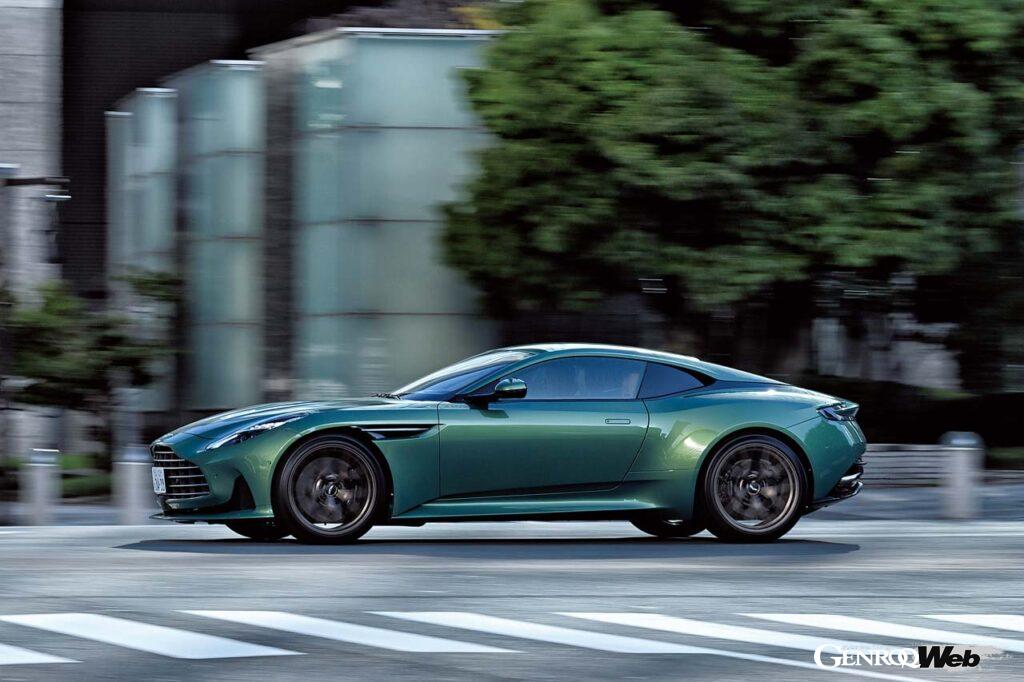
The DB12’s power feel is smooth across the entire range. It picks up speed from around 3000 rpm, and then becomes even more powerful around 5000 rpm.
The sound, another important feature of sports car engines, is a stark contrast. The sound quality and volume resonating in the cabin change depending on the drive mode, but while the AMG has a rich and refined sound in any mode, the Aston’s is somehow rough and wild.
This wildness, created by Aston, is also reflected in the ride quality of the DB12 itself: the bonded aluminium coupe body is incredibly rigid, and in softer GT mode, the excellent variable dampers supplely move up and down to absorb bumps, but the ride is still somewhat bony.
Furthermore, the damping tightens rapidly as you increase the driving mode, and in the highest Sport+ mode, there’s no bouncing, but it still resonates directly through your spine. By modern standards, it would have to be called “stiff,” but at the same time, the car’s firm horizontal posture, agility, and directness are exceptional. Furthermore, thanks to the transaxle that achieves exquisite weight distribution, traction performance is more than enough for the maximum torque of 800Nm, and the turning ability is nothing short of impressive, but there’s always that tingling tension that only a high-powered FR car can provide, as if to say, “If you underestimate me, you’ll get hurt.” This ruggedness and wildness are also a uniquely British view of sports cars, cultivated on rough roads and a tradition of grass-roots racing, and they are also present in this 30 million yen luxury coupe.

The new GT’s 4WD system’s overwhelming traction completely controls the 800Nm of torque. The car has an outstanding sense of stability, and on dry roads, there’s no sign of anything happening no matter how you drive it.
At first glance, the AMG GT evokes a much more classic and spartan image than the DB12, but as mentioned at the beginning, this new AMG is a brilliant transformation from its predecessor, which had a cafe racer-like finish, into a comfortable and sophisticated luxury sports coupe.
In fact, the new GT is clearly more flexible than the DB12, not only in terms of the flat and smooth engine feel, but also in terms of handling and ride comfort. There’s no doubt it’s more comfortable than the DB12 in any mode, and even in the Sport+/Race mode, which is the most stiff, there’s no sharp jerks. And yet the roof remains flat and stable without any unnecessary movement, likely due to the excellence of the advanced electronically controlled dampers, which act as stabilizers by linking the left and right sides, as well as the clever body rigidity and high center of gravity settings.
The DB12 is a deliberate attempt to ridicule preconceptions
What’s more, the new GT has complete control over the 800Nm of torque, the same as the DB12. At least in dry conditions, you can feel completely at ease no matter how you drive the car, without any problems (or so it seems). This is supported by high-tech features such as the aforementioned linked left and right electronically controlled dampers, the 4WD (4Matic+) system that precisely controls drivetrain distribution, and four-wheel steering.
Wildness and refinement, boldness and precision, tension and security, classic and modern… The flavor of British and German super sports cars, which share the same heart, is a little different from what you might imagine from their luxurious design and interior furnishings. As a car enthusiast, while I’m impressed by the stress-free driving of AMG cars, which incorporate the latest high technology, I can’t forget the comfortable tension of Aston, and my ambition to one day master it never fades.
However, even the DB12’s hardware is adorned with high-tech features, and given Aston’s technological capabilities and the true nature of the 4.0-liter V8 twin-turbo engine glimpsed in the AMG GT, the DB12’s quintessentially British flavor is undoubtedly intentional and deliberate.

[1]

[2]
[1] The DB12’s tire sizes are 275/35ZR21 in the front and 325/30ZR21 in the rear. The tires are Michelin Pilot Sport S5 and are stamped with the Aston Martin “AML” seal. [2] The AMG GT 63’s tires are 295/30R21 in the front and 305/30R21 in the rear, also with Michelin Pilot Sport S5. Because it is an AWD, the difference in size between the front and rear is small.
REPORT / Hiromune SANO
PHOTO / Satoshi KAMIMURA
MAGAZINE / GENROQ January 2025 issue
SPECIFICATIONS
Aston Martin DB12
Body size: Length 4725mm, Width 1980mm, Height 1295mm,
Wheelbase: 2805mm,
Vehicle weight: 1685kg,
Engine type: V8 DOHC twin turbo,
Total displacement: 3982cc,
Maximum output: 500kW (680PS) / 6000rpm,
Maximum torque: 800Nm (81.6kgm) / 2750-6000rpm,
Transmission: 8-speed AT
, Drive system: RWD,
Suspension: Front double wishbone, rear multi-link
, Brakes: Front and rear ventilated discs,
Tire size: Front 275/35ZR21, rear 325/30ZR21,
Top speed: 325km/h,
0-100km/h acceleration: 3.6 seconds,
Vehicle price: 29.9 million yen
Mercedes-AMG GT 63 4Matic Plus Coupe
Body size: Length 4730mm, Width 1985mm, Height 1355mm,
Wheelbase: 2700mm
, Vehicle weight: 1940kg
, Engine type: V8 DOHC twin turbo,
Total displacement: 3982cc,
Maximum output: 430kW (585PS) / 5500-6500rpm,
Maximum torque: 800Nm (81.6kgm) / 2500-5000rpm,
Transmission: 9-speed automatic,
Drive system: AWD ,
Suspension: Front 5-link, Rear multi-link,
Brakes: Front and rear ventilated discs,
Tire size: Front 295/30R21, Rear 305/30R21,
Top speed: 315km/h,
0-100km/h acceleration: 3.2 seconds,
Vehicle price: 27.5 million yen
[Inquiries]
Aston Martin Japan Limited
TEL 03-5797-7281
https://www.astonmartin.com/ja
Mercedes Call
TEL 0120-190-610
https://www.mercedes-benz.co.jp/