
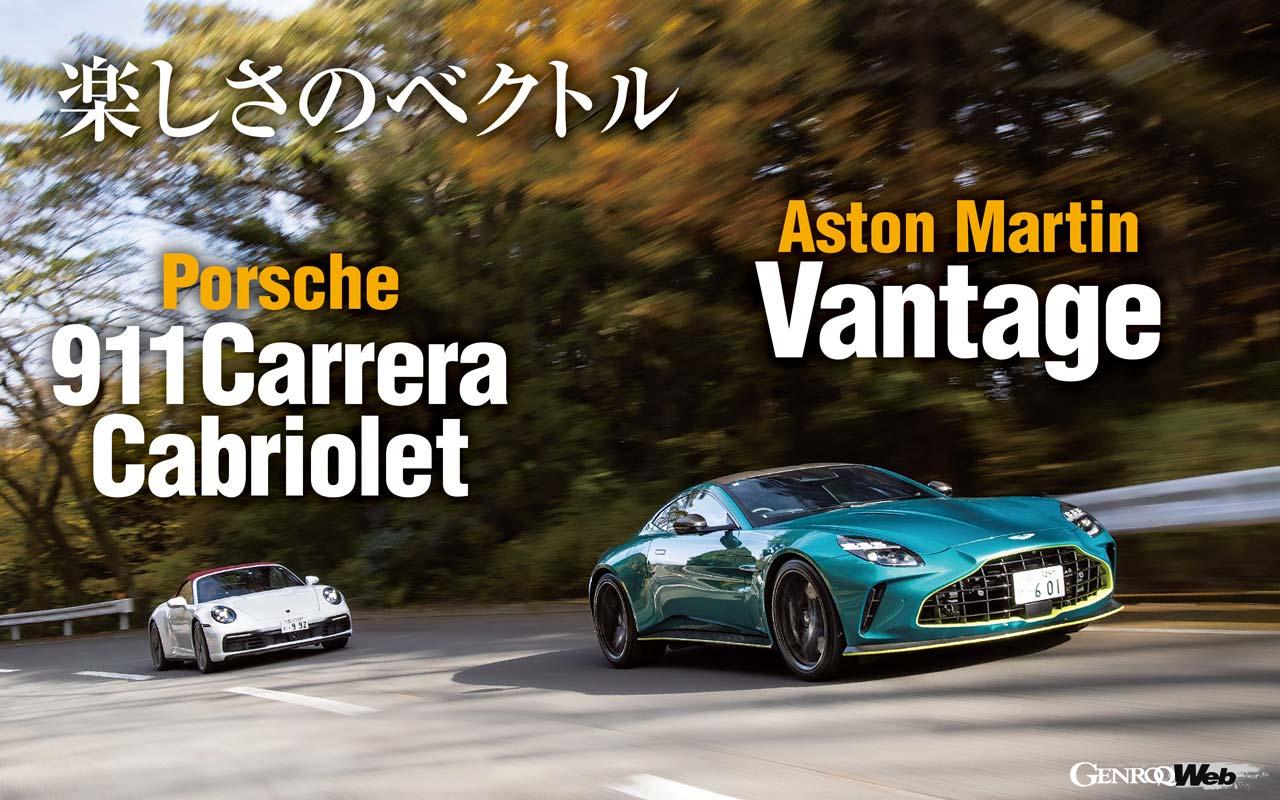

Aston Martin Vantage
X
Porsche 911Carrera Cabriolet
Two cars that always maintain a close relationship with motorsports

“Vantage” means superiority or dominance. Aston Martin first used the term in 1951, the year after the DB2 Mark 1 was fitted with the traditional straight-six LB6 engine, designed by Bentley and manufactured by Lagonda. The Vantage was created when the engine was tuned to a higher output, with the compression ratio and intake and exhaust systems tuned.
The Vantage was later used as a high-performance grade for the DB5, DB6, and V8 series, and was promoted to a catalog grade in 2005. Since then, it has become known in the motorsports world as the most compact and sporty Aston Martin. While small cars are often seen as entry-level grades, Aston has developed a unique position for the Vantage by becoming more actively involved in racing than ever before. Naturally, this branding is also connected to F1.
When we think about this position, the Porsche 911 is a car that seems to overlap with this. Since its birth, it has also maintained a close relationship with motorsports, and from the water-cooled generation onwards, it has expanded its appeal to casual users. The design concepts of size and practicality meshed well with this, resulting in a huge increase in sales, which continues to this day.
In any case, the company has built an ideal business model in the sports car category, and many models use the 911 as a benchmark. Looking at the new Vantage under that assumption, the same and different directions become apparent.
Maximum output slightly higher than the 911 Turbo S

[1]

[2]

[3]

[4]

[5]
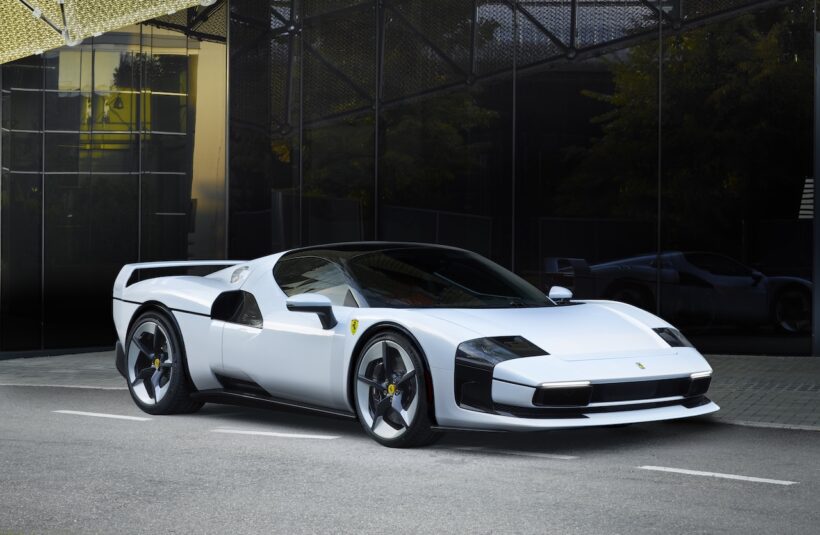
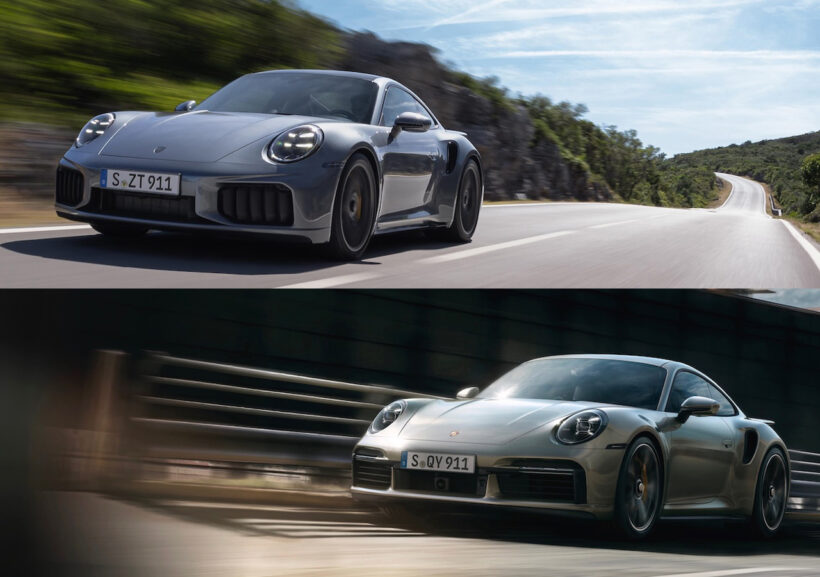
[1] The extra-large diffuser generates powerful downforce. The ducktail shape of the rear lid is also quite aggressive. [2] The 4.0-liter V8 twin-turbo engine is based on that of Mercedes-AMG, but Aston Martin has made extensive modifications to it, resulting in a peak power of 665 PS and a maximum torque of 800 Nm. [3] Exclusive design wheels inspired by the classic Fuchs wheels are optional. [4] The cockpit combines beauty and practicality. The center monitor is 10.25 inches in size. [5] The 911 continues to evolve while maintaining its basic design. The new model also finally has a digital center tachometer.
Another aspect that can be cited in the same direction is the major overhaul of static quality. The craftsmanship and stitching of the dash panel and door trim have become more delicate, and the texture and operation of the physical switches deliberately left in the center console have also been refined. The infotainment system now also supports OTA, and smartphone connectivity has been made even more precise. Perhaps thanks to these changes, the basic sense of quality felt when sitting in the car seems comparable to that of the DB12.
In terms of styling, the grille shape and headlights are designed in the latest style that is similar to that of the DB12, while the distinctive taillight design is retained at the rear. The front and rear bumpers also have new designs, incorporating the latest ideas for airflow and thermal management.
The shape also shows that attention has been paid to the cooling system, and the reason for this is that the new model has achieved a dramatic power increase. The 4.0-liter V8 twin-turbo engine is the same as the previous model, the M177 series supplied by Mercedes-AMG, but various modifications have been made, such as increasing the turbine diameter, changing the compression ratio, and revamping the cam profile, resulting in an increase of 155 PS and 115 Nm of torque compared to the previous model. The output of 665 PS/800 Nm is very close to that of the DB12, and if compared to the 911, it is slightly higher than the Turbo S. Driving all that in a compact body with FR is sure to be quite a thrill.
Rear tires that hold up better than you’d expect
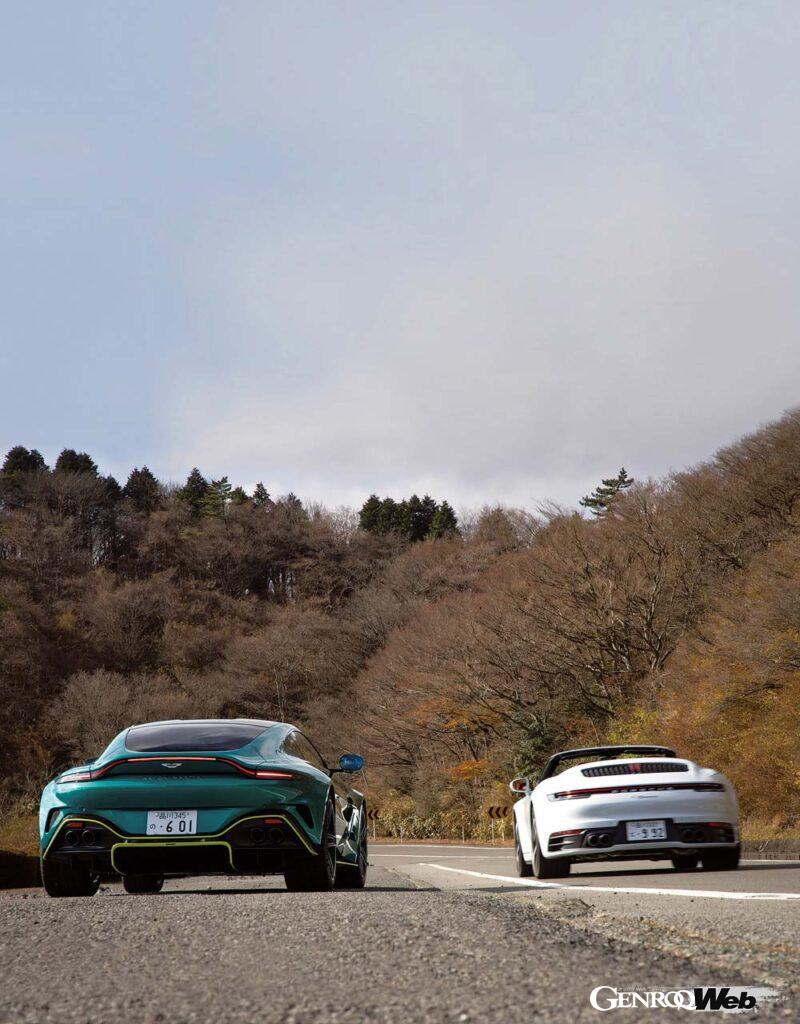
From the moment you start rolling, you can feel the attack of the suspension, which has been tightened to match the chassis’ increased solidity. To handle this much power, it’s inevitable that the springs, stabilizers and other hardware will be noticeably stiffer. However, because the arms that support the chassis and the unsprung parts are not at all affected by this stiffness, the damping follows the movement smoothly, and the feedback is rounded despite the stiffness. The steering feel is precise and clean, with no sense of the muddy fluttering that was present in the early days of the previous model. The brakes are also smooth to operate, operating linearly according to the pressure and amount of pedal pressure. This level of refinement is also different from the previous model.
The speed when you step on the gas is impressive. The difference in acceleration time from 0 to 100 km/h is only 0.2 seconds, but the impression is that the firepower is twice as great as the previous model. However, what is surprising is that the rear tires hold on better than expected. As with the previous model, in addition to the load optimization by the transaxle, the new model also has improved suspension tracking.
I think that the new Vantage has clearly distinguished itself from the all-rounder evolution of the 911, emphasizing its pure sports car side. The reason it can separate itself from the 911 is probably because the DB12 has greatly improved its suitability as a GT. In other words, the Vantage is aiming to be a more refined pure sports car. It seems we should reconsider our perception of this car.
REPORT/Toshifumi WATANABE
PHOTO/Akio HIRANO
MAGAZINE/GENROQ February 2025 issue
SPECIFICATIONS
Aston Martin Vantage
Body size: Overall length 4495mm, overall width 1980mm, overall height 1275mm,
wheelbase: 2705mm,
dry weight: 1745kg
, engine type: V8 DOHC twin turbo,
displacement: 4.0L,
maximum output: 470kW (665PS) / 6000rpm
, maximum torque: 800Nm (81.6kgm) / 2000-5000rpm,
transmission: 8-speed AT,
drive system: RWD,
suspension: front double wishbone, rear multi-link
, brakes: front and rear ventilated discs,
tires and wheels: front 275/35ZR21, rear 325/30ZR21,
0-100km/h acceleration: 3.5 seconds,
top speed: 325km/h,
vehicle price: 26.9 million yen
Porsche 911 Carrera Cabriolet
Body size: Length 4542, width 1852, height 1299mm
Wheelbase: 2450mm
Dry weight: 1675kg
Engine type: Horizontally opposed 6-cylinder DOHC twin turbo
Displacement: 2981cc
Maximum output: 290kW (394PS) / 7500rpm
Maximum torque: 450Nm (45.9kgm) / 2500-4000rpm
Transmission: 8-speed AT
Drive system: RWD
Suspension: Front MacPherson strut, rear multi-link
Brakes: Front and rear ventilated discs
Tires & wheels: Front 245/35ZR20, rear 305/30ZR21
0-100km/h acceleration: None
Top speed: None
Vehicle price: 16.54 million yen
[Inquiries]
Aston Martin Japan Limited
TEL 03-5797-7281
https://www.astonmartin.com/ja
Porsche Contact
TEL 0120-846-911
https://www.porsche.com/japan/