

Morgan Plus Four
This is the first minor design change in about 70 years.
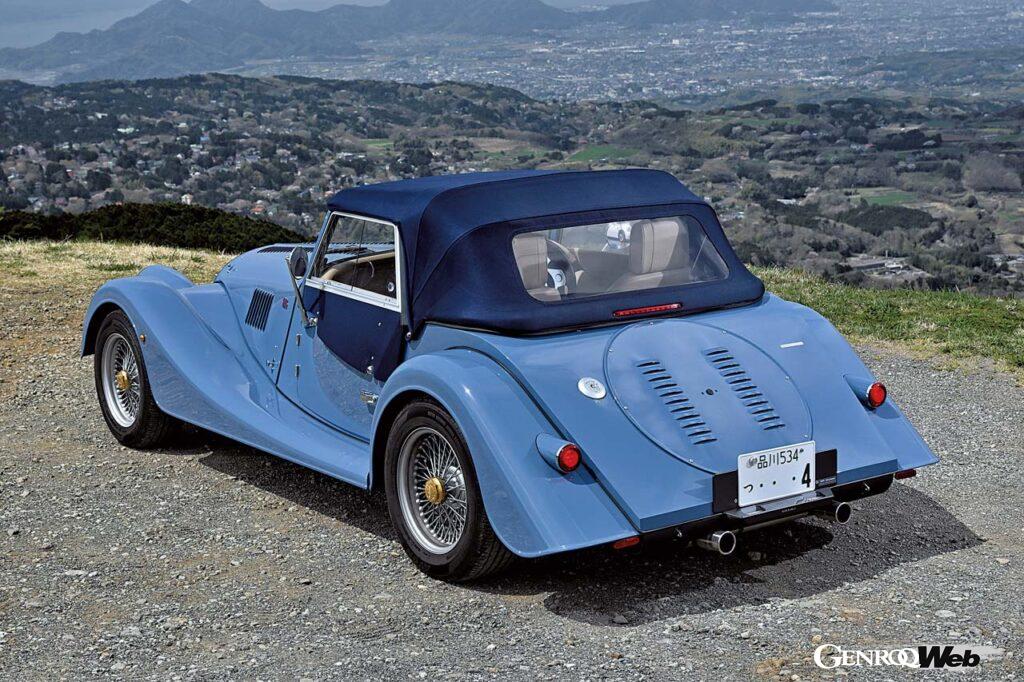
The minor change has improved the fit and ease of installation of the side windows, and the rear window has also been enlarged to expand rear visibility.
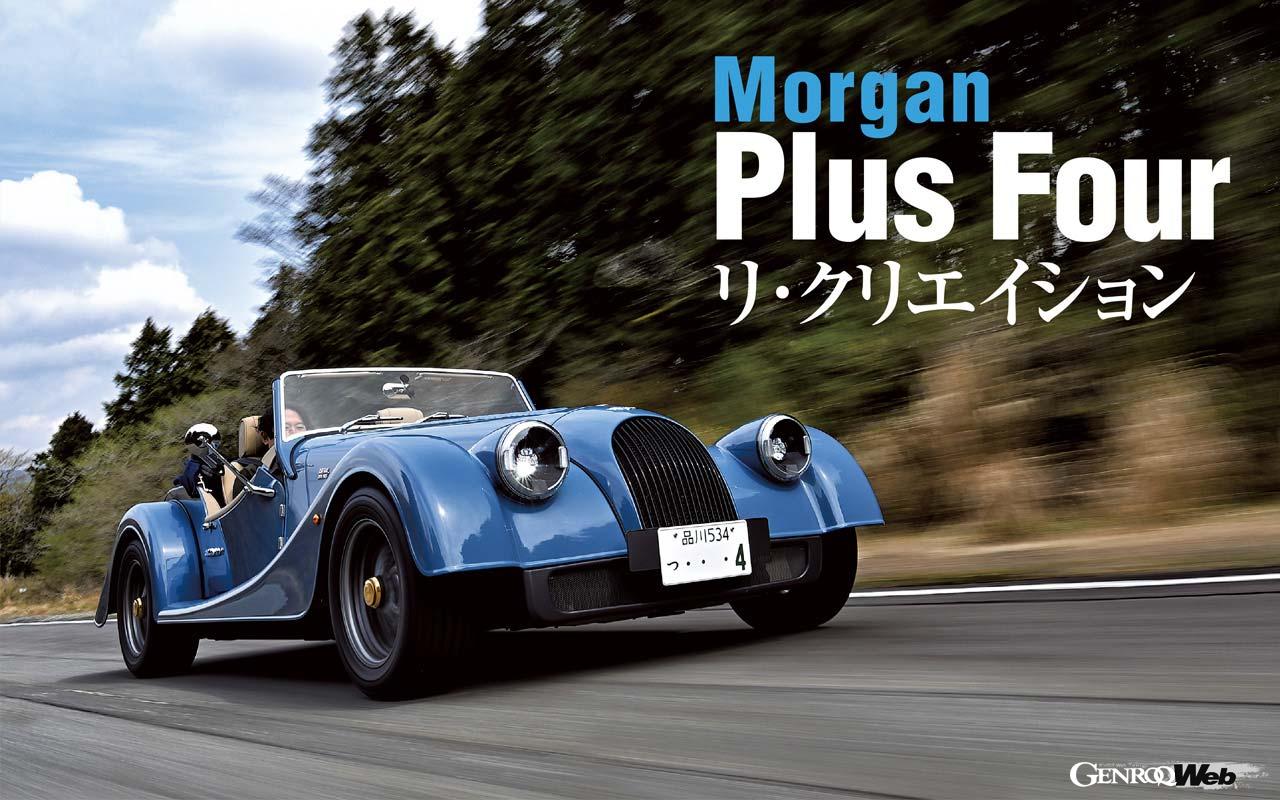
There are a few cars that come to mind where your upper body is exposed when you sit in the driver’s seat, but these days, even if they’re an option, these might be the only new cars that have wire wheels. That was the first thing that came to mind when I got into the Morgan Plus Four. With its
independent front and rear fenders, wing-like opening hood, rounded radiator grille, flat front window, and long, chrome-plated door mirrors, the Morgan Plus Four certainly has the look of a “classic car” that everyone associates with.

[1]

[2]
[1] There is a wide range of coordination options, with six seat colors and 12 piping colors to choose from. The interior is reasonably tight, making it easy to get in and out. There is also space behind the seats for some luggage. [2] The only tires and wheels available are 15 inches, but there are many wheel options. The test vehicle was fitted with silver-painted wire-spoke wheels.
That’s because the styling of the Plus Four has remained essentially unchanged since the 4/4 (the name comes from four wheels and four cylinders!), which the Morgan Motor Company released in 1936 as an attempt to break away from being a manufacturer of three-wheeled sports cars. More specifically, it follows almost exactly the same form as the 1954 model of the first-generation Plus Four, which was released in 1950 as a high-powered version of the 4/4 (at which point the radiator grille changed from an upright flat type to the current round type).
Not just a “living fossil”

The cockpit is extremely simple. In front of the driver are the fuel and water temperature systems, with various information displayed on the LCD screen between them. The speedometer is located on the center left, and the tachometer on the center right. In addition to a 6-speed manual transmission, an 8-speed automatic transmission is also available.
However, describing Morgan Plus Four as a “living fossil” is both half correct and half incorrect.
As you may know, with the 2018 model, Morgan said goodbye to the basic structure of the steel ladder frame chassis with front sliding pillars and rear leaf springs that it had maintained since its inception, and adopted a bonded aluminum bathtub monocoque chassis called the “CX Generation Platform” starting with the Plus 6 released in 2019. As a result, the front and rear suspensions have also changed to double wishbones.
On the other hand, the body is 180mm shorter in length and 70mm narrower in width compared to the previous model, but this is due to differences in details such as the presence or absence of front and rear overriders, and the size is almost the same. However, the front and rear tread has been widened from 1290/1440mm to 1492mm both front and rear, and the wheelbase has also been extended by 30mm to 2520mm.
According to the vehicle inspection certificate, the vehicle weight is 1,060 kg, slightly heavier than the previous model, but the front axle load is 520 kg and the rear axle load is 540 kg, achieving an almost 50:50 front-to-rear weight distribution. The CX-Generation platform weighs just 97 kg, and its torsional rigidity is said to be 100% improved compared to the monocoque chassis used in the Plus 8, which was released in 2012.
Incidentally, the open-top body itself is made of an ash frame with aluminum panels attached, just like the previous model. Some people may be unsure when they hear “frame made of wood,” but the plywood, in which the fibers are pressed together so that they cross, is easy to process and is a strong composite material that is resistant to impacts. What’s more, the thickness has been increased by 18mm from the new Plus Four & Six, making it even more rigid.
The dynamic texture is modern enough

The engine is a high-output version of the 2.0-liter 4-cylinder turbo previously installed in the BMW 330i, etc. Its specifications are 258 PS/5500 rpm and 350 Nm/1000-5500 rpm.
The engine housed in the nose is the same BMW-made 1998cc inline 4-cylinder DOHC turbo engine as the 3 Series. It produces a maximum output of 258 PS and a maximum torque of 350 Nm with the 6-speed manual transmission that I test drove, and 400 Nm with the 8-speed automatic transmission. With a top speed of 240 km/h and acceleration from 0 to 100 km/h in 5.2 seconds, it boasts performance that is beyond its appearance (sorry).
When actually driving, the clutch pedal requires a fair amount of pressure, which is a bit of a surprise, but other than that, there’s nothing to be particularly careful about. The BMW engine also revs up sharply up to its limit of 6000 rpm, but it also has a flexible engine characteristic that generates peak torque from 1000 rpm, making it easy to handle even on winding roads, where holding third gear is enough.
Another thing that surprised me was how stable the chassis was and how comfortable the ride was. In fact, the Plus Four has undergone a minor change for the 2024 model, with new design features such as projector headlights, new front and rear fenders, taillights, and rearview mirrors, as well as suspension with improved spring rates and dampers.


The previously separate headlights and turn signals have been integrated into a single combination light, creating a unique design. The side mirrors also feature a new design, with the “MORGAN” logo at the top.
The first thing you notice about this is the straight-line stability. Even when cruising at 120km/h on the highway, you no longer have to constantly grip the steering wheel, wary of the car “spinning sideways” at uneven joints, as was the case in the sliding pillar era. The aerodynamics also seem to have been refined, and the front doesn’t feel like it’s floating.
Enjoy the classics with ease

The Plus Four chassis can handle the 2.0-liter turbo four-cylinder’s 258 PS/350 Nm.
The Plus Four really shines on winding roads. With a steering ratio of 2.8 turns lock-to-lock, which isn’t too sensitive, the electric power steering has just the right amount of weight, and the Avon ZV1 tires have just the right amount of grip and feel, so it’s well balanced and maintains a slight understeer, making it a perfect fit for a “classic” style of aggressively turning the car with the throttle.
Also, starting with the 2023 model, in addition to ABS, ESC is finally being equipped, which is good news as it reduces the risk somewhat in the event of an emergency.
Without fear of being misunderstood, I would say that the Morgan Plus Four is a Caterham Seven for adults that is “80% as Spartan, but with added comforts such as air conditioning, sufficient weather resistance where necessary, and a high-quality, comfortable ride.”
It’s also proof that the Plus Four continues to grow, 75 years after its birth, retaining the directness and response that’s so characteristic of Morgan, but with a new chassis and powertrain, as well as a more refined suspension, it has become a sports car far more refined than ever before.

The stop lamp and turn signal are integrated, and the model badge has a simple design, giving the rear view a cleaner look.
REPORT / Yoshio Fujiwara
PHOTO / Satoshi Kamimura
MAGAZINE / GENROQ June 2025 issue
SPECIFICATIONS
Morgan Plus Four
Body size: Length 3830, Width 1650, Height 1250mm
Wheelbase: 2520mm
Vehicle weight: 1013kg
Engine: Inline 4-cylinder DOHC turbo
Total displacement: 1998cc
Maximum output: 190kW (258PS) / 5500rpm
Maximum torque: 350Nm (35.7kgm) / 1000-5500rpm
Transmission: 6-speed MT
Drive system: RWD
Suspension type: Front and rear double wishbone
Brakes: Front and rear ventilated disc Tire
size: Front and rear 205/60R15
Top speed: 240km/h
0-100km/h acceleration: 5.2 seconds
Vehicle price: 16,687,000 yen
[Inquiries]
Morgan Cars Japan SCI
https//www.morgan-cars.jp