

FERRARI 296 SPECIALE
Traffic jams aren’t a problem
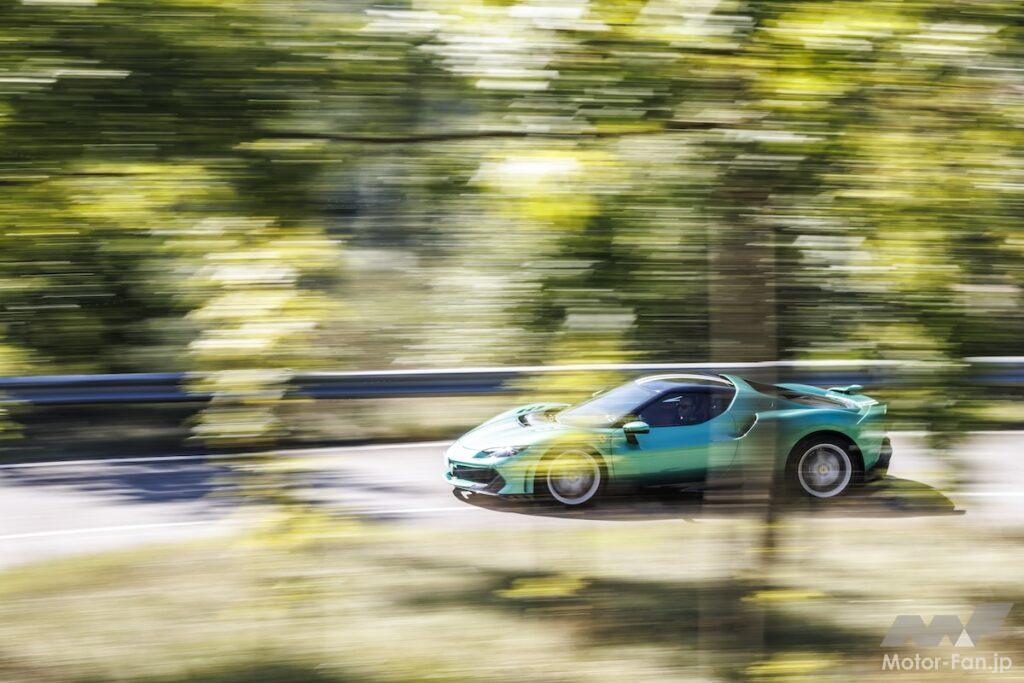
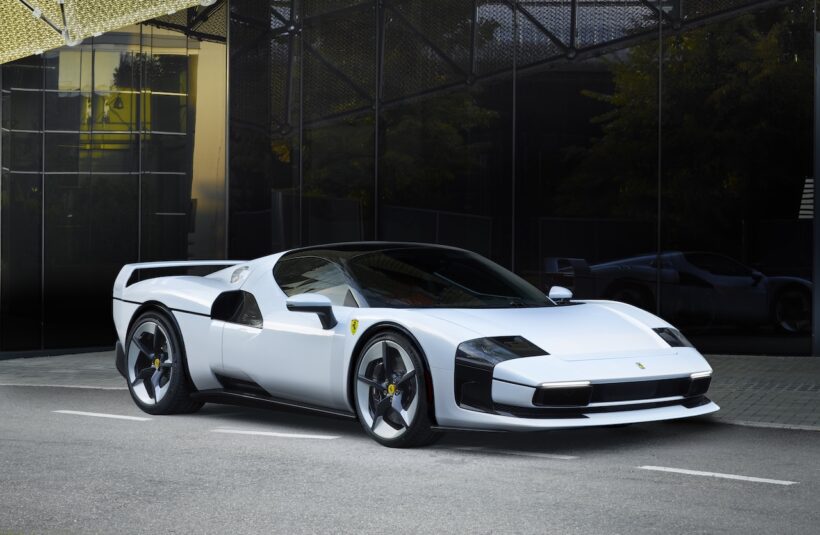
Ferrari 296 Speciale
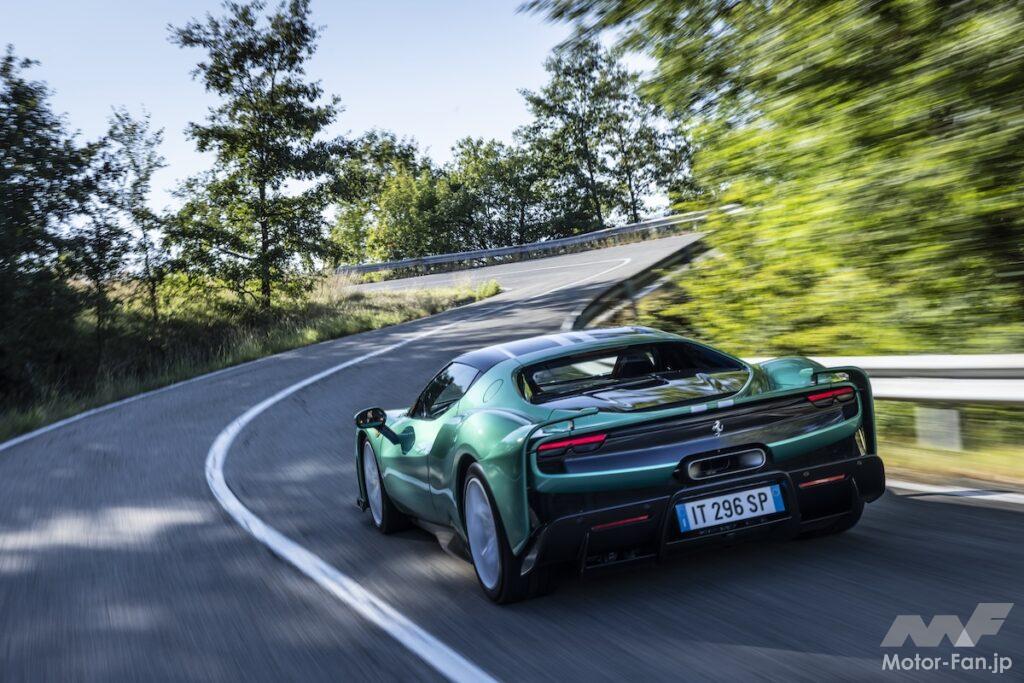
After finishing the test drive of the 296 Speciale at the Fiorano Circuit and having lunch, we were then treated to a test drive on public roads. The route shown on the navigation app “Tourboss,” which we were asked to install in advance, was a circular course to Fanano in the southern part of Modena province and back, a total distance of approximately 130 km, a driving time of 2 hours and 30 minutes, quite a substantial journey. It was like taking an empty 246 from Tokyo and heading back to Ybitsu Pass.
We set off from the center of Maranello, where Ferrari fans gather, and headed south. The 296 Speciale, which had just been released, was naturally the center of attention and was photographed relentlessly. At everyday speeds, the 296 Speciale, like the 296 GTB, exudes the smoothness of the EV assist. At a steady speed of around 2000 rpm, there is no nervousness, and you don’t even notice the intervention.
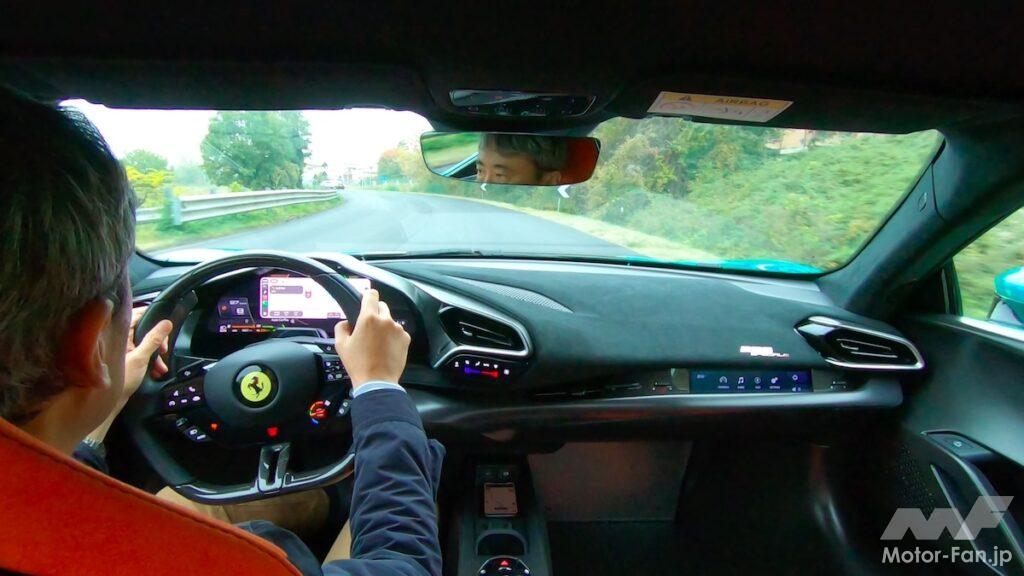
The navigation system was still in Italian, but the route displayed on the in-car smartphone app was very convenient, and I was able to drive smoothly by following the route guidance. However, while using CarPlay, there were some complicated moments before I got around to switching the charge on/off on the e-Manettino, and it was often difficult to use the vehicle’s functions, which was a bit frustrating.
On the other hand, the benefit of the steering being a physical switch is great, as operating errors while driving have almost completely disappeared, so the operation itself is less stressful. Reliable operation is a great source of peace of mind on public roads.
With the same naturalness as the standard 296 GTB
Ferrari 296 Speciale
The circuit test vehicle was equipped with the standard passive suspension, but the test vehicle for public roads was equipped with the optional MagneRide electronically controlled variable dampers. This means that the ride is comfortable at city speeds, and although it is naturally different from the vehicle that I had been driving at full throttle on the circuit just a moment ago, there is a certain degree of harshness, but there is no need to worry about racing car-like stiffness. The damping control works finely, and the response to inputs from low to medium speeds is as natural as that of a normal 296 GTB, and is extremely smooth. Apart from the depth of comfort I felt on the circuit, I was amazed at how comfortable it was on public roads.
Soon we entered the winding roads of the suburbs. Here, the advantages of the 296 GTB’s lightness and low center of gravity became clear. The initial steering response was extremely accurate, and there was a sense that the nose was moving half a step ahead of our will. However, as long as the sport mode was selected, the exquisite electronic control ensured that traction picked up smoothly, and the tension of the ultra-high-power rear-wheel drive was reduced. It was also nice that the precise motor control eliminated the shift shock caused by the DCT.
Although the locations of speed cameras (Orbis) were shared in advance during the course briefing before the test drive, there were times when local cars were speeding quite fast, which was confusing for a foreign driver (me). The road was narrow and winding, and a bus suddenly appeared from a blind corner, which made me nervous, but the reliable brakes and a clear sense of vehicle width allowed me to get away unscathed. The brake pedal also had excellent feel, giving a sense of security. The ABS EVO recalibration was clearly effective on public roads, and the grip estimation derived from the 6D sensor, which impressed me at Fiorano, effectively absorbed subtle changes in the road surface. As a result, it’s fair to say that the brakes provide the car with “room to maneuver” on public roads.
High convenience provided by the front lifter
Ferrari 296 Speciale
After taking photos at a photo spot halfway, we headed for Maranello. On the way back, it was raining lightly. The tires were specially designed Michelin Pilot Sport Cup 2, which are not good at wet conditions, but it wasn’t as scary as I had expected.
By the way, I also found the car to be surprisingly convenient. This was largely due to the front lifter, which gave me a tremendous sense of security when going over the hump at the entrance to Zone 30 or making a U-turn while taking photos. It certainly deserves to be called a “Speciale” and can be used on an everyday basis. On the other hand, the bucket seats were a bit difficult to use for long rides. Furthermore, the door trim has been simplified, and there were times when it was difficult to find a place to place one’s left hand if driving a left-hand drive car, but these are minor issues compared to the joy of being on the circuit.
Unlike the 4-digit horsepower AWD of the same Speciale model, the SF90XX, the 296 Speciale has the tension of a high-output rear-wheel drive, but on public roads it is a super sports car that is perfectly suitable for everyday use thanks to the smoothness of the hybrid, the comfortable ride of MagneRide, and clever electronic control. To be precise, the comfort is one level more sporty than the GTB, but the combination of physical switches gives it a “sharpness that is easy to handle.” Even when driving on real public roads, the level of completion makes you honestly think, “I want to drive it again.”
PHOTO/Ferrari SpA
SPECIFICATIONS
Ferrari 296 Speciale
Body size: Total length 4625, total width 1968, total height 1181mm
Wheelbase: 2600mm
Vehicle dry weight: 1410kg
Engine: V6 DOHC twin turbo
engine Total displacement: 2992cc
Engine maximum output: 700PS (515kW) / 8000rpm
Engine maximum torque: 755Nm / 6000rpm
Motor maximum output: 154PS (113kW)
System maximum output: 880PS
Transmission: 8-speed DCT
Drive system: RWD
Suspension type: Front double wishbone, rear multi-link
Brakes: Front and rear ventilated disc Tire
size (rim width): Front 245/35ZR20 (9J) Rear 305/35ZR20 (11J)