
![Valkyrie, an F1-class hypercar created in collaboration with Red Bull [Aston Martin Archive]](https://wheelfeed.com/wp-content/uploads/2024/10/4380-1761211237948.jpg)
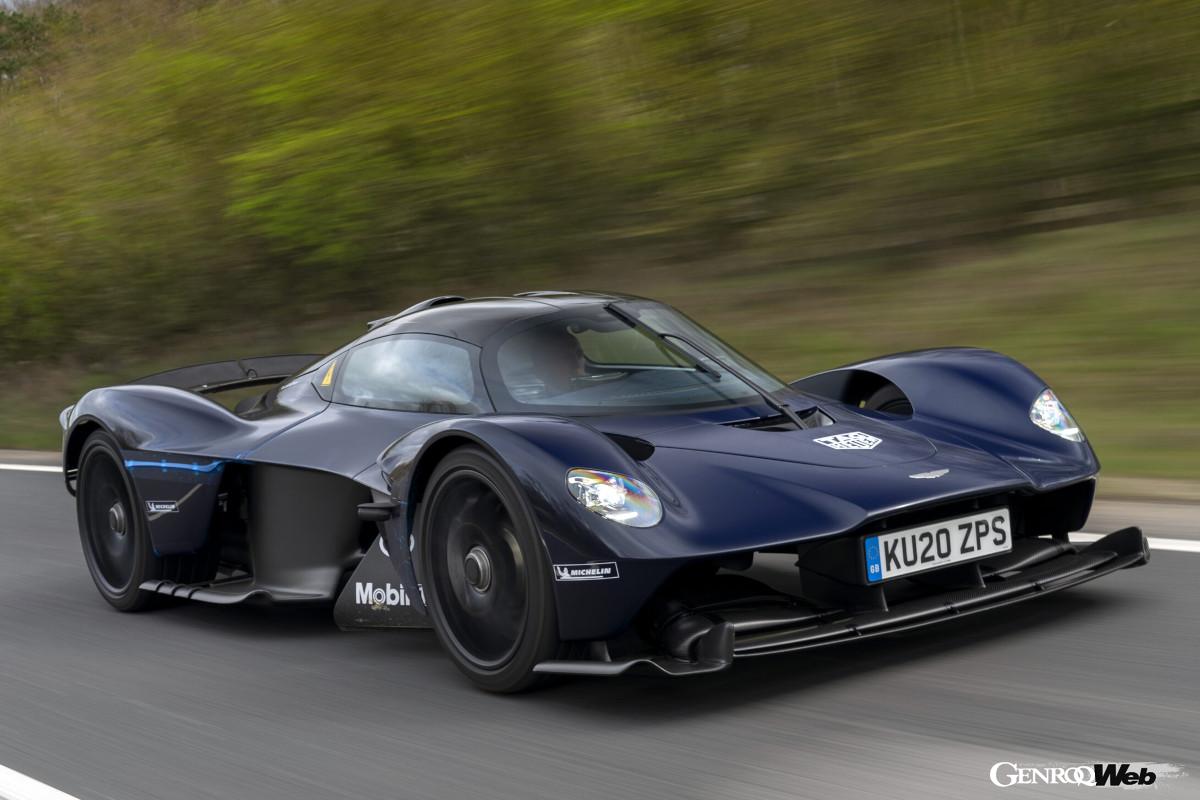
VALKYRIE (2021)
Dreaming of the ultimate supercar
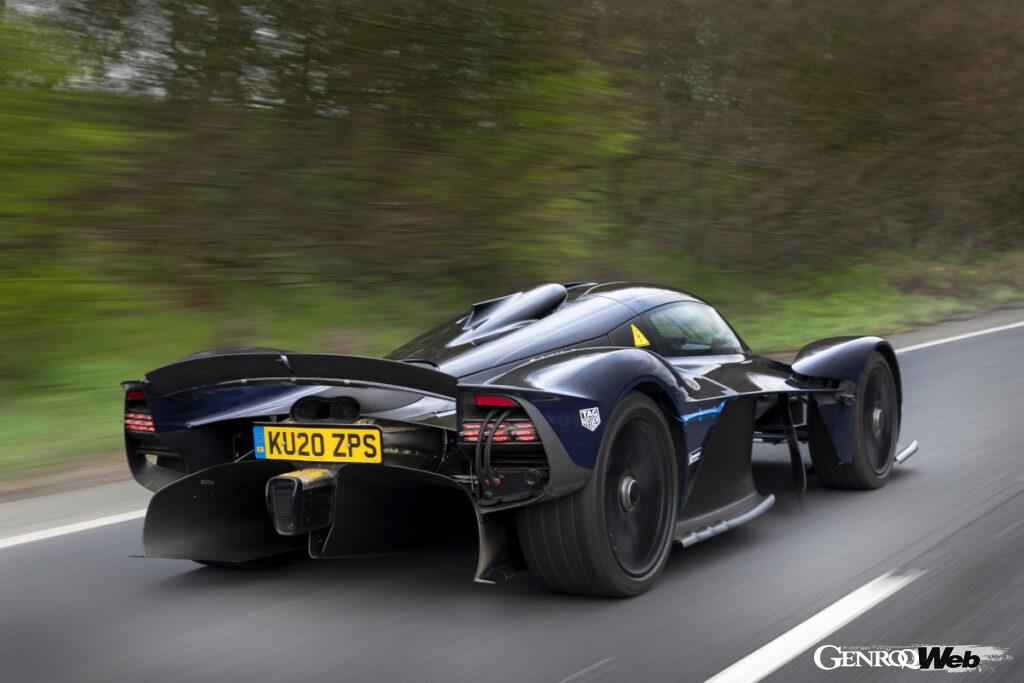
Aston Martin, which has had a partnership with Red Bull Racing since 2016, held a press conference at the opening race in Melbourne, Australia, where it was announced that Red Bull Chief Technical Officer Adrian Newey and Aston Martin Chief Creative Officer Marek Reichman have teamed up to launch a hypercar project called Project AM-RB 001.
Newey has long dreamed of designing the ultimate supercar, and in 2010 he unveiled the non-rule F1 car, the Red Bull X2010. The AM-RB 001 was designed as a two-seater version of that, a super sports car that overturned existing concepts.
Its development was carried out jointly by Red Bull Racing, Red Bull Advanced Technologies, Aston Martin, and Swiss-based AF Racing AG, and the first mockup was unveiled at Gaydon in July 2016. It was announced that the car would have a naturally aspirated V12 engine mounted behind a carbon fiber monocoque chassis, have a power-to-weight ratio of 1.0, and be capable of lap times at Silverstone equivalent to those of F1 or LMP1 cars. At least 99 units, and no more than 150, would be produced, with prices expected to range from 2 million to 3 million pounds.
The AM-RB 001 was officially unveiled as the “Valkyrie” at the 2017 Geneva Motor Show, and in October of the same year, the development of the “Valkyrie AMR Pro,” a circuit version based on the LMP1 Le Mans Sports Prototype, was also revealed.
Cosworth 6.5 liter V12 DOHC and F1 KERS

[1]

[2]
[1] Designed as a super sports car that could be considered a two-seater version of F1. [2] Cosworth 6.5-liter V12 DOHC unit that produces a maximum output of 1014 PS and a maximum torque of 740 Nm.
Since then, development of the Valkyrie has continued in strict secrecy, but in 2019 it was announced that the power unit would be a hybrid combining a Cosworth 6.5-liter V12 DOHC unit that produces a maximum output of 1,014 PS and a maximum torque of 740 Nm, with an electric motor from Integral Powertrain and a Rimac battery, and a boost and energy recovery mechanism that applies F1 KERS technology.
In 2019, when the ACO announced the introduction of hypercar regulations for the 24 Hours of Le Mans, the company announced that it would enter the race as a works team with the Valkyrie Hypercar, and demonstrated its first working prototype, the VP1, at the British Grand Prix that year.
However, when Lawrence Stroll became owner and chairman, the Le Mans Hypercar program was canceled in order to focus resources on F1, and development of the Valkyrie itself was significantly delayed due to the impact of COVID-19.
Thus, there was no news of the Valkyrie for a while, but Newey himself drove a prototype close to the production model at the Goodwood Festival of Speed in July 2021.
Participating in WEC and IMSA from 2025

[1]

[2]
[1] The Valkyrie AMR Pro is a circuit version based on the LMP1 Le Mans Sports Prototype. [2] The Valkyrie Spyder (right) features a removable roof and butterfly doors.
In addition, the chassis has been widened by 96mm in front tread, 115mm in rear tread, and 380mm in wheelbase, and is fitted with a special body that generates twice the downforce compared to the road version.Furthermore, the hybrid system has been removed and a 6.5-liter V12 engine that produces 1000PS has been installed, and the front and rear double wishbones have been made out of carbon fiber, making the Valkyrie AMR Pro extremely lightweight.
In addition, the Valkyrie Spyder, featuring a removable roof and butterfly doors, was officially unveiled at Monterey Car Week in August.
The first production car will be completed in November 2021, with deliveries to follow. It has also been announced that the Valkyrie AMR-LMH, based on the AMR Pro, will be developed in 2023 and will compete in the WEC and IMSA from 2025, once again drawing attention to the company’s progress.











![The S-Type, widely regarded as Bentley’s masterpiece post-war saloon [Bentley 100 Years of Car History]](https://wheelfeed.com/wp-content/uploads/2025/11/4703-1762127546348.jpg)