
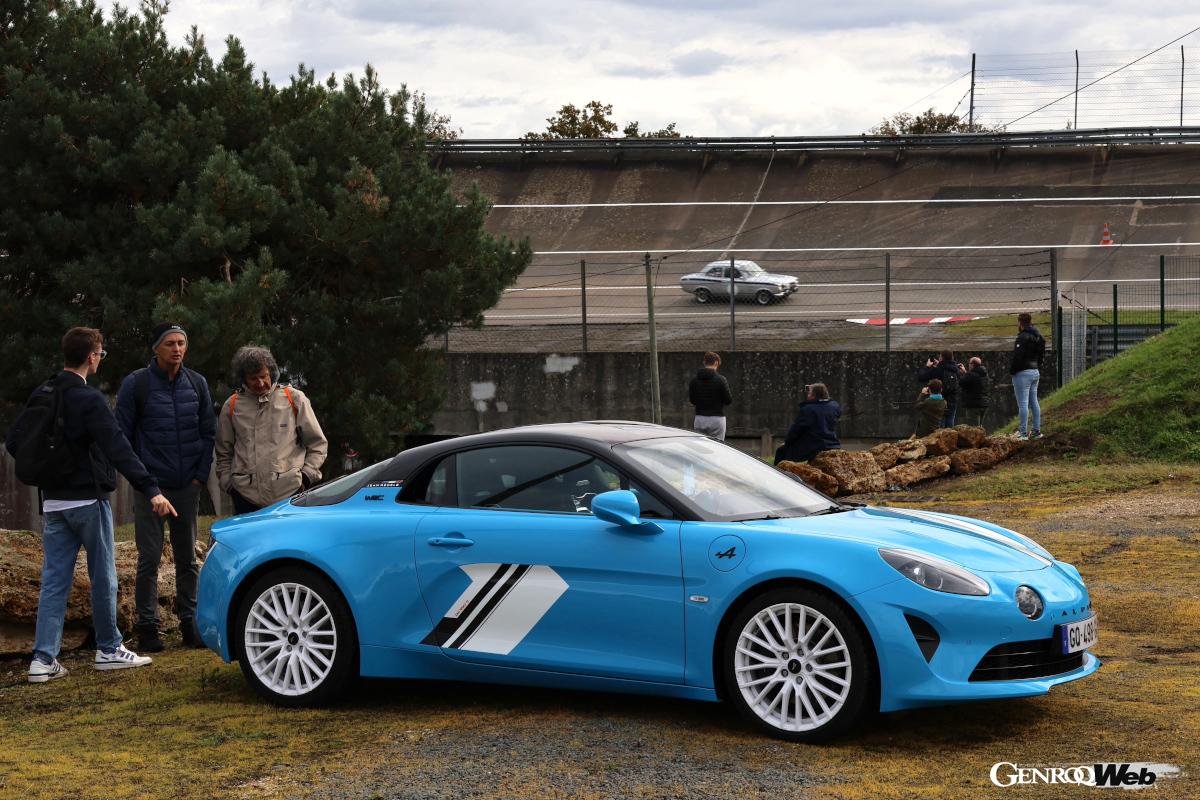

L’autodrome de Linas-Montlhéry
The French supercar scene
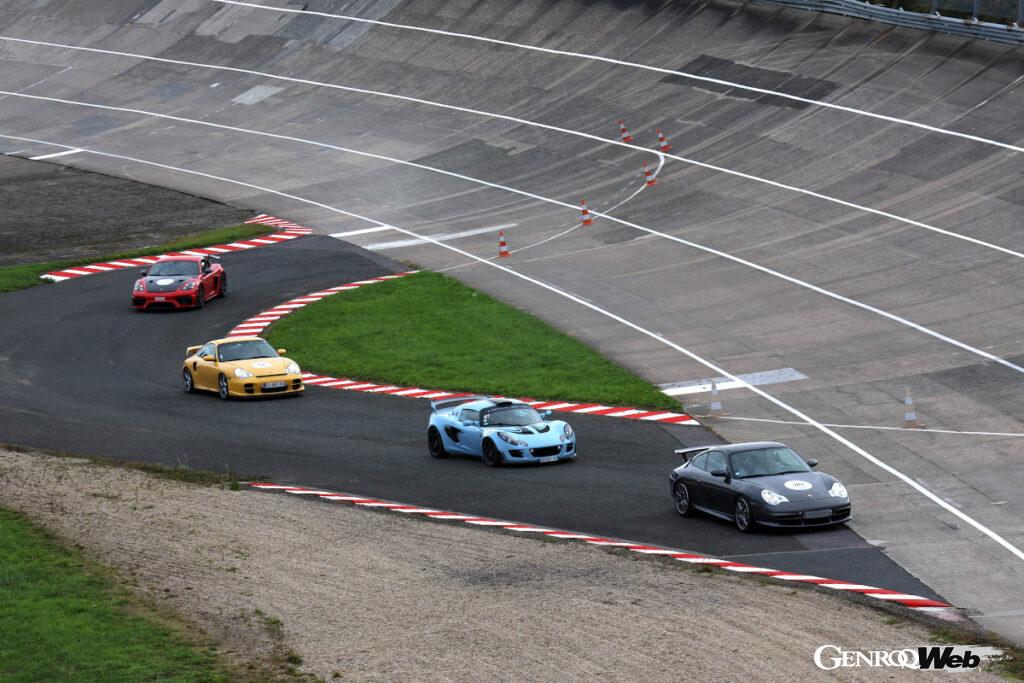
A driving session for the Supercar division. After passing through the 52-degree banking that is a Linas-Montlhéry specialty, the entrants approach the following straightaway.
I apologize for starting off with such a harsh story, but it’s not easy to own the latest super sports car in France. This is due to the recent introduction of a tax system called “MARS” based on carbon dioxide emissions. For example, if you buy a Ferrari Roma in 2024, you’ll have to pay an additional 60,000 euros (approximately 9.8 million yen). Considering that a Peugeot 2008 can be purchased for just 170 euros (approximately 27,000 yen), depending on the model, you can see how tough this is.
As a result, many of the supercars seen in France, including at the Linas-Montlhély venue, have license plates from neighboring countries, especially tax havens. There’s clear data to support this. According to a 2022 survey by Car Industry Analysis, the number of new Ferrari registrations per 1,000 people is first in Monaco, second in Andorra, and third in Luxembourg. Monaco, in particular, has 2.86 units, far ahead of Andorra, which also borders France, at 0.233 units.
Of course, France also offers benefits. These include various incentives for historic cars. Thirty years after registration and passing inspection by the French Federation of Vintage Vehicle Associations (FFVE), vehicle inspections are simplified and the intervals between inspections are extended. The original license plate from the initial registration can be kept. Even models that have never been registered in France before can be easily registered. Compulsory insurance is also available at a low cost. In terms of everyday driving, FFVE-certified vehicles can be driven in urban areas where entry for older cars is restricted due to the European emission standard “Euro.” This is why you’ll see “FFVE Certified” cars proudly listed in the used car sales section.
Seniors and ancestors

[1]
[2]

[3]
[4]
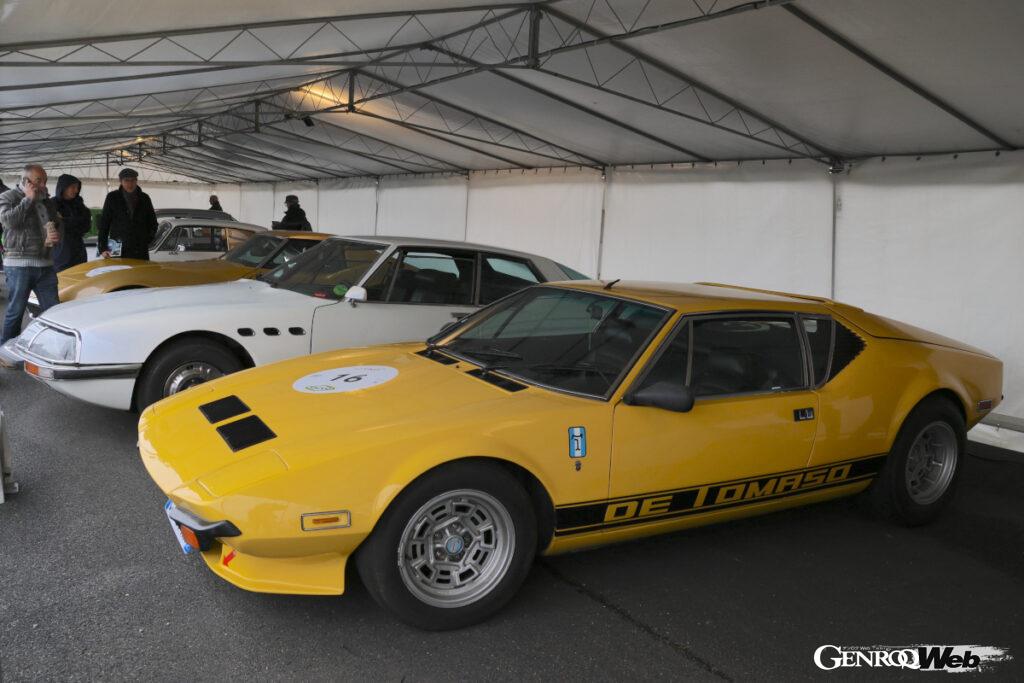
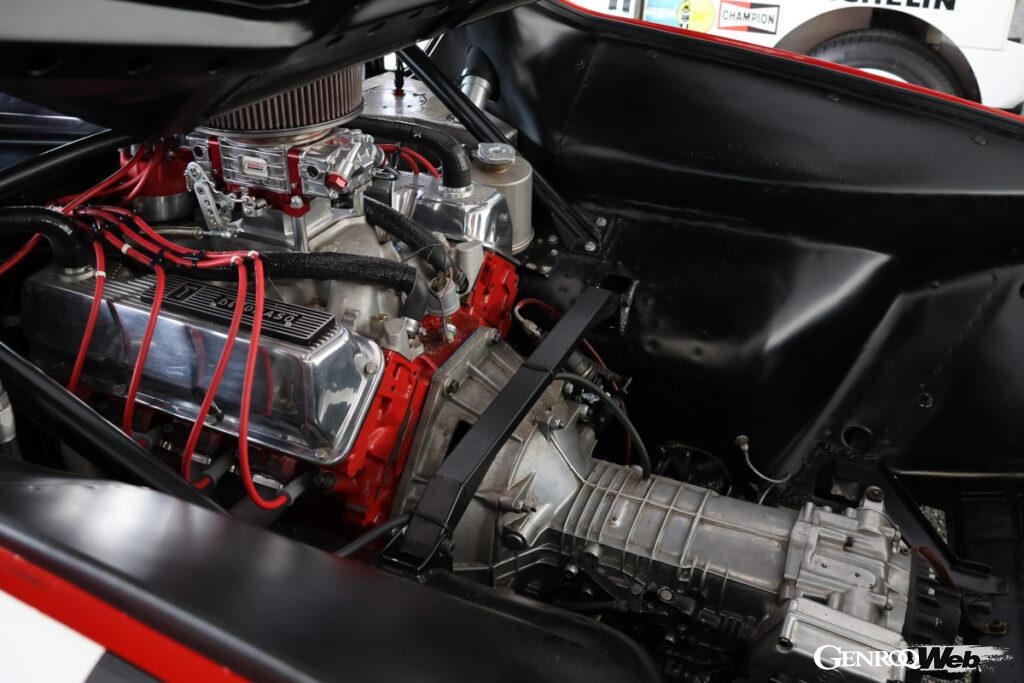
[1] A 1970 Chevrolet Corvette C3 competing in the 1970s category speeds down the bank. [2] A 1973 De Tomaso Pantera in the same color as the original catalog. The lines intended by Tom Giarda, an American designer active in Italy, are clearly visible. Meanwhile, the chassis was designed by Giampaolo Dallara. [3] This is the 1972 De Tomaso Pantera Group 4 driven by the late racing driver Herbert Muller. Note also the overfenders that accommodate the wide-tread tires. [4] In the rear engine bay, a Ford V8 OHV “Boss” 351 unit and a ZF five-speed gearbox are mounted longitudinally.
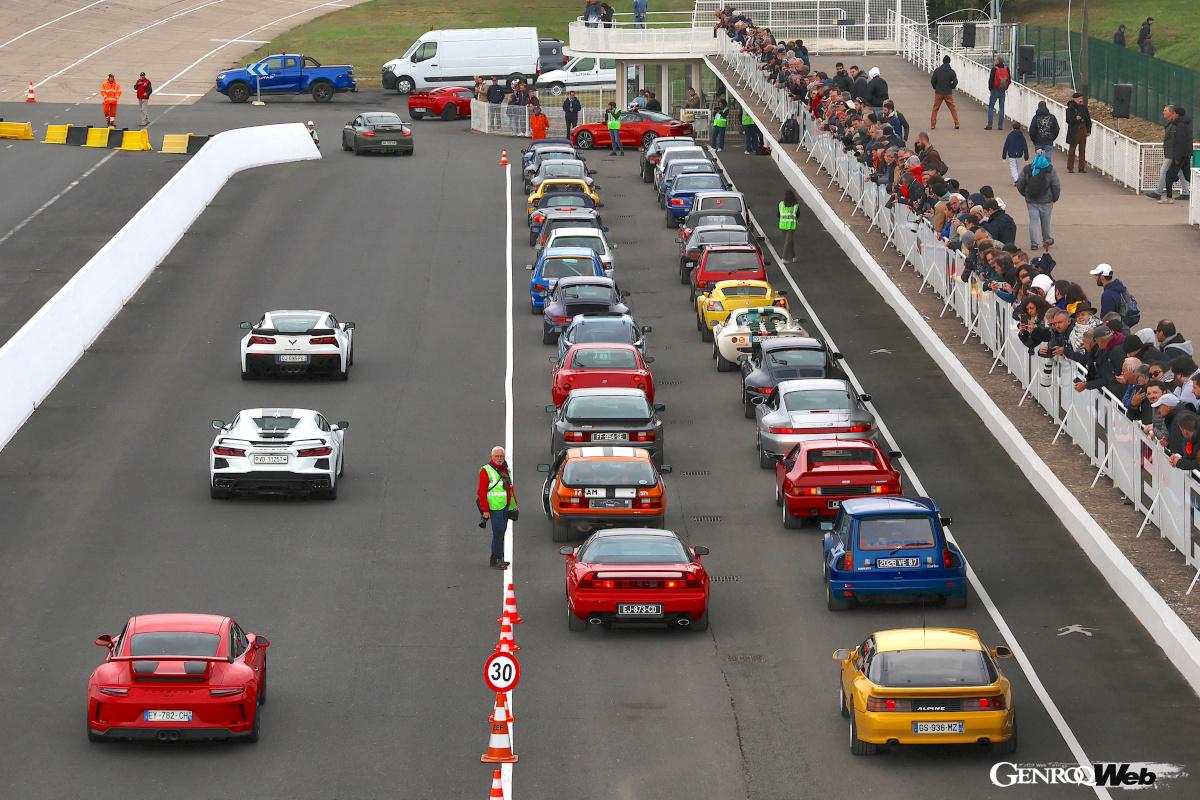
Of the eight categories set up for the 100th anniversary event at the Linas-Montlhéry Circuit, 30 general-purpose cars were entered in the supercar division. The most numerous was Porsche with 13 cars, followed by Ferrari and Lotus with three each. The oldest car was a 2004 Porsche 911 Type 993, while the youngest were an Alpine A110R Le Mans and a Lotus Emira.
From the perspective of supercars in a broad sense, there were some interesting models in the 1970s category that stood out as predecessors. For example, the Chevrolet Corvette (C3) is a symbol of the fact that there have been many fans of American muscle cars among the French for many years.
There was also the 1972 De Tomaso Pantera Group 4. It was one of a total of 14 cars produced, including the road-going GT. Looking at its history, it rolled off the line at the Modena factory in 1972 and was tested by Mike Parkes the following March. It was then sold to Swiss private racing driver Herbert Muller, who raced it at Le Mans in 1972.
French Speed Connection, a historic supercar specialist in the 15th arrondissement on the left bank of the Seine in Paris, which is currently putting this car up for sale, proudly states that “it can be applied to participate in historic races and major competitions, from the Le Mans Classic to the Daytona Classic.” This event was undoubtedly also a chance for professionals to meet potential customers.
What is the source of the mellow aroma?

[1]

[2]

[3]

[4]
[5]

[6]

[7]

[8]
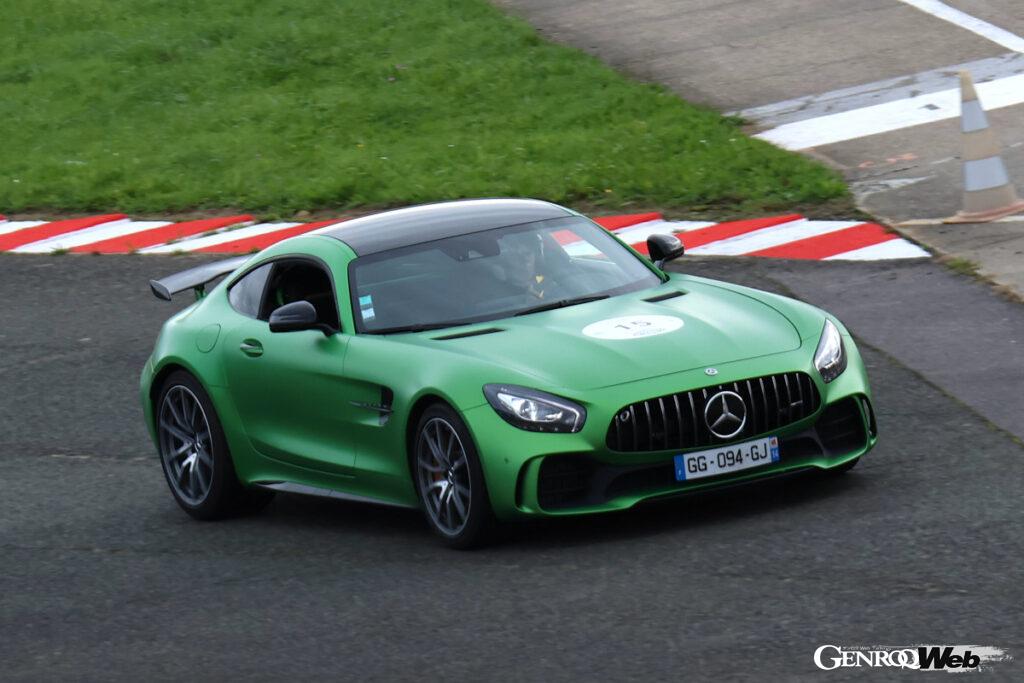
[1] A 1991 Porsche 911 GT2R (993) sporting the logo of French luxury lingerie brand Lise Charmel. [2] A 2007 Audi R8 is followed by a 2019 Alfa Romeo 4C and a 2017 Chevrolet Corvette C7 Z06. [3] A 2008 D8 270RS by Dutch car maker Donkervoort, formerly known for its Lotus 7 replica. [4] The only Japanese brand in the Supercar division is the 2016 Honda NSX (right). It was brought by the French YouTube automotive channel “Mécanique Sportif.” [5] A 2018 Mercedes-Benz AMG GTR. [6] A 2023 Ferrari 296 GTB with a V6 twin-turbocharged plug-in hybrid. [7] Numerous club corners were set up throughout the venue. This is the corner for Club Maserati France, founded in 1977. From postwar luxury GTs like the A6 to young timers like the Biturbo and the 4200GT shown in the photo, a wide range of vehicles are welcome. [8] Grilling sausages in a 1927 Avion-Voisin LSR.
The only sounds heard at the venue are occasional announcements encouraging spectators to prepare to enter the course. There is no background music that seems out of place with the age of the vehicles. This allows visitors to fully enjoy the engine sounds and exhaust notes reverberating from the banking. It is a social gathering place for adults.
At noon, a mellow aroma wafted through the air. It was the gas station of Yakko Oil, the main sponsor of the race. Outside stood the Avion Voisin LSR, a classic French high-performance car with origins in the aviation industry. Its sleek aluminum body gleamed, and it was here, in Montlhéry in 1927, that it set a world record by covering 28 hours at an average speed of 113 miles per hour (approximately 181.8 km/h).
The front hood was open, so I took a peek to see what they were doing and saw that they were grilling sausages on a grill that cleverly utilized the heat from the 12-cylinder, 4.9-liter, 140 HP engine. This was the source of the aroma. Again, there was no ostentatious announcement, and it was done casually, which was very stylish.
Although it was idling the whole time, it started leaking oil towards the end of the burn. It seemed that the signs of its age could not be hidden. However, throughout the performance, many visitors were pointing their smartphone cameras at it. This ancestor of the supercar was a huge hit.
Report & Photo by Akio Lorenzo OYA










![Hyundai unveils music-driven fully electric concept model in collaboration with MIYAVI [Tokyo Auto Salon 2026]](https://wheelfeed.com/wp-content/uploads/2026/01/4741-1768026274388.jpg)